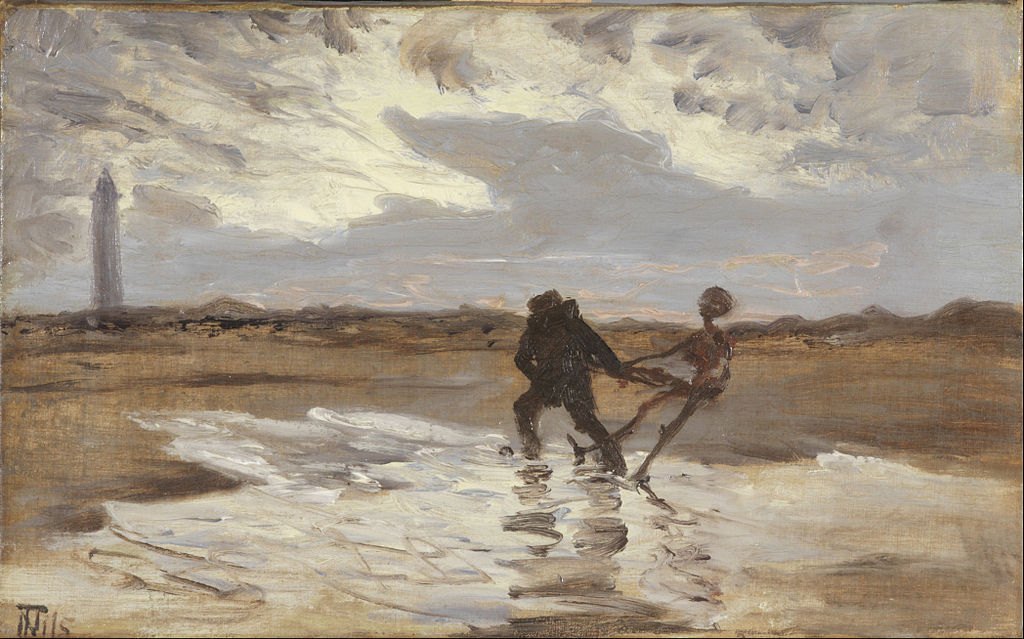
Draugen — The drowned man who never came home
Coastal Norway's sea-revenant — a sailor drowned and never buried, sailing half a boat against the wind with a crew of the dead. See him and one man on your own boat is not coming home.
A boat sailing against the wind with only half a hull — split lengthwise, crewed by the dead — is the worst thing a fisherman on the outer coast can see. It is the draugen, and it means one man on his own boat is not coming home.
The draugen is the spirit of a sailor drowned at sea and never recovered for burial in consecrated ground, held to the water by an unfinished funeral. He belongs to the fishing communities of the outer north — Nordland 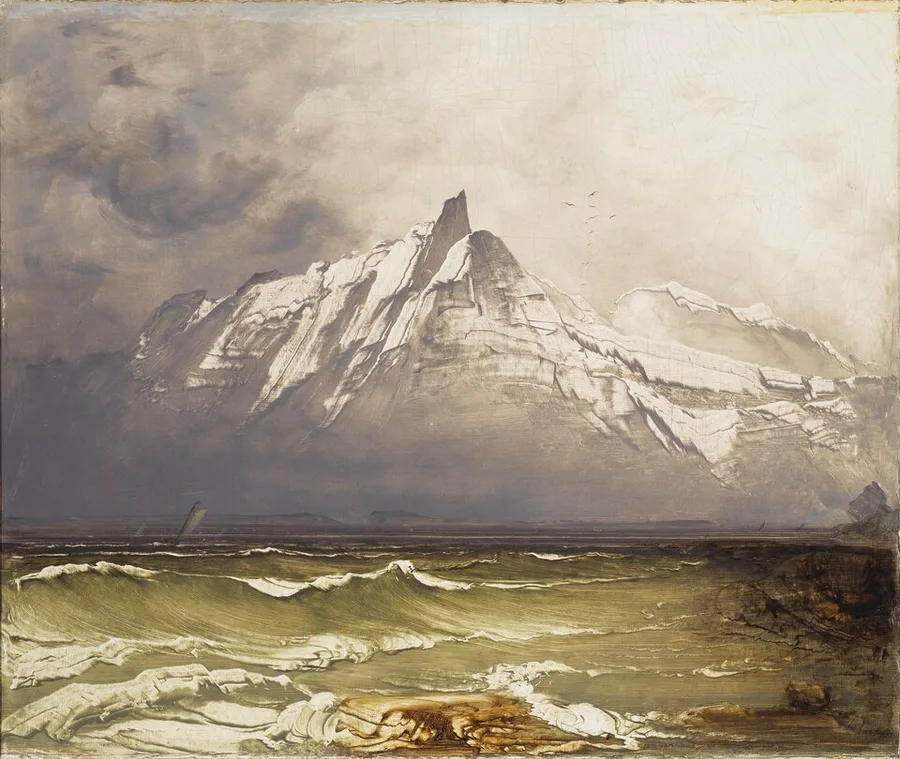 Peder Balke, Fra Nordland, Nationalmuseum (Stockholm) Peder Balke's Nordland — sheer peaks over green breakers, one sail far out. Balke sailed this coast in 1832; this is the sea the draug tradition belongs to, the water that keeps its drowned and sends them back against the wind. Northern Norwegian county running from south of the Arctic Circle
to the border with Troms og Finnmark in the north. In the
petty-kingdom era the southern part of Hålogaland; today one of the
largest Norwegian counties by area but among the most thinly
populated, the long-coastal heartland of cod fishing and the home
of the Lofoten archipelago. Principal city: Bodø.
Nordland Also discussed in Before There Was Norway — petty kingdoms at the edge of the world , Lofoten
Peder Balke, Fra Nordland, Nationalmuseum (Stockholm) Peder Balke's Nordland — sheer peaks over green breakers, one sail far out. Balke sailed this coast in 1832; this is the sea the draug tradition belongs to, the water that keeps its drowned and sends them back against the wind. Northern Norwegian county running from south of the Arctic Circle
to the border with Troms og Finnmark in the north. In the
petty-kingdom era the southern part of Hålogaland; today one of the
largest Norwegian counties by area but among the most thinly
populated, the long-coastal heartland of cod fishing and the home
of the Lofoten archipelago. Principal city: Bodø.
Nordland Also discussed in Before There Was Norway — petty kingdoms at the edge of the world , Lofoten 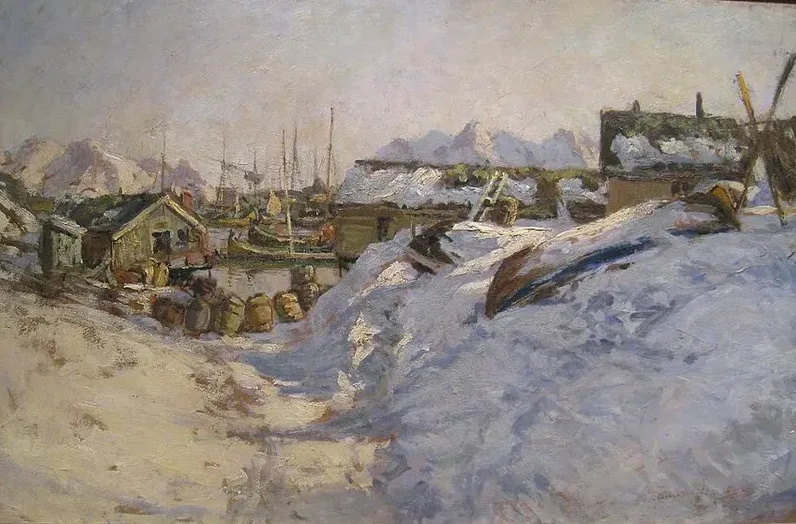 Gunnar Berg, Vinter i Lofoten (before 1893), via Wikimedia Commons Gunnar Berg's winter Lofoten — barrels stacked by the boathouses, masts against the snow-covered peaks. These are the boats and boathouses of the winter cod fishery the draug haunted, the open-boat season rowed in the dark months on a sea that did not always give its crews back. Archipelago in Nordland County in northern Norway, lying north of
the Arctic Circle and stretching about a hundred and seventy
kilometres off the mainland coast. Famous for dramatic peaks
rising directly out of the sea, traditional fishing villages built
on stilts (rorbuer), and the centuries-old winter cod-fishing
industry that supplied the dried-stockfish trade Bergen ran during
the Hanseatic era. Site of the reconstructed Viking-Age chieftain's
hall at Borg — the largest known Viking-Age building in Scandinavia.
Lofoten Islands Also discussed in The Viking Age — longships, legends, and the first "Norway"The Golden Age — a North Atlantic empire … reaching farther than you thinkThe Germans Who "Ruled" Bergen — the Hanseatic merchants on Bryggen Wharf , Vesterålen
Gunnar Berg, Vinter i Lofoten (before 1893), via Wikimedia Commons Gunnar Berg's winter Lofoten — barrels stacked by the boathouses, masts against the snow-covered peaks. These are the boats and boathouses of the winter cod fishery the draug haunted, the open-boat season rowed in the dark months on a sea that did not always give its crews back. Archipelago in Nordland County in northern Norway, lying north of
the Arctic Circle and stretching about a hundred and seventy
kilometres off the mainland coast. Famous for dramatic peaks
rising directly out of the sea, traditional fishing villages built
on stilts (rorbuer), and the centuries-old winter cod-fishing
industry that supplied the dried-stockfish trade Bergen ran during
the Hanseatic era. Site of the reconstructed Viking-Age chieftain's
hall at Borg — the largest known Viking-Age building in Scandinavia.
Lofoten Islands Also discussed in The Viking Age — longships, legends, and the first "Norway"The Golden Age — a North Atlantic empire … reaching farther than you thinkThe Germans Who "Ruled" Bergen — the Hanseatic merchants on Bryggen Wharf , Vesterålen 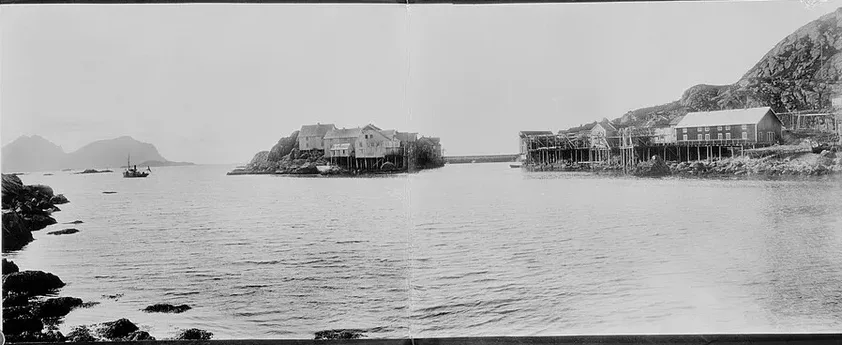 Unknown photographer, Nyksund, Vesterålen (c. 1900–1910), Havnedirektoratet collection, National Archives of Norway A c. 1900 harbour photograph of the Nyksund fishing village. These outer, ocean-facing communities kept one of Norway's strongest draug traditions, the drowned, unburied sailor whose split half-boat sails against the wind, set into Bø's coat of arms in 1987. Archipelago in Nordland immediately north of Lofoten,
spread over Hinnøya, Langøya, Andøya, and hundreds of
smaller islands, its outer districts living for centuries
on the cod fisheries of the surrounding banks. The fishing
communities of the ocean side kept one of the strongest
draug traditions on the Norwegian coast — the drowned,
unburied sailor whose split half-boat sails against the
wind. Bø, the fishing municipality on the west side of
Langøya, set the figure in heraldry: its coat of arms,
granted 7 August 1987, bears a silver half-boat with mast
and square sail on a black field.
Vesterålen . What he looks like depends on where you ask. In the north he is headless, hunched in leather sea-gear at the tiller; in Trøndelag
Unknown photographer, Nyksund, Vesterålen (c. 1900–1910), Havnedirektoratet collection, National Archives of Norway A c. 1900 harbour photograph of the Nyksund fishing village. These outer, ocean-facing communities kept one of Norway's strongest draug traditions, the drowned, unburied sailor whose split half-boat sails against the wind, set into Bø's coat of arms in 1987. Archipelago in Nordland immediately north of Lofoten,
spread over Hinnøya, Langøya, Andøya, and hundreds of
smaller islands, its outer districts living for centuries
on the cod fisheries of the surrounding banks. The fishing
communities of the ocean side kept one of the strongest
draug traditions on the Norwegian coast — the drowned,
unburied sailor whose split half-boat sails against the
wind. Bø, the fishing municipality on the west side of
Langøya, set the figure in heraldry: its coat of arms,
granted 7 August 1987, bears a silver half-boat with mast
and square sail on a black field.
Vesterålen . What he looks like depends on where you ask. In the north he is headless, hunched in leather sea-gear at the tiller; in Trøndelag 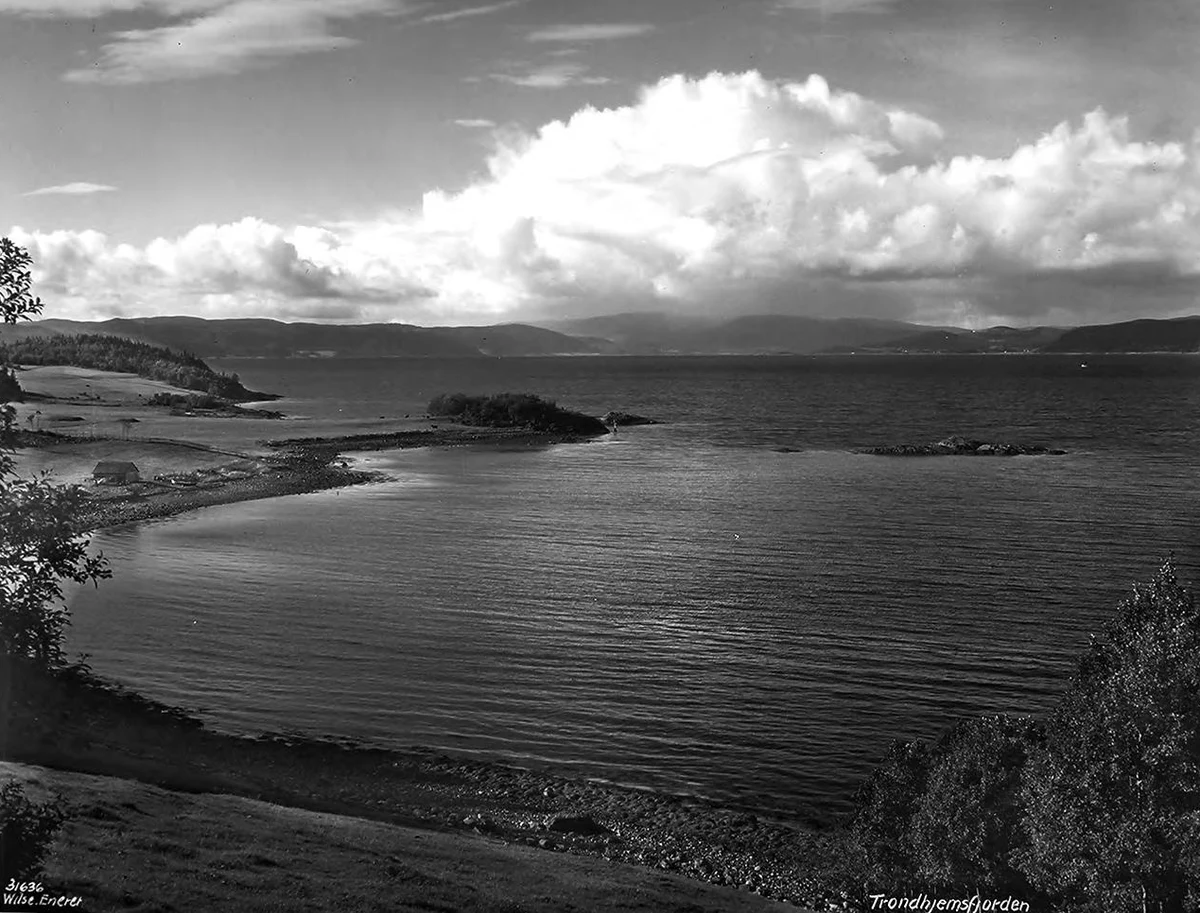 Anders Beer Wilse, Trondhjemsfjorden (1927), Nasjonalbiblioteket The fjord at Trøndelag's coastal edge, empty and bright in Wilse's 1927 photograph. This is the seaweed-faced draugen's country — one Trøndelag tale has the two kinds of draug meet on shingle like this to fight over a drowned man washed up between them. Region of central Norway around the Trondheim Fjord, north of Stadt
and south of Hålogaland. Its agriculturally rich Trondheim plain
is the second-largest area of arable land in the country and the
base of the medieval earls of Lade. Trondheim — founded by Olav
Tryggvason in 997 as Nidaros — became the seat of the Norwegian
archbishopric in 1153 and remains the country's third-largest city
and ecclesiastical capital.
On the trip Day 3-5 of the trip routes the Gråhårsklubben (the Oldsters) through
Trøndelag for the Slektsreisen heritage drive — Trondheim and the
Nidaros Cathedral on Day 3, then Stjørdal and Hegra, then on up
the Stjørdalen valley to Kylloplass.
Trøndelag (Trondheim) Also discussed in Before There Was Norway — petty kingdoms at the edge of the worldWorshiping Odin and Thor — the lived religion of pre-Christian NorwayThe King Who Became a Saint — how the Nordmen came to ChristThe Long Fall — the sudden loss of Norwegian nobility, the end of the kings, and half of Norway gone foreverLutheran Norway and Pietism — a farmer named Hans Nielsen Hauge and a lay revival that could not be silencedThe Hytte — a sacred pastime of modern Norway and the south he wears a knot of seaweed where his face should be, and one Trøndelag tale has the two kinds meet on the shingle and fight over a drowned man washed up between them.
Anders Beer Wilse, Trondhjemsfjorden (1927), Nasjonalbiblioteket The fjord at Trøndelag's coastal edge, empty and bright in Wilse's 1927 photograph. This is the seaweed-faced draugen's country — one Trøndelag tale has the two kinds of draug meet on shingle like this to fight over a drowned man washed up between them. Region of central Norway around the Trondheim Fjord, north of Stadt
and south of Hålogaland. Its agriculturally rich Trondheim plain
is the second-largest area of arable land in the country and the
base of the medieval earls of Lade. Trondheim — founded by Olav
Tryggvason in 997 as Nidaros — became the seat of the Norwegian
archbishopric in 1153 and remains the country's third-largest city
and ecclesiastical capital.
On the trip Day 3-5 of the trip routes the Gråhårsklubben (the Oldsters) through
Trøndelag for the Slektsreisen heritage drive — Trondheim and the
Nidaros Cathedral on Day 3, then Stjørdal and Hegra, then on up
the Stjørdalen valley to Kylloplass.
Trøndelag (Trondheim) Also discussed in Before There Was Norway — petty kingdoms at the edge of the worldWorshiping Odin and Thor — the lived religion of pre-Christian NorwayThe King Who Became a Saint — how the Nordmen came to ChristThe Long Fall — the sudden loss of Norwegian nobility, the end of the kings, and half of Norway gone foreverLutheran Norway and Pietism — a farmer named Hans Nielsen Hauge and a lay revival that could not be silencedThe Hytte — a sacred pastime of modern Norway and the south he wears a knot of seaweed where his face should be, and one Trøndelag tale has the two kinds meet on the shingle and fight over a drowned man washed up between them.
He is as much a sound as a sight. He cries a long wail across the water before a storm — h — a — u, or sometimes just so cold — and a knock against the hull on a calm night is the draugen trying to climb aboard. To hear the cry from your own boat is already the wrong sign. Answering it from the deck sinks you; not answering does not save you.
The figure came down from the Old Norse draugr, the corpse that would not stay in its mound in the Icelandic sagas. Over the centuries his home moved from the burial mound to the sea, and his grievance from disturbed grave-goods to a body the sea would not give back. The parson Andreas Faye 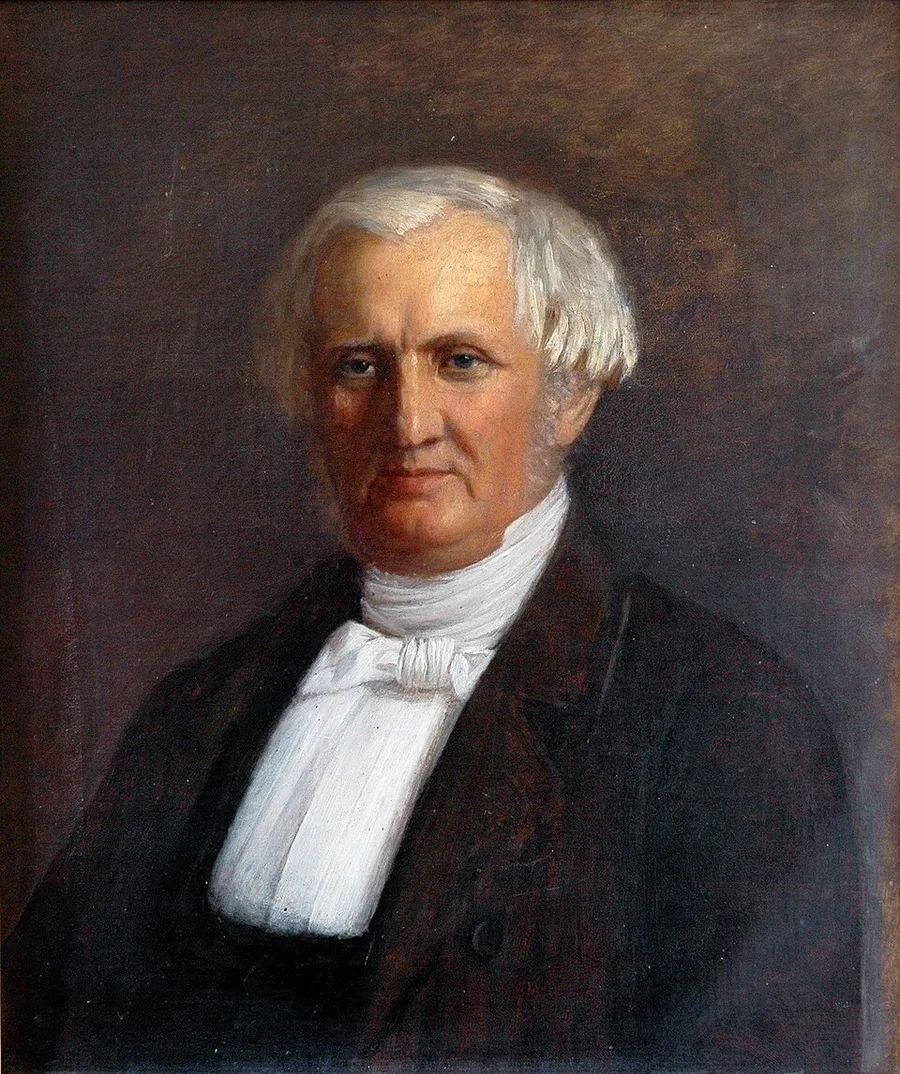 Christiane Schreiber, Portrait of Andreas Faye (1861), Rektorgalleriet, Universitetet i Agder Christiane Schreiber's 1861 portrait of Andreas Faye, the Holt parson-collector whose *Norske Sagn* (1833), enlarged in 1844 as *Norske Folke-Sagn*, first set Norway's legends in print — the draug of the coast, the nøkken of the fresh waters, and the Black Death lore Kittelsen later drew his Pesta from. Norwegian parson, historian and folklore collector
(1802–1869), a teacher in Arendal and from 1833 parish
priest at nearby Holt. His Norske Sagn (Arendal, 1833)
was the first published collection of Norwegian legends
and is counted as the beginning of folklore study in
Norway; a revised, expanded second edition appeared in
1844 as Norske Folke-Sagn. Faye recorded rather than
retold — a documentary register that drew a scathing
anonymous review from the historian P. A. Munch. But the
collection awakened the interest that Asbjørnsen and
Moe's folktale volumes of 1841–44 built on, and it became
Theodor Kittelsen's sourcebook: Kittelsen drew Pesta from
Faye's Black Death chapter for Svartedauen (1900).
Also discussed in Pesta — an old woman walking from farm to farmNøkken — the water-spirit who pulls you under put the coastal tellings in print in his 1844 Norske Folke-Sagn; Theodor Kittelsen
Christiane Schreiber, Portrait of Andreas Faye (1861), Rektorgalleriet, Universitetet i Agder Christiane Schreiber's 1861 portrait of Andreas Faye, the Holt parson-collector whose *Norske Sagn* (1833), enlarged in 1844 as *Norske Folke-Sagn*, first set Norway's legends in print — the draug of the coast, the nøkken of the fresh waters, and the Black Death lore Kittelsen later drew his Pesta from. Norwegian parson, historian and folklore collector
(1802–1869), a teacher in Arendal and from 1833 parish
priest at nearby Holt. His Norske Sagn (Arendal, 1833)
was the first published collection of Norwegian legends
and is counted as the beginning of folklore study in
Norway; a revised, expanded second edition appeared in
1844 as Norske Folke-Sagn. Faye recorded rather than
retold — a documentary register that drew a scathing
anonymous review from the historian P. A. Munch. But the
collection awakened the interest that Asbjørnsen and
Moe's folktale volumes of 1841–44 built on, and it became
Theodor Kittelsen's sourcebook: Kittelsen drew Pesta from
Faye's Black Death chapter for Svartedauen (1900).
Also discussed in Pesta — an old woman walking from farm to farmNøkken — the water-spirit who pulls you under put the coastal tellings in print in his 1844 Norske Folke-Sagn; Theodor Kittelsen 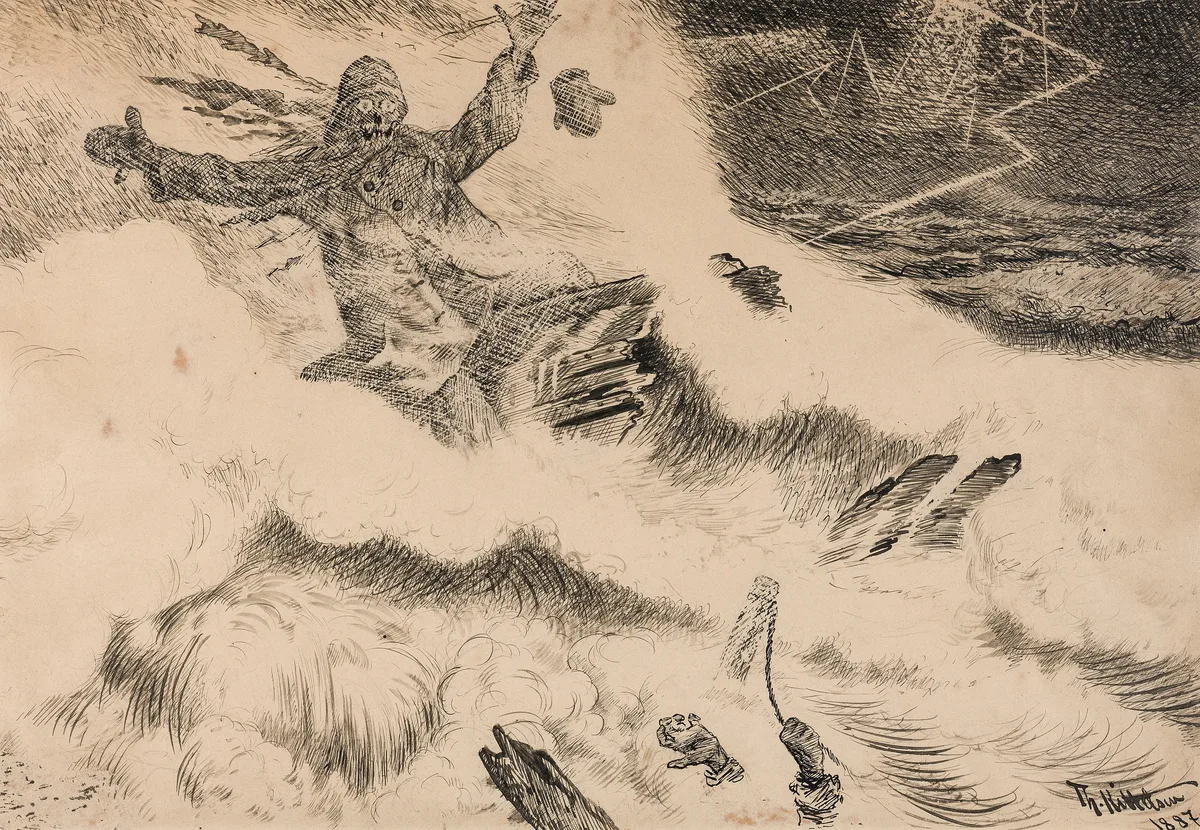 Theodor Kittelsen, Draugen (1887), illustration for Troldskab (1892) The draugen himself as Kittelsen drew him — skull-faced in sea-gear, riding the wreck he has just made. The drawing went into Troldskab (1892), the book fed by the artist's years at the Skomvær lighthouse on outer Lofoten. Norwegian painter and illustrator (1857–1914), born in
Kragerø, who more than any other artist fixed the visual
identity of the country's folklore beings. Erik Werenskiold
brought him into the illustrated Asbjørnsen folktale editions
in the early 1880s. A stay at the Skomvær lighthouse on outer
Lofoten (1887–89), where his brother-in-law served as
assistant keeper, fed Troldskab (1892). His plague-hag
drawings, begun after an encounter with an old woman on the
island of Skåtøy, were published as the book Svartedauen in
1900. The same year, at Lauvlia in Sigdal, he painted his
Soria Moria pictures; the national collection bought them at
once. Nøkken (1904) — two pale eyes in a black lily-pool —
is held by the Nasjonalmuseet; Da Huldra forsvant (1908)
paints her vanishing.
Also discussed in Pesta — an old woman walking from farm to farmHuldra — the girl in the forest with a secretNøkken — the water-spirit who pulls you underNorske eventyr — the folk tales almost lost foreverSoria Moria — the shining castle always out of reach , who lived at the Skomvær lighthouse on outer Lofoten from 1887 to 1889 — his brother-in-law was the assistant keeper — drew him afterwards; and the fishing town of Bø in Vesterålen set the half-boat on its coat of arms in 1987 — the drowned man’s boat, still sailing, made the town’s own emblem.
Theodor Kittelsen, Draugen (1887), illustration for Troldskab (1892) The draugen himself as Kittelsen drew him — skull-faced in sea-gear, riding the wreck he has just made. The drawing went into Troldskab (1892), the book fed by the artist's years at the Skomvær lighthouse on outer Lofoten. Norwegian painter and illustrator (1857–1914), born in
Kragerø, who more than any other artist fixed the visual
identity of the country's folklore beings. Erik Werenskiold
brought him into the illustrated Asbjørnsen folktale editions
in the early 1880s. A stay at the Skomvær lighthouse on outer
Lofoten (1887–89), where his brother-in-law served as
assistant keeper, fed Troldskab (1892). His plague-hag
drawings, begun after an encounter with an old woman on the
island of Skåtøy, were published as the book Svartedauen in
1900. The same year, at Lauvlia in Sigdal, he painted his
Soria Moria pictures; the national collection bought them at
once. Nøkken (1904) — two pale eyes in a black lily-pool —
is held by the Nasjonalmuseet; Da Huldra forsvant (1908)
paints her vanishing.
Also discussed in Pesta — an old woman walking from farm to farmHuldra — the girl in the forest with a secretNøkken — the water-spirit who pulls you underNorske eventyr — the folk tales almost lost foreverSoria Moria — the shining castle always out of reach , who lived at the Skomvær lighthouse on outer Lofoten from 1887 to 1889 — his brother-in-law was the assistant keeper — drew him afterwards; and the fishing town of Bø in Vesterålen set the half-boat on its coat of arms in 1987 — the drowned man’s boat, still sailing, made the town’s own emblem.