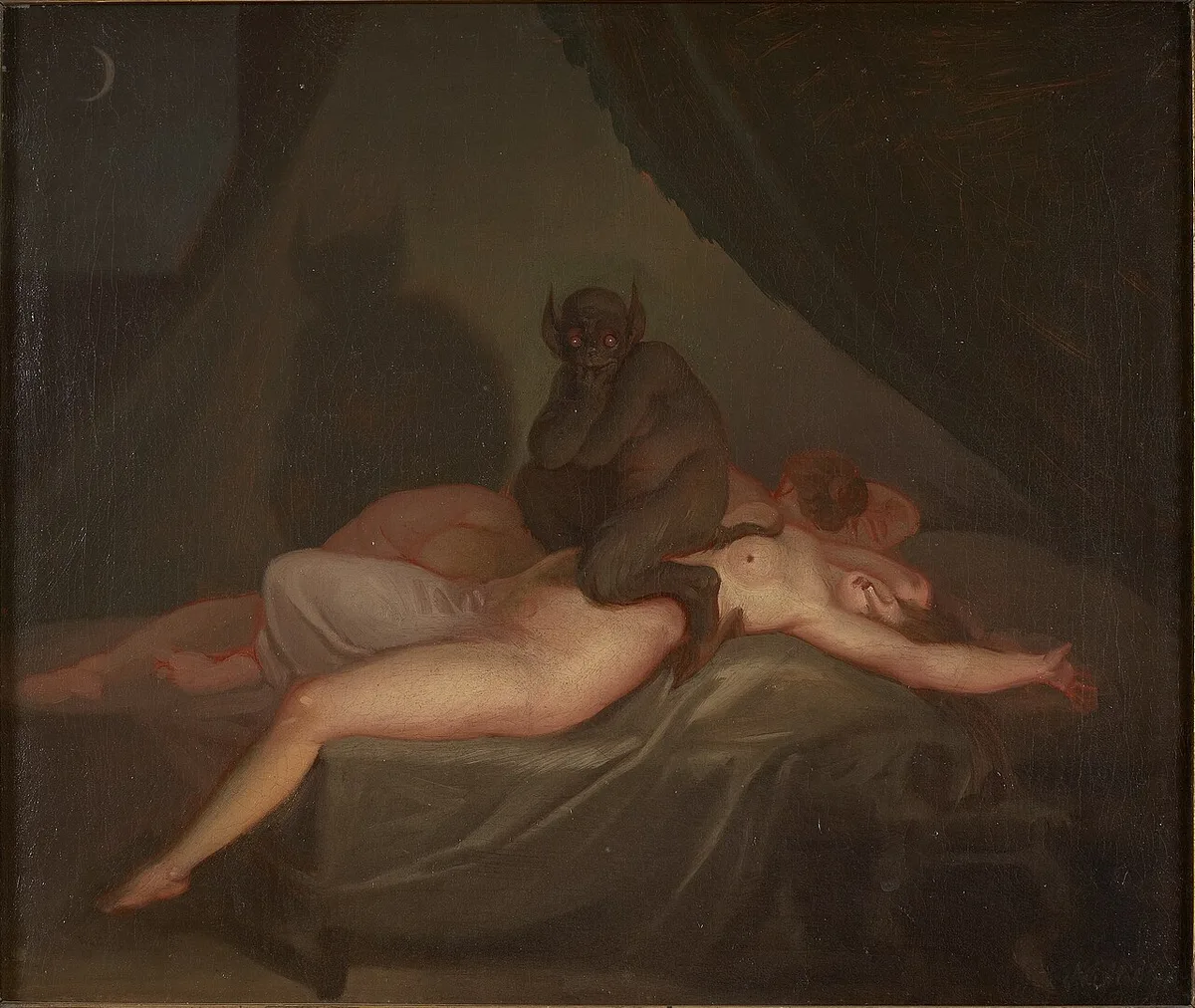
Mare — The creature behind the word nightmare
A small, crushing thing that sits on a sleeper's chest in the dark, holding the body still and souring the dream. The name Norway gave it is a thousand years older than the diagnosis — and it is buried inside the English word "nightmare."
A sleeper wakes in the dark, eyes open, and cannot move. Something small and very heavy is sitting on the chest, pressing the breath out. This is the mare — what a neurologist now files under sleep paralysis, the body still locked in the muscle-stillness of REM sleep while the mind has come awake. Norwegians had a name and a face for it a thousand years before there was a diagnosis.
Her name comes from Old Norse mara, kin to the verb merja, to crush. She is older than nearly everything else in the folklore: the court poet Þjóðólfr of Hvinir 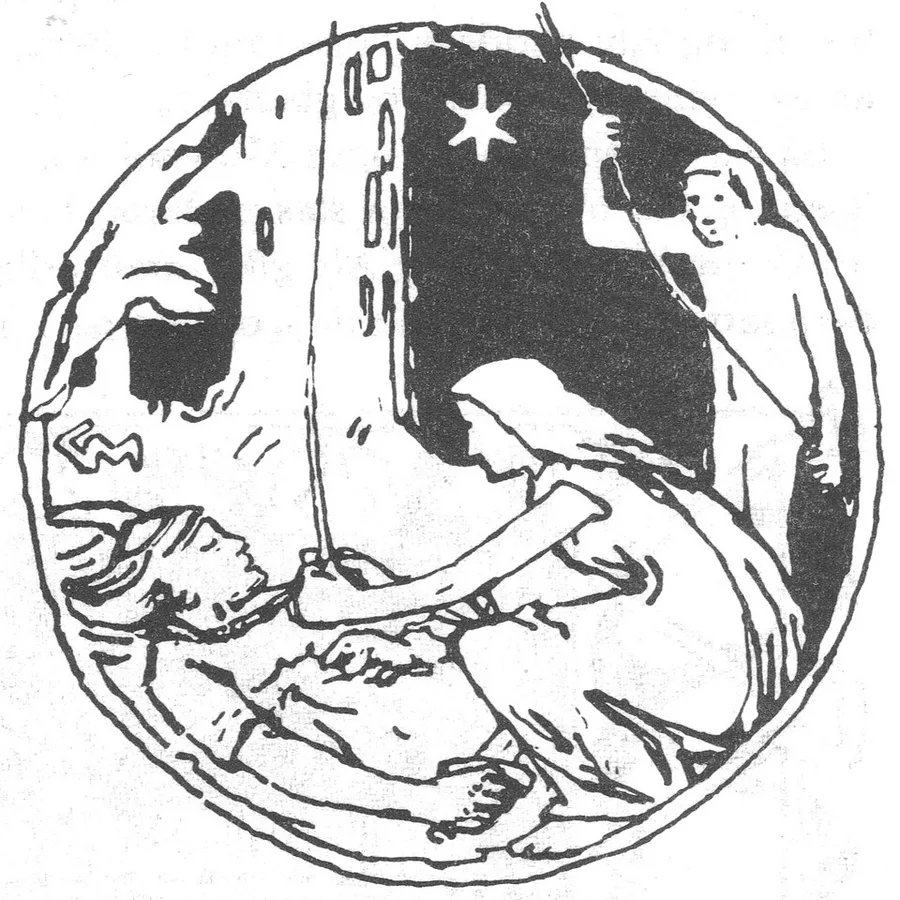 Gerhard Munthe, Ynglinge-saga vignette: Skjálf and King Agni, in Snorre Sturlason: Kongesagaer, J.M. Stenersen & Co, 1899 Munthe's vignette shows the poem's other bed-death — Queen Skjálf hangs King Agni with the cord of his own gold neck-ring, no mara's work. No scene of Vanlandi's stanza exists to show; the mara that treads him to death stands three kings away in the same catalogue. Late-ninth-century Norwegian skald, court poet probably of Harald
Fairhair. Traditionally attributed as the composer of Ynglingatal,
the skaldic genealogical poem tracing the Vestfold Yngling kings
back through a sequence of Swedish predecessors to the god Frey.
How much of the genealogy is historical and how much is
legitimating mythology is debated; the poem itself is genuine and
one of the earliest surviving skaldic compositions.
Also discussed in Before There Was Norway — petty kingdoms at the edge of the world set a mara in his Ynglingatal
Gerhard Munthe, Ynglinge-saga vignette: Skjálf and King Agni, in Snorre Sturlason: Kongesagaer, J.M. Stenersen & Co, 1899 Munthe's vignette shows the poem's other bed-death — Queen Skjálf hangs King Agni with the cord of his own gold neck-ring, no mara's work. No scene of Vanlandi's stanza exists to show; the mara that treads him to death stands three kings away in the same catalogue. Late-ninth-century Norwegian skald, court poet probably of Harald
Fairhair. Traditionally attributed as the composer of Ynglingatal,
the skaldic genealogical poem tracing the Vestfold Yngling kings
back through a sequence of Swedish predecessors to the god Frey.
How much of the genealogy is historical and how much is
legitimating mythology is debated; the poem itself is genuine and
one of the earliest surviving skaldic compositions.
Also discussed in Before There Was Norway — petty kingdoms at the edge of the world set a mara in his Ynglingatal 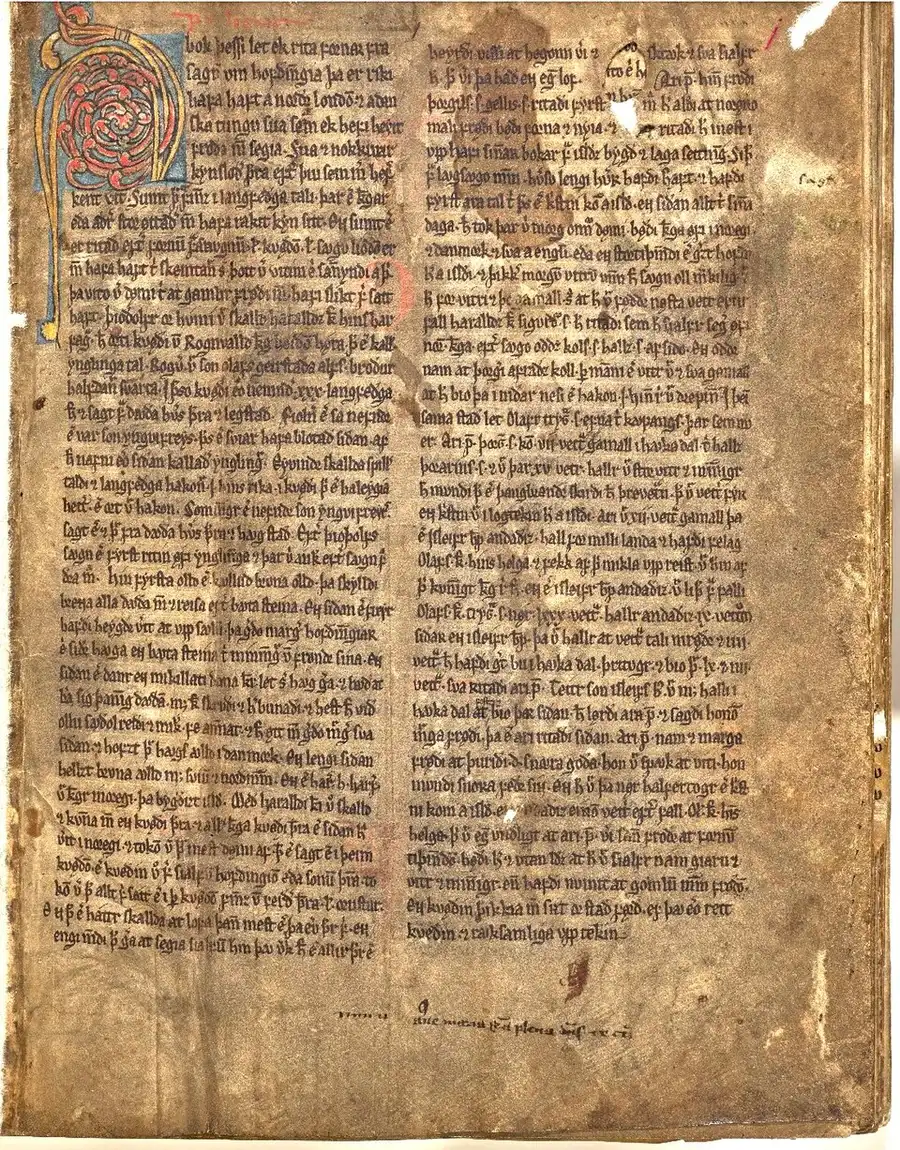 Codex Frisianus (AM 45 fol., c. 1300), first page; photo CC0 via Wikimedia Commons Ynglingatal survives only inside Snorri's Heimskringla, and this first leaf of the Codex Frisianus (c. 1300) carries the prologue that names Þjóðólfr of Hvinir and his poem — the words "ynglinga tal" stand legible partway down the first column. Late-ninth-century skaldic genealogical poem, traditionally
attributed to Þjóðólfr of Hvinir. Traces the descent of the Vestfold
Yngling dynasty through a sequence of Swedish kings back to the god
Frey. Preserved in fragments quoted in Snorri Sturluson's
Heimskringla (specifically in Ynglinga saga, which Snorri built
around it). The poem's form is a death-catalogue: stanza by stanza
it counts off king after king by the manner of his dying — Agni
hanged by Queen Skjálf with the cord of his own gold neck-ring,
Vanlandi trodden to death in his sleep by a mara. A royal pedigree
kept as a ledger of deaths is how a night-creature comes to stand
in a genealogy of kings.
Also discussed in Before There Was Norway — petty kingdoms at the edge of the world before Norway was Christian, in the late 800s. In the scene as Snorri retells it three centuries on, the Swedish king Vanlandi lies down at Uppsala
Codex Frisianus (AM 45 fol., c. 1300), first page; photo CC0 via Wikimedia Commons Ynglingatal survives only inside Snorri's Heimskringla, and this first leaf of the Codex Frisianus (c. 1300) carries the prologue that names Þjóðólfr of Hvinir and his poem — the words "ynglinga tal" stand legible partway down the first column. Late-ninth-century skaldic genealogical poem, traditionally
attributed to Þjóðólfr of Hvinir. Traces the descent of the Vestfold
Yngling dynasty through a sequence of Swedish kings back to the god
Frey. Preserved in fragments quoted in Snorri Sturluson's
Heimskringla (specifically in Ynglinga saga, which Snorri built
around it). The poem's form is a death-catalogue: stanza by stanza
it counts off king after king by the manner of his dying — Agni
hanged by Queen Skjálf with the cord of his own gold neck-ring,
Vanlandi trodden to death in his sleep by a mara. A royal pedigree
kept as a ledger of deaths is how a night-creature comes to stand
in a genealogy of kings.
Also discussed in Before There Was Norway — petty kingdoms at the edge of the world before Norway was Christian, in the late 800s. In the scene as Snorri retells it three centuries on, the Swedish king Vanlandi lies down at Uppsala 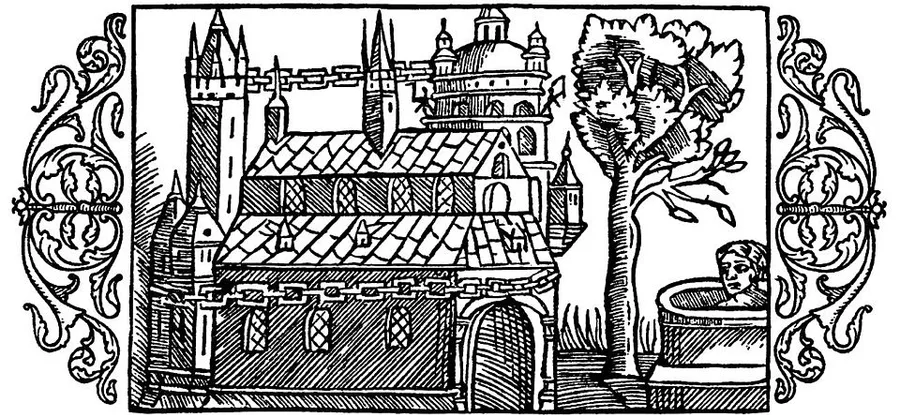 Olaus Magnus, woodcut of the Uppsala temple, Historia de Gentibus Septentrionalibus (1555) Olaus Magnus's 1555 woodcut of the fabled heathen temple at Uppsala — the golden chain about its roofline, the sacred tree and spring beside it — a Renaissance image of the great Svear cult site and its ninth-year sacrifices. The great cult site of the Svear, on a mound-studded ridge
north of the modern Swedish city of Uppsala, and royal
seat of the legendary Yngling kings — Ynglingatal (late
800s) already set a mara treading King Vanlandi to death
there, a scene Snorri retold in Ynglinga saga (c. 1225).
Three great royal mounds of the 5th–6th centuries still
stand. Adam of Bremen, writing in the 1070s, described a
temple at Uppsala with images of Thor, Wodan, and Fricco
and a festival every ninth year at which nine males of
every living kind, men among them, were sacrificed and
hung in the grove beside it — the most-cited contemporary
account of a Norse blót, though second-hand and much
argued over. A Christian church rose on the site in the
12th century.
Also discussed in Worshiping Odin and Thor — the lived religion of pre-Christian Norway and cries out that a mara is treading on him; his men seize his head and she moves to his legs, they seize his legs and she goes back to his head, and he dies between their hands.
Olaus Magnus, woodcut of the Uppsala temple, Historia de Gentibus Septentrionalibus (1555) Olaus Magnus's 1555 woodcut of the fabled heathen temple at Uppsala — the golden chain about its roofline, the sacred tree and spring beside it — a Renaissance image of the great Svear cult site and its ninth-year sacrifices. The great cult site of the Svear, on a mound-studded ridge
north of the modern Swedish city of Uppsala, and royal
seat of the legendary Yngling kings — Ynglingatal (late
800s) already set a mara treading King Vanlandi to death
there, a scene Snorri retold in Ynglinga saga (c. 1225).
Three great royal mounds of the 5th–6th centuries still
stand. Adam of Bremen, writing in the 1070s, described a
temple at Uppsala with images of Thor, Wodan, and Fricco
and a festival every ninth year at which nine males of
every living kind, men among them, were sacrificed and
hung in the grove beside it — the most-cited contemporary
account of a Norse blót, though second-hand and much
argued over. A Christian church rose on the site in the
12th century.
Also discussed in Worshiping Odin and Thor — the lived religion of pre-Christian Norway and cries out that a mara is treading on him; his men seize his head and she moves to his legs, they seize his legs and she goes back to his head, and he dies between their hands.
By morning she left evidence. Hair was found knotted into tight tangles, and horses came in from the field with their manes plaited and their bodies sweat-dark and trembling, ridden hard all night — marefletter, mare-braids. (A braided mane could also be the Nisse 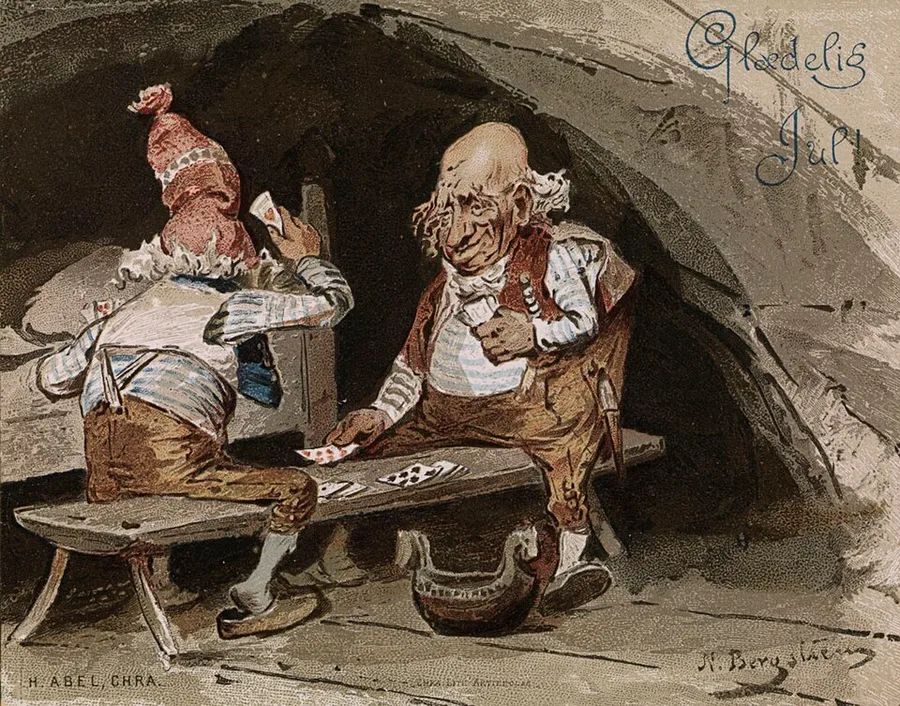 Nils Bergslien, Glædelig Jul (1887), publisher H. Abel, Christiania; Nasjonalbiblioteket Only one of Bergslien's card-players wears the red cap; his bareheaded partner keeps white side-tufts. The festive card sits a world away from the barn where the nisse plaits his favourite horse's mane — the nisseflette that must never be undone, the braid read as blessing where the mare's tangle meant a wound. The guardian spirit of the Norwegian farm — a small,
immensely strong, grey-clad old man in a red cap. In
Norwegian tradition he took over the role of the older
farm-guardians, the gardvord and the haugbonde; the
name is likely a Danish pet-form of Nils, the Nordic form
of Nikolaus. The recorded tradition — set down from Andreas
Faye's Norske Sagn (1833) and Asbjørnsen's
Norske Huldre-Eventyr og Folkesagn (1845–48) onward —
has him tending the animals by night, plaiting his
favourite horse's mane into a nisseflette that must
never be undone, and demanding cream porridge with
butter on Christmas Eve. Jenny Nyström's illustrations
for Viktor Rydberg's poem Tomten (1881) fixed the
red-capped figure that carried the barn spirit into the
gift-bringing julenisse.
On the trip On Day 7 the family walks Maihaugen in Lillehammer, the
open-air museum whose relocated log farmhouses, storehouses,
and barns stand together on one hillside — exactly the kind
of fjøs an old-farm nisse claimed as his own and tended on
his own terms.
Also discussed in Nisse — the short-tempered spirit of the farmTradisjoner — celebrations across the Norwegian year ’s work, a sign he had taken to the horse; but his braid was a blessing and the mare’s was a wound, and you left both alone.)
Nils Bergslien, Glædelig Jul (1887), publisher H. Abel, Christiania; Nasjonalbiblioteket Only one of Bergslien's card-players wears the red cap; his bareheaded partner keeps white side-tufts. The festive card sits a world away from the barn where the nisse plaits his favourite horse's mane — the nisseflette that must never be undone, the braid read as blessing where the mare's tangle meant a wound. The guardian spirit of the Norwegian farm — a small,
immensely strong, grey-clad old man in a red cap. In
Norwegian tradition he took over the role of the older
farm-guardians, the gardvord and the haugbonde; the
name is likely a Danish pet-form of Nils, the Nordic form
of Nikolaus. The recorded tradition — set down from Andreas
Faye's Norske Sagn (1833) and Asbjørnsen's
Norske Huldre-Eventyr og Folkesagn (1845–48) onward —
has him tending the animals by night, plaiting his
favourite horse's mane into a nisseflette that must
never be undone, and demanding cream porridge with
butter on Christmas Eve. Jenny Nyström's illustrations
for Viktor Rydberg's poem Tomten (1881) fixed the
red-capped figure that carried the barn spirit into the
gift-bringing julenisse.
On the trip On Day 7 the family walks Maihaugen in Lillehammer, the
open-air museum whose relocated log farmhouses, storehouses,
and barns stand together on one hillside — exactly the kind
of fjøs an old-farm nisse claimed as his own and tended on
his own terms.
Also discussed in Nisse — the short-tempered spirit of the farmTradisjoner — celebrations across the Norwegian year ’s work, a sign he had taken to the horse; but his braid was a blessing and the mare’s was a wound, and you left both alone.)
The lore carried two versions of her. In one she is her own creature, a small heavy night-being who comes from outside and chooses you. In the other she is a sleeping woman’s spirit slipped loose — the neighbour could be a mare without knowing it, going out at night to ride others and back before dawn. A girl could be born a mare — the price, tradition said, of her mother easing the birth by crawling through a foal’s caul; a boy born the same way became a werewolf.
Against her the bed was armoured with steel — under the pillow — and with a marekvist, the dense knot of twigs a birch grows when a fungus gets into it — a witches’-broom, cut and hung over the sleeper. The holed stone at the headboard and the shoes set wrong-way-round at the door belonged to her English and German cousins; the Norwegian cures were steel and the birch tangle.
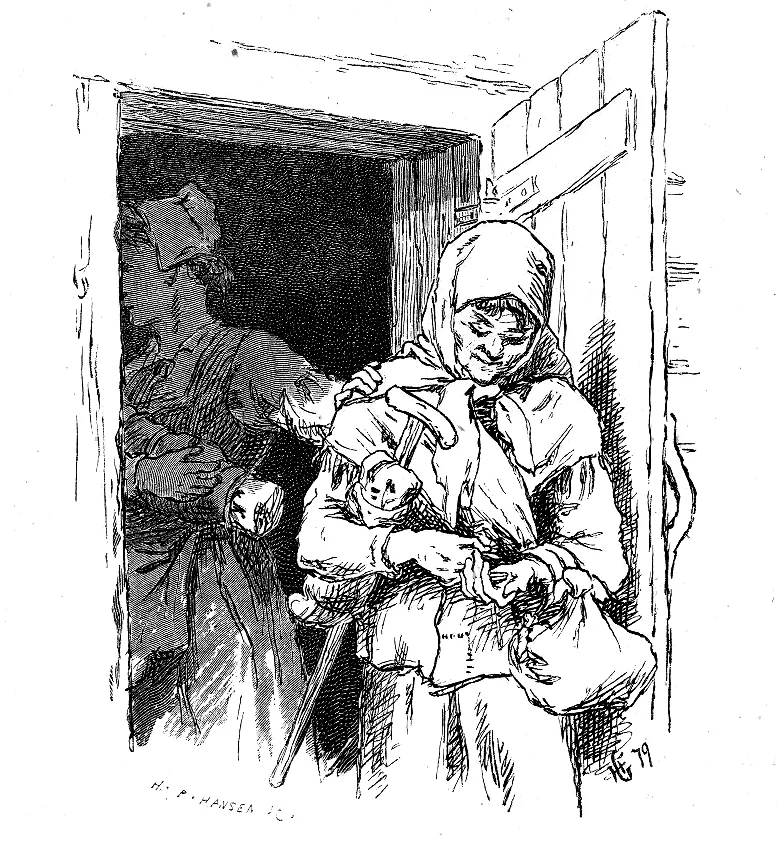
The Old English mære fused into night-mare by around 1300, and the word kept the creature inside it. The German Mahr still names the creature herself, and Swedish keeps the being alive as plain mara beside the dream she causes, mardröm; the Dutch say nachtmerrie, and Norwegian rides her still in mareritt, the mare-ride — every time anyone says the word for a bad dream, the mare is in it.