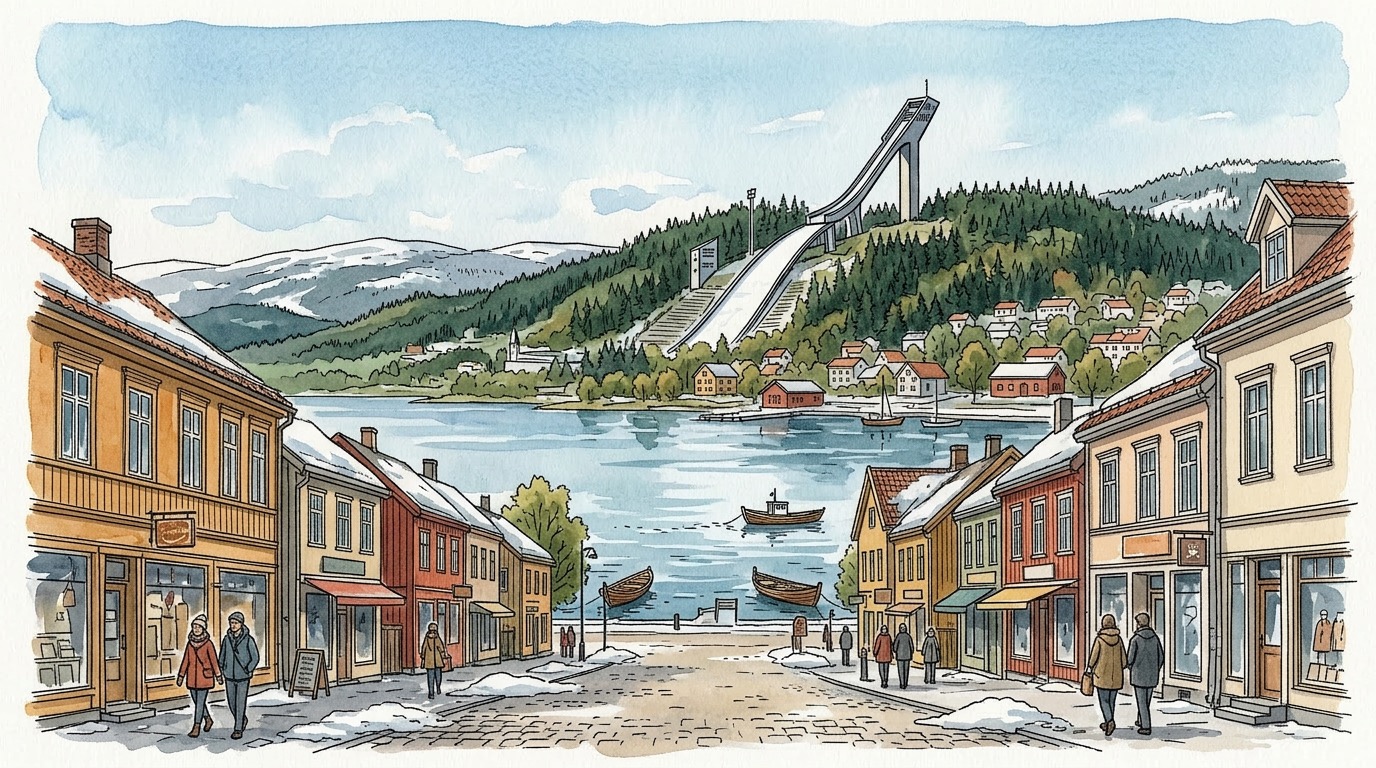

Lillehammer
Where both travel groups reunite — the 1994 Winter Olympic town, Norway's great open-air folk museum, and the parish church at Øyer.
Why this place
Lillehammer is the location of the Beard/Jensen family reunion. The two tracks of the trip converge here.
What happens here
Day 4 evening. The Ungdommene arrive from Bergen by way of Oslo Gardermoen.
Day 5. The Gråhårsklubben drive south from Trondheim and arrive in the evening. The Ungdommene spend the day in town — walk Storgata, the long shopping street; up into the 1994 Olympic Park and Lysgårdsbakkene, the ski jump that hosted the games. Dinner together that evening with the whole group for the first time since Oslo.
Day 6. Visit to Øyer Church, fifteen minutes north of the city along the Gudbrandsdalslågen river. The afternoon is free in town.
Day 7. Visit to Maihaugen, the open-air folk museum that has assembled over two hundred historic buildings from across the Gudbrandsdalen valley — farmsteads, stave churches, town houses — into one of the great living museums in Northern Europe. Marthe and Trygve head onward on their own travels this day. In the afternoon, the entire group drives south to Oslo Gardermoen Airport and a final night at the airport hotel for the early Sunday flights.
Day 8. The flights home from Oslo.
Background
Lillehammer hosted the 1994 Winter Olympics — the games Norwegians still remember as the high point of their country’s modern self-presentation to the world. The Olympic ski jump and the Lysgårdsbakkene arena are still in use.
Maihaugen began in 1887 as a private collection by the dentist Anders Sandvig, who had moved to Lillehammer in 1885 and started saving wooden buildings from across the Gudbrandsdalen valley as the region modernized. The open-air museum opened to the public in 1904 and now holds over two hundred historic structures — the 12th-century Garmo Stave Church, a 19th-century farm village, a 20th-century town quarter, and the Norwegian Olympic Museum. The Norwegian Wikipedia entry on Maihaugen calls it the country’s largest open-air museum; outside Norway, the title is generally given to Skansen in Stockholm.
Øyer itself is a small parish about 15 km north of Lillehammer along the Gudbrandsdalslågen river. The church dates to 1725 and the parish registers — like most Norwegian parish registers — reach back four centuries.
In Lillehammer
Eat · Buy · Do
A short list of places to taste, things to bring home, and things to see.
Learn more
Journals from Lillehammer
No posts yet. During the trip, journal entries and photos from Lillehammer will appear here.