
Nærøyfjord
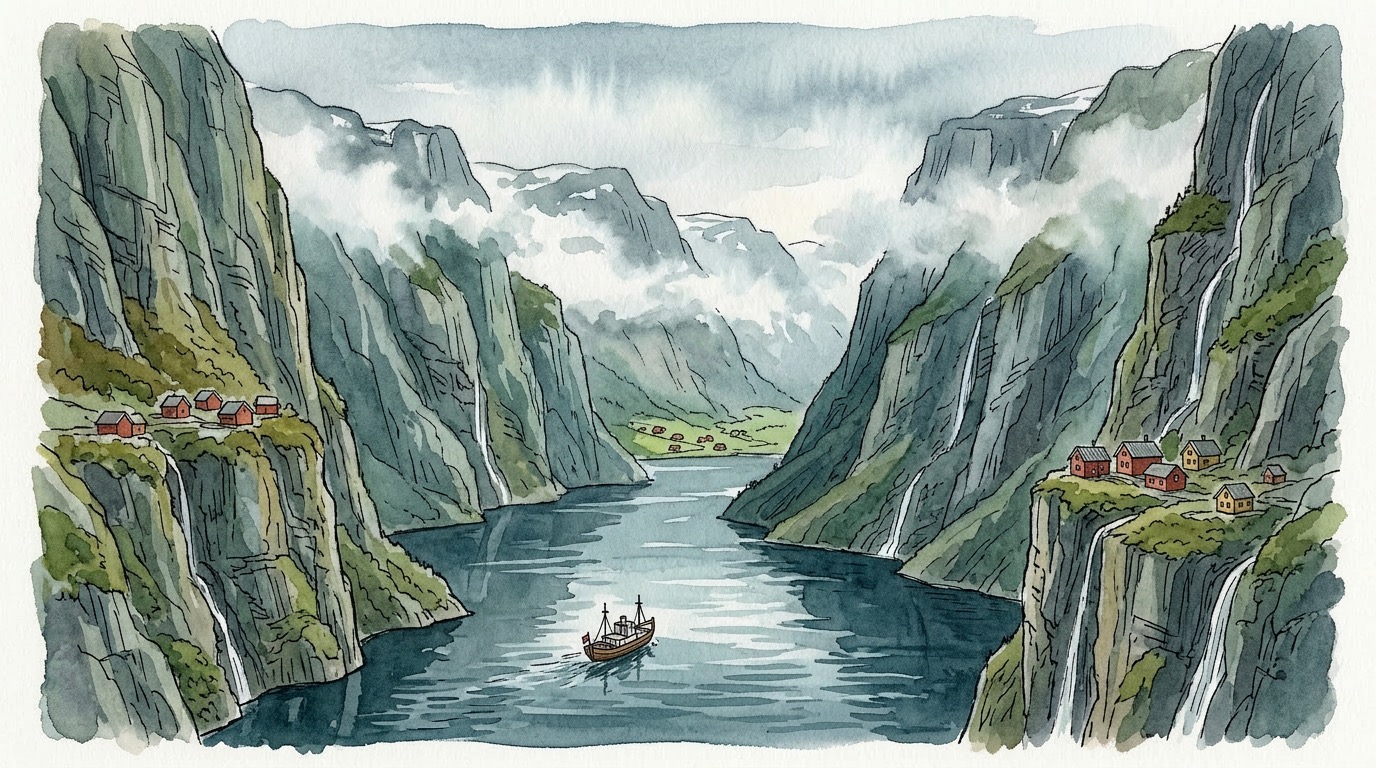
A UNESCO World Heritage fjord — at points only 250 meters wide, walled by sheer rock up to 1,400 meters high. Crossed by boat between Flåm and Gudvangen.
Why this place
The Nærøyfjord is the fjord most travel writers reach for when they want to describe what a Norwegian fjord feels like. It is the narrowest in the country, and one of the narrowest in the world. UNESCO inscribed it as a World Heritage Site in 2005.
What happens here
The Ungdommene (the Youngsters) cross the fjord by boat on Day 3 — the cruise leaves Flåm in the late afternoon, runs out the Aurlandsfjord, turns into the Nærøyfjord proper, and arrives at the small village of Gudvangen at the inner end as the long northern light starts to gold. Open-deck and indoor seating both; most photographs come from outside despite the wind.
What to look for from the boat:
- Abandoned cliffside farms on the rock walls — some accessible only by rope ladder, all photogenic
- Several waterfalls dropping straight off the rim
- Goat farms still in use on the lower slopes
- Seals occasionally on the water
Background
The fjord is 17 kilometres long and at its narrowest 250 metres wide, walled by cliffs that rise as much as 1,400 metres straight out of the water (with the surrounding peaks higher still). It was inscribed as UNESCO World Heritage in 2005 alongside the Geirangerfjord further north — paired under natural-heritage criteria vii (exceptional natural beauty) and viii (an outstanding example of glacial fjord landscape). UNESCO’s citation calls the pair “among the most scenically outstanding fjord areas on the planet.”
Geologically, the Nærøyfjord is a textbook fjord proper — a U-shaped trough carved by Quaternary-era glaciers into pre-existing river valleys, then flooded by the sea as the ice retreated about 10,000 years ago. The cliff walls show the polish of ice abrasion in places; the hanging side-valleys and the waterfalls cascading off them are tributaries that the main glacier cut faster and deeper than they could.
The cliffside farms still visible from the boat — small clearings on impossible ledges — were inhabited into the early twentieth century. The last of them were abandoned in the 1960s; some were reachable only by rope ladder. A few of the lower slopes are still in use for goat-grazing, the milk going to the local geitost (the sweet, caramelized brown whey cheese) production.
Since 2002 the fjord and its catchment have been protected as a Landscape Protection Area (landskapsvernområde), with motor-vessel restrictions, no overnight cruise-ship calls, and rules preserving the cultural-landscape farms even when no longer inhabited.
The Nærøyfjord is itself a branch of the larger Aurlandsfjord, which is in turn a branch of the Sognefjord — the longest fjord system in the country, reaching more than 200 kilometres up the western interior.
In Nærøyfjord
Eat · Buy · Do
A short list of places to taste, things to bring home, and things to see.
Learn more
Journals from Nærøyfjord
No posts yet. During the trip, journal entries and photos from Nærøyfjord will appear here.