The Crusades?!!!! — Sixty ships from Bergen, bound for the Holy Land
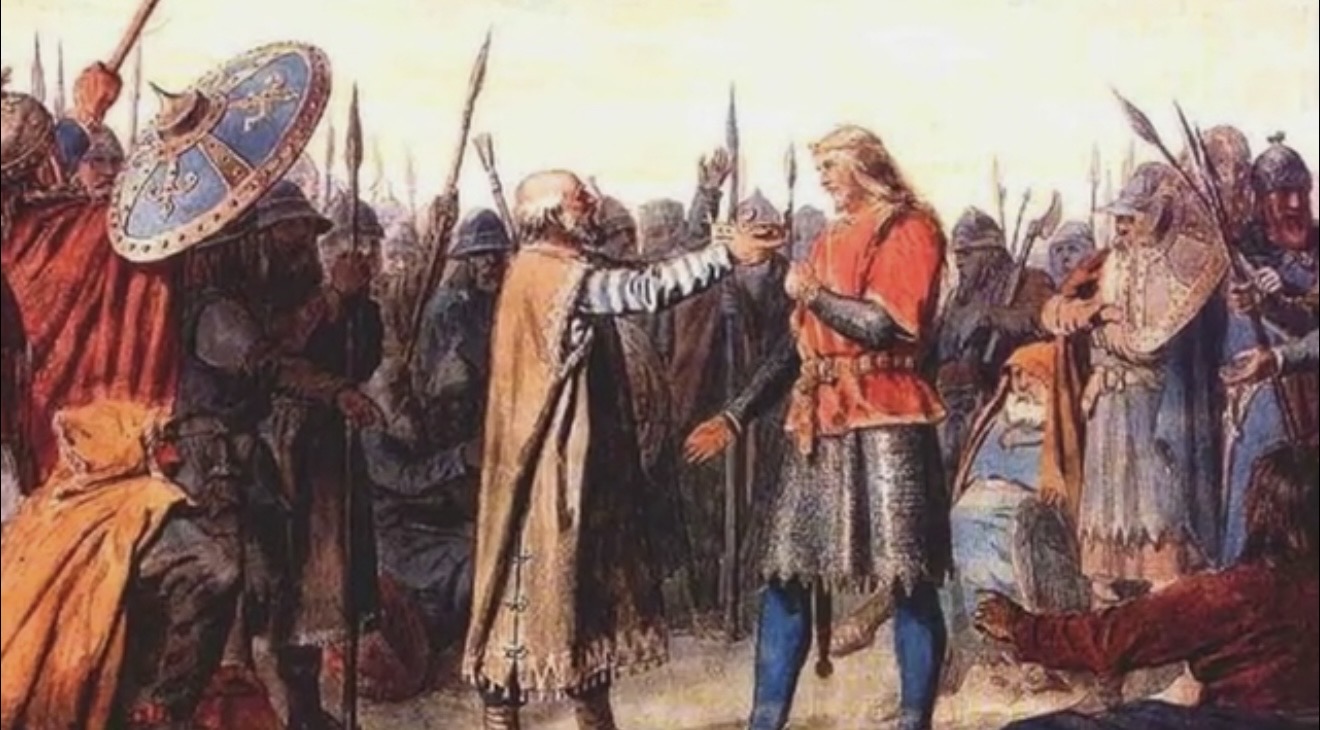
In 1107 the king of Norway, not yet out of his teens, sailed from Bergen with sixty ships — the first reigning monarch in Europe to lead a crusade in person. Sigurd Jorsalfar came home four years later by way of Constantinople, having reached Jerusalem and helped take Sidon.
In the autumn of 1107 a fleet of sixty ships put out from Bergen 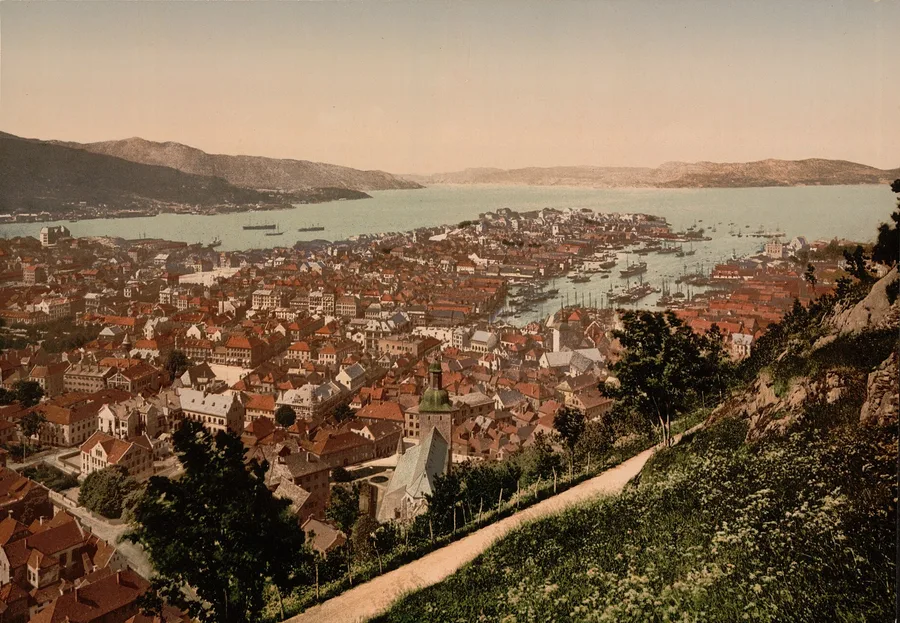 Photochrom print, General view from Fjeldveien, Bergen (c. 1890–1900), Library of Congress Bergen in the 1890s from the Fjellveien path on Fløyfjellet — the whole city between its mountains, Vågen harbour still crowded with sailing ships at its heart. For four centuries Norway's largest city, and the wharf through which the entire western export economy ran. Norway's western trading capital, founded around 1070 on the
inner Byfjorden. For four centuries the largest city in the
country and the wharf through which the entire western export
economy ran — dried cod from the Lofoten fisheries, stockpiled
and traded by the Hanseatic merchants at Bryggen from 1360 to
1754. Norway's commercial and intellectual heart through the
Hanseatic period; overtaken in size by Christiania (Oslo) in the
1830s. The painted wooden Bryggen wharf is on the UNESCO World
Heritage list and substantially what it was in the late
seventeenth century.
In this article Sigurd Jorsalfar's crusade fleet — sixty ships — assembled
and put out from Bergen's harbour in the autumn of 1107.
The city was barely a generation old; the fleet's departure
for the Holy Land is among the first great events in its
written history.
On the trip The Ungdommene (the Youngsters) reach Bergen late on Day 3
via the Norway-in-a-Nutshell train-and-ferry route from
Oslo. On the Day 4 morning they walk Bryggen and ride the
funicular up Mount Fløyen before flying back to Oslo and driving
on to Lillehammer that evening — a day ahead of the Gråhårsklubben
(the Oldsters), who spend the split days north in Trondheim and
the heritage country of Stjørdal, Hegra, and Kylloplass and come
south on Day 5.
Bergen Also discussed in The Germans Who "Ruled" Bergen — the Hanseatic merchants on Bryggen WharfBefore There Was Norway — petty kingdoms at the edge of the worldThe King Who Became a Saint — how the Nordmen came to ChristA Catholic Norway — the faith that gave the kingdom its first institutions and the stave churchesThe Long Fall — the sudden loss of Norwegian nobility, the end of the kings, and half of Norway gone foreverThe Golden Age — a North Atlantic empire … reaching farther than you thinkThe 400-Year Night — when the Northern Lion lay dormantThe Reformation, 1537 — one church eradicated and another imposedWorld War II — the King’s “No” and the Nazis in NorwayKraken — the island-sized beast, logged as factSjøormer — the serpents in the deep lakes and fjordsPesta — an old woman walking from farm to farmFossegrimen — the waterfall fiddler who teaches you to playAlcohol and Vinmonopolet — when and where to buy a drinkEveryday etiquette — quiet voices, wide space, no smilingFood and dining customs — having patience, free water, brunost on everything🚨 Emergencies - important numbers, hospitals, and what you can doLanguage basics — just enough Norwegian to be politeWhat to wear — the layering system, on the ground on the western Norwegian coast and turned south. The ships were not going raiding. Their course ran the length of Latin Christendom
Photochrom print, General view from Fjeldveien, Bergen (c. 1890–1900), Library of Congress Bergen in the 1890s from the Fjellveien path on Fløyfjellet — the whole city between its mountains, Vågen harbour still crowded with sailing ships at its heart. For four centuries Norway's largest city, and the wharf through which the entire western export economy ran. Norway's western trading capital, founded around 1070 on the
inner Byfjorden. For four centuries the largest city in the
country and the wharf through which the entire western export
economy ran — dried cod from the Lofoten fisheries, stockpiled
and traded by the Hanseatic merchants at Bryggen from 1360 to
1754. Norway's commercial and intellectual heart through the
Hanseatic period; overtaken in size by Christiania (Oslo) in the
1830s. The painted wooden Bryggen wharf is on the UNESCO World
Heritage list and substantially what it was in the late
seventeenth century.
In this article Sigurd Jorsalfar's crusade fleet — sixty ships — assembled
and put out from Bergen's harbour in the autumn of 1107.
The city was barely a generation old; the fleet's departure
for the Holy Land is among the first great events in its
written history.
On the trip The Ungdommene (the Youngsters) reach Bergen late on Day 3
via the Norway-in-a-Nutshell train-and-ferry route from
Oslo. On the Day 4 morning they walk Bryggen and ride the
funicular up Mount Fløyen before flying back to Oslo and driving
on to Lillehammer that evening — a day ahead of the Gråhårsklubben
(the Oldsters), who spend the split days north in Trondheim and
the heritage country of Stjørdal, Hegra, and Kylloplass and come
south on Day 5.
Bergen Also discussed in The Germans Who "Ruled" Bergen — the Hanseatic merchants on Bryggen WharfBefore There Was Norway — petty kingdoms at the edge of the worldThe King Who Became a Saint — how the Nordmen came to ChristA Catholic Norway — the faith that gave the kingdom its first institutions and the stave churchesThe Long Fall — the sudden loss of Norwegian nobility, the end of the kings, and half of Norway gone foreverThe Golden Age — a North Atlantic empire … reaching farther than you thinkThe 400-Year Night — when the Northern Lion lay dormantThe Reformation, 1537 — one church eradicated and another imposedWorld War II — the King’s “No” and the Nazis in NorwayKraken — the island-sized beast, logged as factSjøormer — the serpents in the deep lakes and fjordsPesta — an old woman walking from farm to farmFossegrimen — the waterfall fiddler who teaches you to playAlcohol and Vinmonopolet — when and where to buy a drinkEveryday etiquette — quiet voices, wide space, no smilingFood and dining customs — having patience, free water, brunost on everything🚨 Emergencies - important numbers, hospitals, and what you can doLanguage basics — just enough Norwegian to be politeWhat to wear — the layering system, on the ground on the western Norwegian coast and turned south. The ships were not going raiding. Their course ran the length of Latin Christendom 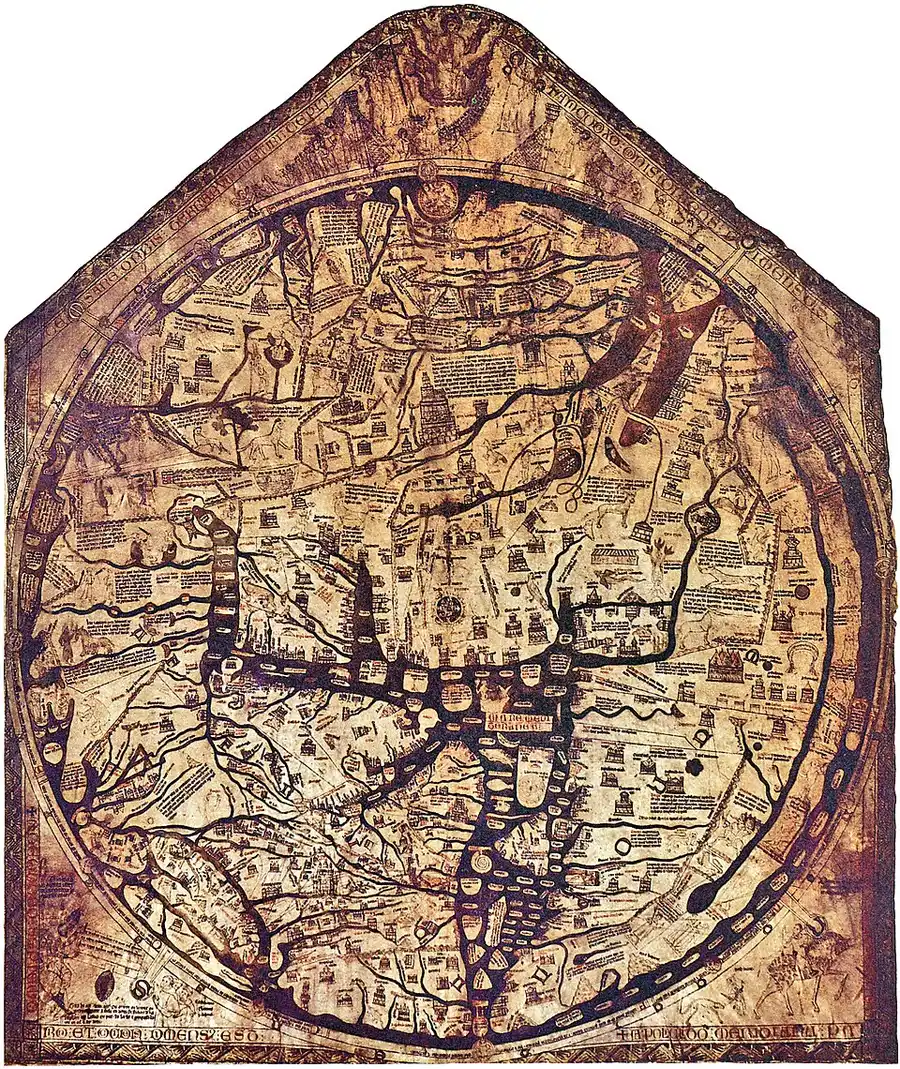 Richard of Haldingham (attrib.), Hereford Mappa Mundi (c. 1300), Hereford Cathedral Centered on Jerusalem and dense with the cities and peoples of the medieval Christian world, the Hereford Mappa Mundi maps the same Latin Christian geography — Norway included since its eleventh-century conversion — that made a Norwegian king's crusade to the Holy Land make sense. The medieval cultural and religious community of Western European
countries that recognised the spiritual authority of the Bishop
of Rome and used Latin as the language of their liturgy, law,
scholarship, and diplomacy — distinct from Eastern (Greek)
Christendom centred on Constantinople, with which it formally
split in 1054. Norway joined Latin Christendom in the eleventh
century with the canonisation of Saint Olav and the organisation
of the diocesan structure, and remained in it for five centuries
until the 1537 Reformation made the country Lutheran. At its
height in the high medieval period, Latin Christendom stretched
from Norway to Sicily, from Portugal to the Baltic.
Also discussed in A Catholic Norway — the faith that gave the kingdom its first institutions and the stave churches , through the Strait of Gibraltar
Richard of Haldingham (attrib.), Hereford Mappa Mundi (c. 1300), Hereford Cathedral Centered on Jerusalem and dense with the cities and peoples of the medieval Christian world, the Hereford Mappa Mundi maps the same Latin Christian geography — Norway included since its eleventh-century conversion — that made a Norwegian king's crusade to the Holy Land make sense. The medieval cultural and religious community of Western European
countries that recognised the spiritual authority of the Bishop
of Rome and used Latin as the language of their liturgy, law,
scholarship, and diplomacy — distinct from Eastern (Greek)
Christendom centred on Constantinople, with which it formally
split in 1054. Norway joined Latin Christendom in the eleventh
century with the canonisation of Saint Olav and the organisation
of the diocesan structure, and remained in it for five centuries
until the 1537 Reformation made the country Lutheran. At its
height in the high medieval period, Latin Christendom stretched
from Norway to Sicily, from Portugal to the Baltic.
Also discussed in A Catholic Norway — the faith that gave the kingdom its first institutions and the stave churches , through the Strait of Gibraltar 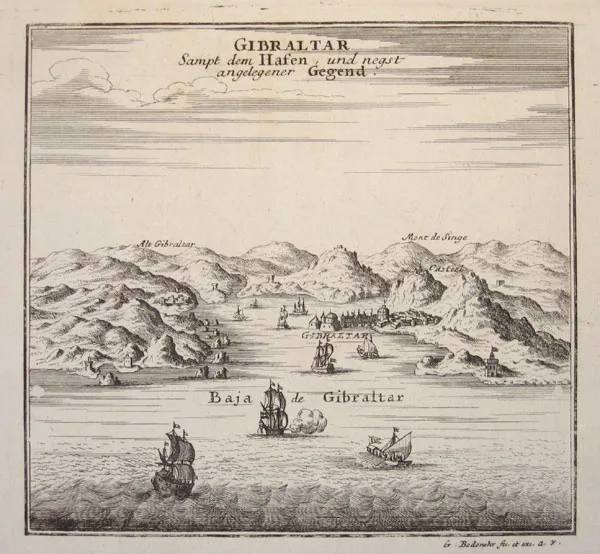 Gabriel Bodenehr, Bay of Gibraltar (c. 1704) A 1704 engraved view of Gibraltar and its bay from the water, ships riding the roads beneath the Rock. Norse fleets passed this strait in both directions — the raiders of 859–62 bound for the Mediterranean, and, centuries later, King Sigurd's crusader fleet on its way east. The narrow strait between the southern tip of Spain and Morocco
connecting the Atlantic Ocean to the Mediterranean Sea, about
thirteen kilometres at its narrowest. The Norse fleet that had
ravaged the Atlantic coast of Iberia in 859–862 passed through
Gibraltar in both directions, raiding into the western Mediterranean
and harrying the Moroccan and southern French coasts before returning
north — the deepest reach south of any Viking-Age expedition.
Also discussed in The Viking Age — longships, legends, and the first "Norway" , east across the Mediterranean, and the harbour they were steering for, after a voyage that would take the better part of four years, lay on the coast of the Holy Land
Gabriel Bodenehr, Bay of Gibraltar (c. 1704) A 1704 engraved view of Gibraltar and its bay from the water, ships riding the roads beneath the Rock. Norse fleets passed this strait in both directions — the raiders of 859–62 bound for the Mediterranean, and, centuries later, King Sigurd's crusader fleet on its way east. The narrow strait between the southern tip of Spain and Morocco
connecting the Atlantic Ocean to the Mediterranean Sea, about
thirteen kilometres at its narrowest. The Norse fleet that had
ravaged the Atlantic coast of Iberia in 859–862 passed through
Gibraltar in both directions, raiding into the western Mediterranean
and harrying the Moroccan and southern French coasts before returning
north — the deepest reach south of any Viking-Age expedition.
Also discussed in The Viking Age — longships, legends, and the first "Norway" , east across the Mediterranean, and the harbour they were steering for, after a voyage that would take the better part of four years, lay on the coast of the Holy Land 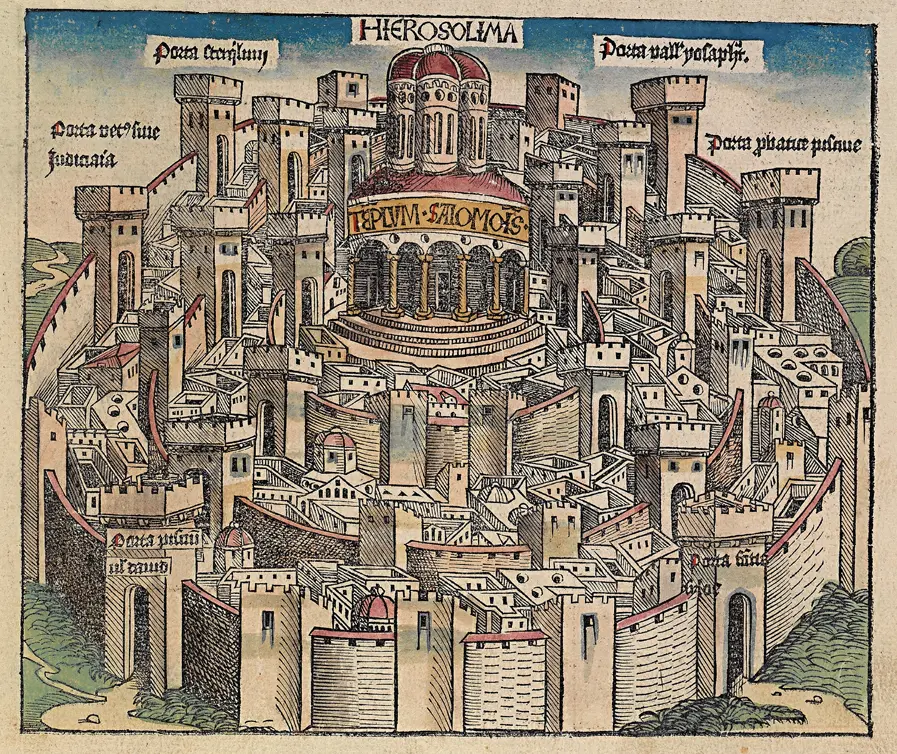 Hartmann Schedel, Hierosolima woodcut, Nuremberg Chronicle (1493) Jerusalem as the Nuremberg Chronicle pictured it in 1493 — a walled holy city drawn for readers who would never see it. This was the Holy Land of the medieval European imagination, the goal that drew Norse pilgrims, Varangian soldiers, and crusading kings alike south. Medieval Christian and Muslim term for the region of Palestine —
the area in which the events of the Old and New Testaments are set,
centred on Jerusalem. In the early eleventh century under Fatimid
Caliphate rule, with a Christian population that retained pilgrim
access to Jerusalem and the other holy sites. Harald Hardrada
served there as a Varangian commander in Byzantine campaigns of
the late 1030s, possibly reaching Jerusalem as a pilgrim. The
Crusader conquest of Jerusalem followed in 1099.
Also discussed in The Viking Age — longships, legends, and the first "Norway" . The man who had called the fleet out was a king of Norway not yet out of his teens.
Hartmann Schedel, Hierosolima woodcut, Nuremberg Chronicle (1493) Jerusalem as the Nuremberg Chronicle pictured it in 1493 — a walled holy city drawn for readers who would never see it. This was the Holy Land of the medieval European imagination, the goal that drew Norse pilgrims, Varangian soldiers, and crusading kings alike south. Medieval Christian and Muslim term for the region of Palestine —
the area in which the events of the Old and New Testaments are set,
centred on Jerusalem. In the early eleventh century under Fatimid
Caliphate rule, with a Christian population that retained pilgrim
access to Jerusalem and the other holy sites. Harald Hardrada
served there as a Varangian commander in Byzantine campaigns of
the late 1030s, possibly reaching Jerusalem as a pilgrim. The
Crusader conquest of Jerusalem followed in 1099.
Also discussed in The Viking Age — longships, legends, and the first "Norway" . The man who had called the fleet out was a king of Norway not yet out of his teens.
The First Crusade 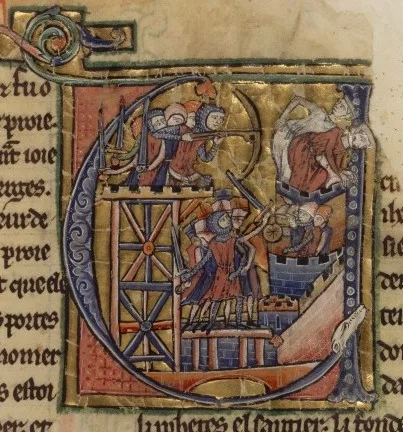 The Siege of Jerusalem, 1099 — medieval manuscript miniature, Bibliothèque nationale de France The First Crusade took Jerusalem on 15 July 1099, founding the Latin kingdom Sigurd Jorsalfar would visit a decade later. This 13th-century manuscript initial shows crusaders storming the walls from a siege tower. The military expedition called by Pope Urban II at the Council
of Clermont in 1095 in response to the Byzantine emperor
Alexios I Komnenos's appeal for help against the Seljuk Turks.
Took Jerusalem on 15 July 1099 after a five-week siege —
the founding act of the crusader Kingdom of Jerusalem and the
three other crusader states (the Principality of Antioch, the
County of Edessa, the County of Tripoli). Led by dukes, counts,
and the second sons of the great noble houses of Latin
Christendom — Godfrey of Bouillon, Bohemond of Taranto, Raymond
of Toulouse, Robert of Normandy — but not by any reigning
king of Western Europe. Sigurd Jorsalfar's 1107–1111 expedition
was the first such crusade led personally by a reigning monarch.
had stormed Jerusalem
The Siege of Jerusalem, 1099 — medieval manuscript miniature, Bibliothèque nationale de France The First Crusade took Jerusalem on 15 July 1099, founding the Latin kingdom Sigurd Jorsalfar would visit a decade later. This 13th-century manuscript initial shows crusaders storming the walls from a siege tower. The military expedition called by Pope Urban II at the Council
of Clermont in 1095 in response to the Byzantine emperor
Alexios I Komnenos's appeal for help against the Seljuk Turks.
Took Jerusalem on 15 July 1099 after a five-week siege —
the founding act of the crusader Kingdom of Jerusalem and the
three other crusader states (the Principality of Antioch, the
County of Edessa, the County of Tripoli). Led by dukes, counts,
and the second sons of the great noble houses of Latin
Christendom — Godfrey of Bouillon, Bohemond of Taranto, Raymond
of Toulouse, Robert of Normandy — but not by any reigning
king of Western Europe. Sigurd Jorsalfar's 1107–1111 expedition
was the first such crusade led personally by a reigning monarch.
had stormed Jerusalem 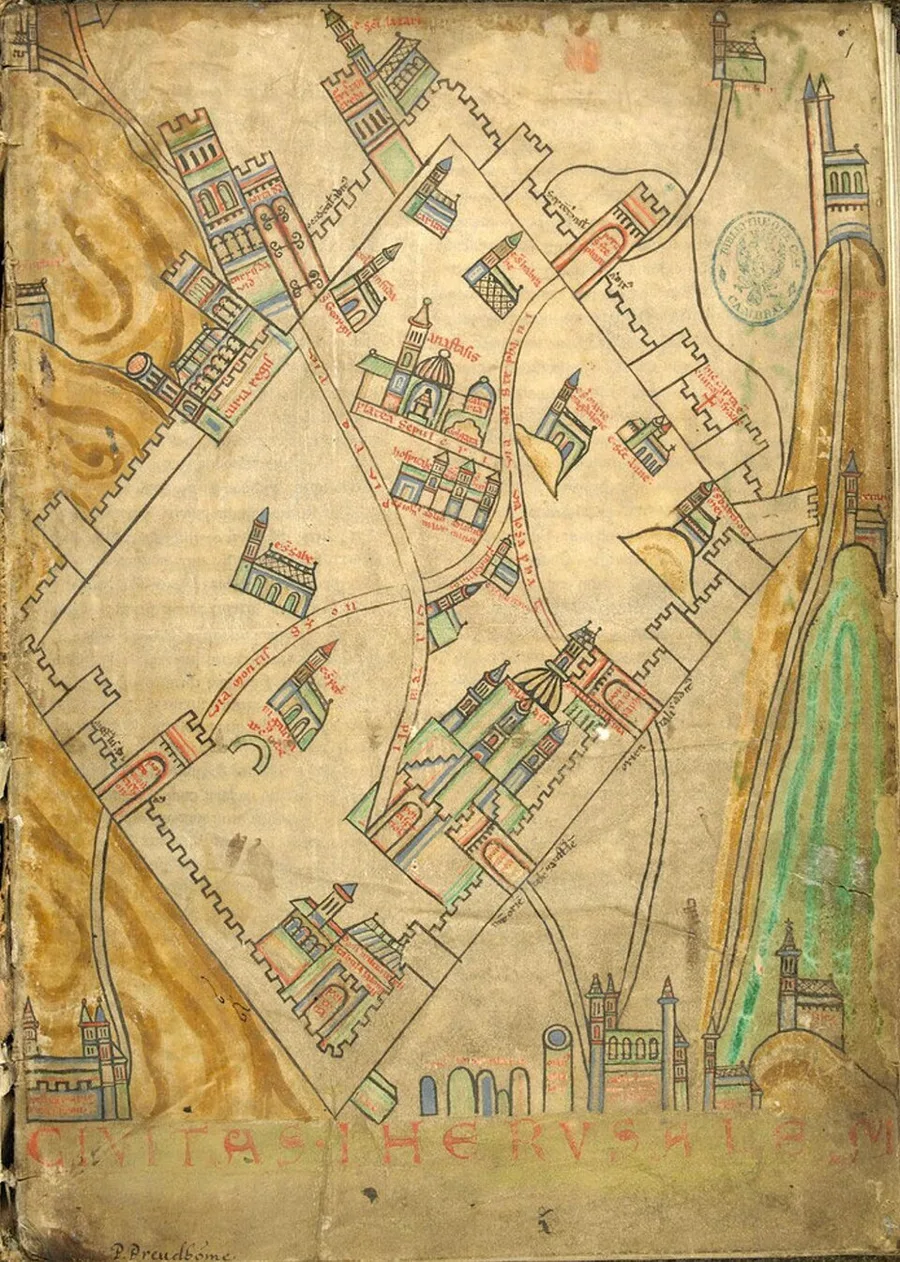 Unknown, Cambrai Map of crusader Jerusalem (c. 1130), Bibliothèque municipale de Cambrai, MS 466 This medieval diagram-map of crusader Jerusalem — the walled city drawn as a diamond, gates and churches named within — is the Jerusalem Sigurd Jorsalfar reaches in 1110, the goal his three-year voyage from Norway was built around. Sacred city of Judaism, Christianity, and Islam, in the
Judean Hills. Under Fatimid Caliphate rule when the First
Crusade took it on 15 July 1099 after a five-week siege —
the founding act of the crusader Kingdom of Jerusalem (1099–
1291). The kingdom was a thin strip of captured Levantine
coast held by a small Frankish army, with the holy city
itself as its religious and political centre. Sigurd
Jorsalfar was received in Jerusalem in 1110 by King Baldwin I,
shown the holy places, and given a splinter of the True Cross
to take home to Norway. Re-taken by Saladin in 1187; under
successive Ottoman, British Mandate, Jordanian, and Israeli
control in the centuries since.
eight years earlier, in the summer of 1099. The men who had stormed it were dukes, counts, and the second sons of the great noble houses of Latin Christendom. Not one reigning king had marched with them. The monarchs of Europe — Philip I of France, William Rufus of England, Henry IV of the German empire — had stayed on their thrones and sent others. The Norwegian king who put out from Bergen in 1107 was the first reigning ruler in the history of Europe to leave his own kingdom and sail for the Holy Land at the head of his own fleet. The expedition entered the record afterwards as the The Norwegian Crusade
Unknown, Cambrai Map of crusader Jerusalem (c. 1130), Bibliothèque municipale de Cambrai, MS 466 This medieval diagram-map of crusader Jerusalem — the walled city drawn as a diamond, gates and churches named within — is the Jerusalem Sigurd Jorsalfar reaches in 1110, the goal his three-year voyage from Norway was built around. Sacred city of Judaism, Christianity, and Islam, in the
Judean Hills. Under Fatimid Caliphate rule when the First
Crusade took it on 15 July 1099 after a five-week siege —
the founding act of the crusader Kingdom of Jerusalem (1099–
1291). The kingdom was a thin strip of captured Levantine
coast held by a small Frankish army, with the holy city
itself as its religious and political centre. Sigurd
Jorsalfar was received in Jerusalem in 1110 by King Baldwin I,
shown the holy places, and given a splinter of the True Cross
to take home to Norway. Re-taken by Saladin in 1187; under
successive Ottoman, British Mandate, Jordanian, and Israeli
control in the centuries since.
eight years earlier, in the summer of 1099. The men who had stormed it were dukes, counts, and the second sons of the great noble houses of Latin Christendom. Not one reigning king had marched with them. The monarchs of Europe — Philip I of France, William Rufus of England, Henry IV of the German empire — had stayed on their thrones and sent others. The Norwegian king who put out from Bergen in 1107 was the first reigning ruler in the history of Europe to leave his own kingdom and sail for the Holy Land at the head of his own fleet. The expedition entered the record afterwards as the The Norwegian Crusade 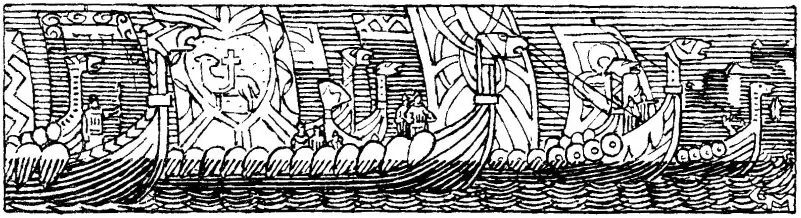 Gerhard Munthe, "Sigurds ferd fra landet", illustration for Magnussønnenes saga, Snorre 1899-edition The fleet putting out from Bergen in 1107 — sixty ships and perhaps five thousand men beginning the four-year voyage this card names. Visually distinct from the Sigurd Jorsalfar card: this is Munthe's wide decorative ship frieze, not Bloch's color painting of the Constantinople entry. The military expedition led personally by Sigurd Jorsalfar,
King of Norway, to the Holy Land in 1107–1111 — the first
crusade ever led in person by a reigning European monarch.
A fleet of sixty ships and perhaps five thousand men put out
from Bergen in the autumn of 1107, wintered in England, then
in Galicia, then in Sicily, and reached Acre in the summer of
1110. The Norwegians fought through the Iberian Atlantic coast
and the western Mediterranean on the way, took several Muslim-
held ports, joined King Baldwin I of Jerusalem at the siege of
Sidon, received a splinter of the True Cross from Patriarch
Gibelin of Arles, and ended the voyage by giving the fleet to
the Byzantine emperor at Constantinople. Sigurd came home
overland in 1111.
. The next reigning monarch to do anything comparable would not set out for almost forty years.
Gerhard Munthe, "Sigurds ferd fra landet", illustration for Magnussønnenes saga, Snorre 1899-edition The fleet putting out from Bergen in 1107 — sixty ships and perhaps five thousand men beginning the four-year voyage this card names. Visually distinct from the Sigurd Jorsalfar card: this is Munthe's wide decorative ship frieze, not Bloch's color painting of the Constantinople entry. The military expedition led personally by Sigurd Jorsalfar,
King of Norway, to the Holy Land in 1107–1111 — the first
crusade ever led in person by a reigning European monarch.
A fleet of sixty ships and perhaps five thousand men put out
from Bergen in the autumn of 1107, wintered in England, then
in Galicia, then in Sicily, and reached Acre in the summer of
1110. The Norwegians fought through the Iberian Atlantic coast
and the western Mediterranean on the way, took several Muslim-
held ports, joined King Baldwin I of Jerusalem at the siege of
Sidon, received a splinter of the True Cross from Patriarch
Gibelin of Arles, and ended the voyage by giving the fleet to
the Byzantine emperor at Constantinople. Sigurd came home
overland in 1111.
. The next reigning monarch to do anything comparable would not set out for almost forty years.
Three brothers, one throne
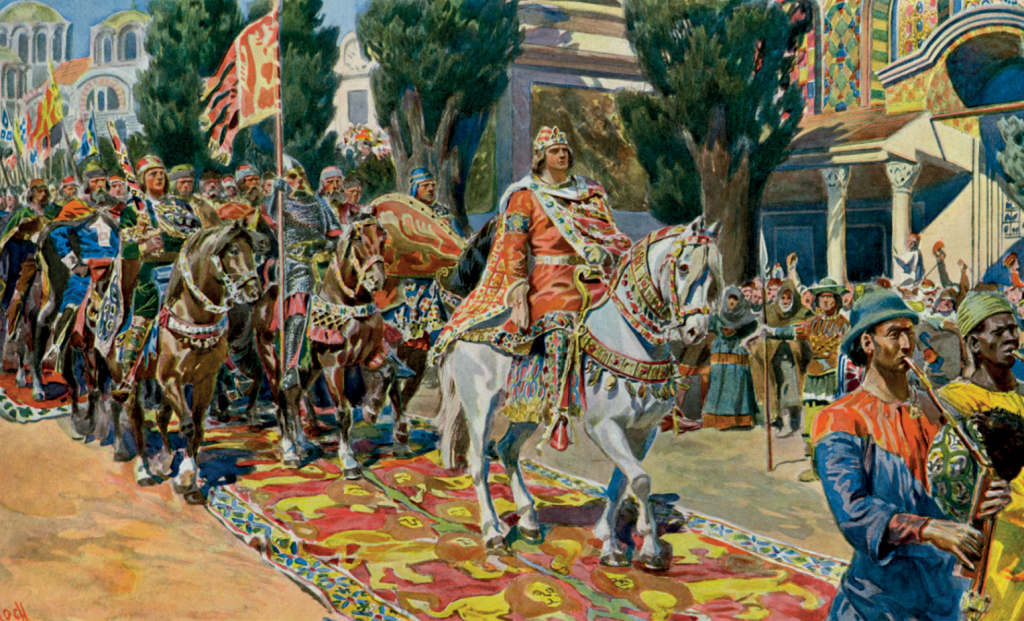
His name was Sigurd Jorsalfar 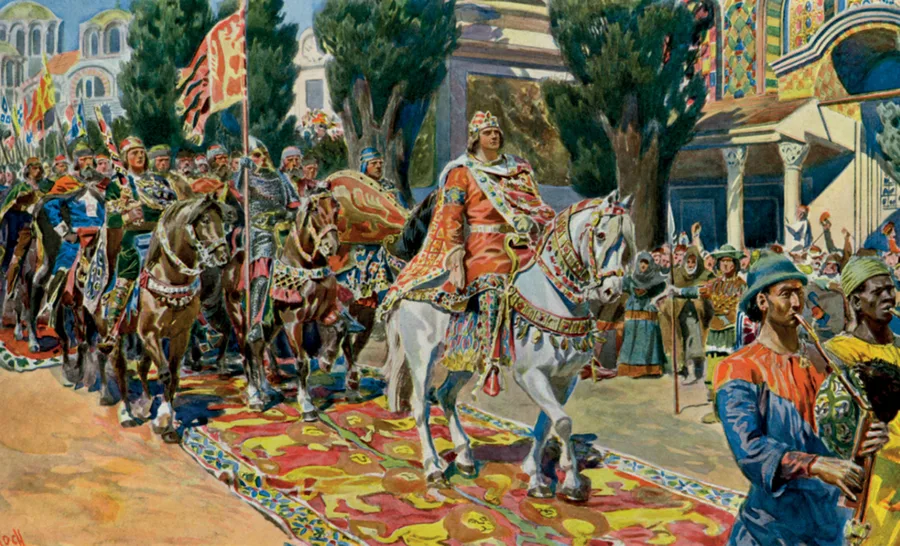 Andreas Bloch, Sigurd Entering Constantinople, in Noregs soge i bilete og ord (Mittet & Co., 1926) Sigurd's crusade ends here — riding through Constantinople's gates at the head of his fleet's crews, the single scene every saga account of the voyage builds toward. Sigurd I Magnusson (c. 1090 – 26 March 1130), king of Norway
1103–1130, bynamed Jorsalfar — "the Jerusalem-farer" — for
leading the Norwegian Crusade of 1107–1111. The first reigning
European monarch ever to lead a crusade to the Holy Land in
person. Ruled jointly with his brothers Eystein I (until 1123)
and Olav (until 1115), then alone for his last seven years.
Brought a splinter of the True Cross back from the siege of
Sidon and kept it at his border town of Konungahella; after
the 1135 Wendish sack of the town the relic disappears from
the record. His contested succession at his death in 1130
opened the century of the Norwegian civil wars.
Also discussed in The Golden Age — a North Atlantic empire … reaching farther than you think . He was one of three sons of King Magnus Barefoot
Andreas Bloch, Sigurd Entering Constantinople, in Noregs soge i bilete og ord (Mittet & Co., 1926) Sigurd's crusade ends here — riding through Constantinople's gates at the head of his fleet's crews, the single scene every saga account of the voyage builds toward. Sigurd I Magnusson (c. 1090 – 26 March 1130), king of Norway
1103–1130, bynamed Jorsalfar — "the Jerusalem-farer" — for
leading the Norwegian Crusade of 1107–1111. The first reigning
European monarch ever to lead a crusade to the Holy Land in
person. Ruled jointly with his brothers Eystein I (until 1123)
and Olav (until 1115), then alone for his last seven years.
Brought a splinter of the True Cross back from the siege of
Sidon and kept it at his border town of Konungahella; after
the 1135 Wendish sack of the town the relic disappears from
the record. His contested succession at his death in 1130
opened the century of the Norwegian civil wars.
Also discussed in The Golden Age — a North Atlantic empire … reaching farther than you think . He was one of three sons of King Magnus Barefoot 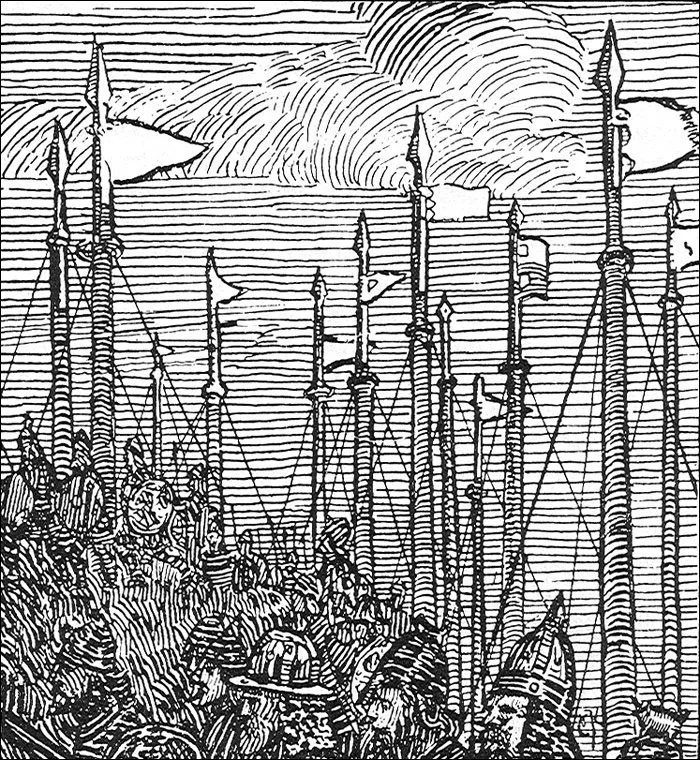 Christian Krohg, illustration for Magnus Berrføtts saga, Norges Kongesagaer vol. 2 (1899), p. 544 Magnus Barefoot's men go ashore in Ireland at dawn — the landing depicted here from the 1103 expedition on which the king himself was ambushed and killed, opening the throne to his three sons. Magnus III Olavsson (1073–1103), king of Norway 1093–1103,
bynamed Berrføtt ("Barefoot" or "Bare-legged") in saga
tradition — said to refer to his adoption of the Gaelic kilt
during campaigns in the Isles. The last Norwegian king to lead
a major Viking-style military expedition in the western Atlantic.
Imposed direct Norwegian rule over the Orkneys, Hebrides, and
Isle of Man across the 1090s, and was killed in 1103 leading
a military expedition into Ireland — struck down in an ambush
in Ulster. Father of Sigurd Jorsalfar, Eystein I, and Olav
Magnusson, who divided the throne between them after his death.
, who had died in 1103 leading a military expedition into Ireland. By the agreement that followed his father’s death, Sigurd held the Norwegian kingdom jointly with his elder brother Eystein I Magnusson
Christian Krohg, illustration for Magnus Berrføtts saga, Norges Kongesagaer vol. 2 (1899), p. 544 Magnus Barefoot's men go ashore in Ireland at dawn — the landing depicted here from the 1103 expedition on which the king himself was ambushed and killed, opening the throne to his three sons. Magnus III Olavsson (1073–1103), king of Norway 1093–1103,
bynamed Berrføtt ("Barefoot" or "Bare-legged") in saga
tradition — said to refer to his adoption of the Gaelic kilt
during campaigns in the Isles. The last Norwegian king to lead
a major Viking-style military expedition in the western Atlantic.
Imposed direct Norwegian rule over the Orkneys, Hebrides, and
Isle of Man across the 1090s, and was killed in 1103 leading
a military expedition into Ireland — struck down in an ambush
in Ulster. Father of Sigurd Jorsalfar, Eystein I, and Olav
Magnusson, who divided the throne between them after his death.
, who had died in 1103 leading a military expedition into Ireland. By the agreement that followed his father’s death, Sigurd held the Norwegian kingdom jointly with his elder brother Eystein I Magnusson 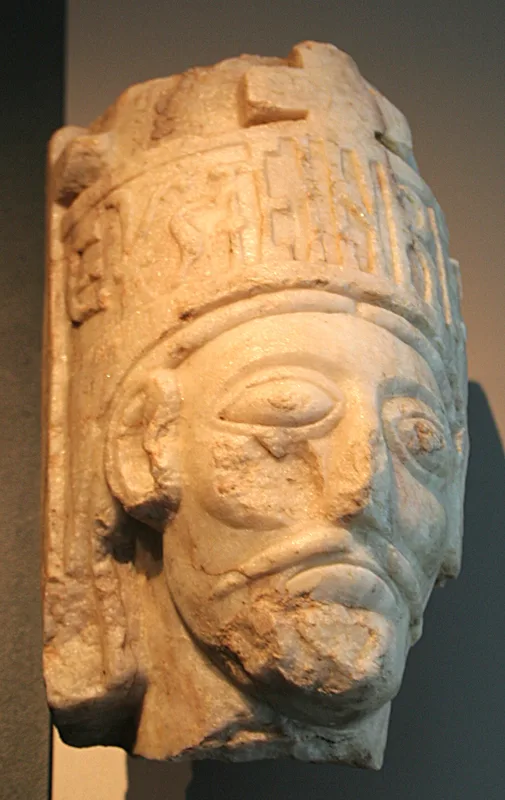 Unknown medieval sculptor, bust of King Eystein I ("EYSTEIN REX"); photo: Nina, University Museum of Bergen, CC BY 2.5 Excavated at Munkeliv Abbey in 1853, this marble head inscribed EYSTEIN REX is the oldest surviving portrait of a Norwegian king — a fitting likeness for the monastery's own founder. King of Norway 1103–1123, sharing the throne with his half-brothers
Sigurd the Crusader and (until 1115) Olav. Remembered chiefly as
a builder and administrator rather than a warrior — the foil to
Sigurd's military exploits in the Mediterranean. Founded the
Benedictine monastery of Munkeliv on the western shore of Bergen
in the early twelfth century, one of the earliest monasteries in
Norway. Sponsored road and harbour improvements across the country
and established the kongsgård (royal estate) infrastructure that
supported the medieval Norwegian court.
Also discussed in A Catholic Norway — the faith that gave the kingdom its first institutions and the stave churchesThe Germans Who "Ruled" Bergen — the Hanseatic merchants on Bryggen Wharf and his younger brother Olav Magnusson
Unknown medieval sculptor, bust of King Eystein I ("EYSTEIN REX"); photo: Nina, University Museum of Bergen, CC BY 2.5 Excavated at Munkeliv Abbey in 1853, this marble head inscribed EYSTEIN REX is the oldest surviving portrait of a Norwegian king — a fitting likeness for the monastery's own founder. King of Norway 1103–1123, sharing the throne with his half-brothers
Sigurd the Crusader and (until 1115) Olav. Remembered chiefly as
a builder and administrator rather than a warrior — the foil to
Sigurd's military exploits in the Mediterranean. Founded the
Benedictine monastery of Munkeliv on the western shore of Bergen
in the early twelfth century, one of the earliest monasteries in
Norway. Sponsored road and harbour improvements across the country
and established the kongsgård (royal estate) infrastructure that
supported the medieval Norwegian court.
Also discussed in A Catholic Norway — the faith that gave the kingdom its first institutions and the stave churchesThe Germans Who "Ruled" Bergen — the Hanseatic merchants on Bryggen Wharf and his younger brother Olav Magnusson 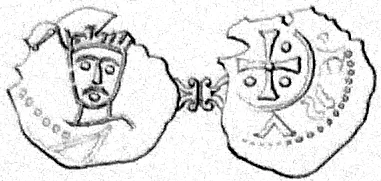 C. I. Schive (drawing), Norges Mynter i Middelalderen (1865), quarter-penny of the condominium of Olav, Eystein and Sigurd No portrait of the boy-king exists. This quarter-penny from the three brothers' joint reign (1103–1115), drawn for C. I. Schive's 1865 coin atlas, carries a legend fragment read as '…LAV' — Olav's own name on the coinage he shared with Sigurd and Eystein. Olav Magnusson (c. 1099 – 22 December 1115), the youngest of the
three sons of Magnus Barefoot. Shared the Norwegian throne with
his elder brothers Sigurd Jorsalfar and Eystein I from his
father's death in 1103. Died young at sixteen, leaving the
throne to be shared between Eystein and Sigurd until Eystein's
death in 1123. The three-brother joint kingship of 1103-1115 was
unusual in medieval Europe and remembered in the saga tradition
as a peaceful and unusually well-managed arrangement.
: a single throne shared by three men without being carved into pieces, an arrangement rare anywhere in medieval Europe but settled enough in Norwegian practice that the brothers made it work for the better part of two decades.
C. I. Schive (drawing), Norges Mynter i Middelalderen (1865), quarter-penny of the condominium of Olav, Eystein and Sigurd No portrait of the boy-king exists. This quarter-penny from the three brothers' joint reign (1103–1115), drawn for C. I. Schive's 1865 coin atlas, carries a legend fragment read as '…LAV' — Olav's own name on the coinage he shared with Sigurd and Eystein. Olav Magnusson (c. 1099 – 22 December 1115), the youngest of the
three sons of Magnus Barefoot. Shared the Norwegian throne with
his elder brothers Sigurd Jorsalfar and Eystein I from his
father's death in 1103. Died young at sixteen, leaving the
throne to be shared between Eystein and Sigurd until Eystein's
death in 1123. The three-brother joint kingship of 1103-1115 was
unusual in medieval Europe and remembered in the saga tradition
as a peaceful and unusually well-managed arrangement.
: a single throne shared by three men without being carved into pieces, an arrangement rare anywhere in medieval Europe but settled enough in Norwegian practice that the brothers made it work for the better part of two decades.
When word reached the brothers that the new Crusader Kingdom of Jerusalem 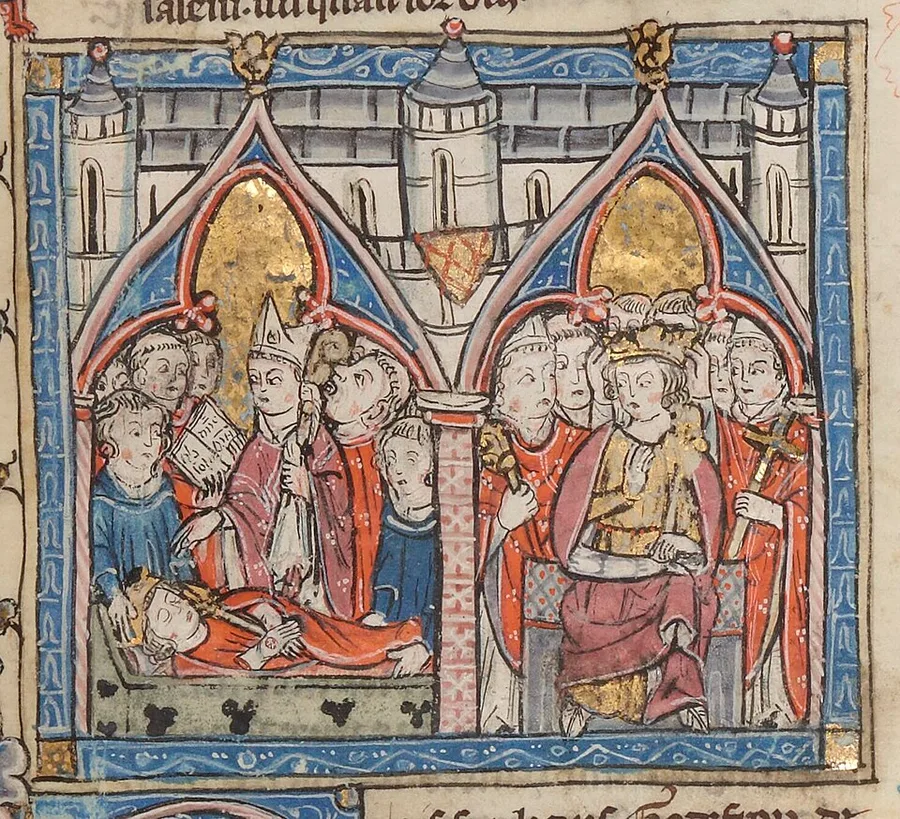 Unknown artist, funeral of Godfrey of Bouillon and coronation of Baldwin I (14th century), BnF Français 2824 This miniature pairs the 1100 funeral of Godfrey of Bouillon with the coronation of Baldwin I as the kingdom's first crowned king — the founding of the state whose ruler, a decade on, received Sigurd Jorsalfar and gave him a splinter of the True Cross. Frankish Christian state established in the Levant by the First
Crusade after the taking of Jerusalem on 15 July 1099. A thin
strip of captured coast held by a small Frankish army, with
Jerusalem itself as the religious and political centre. Ruled
by an elected king from 1100 onward — beginning with Baldwin I
(1100–1118), the first crowned monarch. Reinforced through the
twelfth century by crusading expeditions from Western Europe,
including the Norwegian Crusade of 1107–1111 that joined the
siege of Sidon in 1110. Re-conquered by Saladin in 1187; a
rump kingdom centred on Acre survived until 1291, when the
Mamluk Sultanate's capture of Acre ended the crusader
presence on the Levantine coast.
needed reinforcements to hold what the First Crusade had taken, the question of who would answer was settled the way the brothers settled most things: by negotiation. One of them would go east. Two would stay to govern. Sigurd, the middle brother, around seventeen years old, was the one who went.
Unknown artist, funeral of Godfrey of Bouillon and coronation of Baldwin I (14th century), BnF Français 2824 This miniature pairs the 1100 funeral of Godfrey of Bouillon with the coronation of Baldwin I as the kingdom's first crowned king — the founding of the state whose ruler, a decade on, received Sigurd Jorsalfar and gave him a splinter of the True Cross. Frankish Christian state established in the Levant by the First
Crusade after the taking of Jerusalem on 15 July 1099. A thin
strip of captured coast held by a small Frankish army, with
Jerusalem itself as the religious and political centre. Ruled
by an elected king from 1100 onward — beginning with Baldwin I
(1100–1118), the first crowned monarch. Reinforced through the
twelfth century by crusading expeditions from Western Europe,
including the Norwegian Crusade of 1107–1111 that joined the
siege of Sidon in 1110. Re-conquered by Saladin in 1187; a
rump kingdom centred on Acre survived until 1291, when the
Mamluk Sultanate's capture of Acre ended the crusader
presence on the Levantine coast.
needed reinforcements to hold what the First Crusade had taken, the question of who would answer was settled the way the brothers settled most things: by negotiation. One of them would go east. Two would stay to govern. Sigurd, the middle brother, around seventeen years old, was the one who went.
What he was committing himself to was an undertaking on a scale his country had no recent precedent for. Norway had sent men overseas for three centuries by then, but the men who had gone had gone in their hundreds, on their own account, for plunder and trade. Sigurd was leading out an army of perhaps five thousand under a royal banner, on a religious mission a Norwegian king had never undertaken, for a destination almost none of them had seen. The expedition was the first of its kind.
Three winters at sea
The fleet did not try to make the voyage in a single sailing season. A fleet of sixty ships cannot cross a continent of coastline that fast, and Sigurd did not attempt it. He brought his ships into England for the winter of 1107, and was received there by Henry I of England 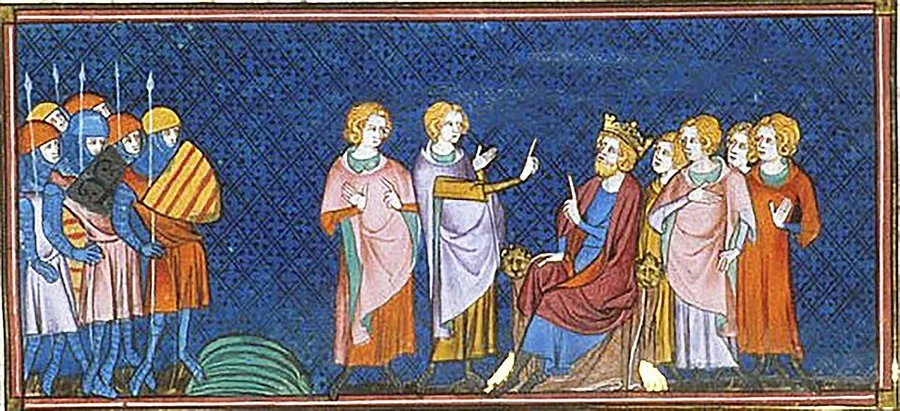 Henry I of England receiving French envoys near Gisors, Chronicles of Saint-Denis (c. 1332-50) A later medieval chronicler's image of Henry I in the diplomatic-reception pose that defined his kingship — the same posture in which he hosted Sigurd Jorsalfar's crusader fleet at his own court through the winter of 1107-1108. King of England 1100–1135, the youngest son of William the
Conqueror. Seized the English throne on the death of his
brother William Rufus, defeated his older brother Robert
Curthose at Tinchebrai in 1106 to add Normandy to his realm,
and ruled an Anglo-Norman state across the English Channel for
thirty-five years. Hosted Sigurd Jorsalfar and the Norwegian
crusader fleet at his court for the winter of 1107–1108, the
first stopover of the four-year voyage to the Holy Land. His
death in 1135 without a clear male heir produced the Anarchy
— twenty years of English civil war until the accession of his
grandson Henry II in 1154.
, who lodged the Norwegians at his court until the weather turned.
Henry I of England receiving French envoys near Gisors, Chronicles of Saint-Denis (c. 1332-50) A later medieval chronicler's image of Henry I in the diplomatic-reception pose that defined his kingship — the same posture in which he hosted Sigurd Jorsalfar's crusader fleet at his own court through the winter of 1107-1108. King of England 1100–1135, the youngest son of William the
Conqueror. Seized the English throne on the death of his
brother William Rufus, defeated his older brother Robert
Curthose at Tinchebrai in 1106 to add Normandy to his realm,
and ruled an Anglo-Norman state across the English Channel for
thirty-five years. Hosted Sigurd Jorsalfar and the Norwegian
crusader fleet at his court for the winter of 1107–1108, the
first stopover of the four-year voyage to the Holy Land. His
death in 1135 without a clear male heir produced the Anarchy
— twenty years of English civil war until the accession of his
grandson Henry II in 1154.
, who lodged the Norwegians at his court until the weather turned.
When spring came the fleet sailed on down the long Atlantic face of Iberia 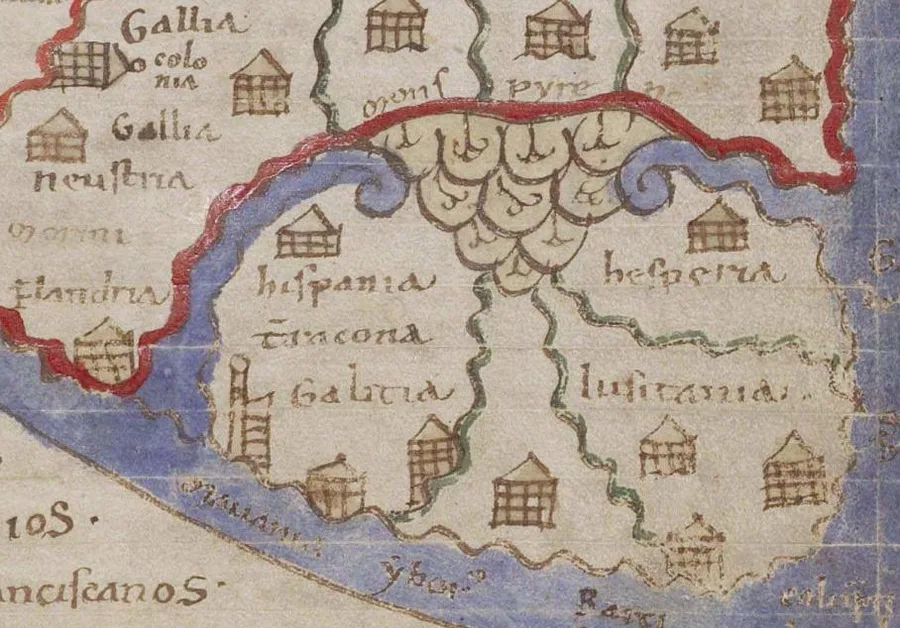 Lambert de Saint-Omer, Iberian peninsula detail, Liber Floridus (c. 1120) Drawn within a decade of Sigurd Jorsalfar's fleet rounding this same coastline in 1108-1109, this map fixes the peninsula's political geography almost exactly as the crusaders found it — Christian kingdoms in the north, Muslim al-Andalus in the south. The Iberian peninsula — the landmass at the southwestern corner
of Europe occupied today by Spain and Portugal, with Andorra,
Gibraltar, and a small piece of southern France. Around 580,000
square kilometres, separated from the rest of Europe by the
Pyrenees and from Africa by the Strait of Gibraltar. In Sigurd
Jorsalfar's time the peninsula was divided politically between
the Christian kingdoms of the north (Castile, León, Aragon,
Portugal, Navarre) and the Muslim al-Andalus in the south.
Sigurd's fleet sailed the entire Atlantic face of Iberia from
Galicia in the northwest to the Strait of Gibraltar in the
south, taking several Muslim-held coastal towns on the way.
(the peninsula that is today Spain and Portugal) and wintered a second time, in Galicia
Lambert de Saint-Omer, Iberian peninsula detail, Liber Floridus (c. 1120) Drawn within a decade of Sigurd Jorsalfar's fleet rounding this same coastline in 1108-1109, this map fixes the peninsula's political geography almost exactly as the crusaders found it — Christian kingdoms in the north, Muslim al-Andalus in the south. The Iberian peninsula — the landmass at the southwestern corner
of Europe occupied today by Spain and Portugal, with Andorra,
Gibraltar, and a small piece of southern France. Around 580,000
square kilometres, separated from the rest of Europe by the
Pyrenees and from Africa by the Strait of Gibraltar. In Sigurd
Jorsalfar's time the peninsula was divided politically between
the Christian kingdoms of the north (Castile, León, Aragon,
Portugal, Navarre) and the Muslim al-Andalus in the south.
Sigurd's fleet sailed the entire Atlantic face of Iberia from
Galicia in the northwest to the Strait of Gibraltar in the
south, taking several Muslim-held coastal towns on the way.
(the peninsula that is today Spain and Portugal) and wintered a second time, in Galicia 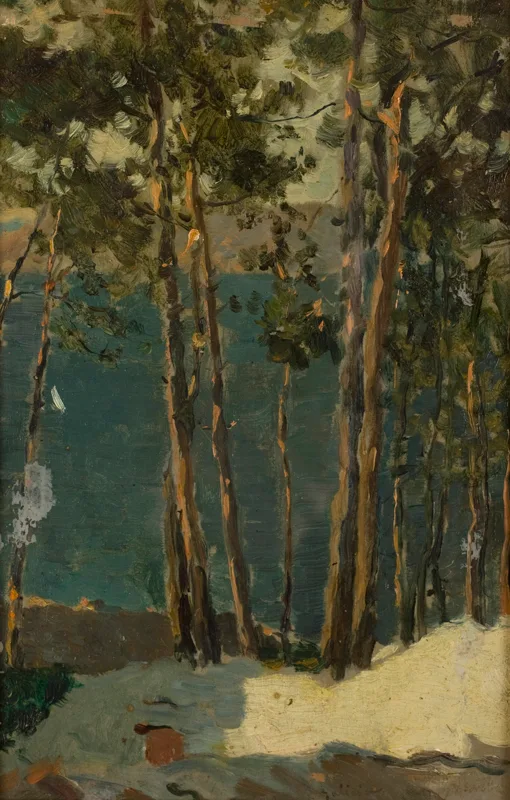 Joaquín Sorolla, Galicia (Ría de Vigo) (1899–1900), Museo de Pontevedra Sorolla's oil sketch of the Ría de Vigo — the drowned-valley coastline of the kingdom where Sigurd's fleet passed the hungry winter of 1108–1109, the season the sagas remember for the Norwegians storming a local count's stronghold after he stopped selling them food. Region of northwestern Spain, bordered by the Atlantic on the
north and west and by Portugal on the south. Site of the great
pilgrim shrine of Santiago de Compostela. Sigurd Jorsalfar's
fleet wintered in Galicia in 1108–1109 on the second leg of the
Norwegian Crusade; the saga tradition remembers the winter as a
hungry one, with the Norwegians storming the stronghold of a
local count who had stopped selling them provisions when the
season turned lean. Modern Galicia is one of the seventeen
autonomous communities of Spain with about 2.7 million people
speaking the Galician language alongside Spanish.
(modern-day northwestern Spain), in the country around the great pilgrim shrine of Santiago de Compostela
Joaquín Sorolla, Galicia (Ría de Vigo) (1899–1900), Museo de Pontevedra Sorolla's oil sketch of the Ría de Vigo — the drowned-valley coastline of the kingdom where Sigurd's fleet passed the hungry winter of 1108–1109, the season the sagas remember for the Norwegians storming a local count's stronghold after he stopped selling them food. Region of northwestern Spain, bordered by the Atlantic on the
north and west and by Portugal on the south. Site of the great
pilgrim shrine of Santiago de Compostela. Sigurd Jorsalfar's
fleet wintered in Galicia in 1108–1109 on the second leg of the
Norwegian Crusade; the saga tradition remembers the winter as a
hungry one, with the Norwegians storming the stronghold of a
local count who had stopped selling them provisions when the
season turned lean. Modern Galicia is one of the seventeen
autonomous communities of Spain with about 2.7 million people
speaking the Galician language alongside Spanish.
(modern-day northwestern Spain), in the country around the great pilgrim shrine of Santiago de Compostela 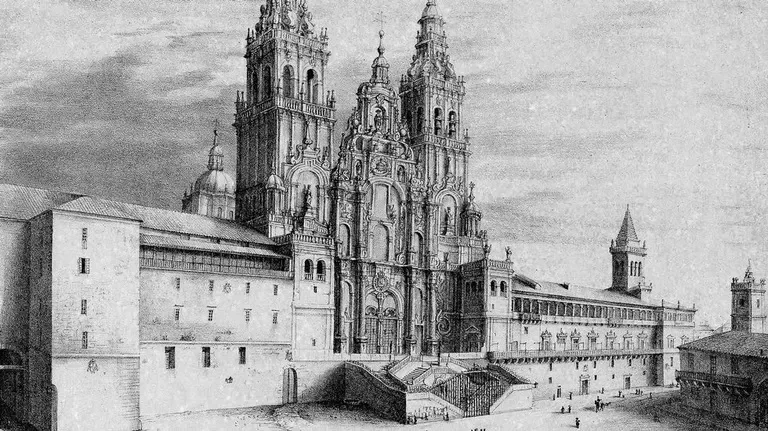 Ramón Gil Rey, lithograph of Santiago cathedral from the Praza do Obradoiro (1838) The Obradoiro facade of the cathedral raised over the apostle's tomb — the goal of the Camino and one of the great pilgrimage destinations of medieval Christendom, the southern counterpart of the pilgrim roads that led north to Nidaros. City in northwestern Spain, capital of Galicia. The discovery of
what was believed to be the tomb of Saint James the Greater in
the early ninth century made the city one of the three great
pilgrimage destinations of medieval Western Christendom —
alongside Rome and Jerusalem, and from the twelfth century
alongside Nidaros and Canterbury as the principal national
pilgrimage sites of northern Europe. The Camino de Santiago
network of pilgrim roads converging on the cathedral is the
largest pilgrim infrastructure that survives from the Middle Ages,
walked again by hundreds of thousands of pilgrims each year.
Also discussed in The King Who Became a Saint — how the Nordmen came to Christ . The saga tradition remembered the Galician winter as a hungry one. A local count who had agreed to sell the Norwegians provisions stopped doing so when the season turned lean, and Sigurd’s men stormed his stronghold and took what they needed.
Ramón Gil Rey, lithograph of Santiago cathedral from the Praza do Obradoiro (1838) The Obradoiro facade of the cathedral raised over the apostle's tomb — the goal of the Camino and one of the great pilgrimage destinations of medieval Christendom, the southern counterpart of the pilgrim roads that led north to Nidaros. City in northwestern Spain, capital of Galicia. The discovery of
what was believed to be the tomb of Saint James the Greater in
the early ninth century made the city one of the three great
pilgrimage destinations of medieval Western Christendom —
alongside Rome and Jerusalem, and from the twelfth century
alongside Nidaros and Canterbury as the principal national
pilgrimage sites of northern Europe. The Camino de Santiago
network of pilgrim roads converging on the cathedral is the
largest pilgrim infrastructure that survives from the Middle Ages,
walked again by hundreds of thousands of pilgrims each year.
Also discussed in The King Who Became a Saint — how the Nordmen came to Christ . The saga tradition remembered the Galician winter as a hungry one. A local count who had agreed to sell the Norwegians provisions stopped doing so when the season turned lean, and Sigurd’s men stormed his stronghold and took what they needed.
From Galicia the voyage became a fighting one. Through 1109 the fleet worked its way south along the Iberian Atlantic coast and into waters no Norwegian ships had sailed before, taking the Muslim-held towns of the south-western shore one after another — Sintra 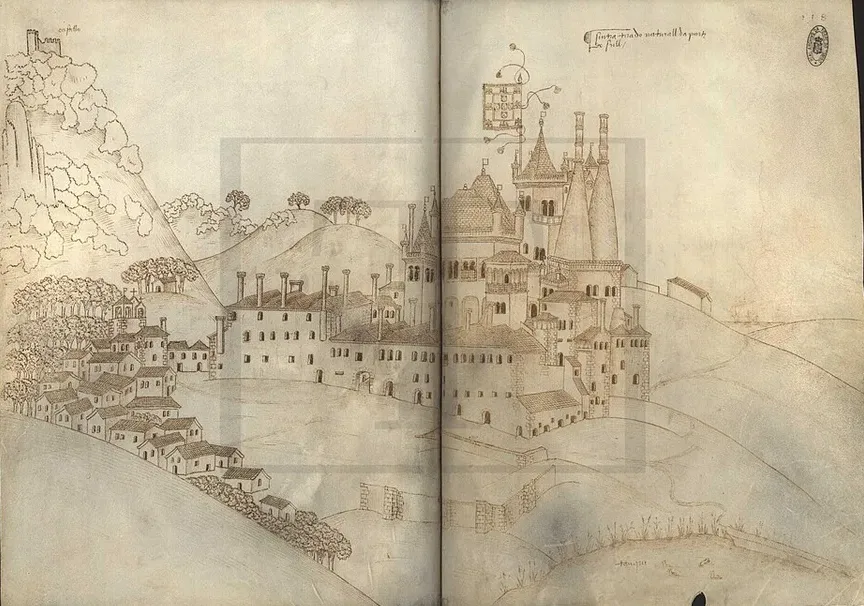 Duarte de Armas, Livro das Fortalezas, fol. 118: Sintra (1509-1510), Arquivo Nacional Torre do Tombo Drawn four centuries after Sigurd's fleet took it, this royal surveyor's record of the Sintra fortress shows the same hilltop stronghold that guarded the approach to Lisbon when the Norwegian crusaders held it briefly in 1109. Town in the hills north of Lisbon in modern Portugal. In
Sigurd Jorsalfar's time a Muslim-held fortified hill town
controlling the approaches to Lisbon from the north. Taken by
the Norwegian crusader fleet in 1109 on its way south down the
Iberian Atlantic coast — one of the first Muslim-held
Iberian towns to be temporarily lost to a foreign Christian
expedition during the crusading period. Permanently re-taken
by Afonso I of Portugal in 1147. Modern Sintra is a UNESCO
World Heritage site for its later Romantic-era palaces.
, then Lisbon
Duarte de Armas, Livro das Fortalezas, fol. 118: Sintra (1509-1510), Arquivo Nacional Torre do Tombo Drawn four centuries after Sigurd's fleet took it, this royal surveyor's record of the Sintra fortress shows the same hilltop stronghold that guarded the approach to Lisbon when the Norwegian crusaders held it briefly in 1109. Town in the hills north of Lisbon in modern Portugal. In
Sigurd Jorsalfar's time a Muslim-held fortified hill town
controlling the approaches to Lisbon from the north. Taken by
the Norwegian crusader fleet in 1109 on its way south down the
Iberian Atlantic coast — one of the first Muslim-held
Iberian towns to be temporarily lost to a foreign Christian
expedition during the crusading period. Permanently re-taken
by Afonso I of Portugal in 1147. Modern Sintra is a UNESCO
World Heritage site for its later Romantic-era palaces.
, then Lisbon 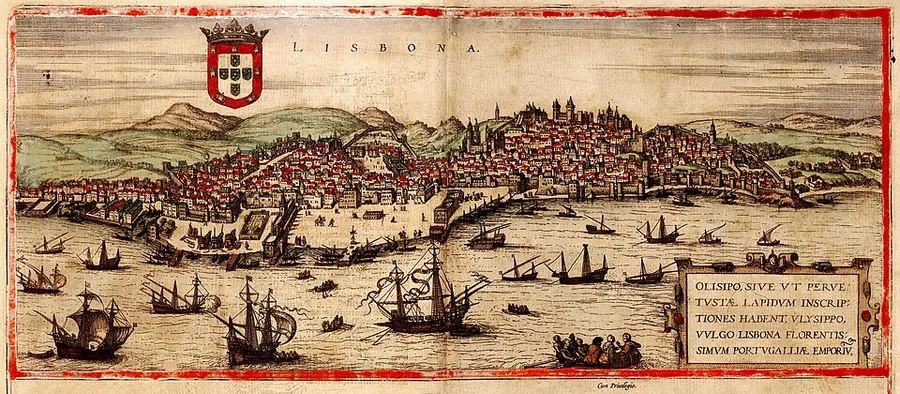 Georg Braun & Frans Hogenberg, view of Lisbon, Civitates Orbis Terrarum (1572) This 1572 engraving is the earliest reliable comprehensive view of Lisbon to survive — the same waterfront city, still under Muslim rule when Sigurd's fleet briefly seized it in 1109, more than four centuries before this image was drawn and nearly two centuries before its skyline was leveled by the 1755 earthquake. Capital of modern Portugal, on the north bank of the Tagus
estuary near the Atlantic coast. In Sigurd Jorsalfar's time
under Muslim rule as part of the Almoravid territories of
al-Andalus. Sigurd's Norwegian crusader fleet took Lisbon
briefly in 1109 on its way south; the city would not pass
permanently into Christian hands until the Second Crusade's
Siege of Lisbon in 1147, when an English-Flemish-German
crusader fleet helped the new Portuguese king Afonso I
capture it. Modern Lisbon has about 545,000 people in the
municipality, around three million in the metropolitan area.
, then Alkasse on the Sado estuary (all in modern-day Portugal). The ships passed through the Strait of Gibraltar, the narrow gate of the Mediterranean, and turned east along a sea that to the men aboard was the far rim of the known world. They fought through the Balearic Islands
Georg Braun & Frans Hogenberg, view of Lisbon, Civitates Orbis Terrarum (1572) This 1572 engraving is the earliest reliable comprehensive view of Lisbon to survive — the same waterfront city, still under Muslim rule when Sigurd's fleet briefly seized it in 1109, more than four centuries before this image was drawn and nearly two centuries before its skyline was leveled by the 1755 earthquake. Capital of modern Portugal, on the north bank of the Tagus
estuary near the Atlantic coast. In Sigurd Jorsalfar's time
under Muslim rule as part of the Almoravid territories of
al-Andalus. Sigurd's Norwegian crusader fleet took Lisbon
briefly in 1109 on its way south; the city would not pass
permanently into Christian hands until the Second Crusade's
Siege of Lisbon in 1147, when an English-Flemish-German
crusader fleet helped the new Portuguese king Afonso I
capture it. Modern Lisbon has about 545,000 people in the
municipality, around three million in the metropolitan area.
, then Alkasse on the Sado estuary (all in modern-day Portugal). The ships passed through the Strait of Gibraltar, the narrow gate of the Mediterranean, and turned east along a sea that to the men aboard was the far rim of the known world. They fought through the Balearic Islands 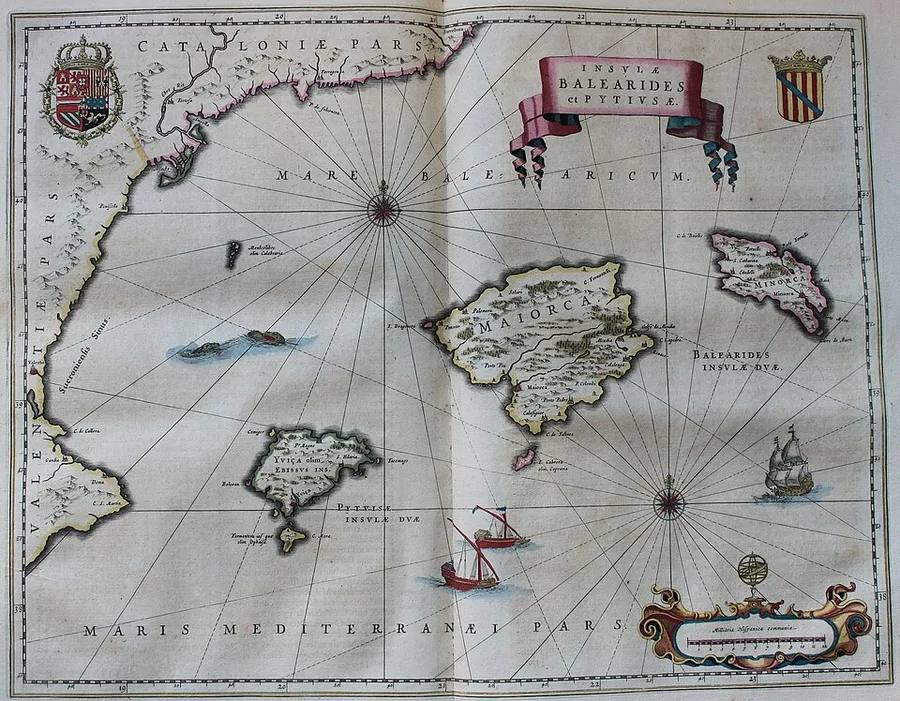 Joan Blaeu, Insulae Balearides et Pytiusae, from Geographia Blaviana (Amsterdam, 1659) Blaeu’s 1659 chart of the Balearic Islands — Maiorca, Minorca and Ibiza, then Muslim-held, which Sigurd Jorsalfar’s fleet raided on its outbound voyage to the Holy Land, storming cave strongholds along the way. Archipelago in the western Mediterranean off the eastern coast
of mainland Spain — Mallorca, Menorca, Ibiza, and Formentera.
In Sigurd Jorsalfar's time the islands were under Muslim rule,
serving as a base for raiders preying on Christian Mediterranean
shipping. Sigurd's Norwegian fleet fought through the Balearics
on its way east in 1109–1110; the saga tradition kept one
Balearic scene in particular — a band of raiders holed up in a
cliff cave above the sea, and the Norwegians coming at them by
hauling their boats up the rock face on ropes and burning them
out. The islands passed into Christian hands in 1229 when
James I of Aragon took Mallorca.
(modern-day Spain); the sagas kept one Balearic scene in particular — a band of raiders holed up in a cliff cave above the sea, and the Norwegians coming at them by hauling their boats up the rock face on ropes and burning them out.
Joan Blaeu, Insulae Balearides et Pytiusae, from Geographia Blaviana (Amsterdam, 1659) Blaeu’s 1659 chart of the Balearic Islands — Maiorca, Minorca and Ibiza, then Muslim-held, which Sigurd Jorsalfar’s fleet raided on its outbound voyage to the Holy Land, storming cave strongholds along the way. Archipelago in the western Mediterranean off the eastern coast
of mainland Spain — Mallorca, Menorca, Ibiza, and Formentera.
In Sigurd Jorsalfar's time the islands were under Muslim rule,
serving as a base for raiders preying on Christian Mediterranean
shipping. Sigurd's Norwegian fleet fought through the Balearics
on its way east in 1109–1110; the saga tradition kept one
Balearic scene in particular — a band of raiders holed up in a
cliff cave above the sea, and the Norwegians coming at them by
hauling their boats up the rock face on ropes and burning them
out. The islands passed into Christian hands in 1229 when
James I of Aragon took Mallorca.
(modern-day Spain); the sagas kept one Balearic scene in particular — a band of raiders holed up in a cliff cave above the sea, and the Norwegians coming at them by hauling their boats up the rock face on ropes and burning them out.
Where the fleet came as a Christian power rather than as a threat, it was received with honour. On Sicily 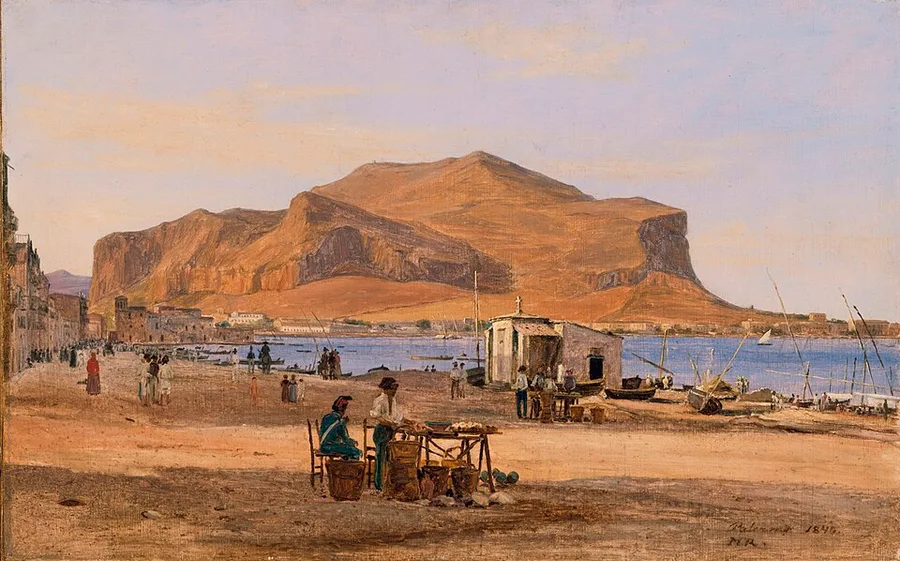 Martinus Rørbye, Palermo Harbor with a View of Monte Pellegrino (1840), Los Angeles County Museum of Art Palermo's harbor beneath Monte Pellegrino, painted by Martinus Rørbye in 1840. In this harbor city Sigurd Jorsalfar's crusade fleet wintered as guests of the young Roger II, and off these coasts Harald Hardrada had campaigned as a Varangian commander a century before. The largest island in the Mediterranean, off the southern tip of
the Italian peninsula. In the early eleventh century divided
politically between Byzantine holdings and the Muslim Kalbid
emirate (under nominal Fatimid suzerainty), fragmenting into
local fiefdoms; from 1061 conquered piecemeal by Norman adventurers,
themselves descended from the Norse settlers of Normandy. Harald
Hardrada fought as a Varangian commander in Byzantine campaigns
against the Sicilian Muslims in the late 1030s, before the Norman
conquest began.
In this article By the time Sigurd's fleet arrived in the autumn of 1109,
Sicily was a Norman county — conquered piecemeal after 1061
by adventurers descended from the Norse settlers of Normandy.
The crusaders wintered at Palermo as guests of the count,
Roger II, then a boy in his early teens under his mother
Adelaide's regency; two decades later he would be crowned
Sicily's first king.
Also discussed in The Viking Age — longships, legends, and the first "Norway" (modern-day Italy) the Norwegians wintered a third time, guests of the island’s young ruler, Count Roger II of Sicily
Martinus Rørbye, Palermo Harbor with a View of Monte Pellegrino (1840), Los Angeles County Museum of Art Palermo's harbor beneath Monte Pellegrino, painted by Martinus Rørbye in 1840. In this harbor city Sigurd Jorsalfar's crusade fleet wintered as guests of the young Roger II, and off these coasts Harald Hardrada had campaigned as a Varangian commander a century before. The largest island in the Mediterranean, off the southern tip of
the Italian peninsula. In the early eleventh century divided
politically between Byzantine holdings and the Muslim Kalbid
emirate (under nominal Fatimid suzerainty), fragmenting into
local fiefdoms; from 1061 conquered piecemeal by Norman adventurers,
themselves descended from the Norse settlers of Normandy. Harald
Hardrada fought as a Varangian commander in Byzantine campaigns
against the Sicilian Muslims in the late 1030s, before the Norman
conquest began.
In this article By the time Sigurd's fleet arrived in the autumn of 1109,
Sicily was a Norman county — conquered piecemeal after 1061
by adventurers descended from the Norse settlers of Normandy.
The crusaders wintered at Palermo as guests of the count,
Roger II, then a boy in his early teens under his mother
Adelaide's regency; two decades later he would be crowned
Sicily's first king.
Also discussed in The Viking Age — longships, legends, and the first "Norway" (modern-day Italy) the Norwegians wintered a third time, guests of the island’s young ruler, Count Roger II of Sicily 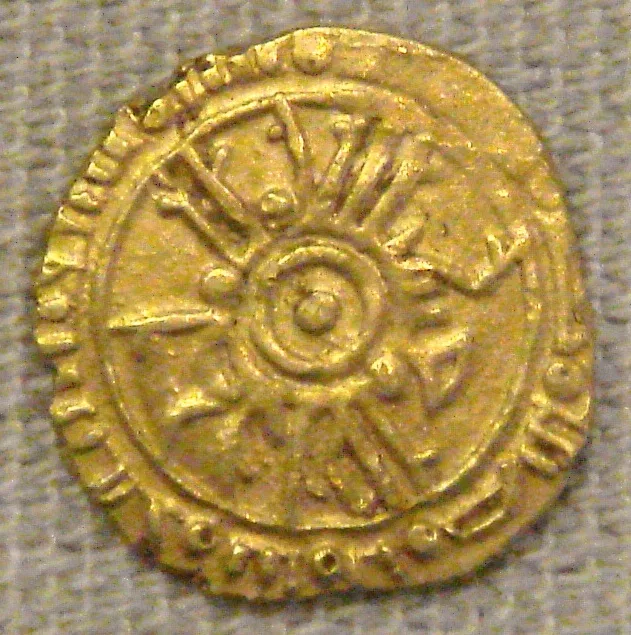 Gold tari of Roger II, Palermo mint (12th c.); photograph by PHGCOM, British Museum Struck in Roger II's own Palermo mint with his title in Arabic script, this coin stands in for the young count on whose Sicily Sigurd Jorsalfar's fleet wintered in 1109-1110 — a coin rather than a repeat of the Martorana mosaic used elsewhere on this article for Roger's later coronation. Count, then King, of Sicily (1095–1154). The son of Roger I, the
Norman conqueror of Sicily from its Muslim Arab rulers in the
1060s and 1070s. Inherited the county in 1105 at age ten and
ruled under regency through his teens — the years when Sigurd
Jorsalfar's Norwegian fleet wintered on the island in 1109–1110
as guests of the young count. Made himself King of Sicily in
1130 (the first crowned king of the Norman south of Italy) by
uniting Sicily, Calabria, and Apulia into the Kingdom of Sicily,
which lasted until Italian unification in 1861. Presided over a
cosmopolitan court that mixed Norman, Greek-Byzantine, and Arab-
Islamic culture at unparalleled intensity in medieval Europe.
— barely in his teens, two decades before he would make himself the first crowned king of the Norman south of Italy. By the summer of 1110, nearly three years out from Bergen, the sixty Norwegian ships came into the harbour at Acre
Gold tari of Roger II, Palermo mint (12th c.); photograph by PHGCOM, British Museum Struck in Roger II's own Palermo mint with his title in Arabic script, this coin stands in for the young count on whose Sicily Sigurd Jorsalfar's fleet wintered in 1109-1110 — a coin rather than a repeat of the Martorana mosaic used elsewhere on this article for Roger's later coronation. Count, then King, of Sicily (1095–1154). The son of Roger I, the
Norman conqueror of Sicily from its Muslim Arab rulers in the
1060s and 1070s. Inherited the county in 1105 at age ten and
ruled under regency through his teens — the years when Sigurd
Jorsalfar's Norwegian fleet wintered on the island in 1109–1110
as guests of the young count. Made himself King of Sicily in
1130 (the first crowned king of the Norman south of Italy) by
uniting Sicily, Calabria, and Apulia into the Kingdom of Sicily,
which lasted until Italian unification in 1861. Presided over a
cosmopolitan court that mixed Norman, Greek-Byzantine, and Arab-
Islamic culture at unparalleled intensity in medieval Europe.
— barely in his teens, two decades before he would make himself the first crowned king of the Norman south of Italy. By the summer of 1110, nearly three years out from Bergen, the sixty Norwegian ships came into the harbour at Acre 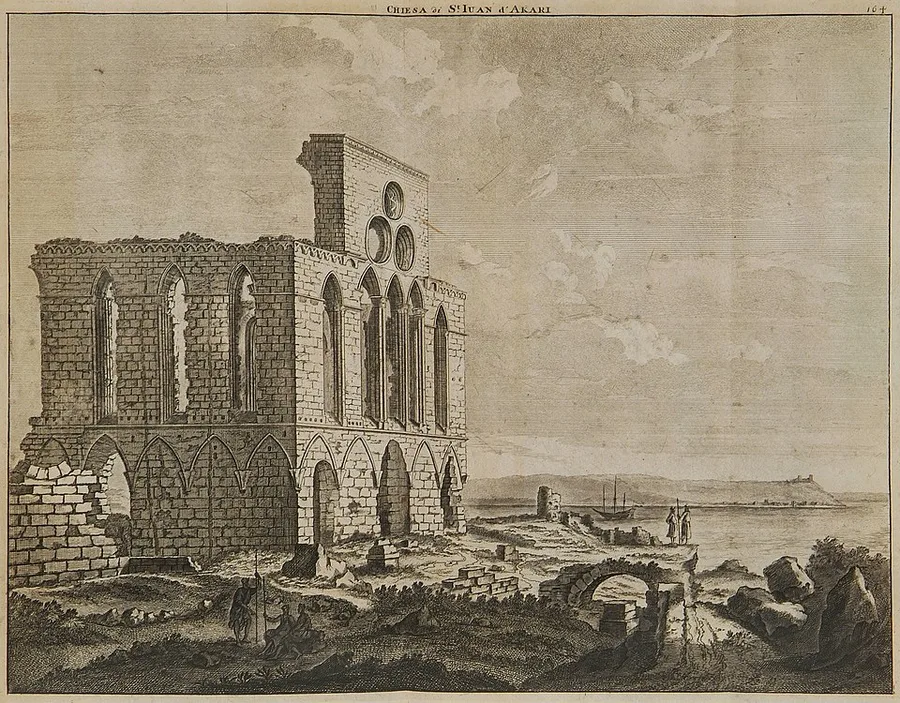 Cornelis de Bruijn, view of the church at Acre, Voyage au Levant (1714) Sigurd's Norwegian fleet made landfall at Acre in summer 1110, three years out from Bergen — Baldwin I's principal port since he took it in 1104 — and this 1714 engraving preserves the ruined look of the town's chief church within its walls. Major port city on the northern Levantine coast, in modern
northern Israel (Hebrew Akko, Arabic Akka). Taken by King
Baldwin I in 1104 with Genoese naval help — one of the early
crusader conquests on the coast and from then on the principal
port of the Kingdom of Jerusalem. Sigurd Jorsalfar's Norwegian
fleet landed at Acre in the summer of 1110, three years out
from Bergen, and was received here by Baldwin. After Saladin
took Jerusalem in 1187, the city of Acre became the de facto
capital of the rump crusader kingdom until its final fall to
the Mamluks in 1291 ended the crusader presence in the Levant.
(modern-day Akko, in northern Israel) on the coast of the Kingdom of Jerusalem.
Cornelis de Bruijn, view of the church at Acre, Voyage au Levant (1714) Sigurd's Norwegian fleet made landfall at Acre in summer 1110, three years out from Bergen — Baldwin I's principal port since he took it in 1104 — and this 1714 engraving preserves the ruined look of the town's chief church within its walls. Major port city on the northern Levantine coast, in modern
northern Israel (Hebrew Akko, Arabic Akka). Taken by King
Baldwin I in 1104 with Genoese naval help — one of the early
crusader conquests on the coast and from then on the principal
port of the Kingdom of Jerusalem. Sigurd Jorsalfar's Norwegian
fleet landed at Acre in the summer of 1110, three years out
from Bergen, and was received here by Baldwin. After Saladin
took Jerusalem in 1187, the city of Acre became the de facto
capital of the rump crusader kingdom until its final fall to
the Mamluks in 1291 ended the crusader presence in the Levant.
(modern-day Akko, in northern Israel) on the coast of the Kingdom of Jerusalem.
At Sidon
Sigurd was received by Baldwin I of Jerusalem 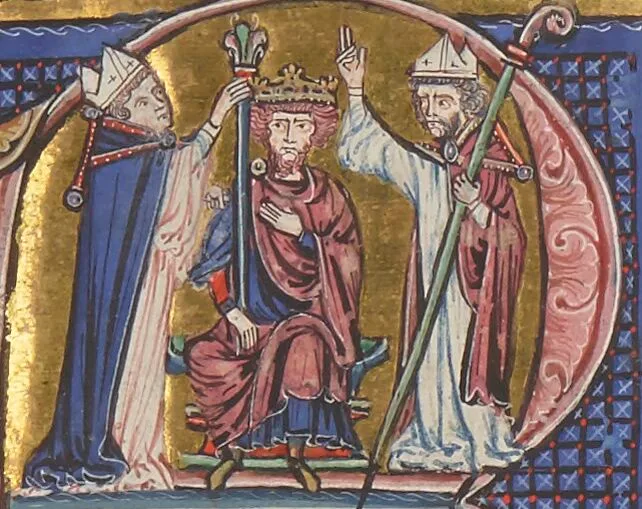 Unknown illuminator, coronation of Baldwin I, Histoire d'Outremer (13th c.), BnF MS Fr. 9081 This manuscript miniature depicts the coronation the canonical describes — Baldwin taking the crown his brother Godfrey had refused, becoming the first king of the crusader Kingdom of Jerusalem that later received Sigurd Jorsalfar as a fellow monarch in 1110. First crowned King of the crusader Kingdom of Jerusalem
(1100–1118). Younger brother of Godfrey of Bouillon, the
Frankish leader who took Jerusalem in the First Crusade in 1099
but refused the crown of king and ruled as Defender of the
Holy Sepulchre until his death in 1100. Baldwin took the
crown his brother had refused, ruled the new kingdom for
eighteen years, expanded the crusader-held coast by taking
Acre (1104), Beirut (1110), Sidon (1110), and other Levantine
ports. Received Sigurd Jorsalfar at Acre in the summer of 1110
as one monarch receives another and rode out with him to the
River Jordan and back. Died on campaign in Egypt in 1118 and
is buried in the Church of the Holy Sepulchre in Jerusalem.
, the first crowned king of Jerusalem, as one monarch receives another — a meeting without precedent in either man’s experience, a king from the Norwegian north come down by sea to the new Frankish kingdom in the south. Baldwin himself rode out with the Norwegian king, in person rather than by delegation, to the River Jordan
Unknown illuminator, coronation of Baldwin I, Histoire d'Outremer (13th c.), BnF MS Fr. 9081 This manuscript miniature depicts the coronation the canonical describes — Baldwin taking the crown his brother Godfrey had refused, becoming the first king of the crusader Kingdom of Jerusalem that later received Sigurd Jorsalfar as a fellow monarch in 1110. First crowned King of the crusader Kingdom of Jerusalem
(1100–1118). Younger brother of Godfrey of Bouillon, the
Frankish leader who took Jerusalem in the First Crusade in 1099
but refused the crown of king and ruled as Defender of the
Holy Sepulchre until his death in 1100. Baldwin took the
crown his brother had refused, ruled the new kingdom for
eighteen years, expanded the crusader-held coast by taking
Acre (1104), Beirut (1110), Sidon (1110), and other Levantine
ports. Received Sigurd Jorsalfar at Acre in the summer of 1110
as one monarch receives another and rode out with him to the
River Jordan and back. Died on campaign in Egypt in 1118 and
is buried in the Church of the Holy Sepulchre in Jerusalem.
, the first crowned king of Jerusalem, as one monarch receives another — a meeting without precedent in either man’s experience, a king from the Norwegian north come down by sea to the new Frankish kingdom in the south. Baldwin himself rode out with the Norwegian king, in person rather than by delegation, to the River Jordan 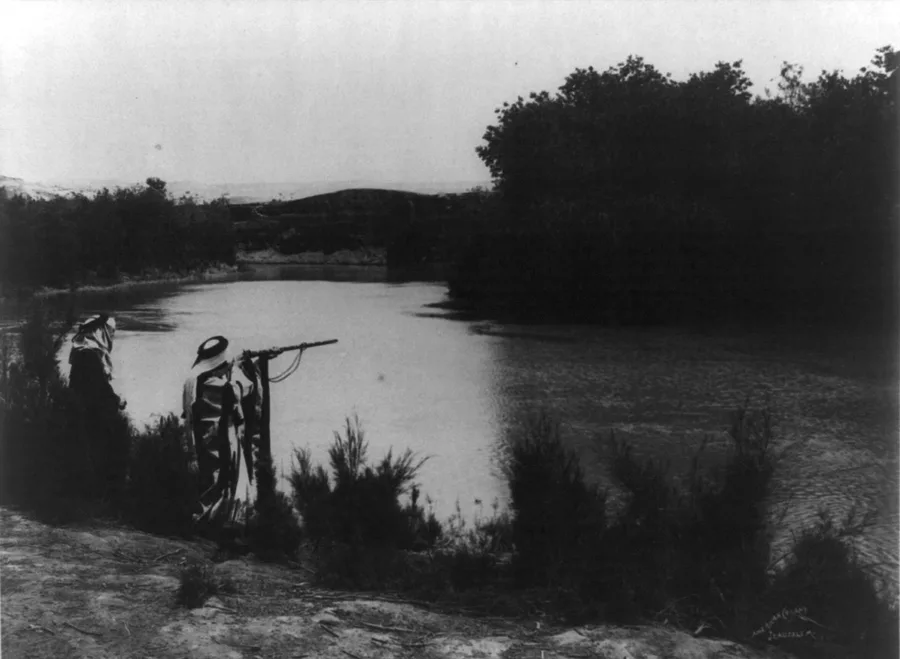 American Colony (Jerusalem) Photo Department, The River Jordan, showing Eastern cliffs (c. 1900), Library of Congress The river itself, photographed around 1900 by the American Colony of Jerusalem — the pilgrimage destination King Baldwin I rode out to at Sigurd's side in 1110, in person rather than by delegation, the honour the sagas remembered as the crusade's high moment. River flowing about 250 kilometres south from the slopes of
Mount Hermon through the Sea of Galilee to the Dead Sea, the
modern eastern border of Israel with Jordan and the West Bank.
In Christian tradition the river of Jesus's baptism by John
the Baptist (Mark 1:9, Matthew 3:13), making it one of the
principal pilgrimage destinations in the crusader-held Holy
Land. King Baldwin I rode out with Sigurd Jorsalfar in person,
rather than by delegation, to the Jordan and back in 1110 — a
ceremonial honour the Norwegian sagas remembered as the high
moment of the Norwegian Crusade.
and back, and showed him the holy places of Jerusalem — the Church of the Holy Sepulchre
American Colony (Jerusalem) Photo Department, The River Jordan, showing Eastern cliffs (c. 1900), Library of Congress The river itself, photographed around 1900 by the American Colony of Jerusalem — the pilgrimage destination King Baldwin I rode out to at Sigurd's side in 1110, in person rather than by delegation, the honour the sagas remembered as the crusade's high moment. River flowing about 250 kilometres south from the slopes of
Mount Hermon through the Sea of Galilee to the Dead Sea, the
modern eastern border of Israel with Jordan and the West Bank.
In Christian tradition the river of Jesus's baptism by John
the Baptist (Mark 1:9, Matthew 3:13), making it one of the
principal pilgrimage destinations in the crusader-held Holy
Land. King Baldwin I rode out with Sigurd Jorsalfar in person,
rather than by delegation, to the Jordan and back in 1110 — a
ceremonial honour the Norwegian sagas remembered as the high
moment of the Norwegian Crusade.
and back, and showed him the holy places of Jerusalem — the Church of the Holy Sepulchre 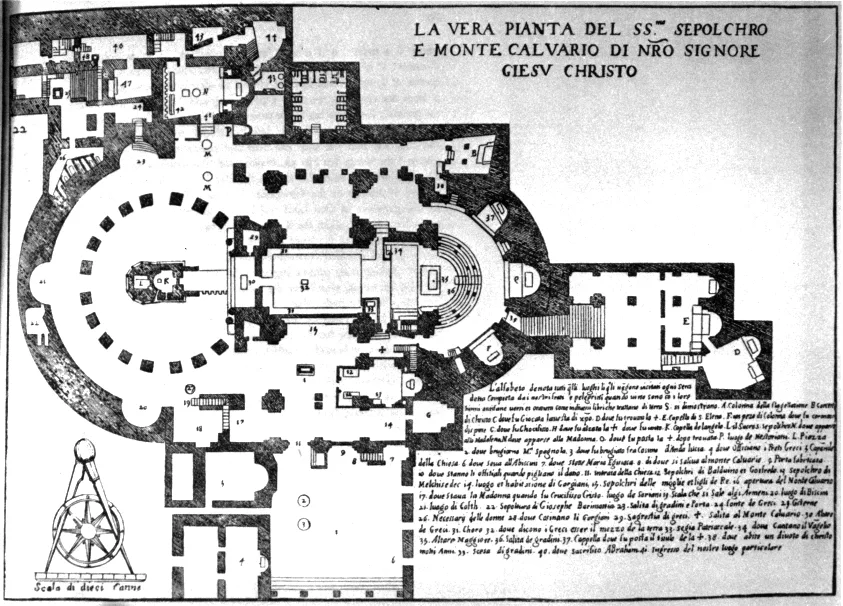 Fra Bernardino Amico, plan of the Church of the Holy Sepulchre (1609) This 1609 architectural plan preserves the layout of the church Baldwin I personally showed Sigurd Jorsalfar in 1110 as the holiest ground in the crusader kingdom, built around the traditional sites of the Crucifixion and the empty tomb. Church in the Old City of Jerusalem traditionally identified as
the site of both the Crucifixion of Jesus (Calvary or Golgotha)
and the empty tomb where he was buried and rose — the holiest
ground in Western Christendom. Originally consecrated under
the Emperor Constantine in 335; substantially destroyed by the
Fatimid Caliph al-Hakim in 1009 and rebuilt later in the
eleventh century. Re-taken by the First Crusade with Jerusalem
on 15 July 1099; shown by King Baldwin I to Sigurd Jorsalfar
in 1110 as the central holy place of the crusader Kingdom of
Jerusalem. Today held under the Status Quo among six
Christian denominations (Greek Orthodox, Latin Catholic,
Armenian Orthodox, Coptic, Ethiopian, and Syriac).
that the First Crusade had taken from the Fatimid Caliphate
Fra Bernardino Amico, plan of the Church of the Holy Sepulchre (1609) This 1609 architectural plan preserves the layout of the church Baldwin I personally showed Sigurd Jorsalfar in 1110 as the holiest ground in the crusader kingdom, built around the traditional sites of the Crucifixion and the empty tomb. Church in the Old City of Jerusalem traditionally identified as
the site of both the Crucifixion of Jesus (Calvary or Golgotha)
and the empty tomb where he was buried and rose — the holiest
ground in Western Christendom. Originally consecrated under
the Emperor Constantine in 335; substantially destroyed by the
Fatimid Caliph al-Hakim in 1009 and rebuilt later in the
eleventh century. Re-taken by the First Crusade with Jerusalem
on 15 July 1099; shown by King Baldwin I to Sigurd Jorsalfar
in 1110 as the central holy place of the crusader Kingdom of
Jerusalem. Today held under the Status Quo among six
Christian denominations (Greek Orthodox, Latin Catholic,
Armenian Orthodox, Coptic, Ethiopian, and Syriac).
that the First Crusade had taken from the Fatimid Caliphate 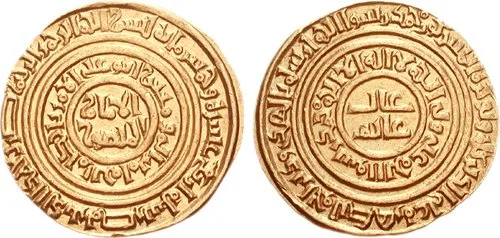 Fatimid gold dinar of al-Amir bi-Ahkam Allah, Cairo mint, 514 AH / 1119-20 CE; photograph via Classical Numismatic Group Struck under al-Amir, the Fatimid caliph on the throne in Cairo when Sigurd's Norwegian fleet and Ordelafo Faliero's Venetian fleet blockaded Fatimid-held Sidon in 1110 — the relief fleet Cairo sent north turned back rather than face them, the empire's last real chance to hold that coast. Shia Ismaili Islamic dynasty that ruled most of North Africa,
the eastern Mediterranean coast, and parts of the Arabian
peninsula from 909 (founding in Tunisia) to 1171 (overthrown
in Egypt by Saladin). At its height under the caliphs of
the tenth and eleventh centuries the Fatimid empire was the
wealthiest and most cosmopolitan state of the medieval Islamic
world, with its capital at Cairo. Held Jerusalem and the
Levantine coast — including Sidon, Tyre, and Ascalon — until
the First Crusade's conquests of 1099–1110. The Fatimid
Egyptian relief fleet that turned back from Sidon in 1110
rather than face the Norwegian and Venetian blockade was the
empire's last serious attempt to save the city.
eleven years before, the relics the city held under crusader keeping. What Sigurd offered in return was the one thing the crusader kingdom most lacked.
Fatimid gold dinar of al-Amir bi-Ahkam Allah, Cairo mint, 514 AH / 1119-20 CE; photograph via Classical Numismatic Group Struck under al-Amir, the Fatimid caliph on the throne in Cairo when Sigurd's Norwegian fleet and Ordelafo Faliero's Venetian fleet blockaded Fatimid-held Sidon in 1110 — the relief fleet Cairo sent north turned back rather than face them, the empire's last real chance to hold that coast. Shia Ismaili Islamic dynasty that ruled most of North Africa,
the eastern Mediterranean coast, and parts of the Arabian
peninsula from 909 (founding in Tunisia) to 1171 (overthrown
in Egypt by Saladin). At its height under the caliphs of
the tenth and eleventh centuries the Fatimid empire was the
wealthiest and most cosmopolitan state of the medieval Islamic
world, with its capital at Cairo. Held Jerusalem and the
Levantine coast — including Sidon, Tyre, and Ascalon — until
the First Crusade's conquests of 1099–1110. The Fatimid
Egyptian relief fleet that turned back from Sidon in 1110
rather than face the Norwegian and Venetian blockade was the
empire's last serious attempt to save the city.
eleven years before, the relics the city held under crusader keeping. What Sigurd offered in return was the one thing the crusader kingdom most lacked.
The Kingdom of Jerusalem in 1110 was a thin strip of captured coast held by a small Frankish army, and its weakness was the water. The crusader-held interior was the work of land battles; the cities along the Levantine shore — the eastern Mediterranean coast, today the shores of Lebanon, Israel, Syria, and Palestine — were the work of sea power. The coastal cities still in Muslim hands — Tyre 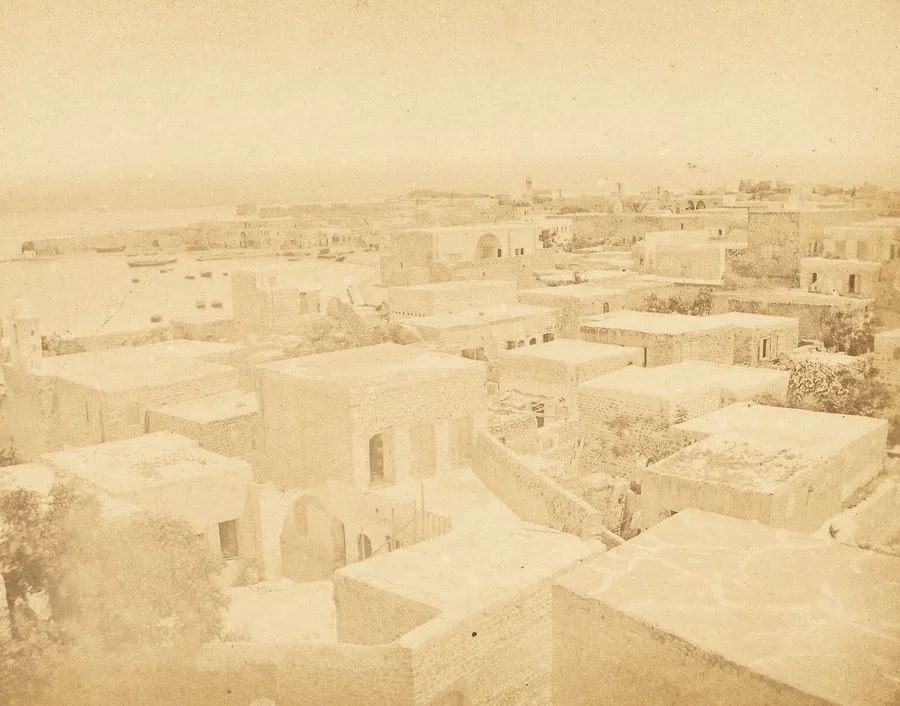 Félix Bonfils, Tyr (c. 1878), albumen print, J. Paul Getty Museum Bonfils photographed Tyre's rooftops and harbor around 1878 — the great Phoenician port still Muslim-held when Sigurd sailed home in 1111. It fell in 1124 to the same land-and-sea method that had taken Sidon fourteen years earlier. Ancient port city on the Levantine coast in modern southern
Lebanon (Arabic Sur), one of the principal Phoenician
cities of antiquity. In Fatimid Caliphate hands at the time
of the First Crusade and one of the last great Muslim-held
Levantine ports the crusaders had not yet taken at the time
of Sigurd Jorsalfar's 1110 expedition. Finally fell to a
combined crusader-Venetian siege in 1124. Remained under
crusader rule until 1291, when its loss to the Mamluks ended
the crusader presence on the Levantine coast.
(modern-day southern Lebanon), Sidon
Félix Bonfils, Tyr (c. 1878), albumen print, J. Paul Getty Museum Bonfils photographed Tyre's rooftops and harbor around 1878 — the great Phoenician port still Muslim-held when Sigurd sailed home in 1111. It fell in 1124 to the same land-and-sea method that had taken Sidon fourteen years earlier. Ancient port city on the Levantine coast in modern southern
Lebanon (Arabic Sur), one of the principal Phoenician
cities of antiquity. In Fatimid Caliphate hands at the time
of the First Crusade and one of the last great Muslim-held
Levantine ports the crusaders had not yet taken at the time
of Sigurd Jorsalfar's 1110 expedition. Finally fell to a
combined crusader-Venetian siege in 1124. Remained under
crusader rule until 1291, when its loss to the Mamluks ended
the crusader presence on the Levantine coast.
(modern-day southern Lebanon), Sidon 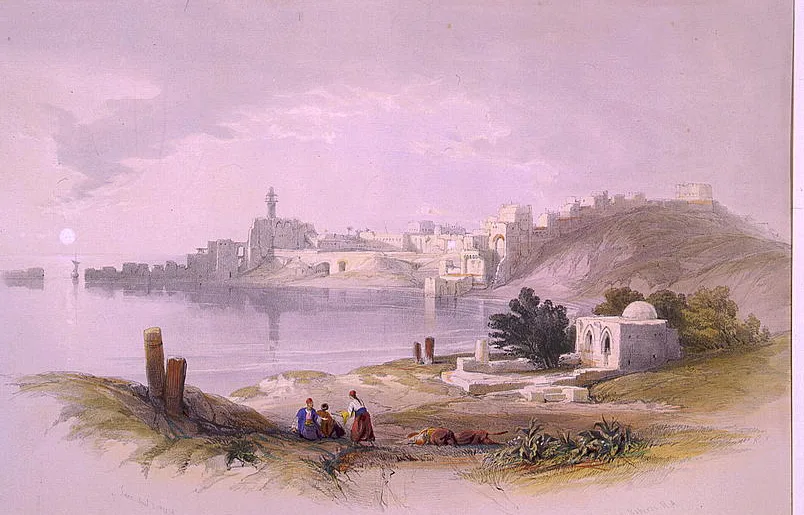 David Roberts (lith. Louis Haghe), Sidon April 28th 1839, The Holy Land (1843), Library of Congress David Roberts drew Sidon from the shore in 1839 — the walled port on its promontory that Baldwin I besieged by land while Sigurd's sixty ships sealed the harbour from the sea in autumn 1110, until the city surrendered that December. Ancient port city on the Levantine coast in modern southern
Lebanon (Arabic Saida), one of the great Phoenician
cities of antiquity and a major Mediterranean trading port
through the medieval period. In Fatimid Caliphate hands at
the time of the First Crusade. Besieged in autumn 1110 by
King Baldwin I of Jerusalem on land and by Sigurd
Jorsalfar's Norwegian fleet (later joined by Doge Ordelafo
Faliero's Venetians) at sea; surrendered to the crusaders
on 4 December 1110. The town remained under crusader rule
until Saladin's reconquest in 1187. The splinter of the
True Cross given to Sigurd at Sidon was the most valuable
object the crusader kingdom ever conferred on a foreign king.
(modern-day Lebanon), Ascalon
David Roberts (lith. Louis Haghe), Sidon April 28th 1839, The Holy Land (1843), Library of Congress David Roberts drew Sidon from the shore in 1839 — the walled port on its promontory that Baldwin I besieged by land while Sigurd's sixty ships sealed the harbour from the sea in autumn 1110, until the city surrendered that December. Ancient port city on the Levantine coast in modern southern
Lebanon (Arabic Saida), one of the great Phoenician
cities of antiquity and a major Mediterranean trading port
through the medieval period. In Fatimid Caliphate hands at
the time of the First Crusade. Besieged in autumn 1110 by
King Baldwin I of Jerusalem on land and by Sigurd
Jorsalfar's Norwegian fleet (later joined by Doge Ordelafo
Faliero's Venetians) at sea; surrendered to the crusaders
on 4 December 1110. The town remained under crusader rule
until Saladin's reconquest in 1187. The splinter of the
True Cross given to Sigurd at Sidon was the most valuable
object the crusader kingdom ever conferred on a foreign king.
(modern-day Lebanon), Ascalon 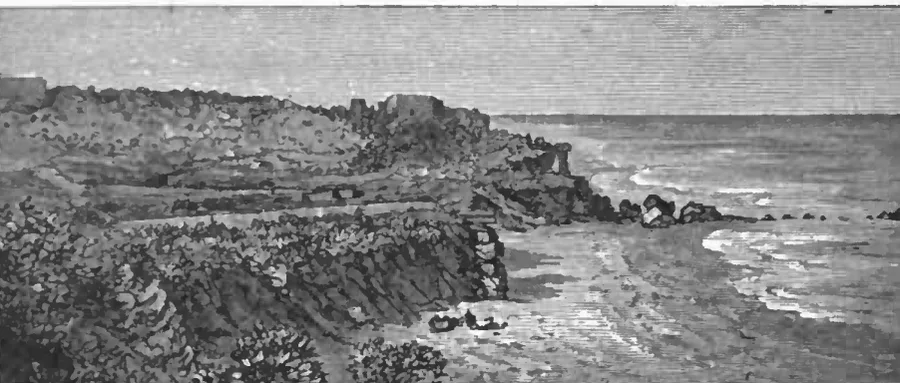 Frank S. De Hass, Ruins of Askelon (1887 engraving) The ruins of Ascalon on their Mediterranean headland, engraved in 1887 — the heavily fortified Fatimid port that Sigurd's fleet still found unconquered in 1110, and that held out against the crusaders until 1153. Ancient port city on the southern Levantine coast in modern
southern Israel (Hebrew Ashkelon). In Fatimid Caliphate
hands at the time of the First Crusade and the southernmost
major Muslim-held Levantine port the crusaders had not yet
taken at the time of Sigurd Jorsalfar's 1110 expedition.
Heavily fortified by the Fatimids as the principal Egyptian
base on the Levantine coast and a constant threat to the
southern flank of the Kingdom of Jerusalem. Finally fell to
the crusaders in 1153 under King Baldwin III. The site is
now an archaeological park within the modern city of Ashkelon.
(modern-day southern Israel) — could be supplied, reinforced, and relieved by the eastern Mediterranean, and as long as that route was open they could not be reduced. Baldwin had almost no ships. Sigurd had sixty.
Frank S. De Hass, Ruins of Askelon (1887 engraving) The ruins of Ascalon on their Mediterranean headland, engraved in 1887 — the heavily fortified Fatimid port that Sigurd's fleet still found unconquered in 1110, and that held out against the crusaders until 1153. Ancient port city on the southern Levantine coast in modern
southern Israel (Hebrew Ashkelon). In Fatimid Caliphate
hands at the time of the First Crusade and the southernmost
major Muslim-held Levantine port the crusaders had not yet
taken at the time of Sigurd Jorsalfar's 1110 expedition.
Heavily fortified by the Fatimids as the principal Egyptian
base on the Levantine coast and a constant threat to the
southern flank of the Kingdom of Jerusalem. Finally fell to
the crusaders in 1153 under King Baldwin III. The site is
now an archaeological park within the modern city of Ashkelon.
(modern-day southern Israel) — could be supplied, reinforced, and relieved by the eastern Mediterranean, and as long as that route was open they could not be reduced. Baldwin had almost no ships. Sigurd had sixty.
The two kings turned the fleet on Sidon, a major port on the Levantine coast and one of the last great cities the crusaders had not yet taken. Through the autumn of 1110, Baldwin Siege of Sidon (1110) 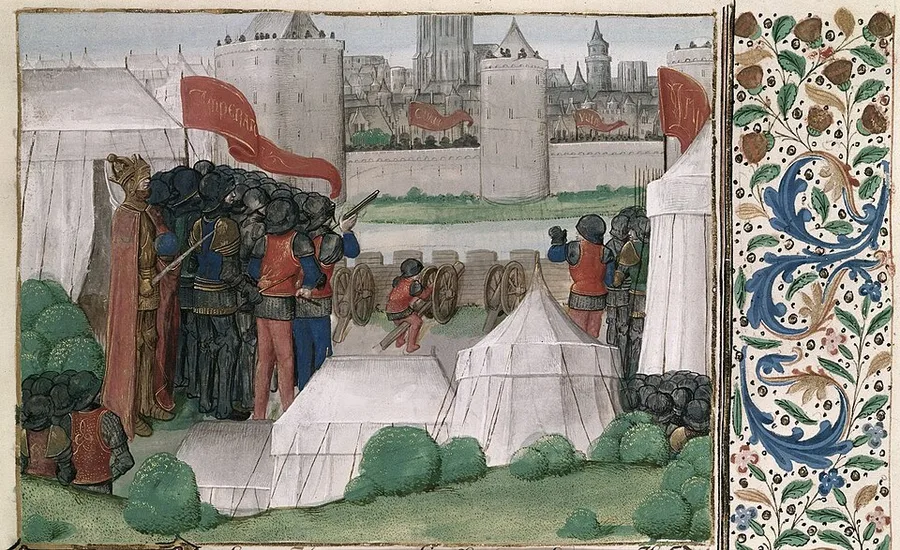 Unknown medieval artist, siege of Caesarea (detail), Chronique d'Ernoul et de Bernard le Trésorier, British Library Royal MS 15 E I No surviving illumination depicts Sidon's own 1110 fall; this 15th-century miniature actually shows the 1101 siege of Caesarea, used here as a same-era stand-in for the same land-and-sea tactics — walls assaulted while ships seal the harbor — that Baldwin I and Sigurd's fleet used together at Sidon. The forty-seven-day siege in autumn 1110 by which the crusader
Kingdom of Jerusalem took the Fatimid-held port of Sidon on
the Levantine coast. King Baldwin I of Jerusalem besieged the
city by land while Sigurd Jorsalfar's Norwegian fleet closed
the harbour from the sea. A Fatimid Egyptian relief fleet sent
up from the south turned back when the Venetian fleet under
Doge Ordelafo Faliero arrived to reinforce the Norwegian
blockade. Cut off from sea supply, the city surrendered on
4 December 1110. The closure of the harbour by the Norwegian
and Venetian fleets between them was credited by the Latin
chroniclers as the act that made the surrender possible.
by land while the Norwegian ships closed its harbour from the sea. A Fatimid Egyptian relief fleet was sent up from the south to break the siege; it turned back when a Venetian fleet under the Doge Ordelafo Faliero
Unknown medieval artist, siege of Caesarea (detail), Chronique d'Ernoul et de Bernard le Trésorier, British Library Royal MS 15 E I No surviving illumination depicts Sidon's own 1110 fall; this 15th-century miniature actually shows the 1101 siege of Caesarea, used here as a same-era stand-in for the same land-and-sea tactics — walls assaulted while ships seal the harbor — that Baldwin I and Sigurd's fleet used together at Sidon. The forty-seven-day siege in autumn 1110 by which the crusader
Kingdom of Jerusalem took the Fatimid-held port of Sidon on
the Levantine coast. King Baldwin I of Jerusalem besieged the
city by land while Sigurd Jorsalfar's Norwegian fleet closed
the harbour from the sea. A Fatimid Egyptian relief fleet sent
up from the south turned back when the Venetian fleet under
Doge Ordelafo Faliero arrived to reinforce the Norwegian
blockade. Cut off from sea supply, the city surrendered on
4 December 1110. The closure of the harbour by the Norwegian
and Venetian fleets between them was credited by the Latin
chroniclers as the act that made the surrender possible.
by land while the Norwegian ships closed its harbour from the sea. A Fatimid Egyptian relief fleet was sent up from the south to break the siege; it turned back when a Venetian fleet under the Doge Ordelafo Faliero 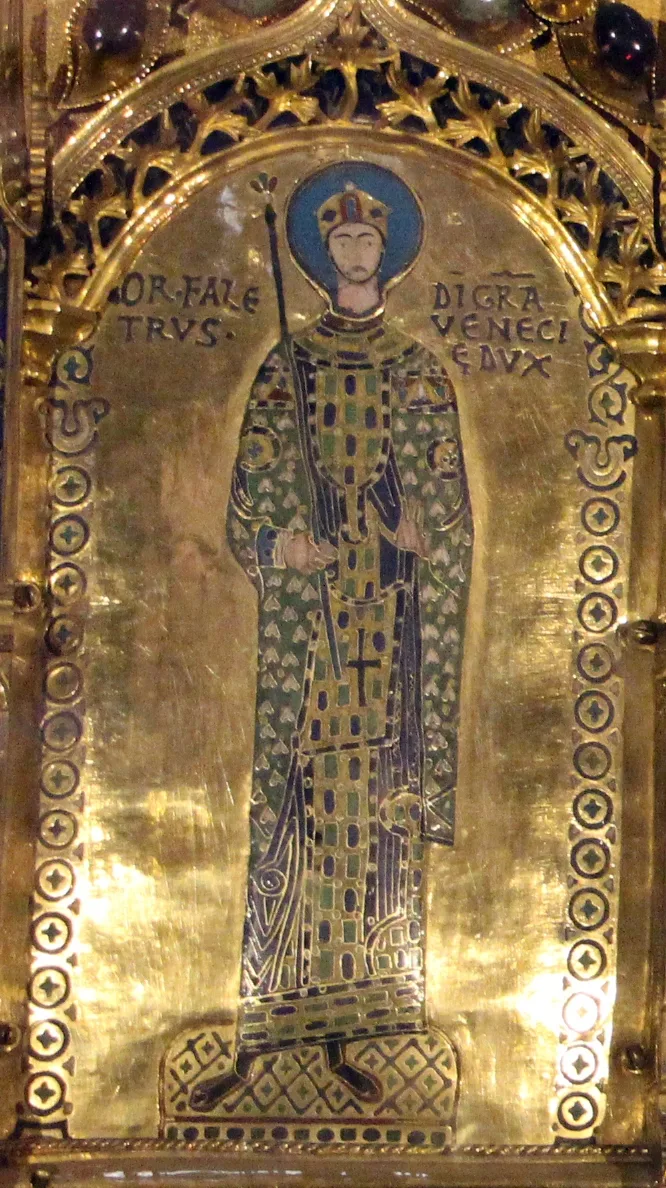 Pala d'Oro panel depicting Doge Ordelafo Faliero (11th-12th c.); photograph by Sailko, CC BY-SA 3.0 The doge who led Venice's fleet to reinforce Sigurd's blockade at Sidon in 1110 is commemorated in gold on Venice's own high altarpiece — his name and likeness added to the Pala d'Oro over an older Byzantine imperial figure, itself a telling emblem of Venice's rising self-image against Byzantium. 34th Doge of Venice (1102–1117). Led the Venetian fleet that
arrived at Sidon in autumn 1110 to reinforce the Norwegian
blockade of the Fatimid-held port, deterring the Egyptian relief
fleet from coming north and securing the surrender of Sidon to
the crusader Kingdom of Jerusalem on 4 December 1110. Through
his reign Venice consolidated its naval presence in the
eastern Mediterranean and secured the trading privileges across
the crusader ports that would make the city the leading
maritime power of the Mediterranean for the next four
centuries. Killed at the Battle of Zara in 1117.
arrived to reinforce the Norwegian blockade, and never came on. Cut off from the only supply line that could have saved it, the city surrendered on 4 December 1110. The Latin chroniclers of the crusader kingdom, writing within years of the event, credited the sealing of the harbour to the Norwegian and Venetian fleets between them. The Norse saga tradition kept the Norwegian end of the story. Without the Northern ships standing in the harbour from the first weeks of the siege, the closing of the sea would not have been possible at all.
Pala d'Oro panel depicting Doge Ordelafo Faliero (11th-12th c.); photograph by Sailko, CC BY-SA 3.0 The doge who led Venice's fleet to reinforce Sigurd's blockade at Sidon in 1110 is commemorated in gold on Venice's own high altarpiece — his name and likeness added to the Pala d'Oro over an older Byzantine imperial figure, itself a telling emblem of Venice's rising self-image against Byzantium. 34th Doge of Venice (1102–1117). Led the Venetian fleet that
arrived at Sidon in autumn 1110 to reinforce the Norwegian
blockade of the Fatimid-held port, deterring the Egyptian relief
fleet from coming north and securing the surrender of Sidon to
the crusader Kingdom of Jerusalem on 4 December 1110. Through
his reign Venice consolidated its naval presence in the
eastern Mediterranean and secured the trading privileges across
the crusader ports that would make the city the leading
maritime power of the Mediterranean for the next four
centuries. Killed at the Battle of Zara in 1117.
arrived to reinforce the Norwegian blockade, and never came on. Cut off from the only supply line that could have saved it, the city surrendered on 4 December 1110. The Latin chroniclers of the crusader kingdom, writing within years of the event, credited the sealing of the harbour to the Norwegian and Venetian fleets between them. The Norse saga tradition kept the Norwegian end of the story. Without the Northern ships standing in the harbour from the first weeks of the siege, the closing of the sea would not have been possible at all.
The four oaths
For his part in it, Sigurd was given the most valuable object the Kingdom of Jerusalem could bestow. By order of King Baldwin and Gibelin of Arles Latin Patriarch of Jerusalem from 1108 until his death in 1112.
Originally Archbishop of Arles in southern France; sent to the
crusader kingdom as papal legate by Pope Paschal II in 1108 and
elected Patriarch at the deposition of his predecessor Arnulf
Malecorne. Co-authorised, with King Baldwin I, the cutting of a
splinter from the True Cross relic in Jerusalem and its
ceremonial handing to Sigurd Jorsalfar in 1110 in exchange for
the four oaths Sigurd swore over it — the institutional
Christianity the Western Church wanted planted in the new
Norwegian kingdom at the northern edge of Latin Christendom.
, the Latin patriarch of Jerusalem, a splinter was cut from the True Cross 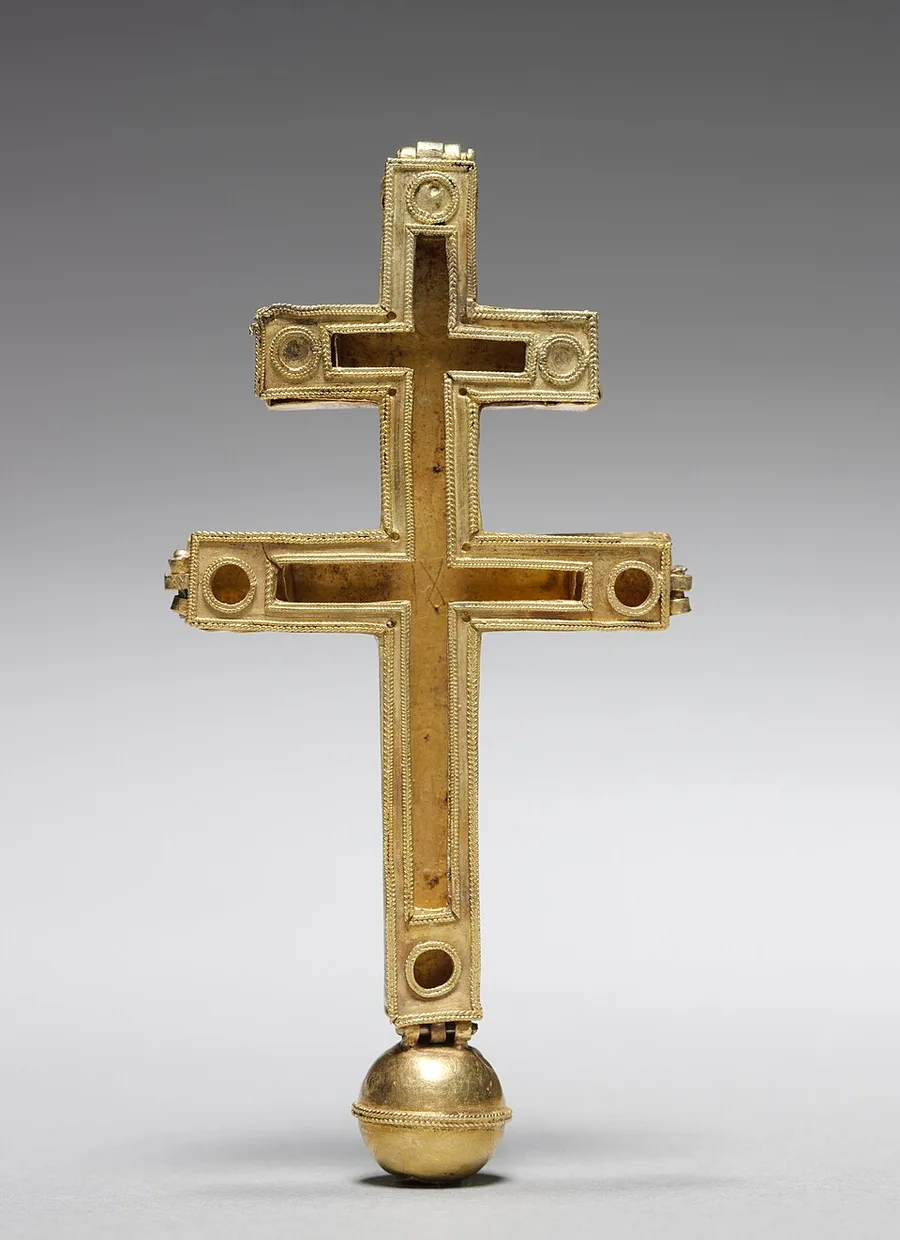 Kingdom of Jerusalem, Double-Arm Reliquary Cross (12th century), Cleveland Museum of Art, 1983.208 Made in 12th-century Jerusalem to hold fragments of the Passion relics, this reliquary is the kind of object the True Cross splinter traveled in when Baldwin I gave it to Sigurd Jorsalfar at Sidon — the most valuable object the crusader kingdom ever gave a foreign king. In Christian tradition, the wood of the cross on which Jesus
was crucified — held to have been recovered in Jerusalem in
the early fourth century by Saint Helena, the mother of the
Emperor Constantine, and enshrined in successive Jerusalem
cathedrals from then onward. Across the medieval period the
most sacred physical relic of Western Christendom; splinters
cut from it were the most valuable single objects a medieval
king could be entrusted with. The splinter given to Sigurd
Jorsalfar at Sidon in 1110 was kept at Konungahella in Norway
until the 1135 Wendish sack of the town; the saga records a
captured priest coming ashore with it; it then disappears
from the record. The main relic itself was
lost at the Battle of Hattin in 1187, captured with the True
Cross-bearer by Saladin's forces.
— the wood of the cross of the crucifixion, regarded across Latin Christendom as the most sacred object in the Christian world — and handed to the Norwegian king.
Kingdom of Jerusalem, Double-Arm Reliquary Cross (12th century), Cleveland Museum of Art, 1983.208 Made in 12th-century Jerusalem to hold fragments of the Passion relics, this reliquary is the kind of object the True Cross splinter traveled in when Baldwin I gave it to Sigurd Jorsalfar at Sidon — the most valuable object the crusader kingdom ever gave a foreign king. In Christian tradition, the wood of the cross on which Jesus
was crucified — held to have been recovered in Jerusalem in
the early fourth century by Saint Helena, the mother of the
Emperor Constantine, and enshrined in successive Jerusalem
cathedrals from then onward. Across the medieval period the
most sacred physical relic of Western Christendom; splinters
cut from it were the most valuable single objects a medieval
king could be entrusted with. The splinter given to Sigurd
Jorsalfar at Sidon in 1110 was kept at Konungahella in Norway
until the 1135 Wendish sack of the town; the saga records a
captured priest coming ashore with it; it then disappears
from the record. The main relic itself was
lost at the Battle of Hattin in 1187, captured with the True
Cross-bearer by Saladin's forces.
— the wood of the cross of the crucifixion, regarded across Latin Christendom as the most sacred object in the Christian world — and handed to the Norwegian king.
The relic was given on conditions. The saga tradition records four oaths Sigurd swore over it, in the presence of twelve of his men sworn beside him: that he would promote the Christian faith in his kingdom with all his power; that he would work to raise an archbishop’s seat for the Norwegian church, independent of the Danish metropolitan see at Lund 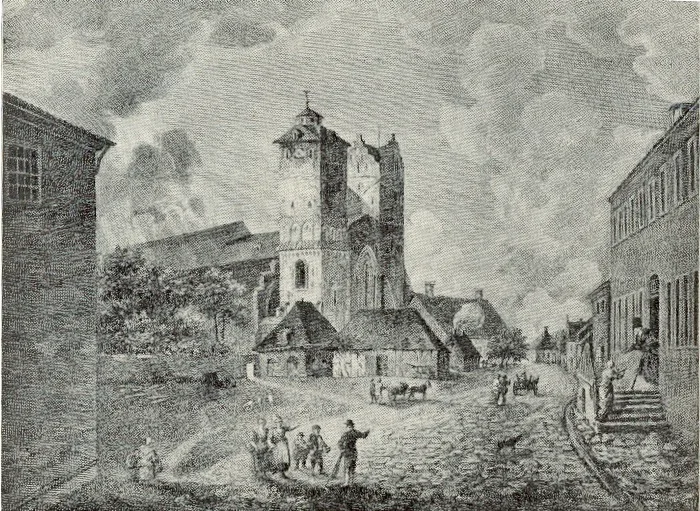 Johan Fredrik Martin after Elias Martin, Lund Cathedral (1782) This 1782 engraving shows Lund Cathedral, the archiepiscopal seat that governed the Norwegian church as suffragan bishoprics from 1104 until Nicholas Breakspear's 1152 mission split off the independent province of Nidaros. Cathedral city in what is now southern Sweden, just inside the
Skåne region (which was Danish territory until 1658). The seat
of the Scandinavian archdiocese from 1104, when Pope Paschal II
detached the Scandinavian church from the German metropolitan
see at Hamburg-Bremen. From 1104 to 1152 the Norwegian bishops
were suffragans of the Lund archbishopric. The 1152 mission of
Nicholas Breakspear created the independent Norwegian province
at Nidaros, separating the Norwegian church from Lund — though
Lund remained the senior Scandinavian see and the metropolitan
of the Danish and Swedish churches through the medieval period.
Also discussed in A Catholic Norway — the faith that gave the kingdom its first institutions and the stave churchesThe Long Fall — the sudden loss of Norwegian nobility, the end of the kings, and half of Norway gone forever ; that he would introduce the church tithe across his country and pay it himself; and that the splinter itself would be placed at the shrine of Saint Olav
Johan Fredrik Martin after Elias Martin, Lund Cathedral (1782) This 1782 engraving shows Lund Cathedral, the archiepiscopal seat that governed the Norwegian church as suffragan bishoprics from 1104 until Nicholas Breakspear's 1152 mission split off the independent province of Nidaros. Cathedral city in what is now southern Sweden, just inside the
Skåne region (which was Danish territory until 1658). The seat
of the Scandinavian archdiocese from 1104, when Pope Paschal II
detached the Scandinavian church from the German metropolitan
see at Hamburg-Bremen. From 1104 to 1152 the Norwegian bishops
were suffragans of the Lund archbishopric. The 1152 mission of
Nicholas Breakspear created the independent Norwegian province
at Nidaros, separating the Norwegian church from Lund — though
Lund remained the senior Scandinavian see and the metropolitan
of the Danish and Swedish churches through the medieval period.
Also discussed in A Catholic Norway — the faith that gave the kingdom its first institutions and the stave churchesThe Long Fall — the sudden loss of Norwegian nobility, the end of the kings, and half of Norway gone forever ; that he would introduce the church tithe across his country and pay it himself; and that the splinter itself would be placed at the shrine of Saint Olav 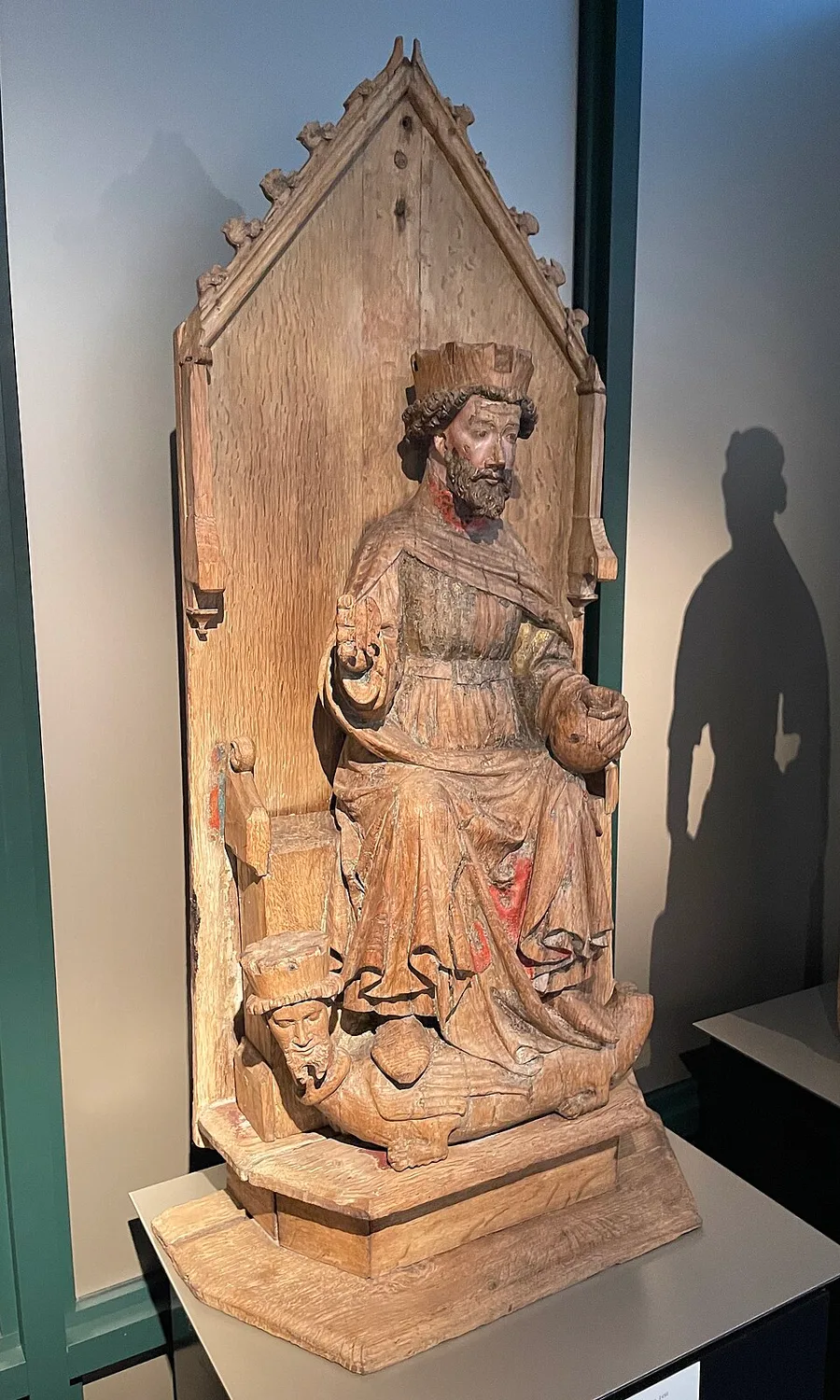 Saint Olav from Austevoll church (c. 1450), University Museum of Bergen; photo Wolfmann, Wikimedia Commons, CC BY-SA 4.0 Olav as medieval Norway saw him: the eternal king crowned and enthroned, trampling a dragon whose crowned human head stands for the heathendom he overcame. Carved around 1450 for Austevoll church south of Bergen — one of the polychrome Olav figures that stood in churches across Norway before the Reformation. Olav Haraldsson, king of Norway 1015–1028, killed at the Battle
of Stiklestad on 29 July 1030 and canonized one year and five days
later by his English bishop Grimkell. Rex Perpetuus Norvegiae —
the Eternal King of Norway. His shrine at Nidaros became the
northernmost pilgrimage destination in medieval Christendom and
the binding narrative of a converted country. The Norwegian Lion
on the modern coat of arms — a golden lion bearing a golden axe
on a red shield — is Saint Olav's iconography.
On the trip The Gråhårsklubben (the Oldsters) visit Nidaros Cathedral on
Tuesday 28 July 2026 — the day before the 996th anniversary of
the Battle of Stiklestad. The Olafskrinet was broken up at the
1537 Reformation and the body buried somewhere inside the
cathedral in a spot no medieval source preserved. The building
is what the nine-and-a-half centuries of devotion built. The
pilgrim road, the Pilegrimsleden, runs past the cathedral's
south door — the same door the medieval pilgrims walked through.
Nidaros Cathedral, Trondheim Also discussed in The King Who Became a Saint — how the Nordmen came to ChristThe Viking Age — longships, legends, and the first "Norway"Worshiping Odin and Thor — the lived religion of pre-Christian NorwayA Catholic Norway — the faith that gave the kingdom its first institutions and the stave churchesThe Reformation, 1537 — one church eradicated and another imposedLutheran Norway and Pietism — a farmer named Hans Nielsen Hauge and a lay revival that could not be silencedThe 400-Year Night — when the Northern Lion lay dormantThe Quiet Revolution — how Norway won its independence without a warWorld War II — the King’s “No” and the Nazis in Norway at Nidaros, the holiest ground in Norway.
Saint Olav from Austevoll church (c. 1450), University Museum of Bergen; photo Wolfmann, Wikimedia Commons, CC BY-SA 4.0 Olav as medieval Norway saw him: the eternal king crowned and enthroned, trampling a dragon whose crowned human head stands for the heathendom he overcame. Carved around 1450 for Austevoll church south of Bergen — one of the polychrome Olav figures that stood in churches across Norway before the Reformation. Olav Haraldsson, king of Norway 1015–1028, killed at the Battle
of Stiklestad on 29 July 1030 and canonized one year and five days
later by his English bishop Grimkell. Rex Perpetuus Norvegiae —
the Eternal King of Norway. His shrine at Nidaros became the
northernmost pilgrimage destination in medieval Christendom and
the binding narrative of a converted country. The Norwegian Lion
on the modern coat of arms — a golden lion bearing a golden axe
on a red shield — is Saint Olav's iconography.
On the trip The Gråhårsklubben (the Oldsters) visit Nidaros Cathedral on
Tuesday 28 July 2026 — the day before the 996th anniversary of
the Battle of Stiklestad. The Olafskrinet was broken up at the
1537 Reformation and the body buried somewhere inside the
cathedral in a spot no medieval source preserved. The building
is what the nine-and-a-half centuries of devotion built. The
pilgrim road, the Pilegrimsleden, runs past the cathedral's
south door — the same door the medieval pilgrims walked through.
Nidaros Cathedral, Trondheim Also discussed in The King Who Became a Saint — how the Nordmen came to ChristThe Viking Age — longships, legends, and the first "Norway"Worshiping Odin and Thor — the lived religion of pre-Christian NorwayA Catholic Norway — the faith that gave the kingdom its first institutions and the stave churchesThe Reformation, 1537 — one church eradicated and another imposedLutheran Norway and Pietism — a farmer named Hans Nielsen Hauge and a lay revival that could not be silencedThe 400-Year Night — when the Northern Lion lay dormantThe Quiet Revolution — how Norway won its independence without a warWorld War II — the King’s “No” and the Nazis in Norway at Nidaros, the holiest ground in Norway.
The oaths were not casual. A fragment of the True Cross was not the kind of object that left Jerusalem easily, and never as a courtesy. It left as a charge. What Baldwin and Gibelin were asking Sigurd for, by giving the relic, was the institutional Christianity the wider Western Church wanted at the edges of Latin Christendom — a national church organised under its own archbishop, a tithe-supported clergy, and an institutional structure tied to Rome rather than locally improvised. The patriarch had asked the Norwegian king to give them, in essence, the Norway they wanted to find in him. Sigurd accepted on the relic.
Through the great city
The crusade had one port left to make. From the Levantine coast, Sigurd sailed north and west to Constantinople 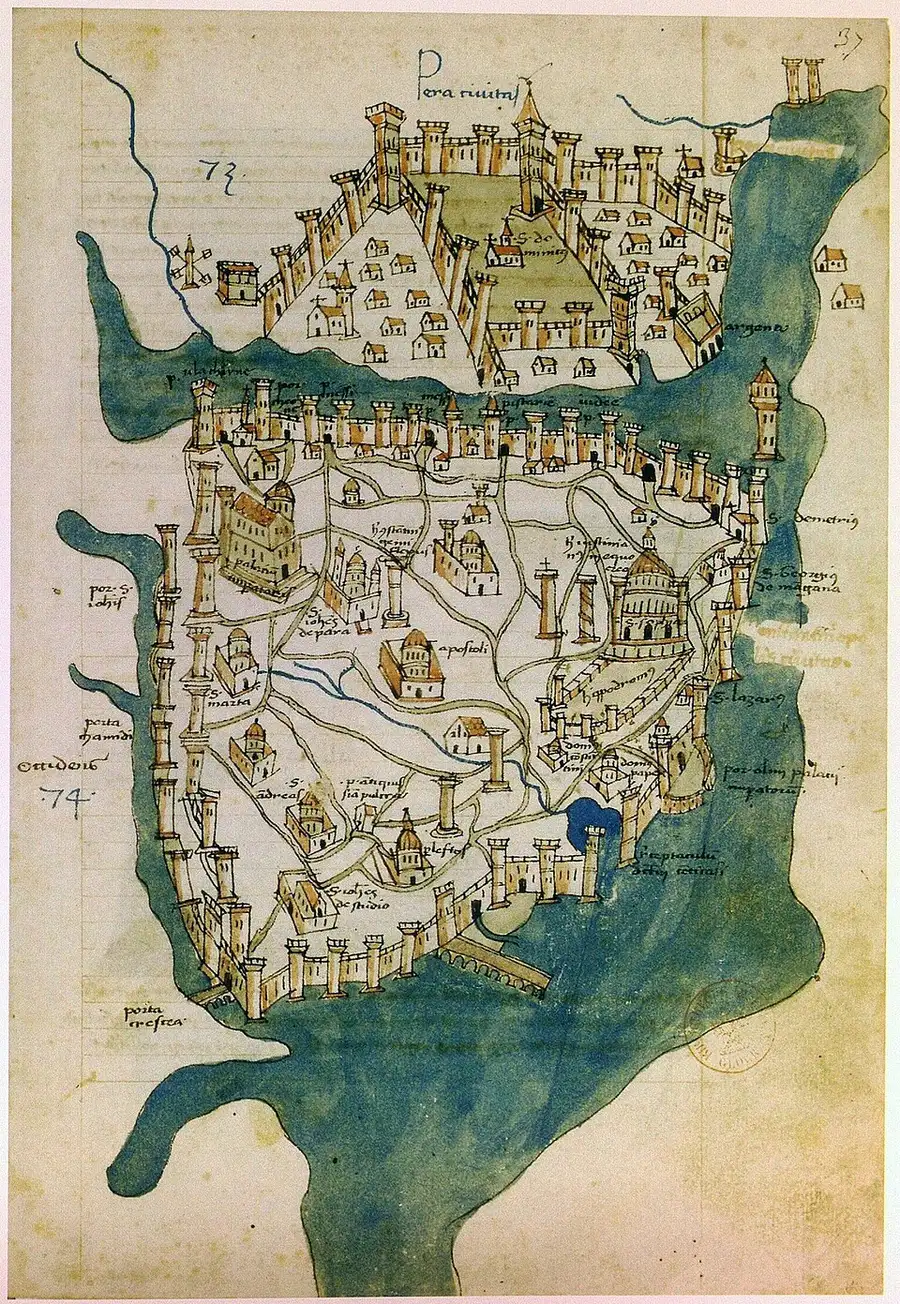 Cristoforo Buondelmonti, Map of Constantinople from the Liber Insularum Archipelagi (before 1430), Bibliothèque nationale de France Buondelmonti's fifteenth-century view of the walled city between the Golden Horn and the Marmara — Miklagard, where Sigurd's voyage ended in 1111: the fleet given to the emperor Alexios, and the dragon-head of the king's own ship set up in a church of the city. Capital of the Eastern Roman (later Byzantine) Empire, on the
Bosphorus where the Black Sea meets the Mediterranean. Founded by
the Roman emperor Constantine in 324 CE on the site of the older
Greek colony of Byzantion and dedicated as the city of Constantinople
on 11 May 330. Capital of the Eastern empire from 395 until its fall
to the Ottoman Turks in 1453; officially renamed Istanbul under
the Turkish Republic in 1930. The Gothic historian Jordanes wrote
the Getica, the first written account of the Norwegian
petty-kingdom world, while working in the city in 551 CE. Norse
mercenaries (the Varangians) later served there as the Byzantine
emperor's elite imperial guard.
Also discussed in Before There Was Norway — petty kingdoms at the edge of the worldThe Viking Age — longships, legends, and the first "Norway" (modern-day Istanbul, Turkey) — Miklagard, “the great city,” as the Norwegians called it — and was received by the Byzantine Empire
Cristoforo Buondelmonti, Map of Constantinople from the Liber Insularum Archipelagi (before 1430), Bibliothèque nationale de France Buondelmonti's fifteenth-century view of the walled city between the Golden Horn and the Marmara — Miklagard, where Sigurd's voyage ended in 1111: the fleet given to the emperor Alexios, and the dragon-head of the king's own ship set up in a church of the city. Capital of the Eastern Roman (later Byzantine) Empire, on the
Bosphorus where the Black Sea meets the Mediterranean. Founded by
the Roman emperor Constantine in 324 CE on the site of the older
Greek colony of Byzantion and dedicated as the city of Constantinople
on 11 May 330. Capital of the Eastern empire from 395 until its fall
to the Ottoman Turks in 1453; officially renamed Istanbul under
the Turkish Republic in 1930. The Gothic historian Jordanes wrote
the Getica, the first written account of the Norwegian
petty-kingdom world, while working in the city in 551 CE. Norse
mercenaries (the Varangians) later served there as the Byzantine
emperor's elite imperial guard.
Also discussed in Before There Was Norway — petty kingdoms at the edge of the worldThe Viking Age — longships, legends, and the first "Norway" (modern-day Istanbul, Turkey) — Miklagard, “the great city,” as the Norwegians called it — and was received by the Byzantine Empire 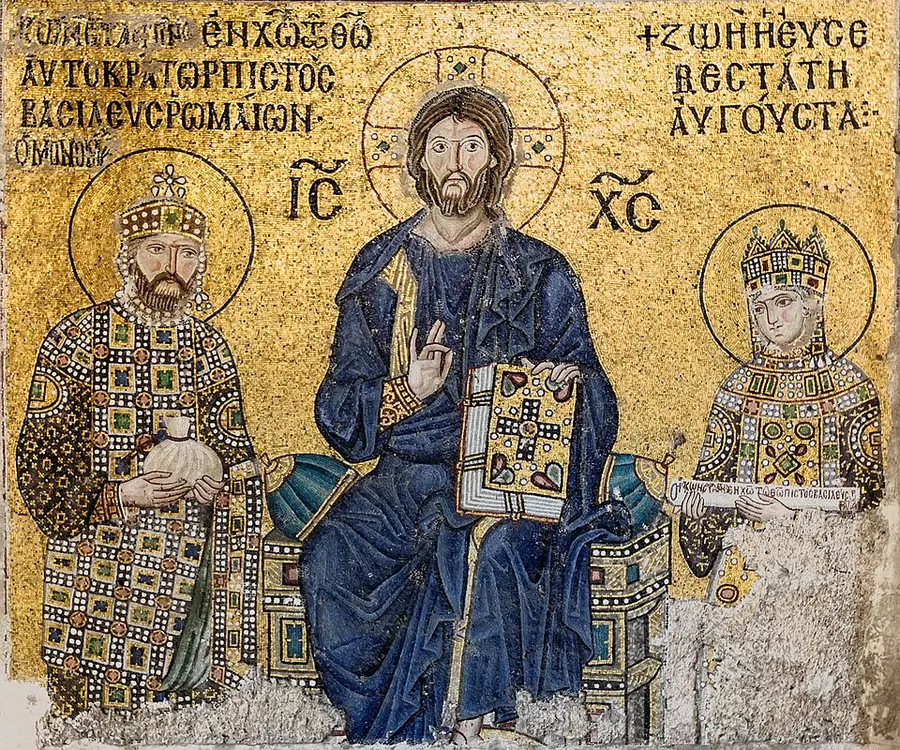 Byzantine mosaicist, Christ Pantocrator with Constantine IX Monomachos and Zoe (Hagia Sophia, c. 1042); photo: Myrabella Gold mosaic in Hagia Sophia: Christ enthroned between Constantine IX Monomachos and the empress Zoe. The emperor pictured reigned a half-century before Alexios I — what the mosaic shows is the imperial court itself, the gold-ground ceremony and wealth of the richest state in the medieval Mediterranean. The continuation of the Eastern Roman Empire after the fall of the
western half in 476, with its capital at Constantinople until the
Ottoman conquest in 1453. The Greek-speaking, Eastern-Christian
Byzantine state was the wealthiest and most institutionally
sophisticated polity of the medieval Mediterranean. The Byzantine
emperors maintained the Varangian Guard — an elite imperial
bodyguard of Norse warriors — from the late tenth century onward;
Harald Hardrada served in it for a decade in his twenties before
returning to claim the Norwegian throne.
Also discussed in The Viking Age — longships, legends, and the first "Norway" emperor Alexios I Komnenos
Byzantine mosaicist, Christ Pantocrator with Constantine IX Monomachos and Zoe (Hagia Sophia, c. 1042); photo: Myrabella Gold mosaic in Hagia Sophia: Christ enthroned between Constantine IX Monomachos and the empress Zoe. The emperor pictured reigned a half-century before Alexios I — what the mosaic shows is the imperial court itself, the gold-ground ceremony and wealth of the richest state in the medieval Mediterranean. The continuation of the Eastern Roman Empire after the fall of the
western half in 476, with its capital at Constantinople until the
Ottoman conquest in 1453. The Greek-speaking, Eastern-Christian
Byzantine state was the wealthiest and most institutionally
sophisticated polity of the medieval Mediterranean. The Byzantine
emperors maintained the Varangian Guard — an elite imperial
bodyguard of Norse warriors — from the late tenth century onward;
Harald Hardrada served in it for a decade in his twenties before
returning to claim the Norwegian throne.
Also discussed in The Viking Age — longships, legends, and the first "Norway" emperor Alexios I Komnenos 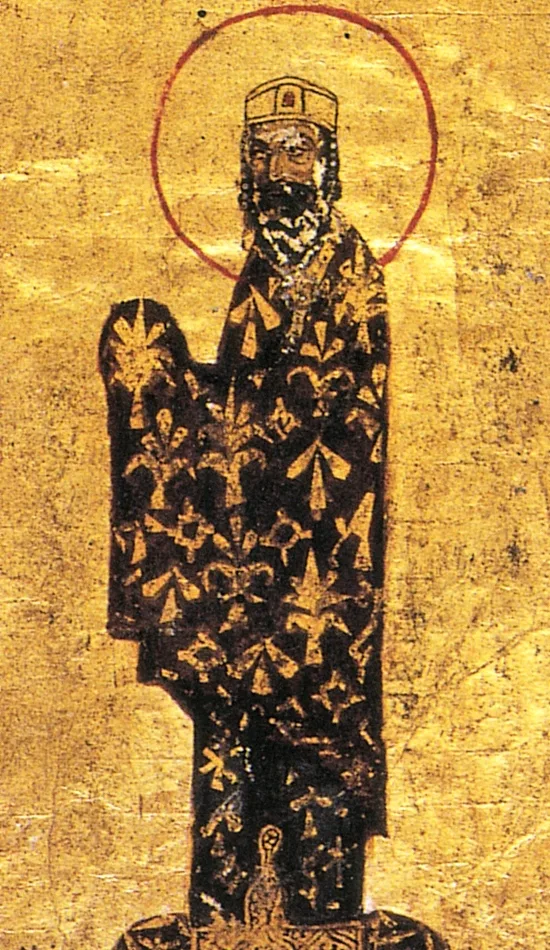 Unknown Byzantine illuminator, portrait of Alexios I Komnenos, Panoplia Dogmatica (12th c.), Biblioteca Apostolica Vaticana, Vat. gr. 666 A near-contemporary portrait of the Byzantine emperor from a theological manuscript produced within his own reign — the same Alexios who received Sigurd Jorsalfar's sixty ships at Constantinople in 1111 and drew many of his returning crusaders into the Varangian Guard. Byzantine Emperor 1081–1118 — founder of the Komnenian dynasty
and the emperor who appealed to Pope Urban II for Western
military aid against the Seljuk Turks in 1095, triggering the
First Crusade. Hosted Sigurd Jorsalfar at the imperial court
in Constantinople in 1111 at the end of the Norwegian Crusade
and received Sigurd's sixty ships as a gift. Recruited many of
the returning Norwegian crusaders into the imperial Varangian
Guard. Daughter Anna Komnene wrote The Alexiad, the principal
Byzantine narrative source for his reign and one of the great
histories of medieval Greek literature.
with the ceremony due a fellow sovereign. There the fleet’s voyage ended. Sigurd presented his ships to the emperor as a gift. The gilded dragon-head from the king’s own vessel was set up in a church in the city, where later Norse travellers reported they could still see it for generations afterward.
Unknown Byzantine illuminator, portrait of Alexios I Komnenos, Panoplia Dogmatica (12th c.), Biblioteca Apostolica Vaticana, Vat. gr. 666 A near-contemporary portrait of the Byzantine emperor from a theological manuscript produced within his own reign — the same Alexios who received Sigurd Jorsalfar's sixty ships at Constantinople in 1111 and drew many of his returning crusaders into the Varangian Guard. Byzantine Emperor 1081–1118 — founder of the Komnenian dynasty
and the emperor who appealed to Pope Urban II for Western
military aid against the Seljuk Turks in 1095, triggering the
First Crusade. Hosted Sigurd Jorsalfar at the imperial court
in Constantinople in 1111 at the end of the Norwegian Crusade
and received Sigurd's sixty ships as a gift. Recruited many of
the returning Norwegian crusaders into the imperial Varangian
Guard. Daughter Anna Komnene wrote The Alexiad, the principal
Byzantine narrative source for his reign and one of the great
histories of medieval Greek literature.
with the ceremony due a fellow sovereign. There the fleet’s voyage ended. Sigurd presented his ships to the emperor as a gift. The gilded dragon-head from the king’s own vessel was set up in a church in the city, where later Norse travellers reported they could still see it for generations afterward.
Many of the Norwegian crusaders never sailed home at all. They took service in the emperor’s household troops, the Varangians  Madrid Skylitzes (Synopsis Historion of John Skylitzes), 12th-century illuminated manuscript, Biblioteca Nacional de España A folio of the Madrid Skylitzes, the illustrated Byzantine chronicle: a Thracesian woman kills a Varangian who had assaulted her, and his comrades hand her his goods in penalty. One of the very few period images of the Norse guardsmen in the emperor's service. Byzantine Greek Várangoi — the Norse warriors who served as the
Byzantine emperor's elite imperial bodyguard from c. 988 onward,
initially recruited under an agreement between Emperor Basil II
and the Kievan Rus prince Vladimir of Kiev. The Varangian Guard
was the most prestigious military service available to a Norse
warrior of the eleventh century; service paid extraordinarily
well and Norse sources speak of returning Varangians as the
wealthy men of their generation. Harald Hardrada commanded
Varangian forces in Sicily, North Africa, and the Holy Land for
a decade before returning north to claim the Norwegian throne.
Also discussed in The Viking Age — longships, legends, and the first "Norway" — the corps of Norse and English warriors who guarded the Byzantine throne. The imperial court sought them out for what their northern descent gave them: tall and strong, trained in the older axe-and-shield tradition of personal combat that Byzantium’s own armies no longer produced, and foreigners whose only loyalty was to the emperor whose hand they took the gold from. They were, in Constantinople’s eyes, the exotic warriors of the north — the most highly-paid soldiers in the city, where a Northern fighter could grow wealthy on imperial wages as nowhere else on the medieval map.
Madrid Skylitzes (Synopsis Historion of John Skylitzes), 12th-century illuminated manuscript, Biblioteca Nacional de España A folio of the Madrid Skylitzes, the illustrated Byzantine chronicle: a Thracesian woman kills a Varangian who had assaulted her, and his comrades hand her his goods in penalty. One of the very few period images of the Norse guardsmen in the emperor's service. Byzantine Greek Várangoi — the Norse warriors who served as the
Byzantine emperor's elite imperial bodyguard from c. 988 onward,
initially recruited under an agreement between Emperor Basil II
and the Kievan Rus prince Vladimir of Kiev. The Varangian Guard
was the most prestigious military service available to a Norse
warrior of the eleventh century; service paid extraordinarily
well and Norse sources speak of returning Varangians as the
wealthy men of their generation. Harald Hardrada commanded
Varangian forces in Sicily, North Africa, and the Holy Land for
a decade before returning north to claim the Norwegian throne.
Also discussed in The Viking Age — longships, legends, and the first "Norway" — the corps of Norse and English warriors who guarded the Byzantine throne. The imperial court sought them out for what their northern descent gave them: tall and strong, trained in the older axe-and-shield tradition of personal combat that Byzantium’s own armies no longer produced, and foreigners whose only loyalty was to the emperor whose hand they took the gold from. They were, in Constantinople’s eyes, the exotic warriors of the north — the most highly-paid soldiers in the city, where a Northern fighter could grow wealthy on imperial wages as nowhere else on the medieval map.
Sigurd himself went home overland: north through the Balkans (modern-day southeastern Europe), Hungary, the German lands, and Denmark, and reached Norway in 1111. He had been gone four years.
What he brought back
He came home with a name. For the rest of his life, and in every record since, Sigurd Magnusson has been Sigurd Jorsalfar — Sigurd the Jerusalem-farer, the king who went to Jerusalem.
Of the four oaths he had sworn over the True Cross, Sigurd kept some and broke some, and the keeping was uneven. He established the church tithe across his realm, which was the work of the rest of his reign and which became one of the foundational fiscal acts of the medieval Norwegian church. He promoted the faith, in the saga tradition’s account, with the conviction of a king who had stood at the holy places.
The splinter of the True Cross, however, never went to Nidaros. Sigurd kept the relic instead at Konungahella 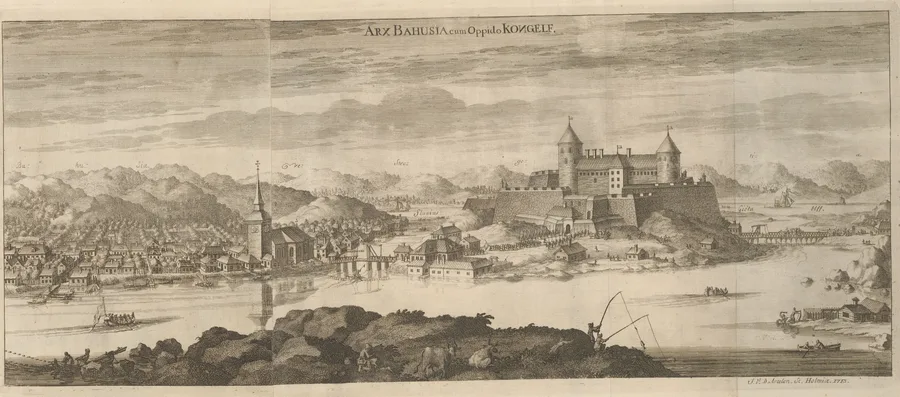 Erik Dahlbergh (eng. J. van den Aveelen), Arx Bahusia cum Oppido Kongelf, Suecia Antiqua et Hodierna (1713), Rijksmuseum Dahlbergh's Suecia Antiqua prospect of Bohus fortress and Kongelf — the successor town on the stretch of the Göta River where medieval Konungahella stood, the border town Sigurd Jorsalfar enlarged and where he kept the True Cross splinter until the Wendish sack of 1135. Medieval Norwegian town on the Göta River about twenty
kilometres north of modern Gothenburg, in what is today
southwestern Sweden. The southeastern border town of medieval
Norway, the country's commercial gateway to the Baltic and
the German lands. Favoured and enlarged by Sigurd Jorsalfar
through his later reign; the splinter of the
True Cross he brought back from Sidon in 1110 was kept here in
a church Sigurd built for it. Destroyed in 1135 by a Wendish
raiding fleet from the southern Baltic coast that sailed up
the Göta and burned the town to the ground. The True Cross
splinter was seized in the sack; the saga records the captured
priest Andres coming ashore with it; it then disappears from
the record. The medieval town site is preserved as an
archaeological park at modern Kungälv.
(now Kungälv, in modern-day western Sweden), the southeastern Norwegian border town on the Göta River
Erik Dahlbergh (eng. J. van den Aveelen), Arx Bahusia cum Oppido Kongelf, Suecia Antiqua et Hodierna (1713), Rijksmuseum Dahlbergh's Suecia Antiqua prospect of Bohus fortress and Kongelf — the successor town on the stretch of the Göta River where medieval Konungahella stood, the border town Sigurd Jorsalfar enlarged and where he kept the True Cross splinter until the Wendish sack of 1135. Medieval Norwegian town on the Göta River about twenty
kilometres north of modern Gothenburg, in what is today
southwestern Sweden. The southeastern border town of medieval
Norway, the country's commercial gateway to the Baltic and
the German lands. Favoured and enlarged by Sigurd Jorsalfar
through his later reign; the splinter of the
True Cross he brought back from Sidon in 1110 was kept here in
a church Sigurd built for it. Destroyed in 1135 by a Wendish
raiding fleet from the southern Baltic coast that sailed up
the Göta and burned the town to the ground. The True Cross
splinter was seized in the sack; the saga records the captured
priest Andres coming ashore with it; it then disappears from
the record. The medieval town site is preserved as an
archaeological park at modern Kungälv.
(now Kungälv, in modern-day western Sweden), the southeastern Norwegian border town on the Göta River 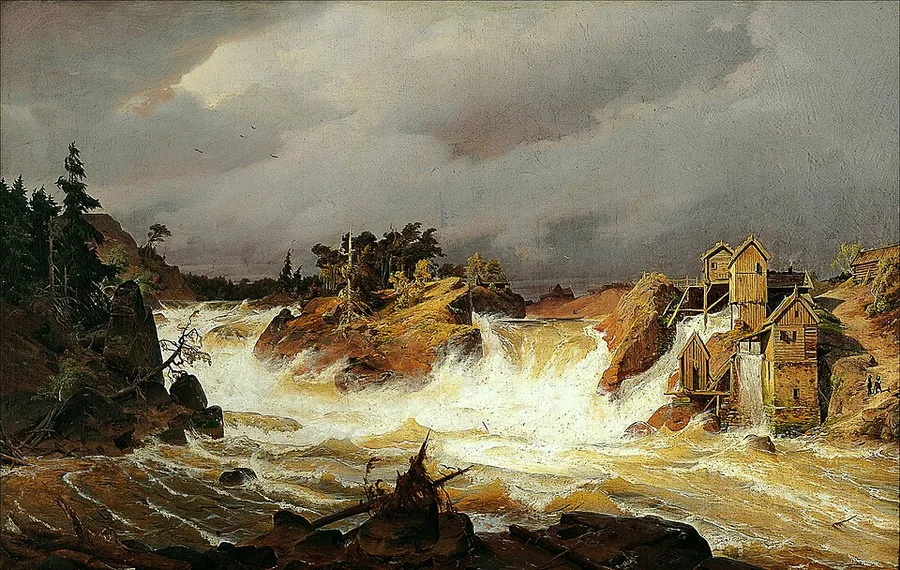 Andreas Achenbach, Trollhättan-Fälle (1836) Andreas Achenbach painted the Göta älv thundering over the Trollhättan falls in 1836 — the river that marked medieval Norway's southeastern border, and the same water the 1135 Wendish raiding fleet entered from the Kattegat, lower down its course, to reach Konungahella. River in modern southwestern Sweden, draining Lake Vänern (the
largest lake in the European Union) west into the Kattegat
strait near modern Gothenburg. About ninety-three kilometres
long. In Sigurd Jorsalfar's time the Göta marked the
southeastern boundary of medieval Norway with Sweden; the
Norwegian border town of Konungahella stood on its bank about
twenty kilometres up from the sea. The 1135 Wendish raiding
fleet that destroyed Konungahella came up the Göta from the
Kattegat. After the 1658 Treaty of Roskilde transferred the
surrounding region (Bohuslän) from Norway to Sweden, the Göta
has been entirely within Swedish territory.
that he favoured and enlarged through his later reign, and he built a church there to house it. The relic stayed at Konungahella through the rest of his life and for five years after his death. In 1135, twenty-five years after the siege of Sidon, a Wendish raid on Konungahella (1135)
Andreas Achenbach, Trollhättan-Fälle (1836) Andreas Achenbach painted the Göta älv thundering over the Trollhättan falls in 1836 — the river that marked medieval Norway's southeastern border, and the same water the 1135 Wendish raiding fleet entered from the Kattegat, lower down its course, to reach Konungahella. River in modern southwestern Sweden, draining Lake Vänern (the
largest lake in the European Union) west into the Kattegat
strait near modern Gothenburg. About ninety-three kilometres
long. In Sigurd Jorsalfar's time the Göta marked the
southeastern boundary of medieval Norway with Sweden; the
Norwegian border town of Konungahella stood on its bank about
twenty kilometres up from the sea. The 1135 Wendish raiding
fleet that destroyed Konungahella came up the Göta from the
Kattegat. After the 1658 Treaty of Roskilde transferred the
surrounding region (Bohuslän) from Norway to Sweden, the Göta
has been entirely within Swedish territory.
that he favoured and enlarged through his later reign, and he built a church there to house it. The relic stayed at Konungahella through the rest of his life and for five years after his death. In 1135, twenty-five years after the siege of Sidon, a Wendish raid on Konungahella (1135) 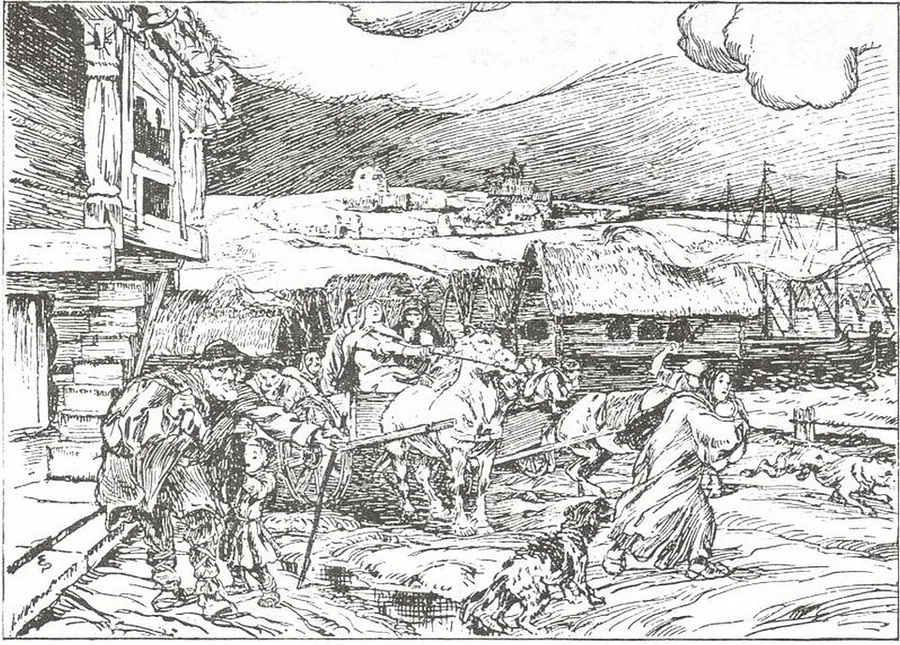 Eilif Peterssen, illustration for Magnus Blindes og Harald Gilles saga, Snorre 1899-edition Townspeople scramble to flee Konghelle as the 1135 Wendish raiding fleet closes in — the sack that burned the town and, with it, the splinter of the True Cross Sigurd had carried home from Sidon. Visually distinct from the Battle of Minne card: a flight scene, not a clash of arms. A Wendish raiding expedition from the southern Baltic coast
that sailed up the Göta River in August 1135 and burned the
Norwegian border town of Konungahella to the ground. About
five hundred and fifty ships under the Wendish prince
Ratibor — by the saga tradition's count — overwhelmed the
town's defences. The splinter of the True Cross that Sigurd
Jorsalfar had brought back from Sidon in 1110 and kept in a
church at Konungahella was seized with the town's plunder —
but the saga records the captured priest Andres being sent
back ashore with the relic, which then disappears from the
record. Konungahella was rebuilt but never recovered its
earlier prominence. The Wendish raids were one of the
principal motives for the later Northern Crusades against
the still-pagan southern Baltic peoples.
from the southern Baltic coast came up the Göta and burned Konungahella to the ground. The raiders seized the splinter of the True Cross with the rest of the town’s plunder — but the saga tradition does not leave it in their hands. In the saga’s telling, misfortune fell on the heathen fleet as it lay off the burned town, was read as the anger of the Christians’ God against men who had presumed to lay hands on the emblem of His suffering, and the Wendish king had the captured priest Andres set into a ship’s boat, the holy cross in his grasp, and sent ashore. From that point the relic disappears from the record. The splinter Norway had sailed three years to fetch from Sidon was gone from the country’s history within a generation.
Eilif Peterssen, illustration for Magnus Blindes og Harald Gilles saga, Snorre 1899-edition Townspeople scramble to flee Konghelle as the 1135 Wendish raiding fleet closes in — the sack that burned the town and, with it, the splinter of the True Cross Sigurd had carried home from Sidon. Visually distinct from the Battle of Minne card: a flight scene, not a clash of arms. A Wendish raiding expedition from the southern Baltic coast
that sailed up the Göta River in August 1135 and burned the
Norwegian border town of Konungahella to the ground. About
five hundred and fifty ships under the Wendish prince
Ratibor — by the saga tradition's count — overwhelmed the
town's defences. The splinter of the True Cross that Sigurd
Jorsalfar had brought back from Sidon in 1110 and kept in a
church at Konungahella was seized with the town's plunder —
but the saga records the captured priest Andres being sent
back ashore with the relic, which then disappears from the
record. Konungahella was rebuilt but never recovered its
earlier prominence. The Wendish raids were one of the
principal motives for the later Northern Crusades against
the still-pagan southern Baltic peoples.
from the southern Baltic coast came up the Göta and burned Konungahella to the ground. The raiders seized the splinter of the True Cross with the rest of the town’s plunder — but the saga tradition does not leave it in their hands. In the saga’s telling, misfortune fell on the heathen fleet as it lay off the burned town, was read as the anger of the Christians’ God against men who had presumed to lay hands on the emblem of His suffering, and the Wendish king had the captured priest Andres set into a ship’s boat, the holy cross in his grasp, and sent ashore. From that point the relic disappears from the record. The splinter Norway had sailed three years to fetch from Sidon was gone from the country’s history within a generation.
The archbishop’s seat Sigurd had sworn to bring did not come in his lifetime either. It came in 1152, more than four decades after he had sworn it, when an English papal legate Nicholas Breakspear (Pope Adrian IV) 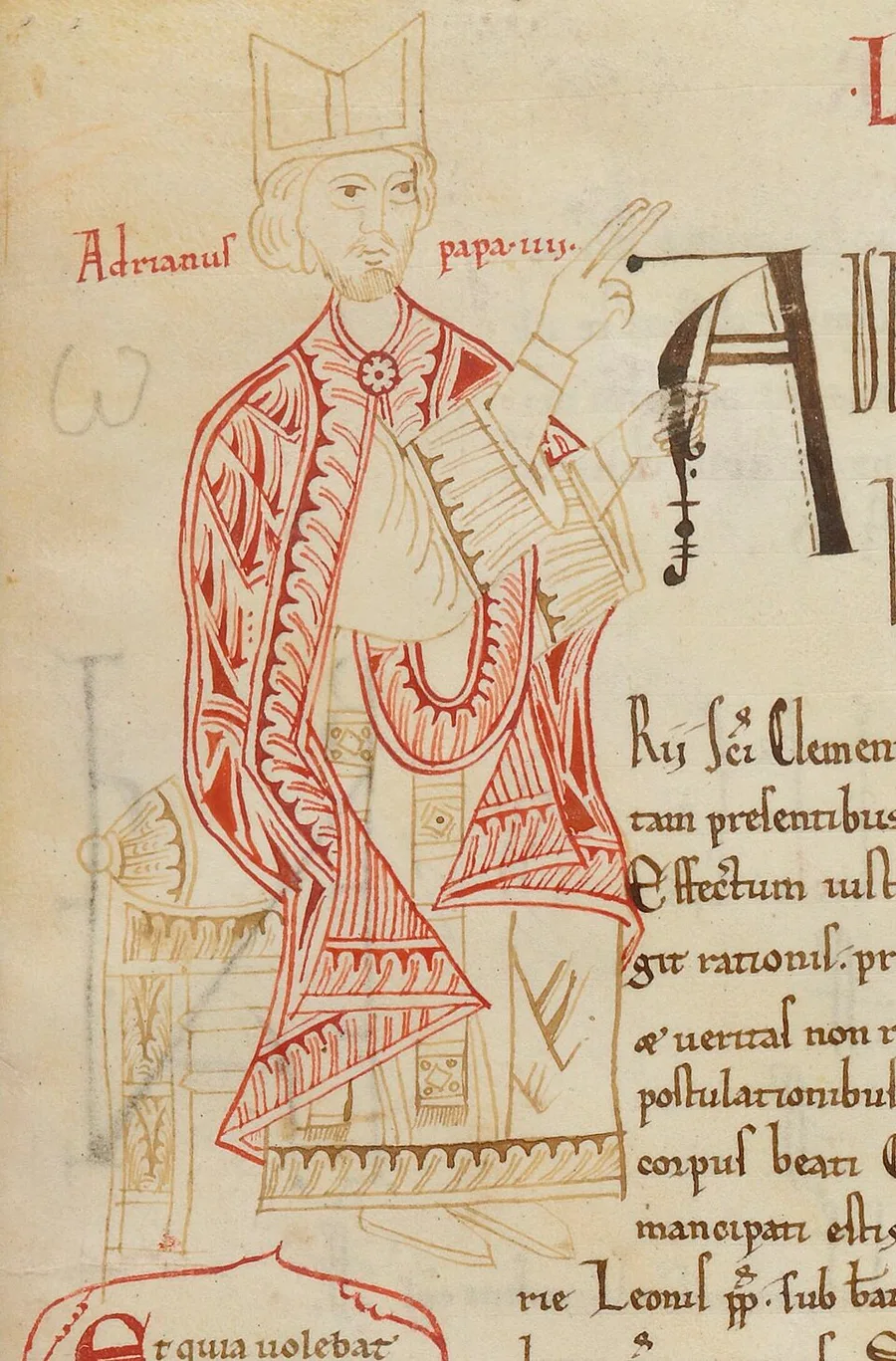 Adrian IV, Chartularium monasterii Casauriensis (c. 1150-1200), Bibliothèque nationale de France (Gallica) A near-contemporary manuscript miniature of Adrian IV — the English cardinal Nicholas Breakspear, sent north as papal legate in 1152, who detached the Norwegian church from Lund and raised Nidaros to an archbishopric two years before he became the only English pope. English cardinal (c. 1100–1159) and, as Pope Adrian IV (1154–1159),
the only Englishman to have held the papacy. In 1152 — two years
before his election to the throne of Saint Peter — Breakspear was
sent as papal legate to Scandinavia and reorganised the Norwegian
church around a new archdiocese at Nidaros, raising the bishop of
Nidaros to archbishop and giving Norway its own ecclesiastical
province independent of Lund. The province stretched from
Trondheim to the Faroes, Greenland, and the Norse colonies of the
British Isles. Died at Anagni in 1159.
Also discussed in A Catholic Norway — the faith that gave the kingdom its first institutions and the stave churchesThe King Who Became a Saint — how the Nordmen came to Christ and detached them from the Danish see at Lund, and the Norwegian church became its own province under its first archbishop. The crusade had carried the obligation home; the country had taken two more generations to discharge it.
Adrian IV, Chartularium monasterii Casauriensis (c. 1150-1200), Bibliothèque nationale de France (Gallica) A near-contemporary manuscript miniature of Adrian IV — the English cardinal Nicholas Breakspear, sent north as papal legate in 1152, who detached the Norwegian church from Lund and raised Nidaros to an archbishopric two years before he became the only English pope. English cardinal (c. 1100–1159) and, as Pope Adrian IV (1154–1159),
the only Englishman to have held the papacy. In 1152 — two years
before his election to the throne of Saint Peter — Breakspear was
sent as papal legate to Scandinavia and reorganised the Norwegian
church around a new archdiocese at Nidaros, raising the bishop of
Nidaros to archbishop and giving Norway its own ecclesiastical
province independent of Lund. The province stretched from
Trondheim to the Faroes, Greenland, and the Norse colonies of the
British Isles. Died at Anagni in 1159.
Also discussed in A Catholic Norway — the faith that gave the kingdom its first institutions and the stave churchesThe King Who Became a Saint — how the Nordmen came to Christ and detached them from the Danish see at Lund, and the Norwegian church became its own province under its first archbishop. The crusade had carried the obligation home; the country had taken two more generations to discharge it.
Sigurd ruled for nineteen years after his return. His brother Olav had died young in 1115, and when Eystein died in 1123 Sigurd held the whole kingdom alone, the first time in his life. His reign is remembered in the saga tradition as a prosperous one, an unusually long stretch of Norwegian peace, ended only by his own death in 1130. What he left behind him was a contested succession that did not resolve in his lifetime and did not resolve in his children’s lifetimes either. The hundred years after 1130 are the years of the Norwegian Civil Wars 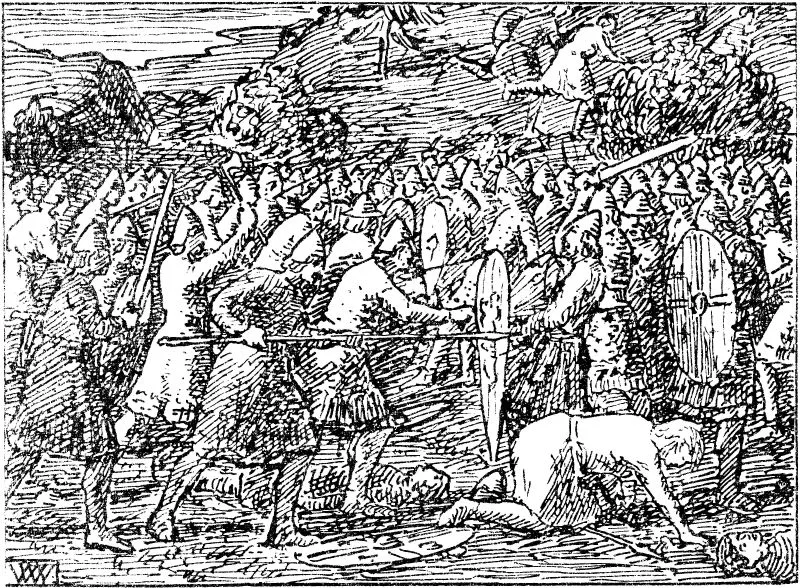 Wilhelm Wetlesen, "Slaget ved Minne", illustration for Haraldssønnenes saga, Snorre 1899-edition The Battle of Minne (1136), fought between rival claimants within a year of Sigurd Jorsalfar's death, is one of the opening clashes of the century of civil war his contested succession set off. The hundred-year period of intermittent civil war over the
Norwegian throne (c. 1130–1240) that followed the contested
succession at the death of Sigurd Jorsalfar in 1130. Multiple
pretenders and pretender-factions — the Birkebeinar (the
"Birch-Legs," supporters of the pretender Sverre Sigurdsson),
the Baglar (church-supported rivals), and various claimants
through legitimate and contested descent — fought across
Norway in shifting coalitions. The civil wars were finally
brought to an end by the kings of the thirteenth-century
Golden Age, particularly Hákon IV Hákonarson, whose long
reign (1217–1263) established the stable royal succession that
Norway had lacked for over a century.
Also discussed in The Golden Age — a North Atlantic empire … reaching farther than you think — the slow grinding fight over the throne that only the thirteenth-century kings would finally bring to an end.
Wilhelm Wetlesen, "Slaget ved Minne", illustration for Haraldssønnenes saga, Snorre 1899-edition The Battle of Minne (1136), fought between rival claimants within a year of Sigurd Jorsalfar's death, is one of the opening clashes of the century of civil war his contested succession set off. The hundred-year period of intermittent civil war over the
Norwegian throne (c. 1130–1240) that followed the contested
succession at the death of Sigurd Jorsalfar in 1130. Multiple
pretenders and pretender-factions — the Birkebeinar (the
"Birch-Legs," supporters of the pretender Sverre Sigurdsson),
the Baglar (church-supported rivals), and various claimants
through legitimate and contested descent — fought across
Norway in shifting coalitions. The civil wars were finally
brought to an end by the kings of the thirteenth-century
Golden Age, particularly Hákon IV Hákonarson, whose long
reign (1217–1263) established the stable royal succession that
Norway had lacked for over a century.
Also discussed in The Golden Age — a North Atlantic empire … reaching farther than you think — the slow grinding fight over the throne that only the thirteenth-century kings would finally bring to an end.
What Sigurd had brought home was a thing of weight no civil war could diminish. The splinter of the True Cross was, in the medieval reckoning, the holiest physical object on earth — the wood of the crucifixion itself, the relic of Calvary. For the quarter-century it rested in the church Sigurd had raised for it at Konungahella, that wood lay in the keeping of a kingdom at the furthest northern edge of Latin Christendom. A Norwegian king had stood at the Sepulchre and the Jordan; had been received in Acre and Constantinople as a fellow sovereign; had fought in the army that took Sidon for Christendom; and had come home with the holiest object a king of his century could be entrusted with. He had crossed the medieval map at its full length, and he had brought a piece of the cross back across it.
And what he had vowed over the cross — the tithe, the archbishopric, the institutional planting of the faith — became, in the four centuries that followed, the foundation of medieval Catholic Norway. The shrine at Nidaros never received the relic. But the Norwegian church Sigurd had pledged to plant did rise. The church that held the country from those vows until the Reformation of 1537 was the church Sigurd had sworn it to.
The gilded dragon-head from Sigurd’s ship stayed in Constantinople, far from the northern forests its timber had grown in. The king who had sailed it there had come home over land. He was the only reigning king of Norway who ever made the journey.
Sources & further reading
Primary sources
- Snorri Sturluson
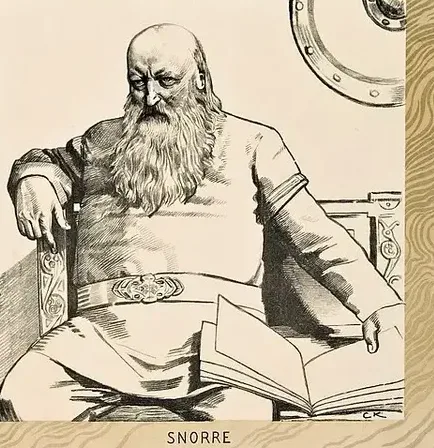 Christian Krohg, Snorre Sturlason (1899), from Norges Kongesagaer; scan: National Library of Norway Christian Krohg's portrait of Snorri from the 1899 folk edition of Heimskringla — the historian seated with a great open book across his knees. No contemporary likeness of Snorri exists; Krohg's drawing is the face Norway gave its most important medieval source. Thirteenth-century Icelandic chieftain, poet, and historian.
Composed the Heimskringla and the Prose Edda in the 1220s
from oral tradition and skaldic verse — three hundred years after
the Viking-age events he describes. The single richest source for
Norway's pre-conversion centuries and also the most aware
Christian-Icelandic editor of them. Modern scholarship accepts
what other sources independently confirm and treats his richest
expansions as the work of a poet writing about a kingdom he had
never seen. Assassinated at Reykholt on 23 September 1241 by
agents of King Hákon IV after a falling-out at court.
Also discussed in The Viking Age — longships, legends, and the first "Norway"Before There Was Norway — petty kingdoms at the edge of the worldWorshiping Odin and Thor — the lived religion of pre-Christian NorwayThe King Who Became a Saint — how the Nordmen came to ChristA Catholic Norway — the faith that gave the kingdom its first institutions and the stave churchesThe Golden Age — a North Atlantic empire … reaching farther than you thinkNordisk Mytologi — Odin, the giants, and Ragnarok , Heimskringla
Christian Krohg, Snorre Sturlason (1899), from Norges Kongesagaer; scan: National Library of Norway Christian Krohg's portrait of Snorri from the 1899 folk edition of Heimskringla — the historian seated with a great open book across his knees. No contemporary likeness of Snorri exists; Krohg's drawing is the face Norway gave its most important medieval source. Thirteenth-century Icelandic chieftain, poet, and historian.
Composed the Heimskringla and the Prose Edda in the 1220s
from oral tradition and skaldic verse — three hundred years after
the Viking-age events he describes. The single richest source for
Norway's pre-conversion centuries and also the most aware
Christian-Icelandic editor of them. Modern scholarship accepts
what other sources independently confirm and treats his richest
expansions as the work of a poet writing about a kingdom he had
never seen. Assassinated at Reykholt on 23 September 1241 by
agents of King Hákon IV after a falling-out at court.
Also discussed in The Viking Age — longships, legends, and the first "Norway"Before There Was Norway — petty kingdoms at the edge of the worldWorshiping Odin and Thor — the lived religion of pre-Christian NorwayThe King Who Became a Saint — how the Nordmen came to ChristA Catholic Norway — the faith that gave the kingdom its first institutions and the stave churchesThe Golden Age — a North Atlantic empire … reaching farther than you thinkNordisk Mytologi — Odin, the giants, and Ragnarok , Heimskringla 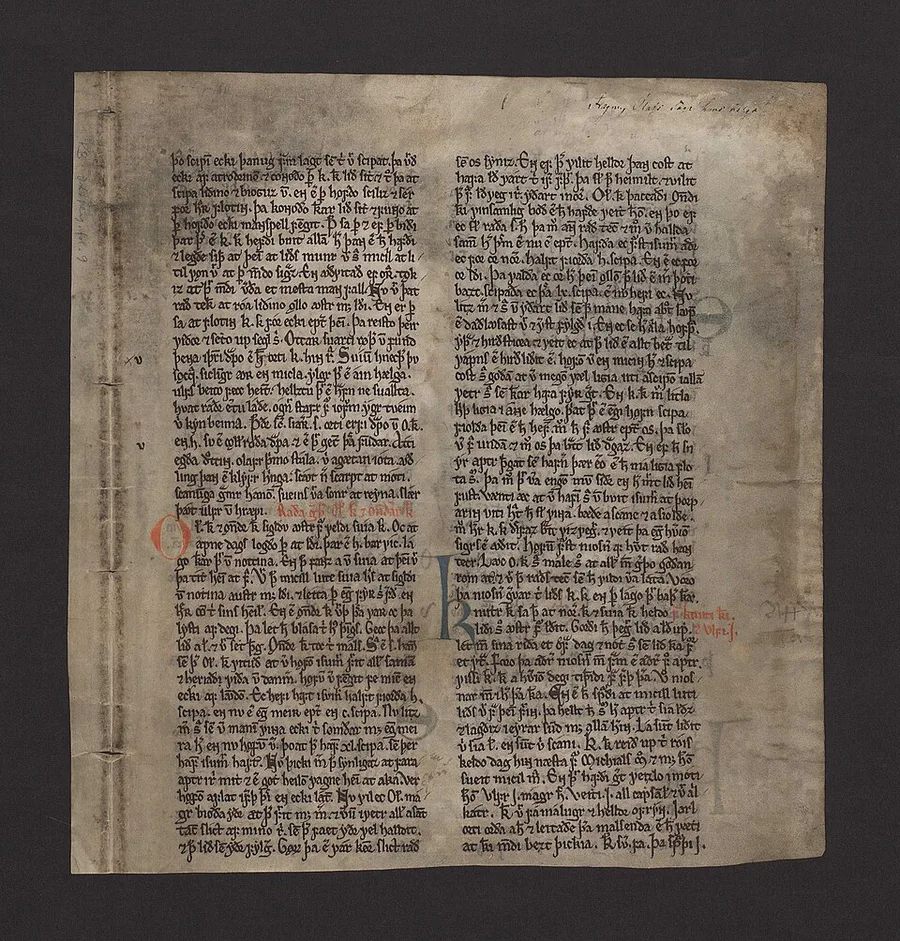 Kringlublaðið (the Kringla leaf), Lbs fragm 82, c. 1260 — National and University Library of Iceland This single surviving vellum leaf is all that remains of the original Kringla manuscript — the best medieval copy of Heimskringla — after the rest burned in Copenhagen's 1728 fire. Snorri Sturluson's prose history of the kings of Norway, composed
in the 1220s. Sixteen sagas running from the semi-mythical Yngling
line through to the late twelfth century. The single most extensive
medieval source for Norway's Viking and Christianization centuries
— trusted on the broad shape of political history, questioned in
the literary expansions, and written by a Christian Icelander
three hundred years after the events.
Also discussed in The Viking Age — longships, legends, and the first "Norway"Worshiping Odin and Thor — the lived religion of pre-Christian NorwayThe King Who Became a Saint — how the Nordmen came to ChristA Catholic Norway — the faith that gave the kingdom its first institutions and the stave churchesThe Golden Age — a North Atlantic empire … reaching farther than you think , Magnússona saga
Kringlublaðið (the Kringla leaf), Lbs fragm 82, c. 1260 — National and University Library of Iceland This single surviving vellum leaf is all that remains of the original Kringla manuscript — the best medieval copy of Heimskringla — after the rest burned in Copenhagen's 1728 fire. Snorri Sturluson's prose history of the kings of Norway, composed
in the 1220s. Sixteen sagas running from the semi-mythical Yngling
line through to the late twelfth century. The single most extensive
medieval source for Norway's Viking and Christianization centuries
— trusted on the broad shape of political history, questioned in
the literary expansions, and written by a Christian Icelander
three hundred years after the events.
Also discussed in The Viking Age — longships, legends, and the first "Norway"Worshiping Odin and Thor — the lived religion of pre-Christian NorwayThe King Who Became a Saint — how the Nordmen came to ChristA Catholic Norway — the faith that gave the kingdom its first institutions and the stave churchesThe Golden Age — a North Atlantic empire … reaching farther than you think , Magnússona saga 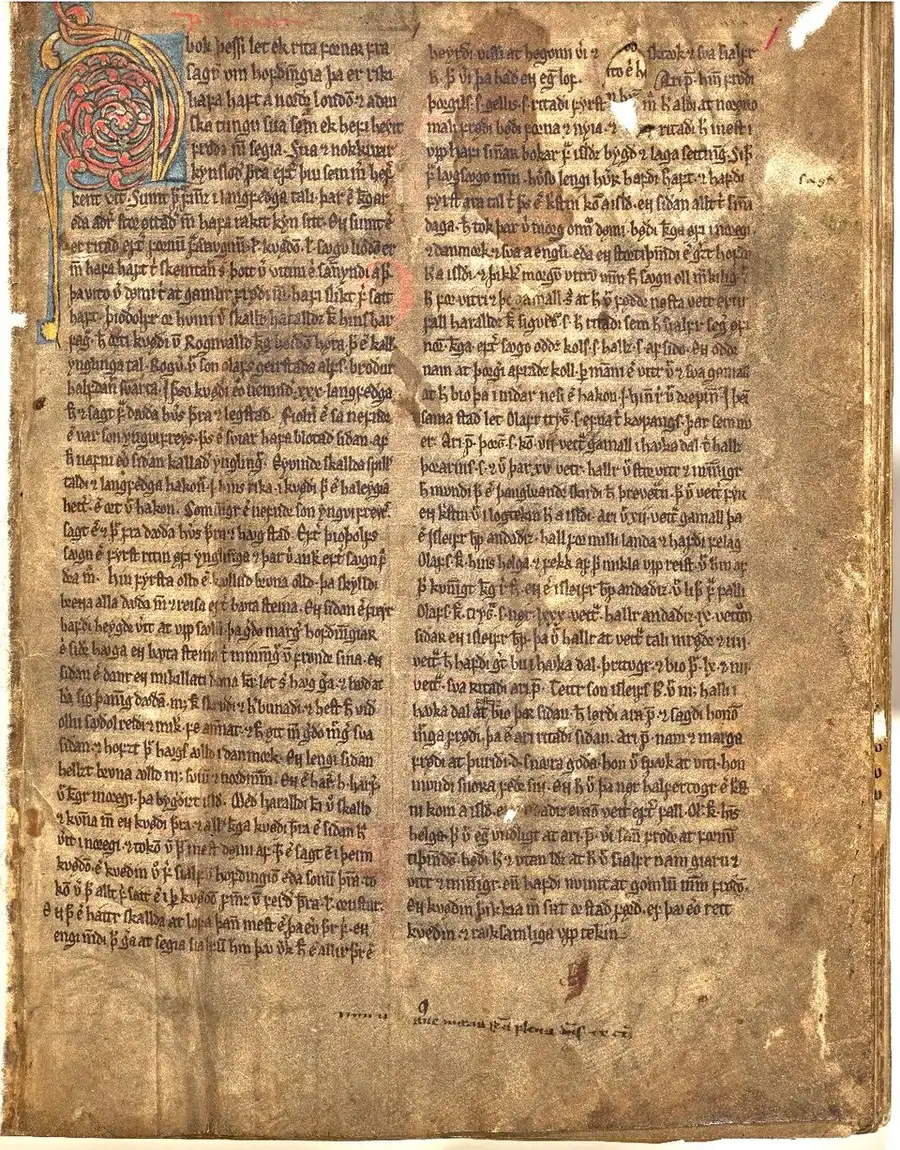 Codex Frisianus (AM 45 fol.), fol. 1r, Prologue of Heimskringla; photo Gottskálk Jensson (2025) The vellum manuscript that carries Magnussona saga to us — Codex Frisianus, copied around 1300-1325 — but this specific folio is its opening Prologue page, not the later leaves that take up Sigurd, Eystein, and Olav's joint reign; a stand-in for the manuscript as physical object, honestly captioned as such. The Saga of Magnus's Sons — the saga in Snorri Sturluson's
Heimskringla covering the joint reign of Sigurd Jorsalfar,
Eystein I, and Olav Magnusson, the three sons of Magnus
Barefoot. Composed in Iceland around 1230, a century after the
events. The principal medieval narrative of the Norwegian
Crusade of 1107–1111 — Sigurd's voyage, the siege of Sidon,
the True Cross splinter and the four oaths sworn over it, the
reception at Constantinople, and the long peace of Sigurd's
reign after his return. The saga preserves anecdotal and
legendary material that earlier and more reliable sources
(the contemporary skaldic verse, the Latin chronicles of the
crusader kingdom) only partly confirm.
(the Saga of Magnus’s Sons), c. 1230. The principal medieval narrative of Sigurd’s crusade, composed in Iceland a century after the events. English translation by Alison Finlay and Anthony Faulkes, 3 vols. (Viking Society for Northern Research, 2011–2015); also in Lee M. Hollander’s older translation (University of Texas Press, 1964, reissued 2009).
Codex Frisianus (AM 45 fol.), fol. 1r, Prologue of Heimskringla; photo Gottskálk Jensson (2025) The vellum manuscript that carries Magnussona saga to us — Codex Frisianus, copied around 1300-1325 — but this specific folio is its opening Prologue page, not the later leaves that take up Sigurd, Eystein, and Olav's joint reign; a stand-in for the manuscript as physical object, honestly captioned as such. The Saga of Magnus's Sons — the saga in Snorri Sturluson's
Heimskringla covering the joint reign of Sigurd Jorsalfar,
Eystein I, and Olav Magnusson, the three sons of Magnus
Barefoot. Composed in Iceland around 1230, a century after the
events. The principal medieval narrative of the Norwegian
Crusade of 1107–1111 — Sigurd's voyage, the siege of Sidon,
the True Cross splinter and the four oaths sworn over it, the
reception at Constantinople, and the long peace of Sigurd's
reign after his return. The saga preserves anecdotal and
legendary material that earlier and more reliable sources
(the contemporary skaldic verse, the Latin chronicles of the
crusader kingdom) only partly confirm.
(the Saga of Magnus’s Sons), c. 1230. The principal medieval narrative of Sigurd’s crusade, composed in Iceland a century after the events. English translation by Alison Finlay and Anthony Faulkes, 3 vols. (Viking Society for Northern Research, 2011–2015); also in Lee M. Hollander’s older translation (University of Texas Press, 1964, reissued 2009). - Halldórr skvaldri, Útfarardrápa, c. 1115. A contemporary skaldic praise-poem on Sigurd’s crusade, surviving in fragments preserved by the later prose tradition. In Skaldic Poetry of the Scandinavian Middle Ages, vol. II, ed. Kari Ellen Gade (Brepols, 2009).
- Morkinskinna
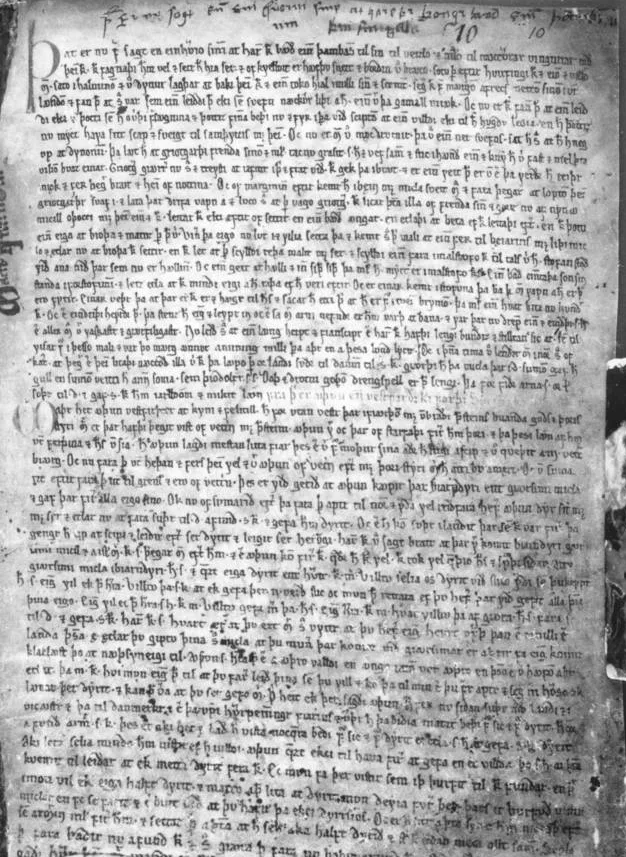 Morkinskinna, GKS 1009 fol (c. 1275), Royal Library, Copenhagen A leaf of GKS 1009 fol itself — the thirteenth-century codex whose deteriorated state earned it the name "Rotten Vellum," and one of the oldest surviving narratives of Sigurd Jorsalfar's crusade. "Rotten Vellum" — an early Icelandic king-collection compiled
around 1220, before Snorri Sturluson's Heimskringla, covering
the Norwegian kings from Magnus the Good (r. 1035–1047) through
the mid-twelfth century. Named for the deteriorated condition
of its surviving thirteenth-century manuscript (GKS 1009 fol.
in the Royal Library, Copenhagen). One of the older surviving
narratives of Sigurd Jorsalfar's Crusade, drawn on by Snorri
and other later saga authors and preserving anecdotal material
not found elsewhere. English translation by Theodore M.
Andersson and Kari Ellen Gade (Cornell University Press, 2000).
, c. 1220. An early Icelandic king-collection with one of the older surviving narratives of the crusade. Translated by Theodore M. Andersson and Kari Ellen Gade as Morkinskinna: The Earliest Icelandic Chronicle of the Norwegian Kings (1030–1157) (Cornell University Press, 2000).
Morkinskinna, GKS 1009 fol (c. 1275), Royal Library, Copenhagen A leaf of GKS 1009 fol itself — the thirteenth-century codex whose deteriorated state earned it the name "Rotten Vellum," and one of the oldest surviving narratives of Sigurd Jorsalfar's crusade. "Rotten Vellum" — an early Icelandic king-collection compiled
around 1220, before Snorri Sturluson's Heimskringla, covering
the Norwegian kings from Magnus the Good (r. 1035–1047) through
the mid-twelfth century. Named for the deteriorated condition
of its surviving thirteenth-century manuscript (GKS 1009 fol.
in the Royal Library, Copenhagen). One of the older surviving
narratives of Sigurd Jorsalfar's Crusade, drawn on by Snorri
and other later saga authors and preserving anecdotal material
not found elsewhere. English translation by Theodore M.
Andersson and Kari Ellen Gade (Cornell University Press, 2000).
, c. 1220. An early Icelandic king-collection with one of the older surviving narratives of the crusade. Translated by Theodore M. Andersson and Kari Ellen Gade as Morkinskinna: The Earliest Icelandic Chronicle of the Norwegian Kings (1030–1157) (Cornell University Press, 2000). - Theodoricus Monachus
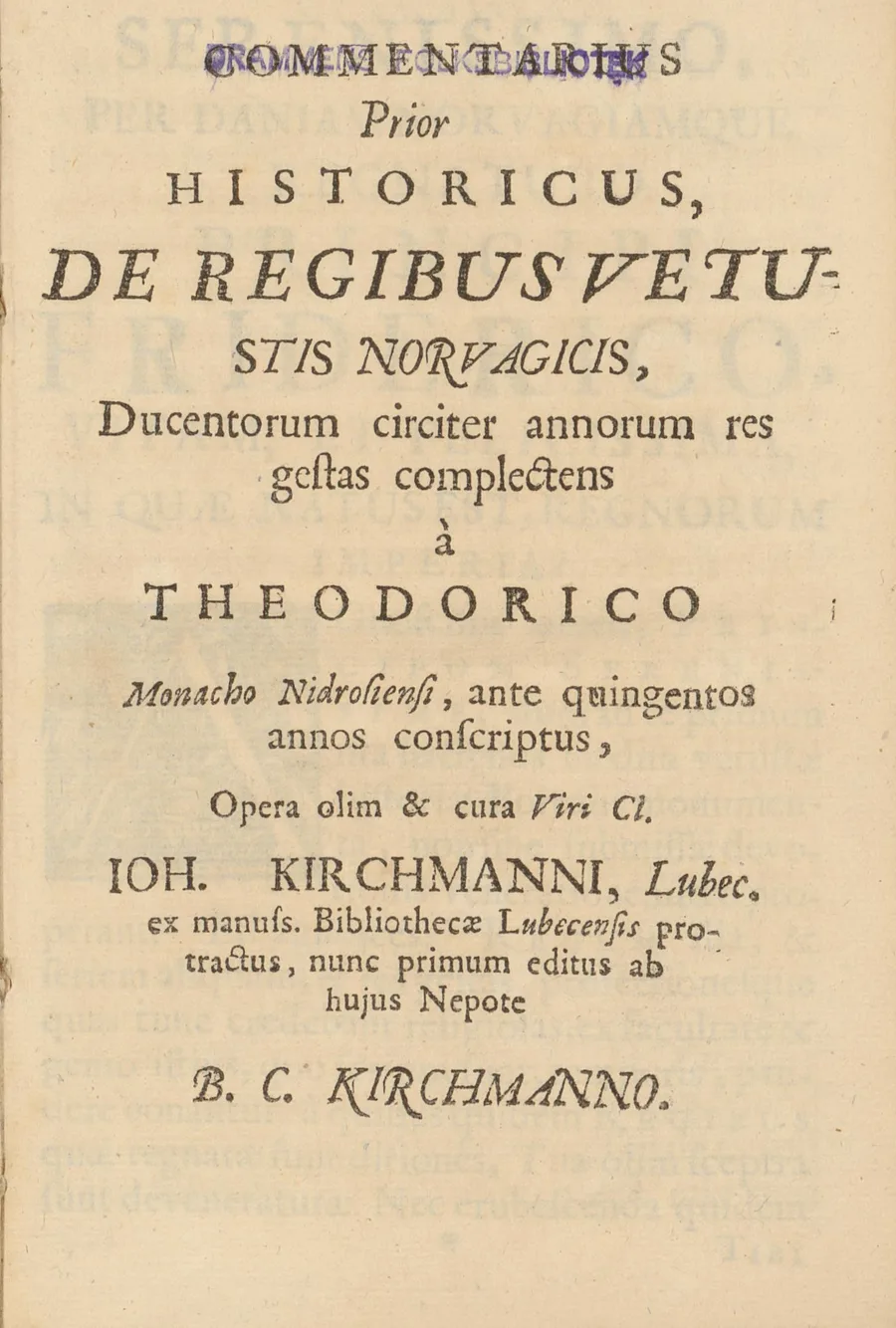 Editio princeps of Theodoricus, in Commentarii historici duo (Amsterdam, 1684), National Library of Norway No likeness of Theodoricus exists and the medieval codex of his history is lost; this 1684 Amsterdam title page is where his work enters print — "by Theodoric, monk of Nidaros, written five hundred years ago," drawn from a Lübeck manuscript that has since vanished too. Norwegian monk and historian, active in the late twelfth century
(probably c. 1175–c. 1185). Author of Historia de antiquitate
regum Norwagiensium ("History of the Antiquity of the Norwegian
Kings"), a short Latin history covering the Norwegian kings from
Harald Fairhair to the death of Sigurd the Crusader (d. 1130). One of the earliest
written accounts of Olav II Haraldsson's sainthood; pre-dates
Snorri Sturluson's Heimskringla by half a century. Almost
certainly a Premonstratensian or Augustinian canon attached to
the cathedral at Nidaros, though the precise identification has
not been settled.
Also discussed in A Catholic Norway — the faith that gave the kingdom its first institutions and the stave churchesThe King Who Became a Saint — how the Nordmen came to Christ , Historia de antiquitate regum Norwagiensium, c. 1180. The earliest Latin Norwegian history. English translation by David and Ian McDougall (Viking Society for Northern Research, 1998).
Editio princeps of Theodoricus, in Commentarii historici duo (Amsterdam, 1684), National Library of Norway No likeness of Theodoricus exists and the medieval codex of his history is lost; this 1684 Amsterdam title page is where his work enters print — "by Theodoric, monk of Nidaros, written five hundred years ago," drawn from a Lübeck manuscript that has since vanished too. Norwegian monk and historian, active in the late twelfth century
(probably c. 1175–c. 1185). Author of Historia de antiquitate
regum Norwagiensium ("History of the Antiquity of the Norwegian
Kings"), a short Latin history covering the Norwegian kings from
Harald Fairhair to the death of Sigurd the Crusader (d. 1130). One of the earliest
written accounts of Olav II Haraldsson's sainthood; pre-dates
Snorri Sturluson's Heimskringla by half a century. Almost
certainly a Premonstratensian or Augustinian canon attached to
the cathedral at Nidaros, though the precise identification has
not been settled.
Also discussed in A Catholic Norway — the faith that gave the kingdom its first institutions and the stave churchesThe King Who Became a Saint — how the Nordmen came to Christ , Historia de antiquitate regum Norwagiensium, c. 1180. The earliest Latin Norwegian history. English translation by David and Ian McDougall (Viking Society for Northern Research, 1998). - Fulcher of Chartres, Historia Hierosolymitana, c. 1101–1127. The earliest Latin chronicle of the Crusader Kingdom and the contemporary Western source for the siege of Sidon. English translation by Frances Rita Ryan, A History of the Expedition to Jerusalem, 1095–1127 (University of Tennessee Press, 1969).
- Albert of Aachen, Historia Ierosolimitana, c. 1130. The major Latin narrative of the First Crusade and its aftermath, including the siege of Sidon. Edited and translated by Susan B. Edgington (Clarendon Press, Oxford Medieval Texts, 2007).
- William of Tyre, Historia rerum in partibus transmarinis gestarum, c. 1170–1184. The standard twelfth-century history of the Kingdom of Jerusalem. English translation by Emily A. Babcock and A. C. Krey, A History of Deeds Done Beyond the Sea (Columbia University Press, 1943).
- Helmold of Bosau, Chronica Slavorum, c. 1170. The Western Latin source for the Wendish raid that destroyed Konungahella in 1135. English translation by Francis J. Tschan (Columbia University Press, 1935; reprinted Octagon Books, 1966).
Modern scholarship
- Pål Berg Svenungsen, Norge og korstogene: En studie av forbindelsene mellom det norske riket og den europeiske korstogsbevegelsen, ca. 1050–1290 (PhD thesis, University of Bergen, 2016). The standard modern study of Norwegian crusading, available open-access through Bergen’s research archive.
- Sverre Bagge, Cross and Scepter: The Rise of the Scandinavian Kingdoms from the Vikings to the Reformation (Princeton University Press, 2014). The standard modern synthesis on medieval Scandinavian political-religious formation, with substantial treatment of Sigurd’s reign.
- Knut Helle, ed., The Cambridge History of Scandinavia, Volume 1: Prehistory to 1520 (Cambridge University Press, 2003). The reference treatment of Sigurd’s place in the consolidation of the medieval Norwegian kingdom.
- Gary B. Doxey, “Norwegian Crusaders and the Balearic Islands,” Scandinavian Studies 68, no. 2 (Spring 1996): 139–160. The standard article on the Balearic episode of the voyage.
- Jonathan Riley-Smith, The First Crusaders, 1095–1131 (Cambridge University Press, 1997). Places Sigurd’s expedition in the wider European crusading movement.
- Christopher Tyerman, God’s War: A New History of the Crusades (Penguin / Harvard University Press, 2006). The most comprehensive modern history of the Crusades in English, with the strategic context for the Sidon siege.
- Thomas Asbridge, The Crusades: The War for the Holy Land (Simon & Schuster / Ecco, 2010). The leading recent narrative history of the Crusades, with the early Crusader Kingdom under Baldwin I.
- Sigfús Blöndal, The Varangians of Byzantium, trans. and rev. Benedikt S. Benedikz (Cambridge University Press, 1978). The standard study of the Norse Imperial Guard whom Sigurd’s men joined in Constantinople.
- Hans Eberhard Mayer, The Crusades, trans. John Gillingham, 2nd English edition (Oxford University Press, 1988). The classic short history of the Crusades.
Reference
- Store norske leksikon (snl.no). The Norwegian peer-reviewed encyclopedia. See in particular Sigurd 1 Magnusson Jorsalfare, Magnussønnenes saga, Slaget om Sidon 1110, and Konungahella.
- Diplomatarium Norvegicum, 23 vols. The standard collection of medieval Norwegian documents, online at https://www.dokpro.uio.no/dipl_norv/diplom_field_eng.html.
Visit
- Bergen. The western Norwegian port from which Sigurd’s fleet of sixty ships put to sea in 1107. The medieval Bryggen wharf, now a UNESCO World Heritage site, stands on the eastern shore of the harbour the fleet would have departed from.
- Nidaros Cathedral, Trondheim. The shrine of Saint Olav where Sigurd had sworn to place the True Cross splinter. The cathedral over Olav’s burial place is the building the relic was promised to.
- Kungälv (medieval Konungahella), about twenty kilometres north of Gothenburg on the Göta River. The site of the southeastern border town where Sigurd actually kept the relic, and where it was destroyed in the Wendish raid of 1135. The medieval town site is preserved as an archaeological park; nothing of Sigurd’s Church of the Holy Cross survives.
- Stiklestad National Cultural Centre, Verdal in Trøndelag. The battle site at which Saint Olav was killed in 1030 — the saint whose shrine Sigurd had sworn the relic to.