A Catholic Norway — The faith that gave the kingdom its first institutions and the stave churches
For five centuries, from Olav's canonization in 1031 to the imposed Reformation of 1537, Norwegian Christianity was Catholic. The medieval church built the country's first national administration, the three regional saint-followings, the monasteries, and the stave churches.
For five centuries — from the canonization of Saint Olav 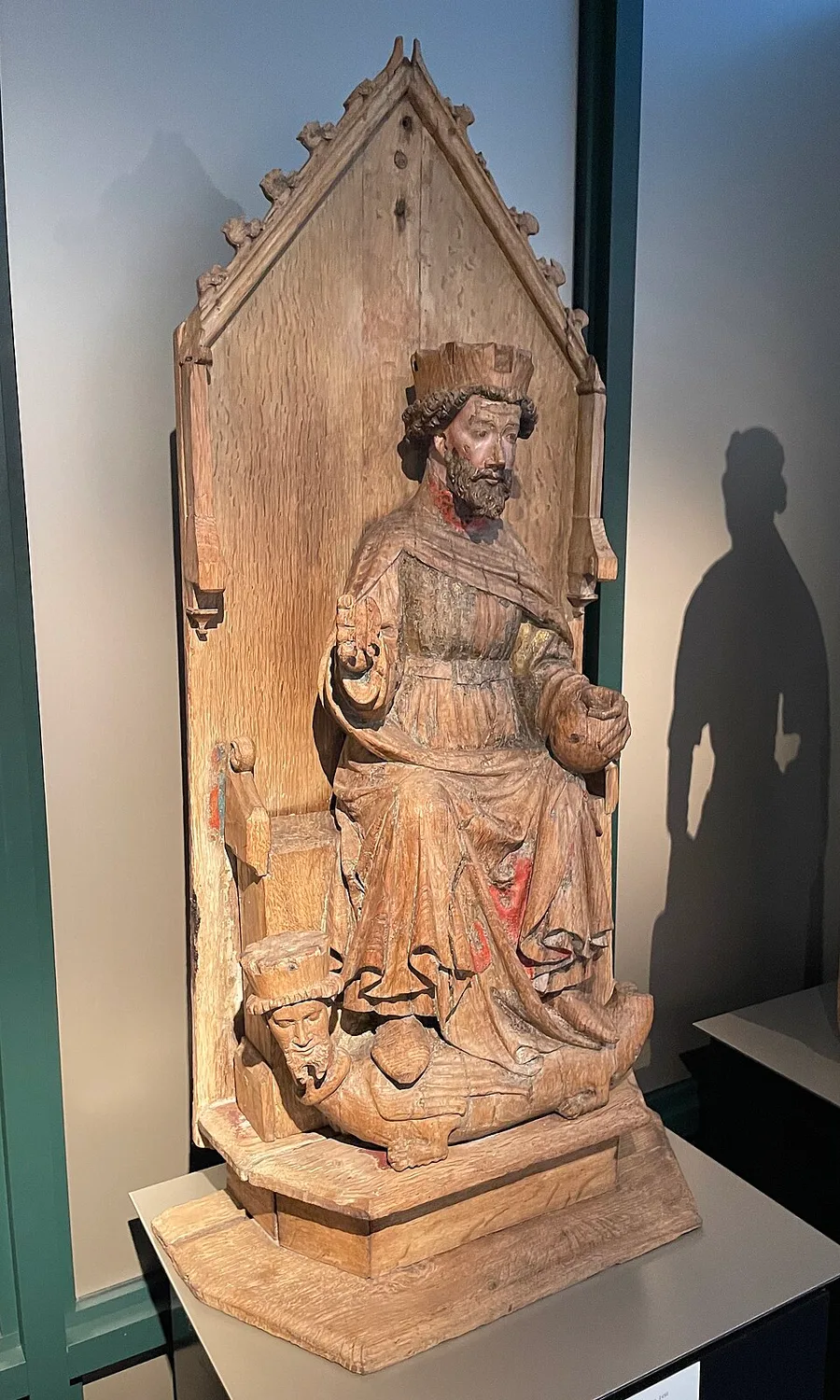 Saint Olav from Austevoll church (c. 1450), University Museum of Bergen; photo Wolfmann, Wikimedia Commons, CC BY-SA 4.0 Olav as medieval Norway saw him: the eternal king crowned and enthroned, trampling a dragon whose crowned human head stands for the heathendom he overcame. Carved around 1450 for Austevoll church south of Bergen — one of the polychrome Olav figures that stood in churches across Norway before the Reformation. Olav Haraldsson, king of Norway 1015–1028, killed at the Battle
of Stiklestad on 29 July 1030 and canonized one year and five days
later by his English bishop Grimkell. Rex Perpetuus Norvegiae —
the Eternal King of Norway. His shrine at Nidaros became the
northernmost pilgrimage destination in medieval Christendom and
the binding narrative of a converted country. The Norwegian Lion
on the modern coat of arms — a golden lion bearing a golden axe
on a red shield — is Saint Olav's iconography.
In this article The opening event of the Norwegian Catholic age — Olav's
canonization at Nidaros in 1031 — is the subject of the Saint
Olav article. This article picks up the institutional Catholic
Norway he founded and the five centuries that followed.
On the trip The Gråhårsklubben (the Oldsters) visit Nidaros Cathedral on
Tuesday 28 July 2026 — the day before the 996th anniversary of
the Battle of Stiklestad. The Olafskrinet was broken up at the
1537 Reformation and the body buried somewhere inside the
cathedral in a spot no medieval source preserved. The building
is what the nine-and-a-half centuries of devotion built. The
pilgrim road, the Pilegrimsleden, runs past the cathedral's
south door — the same door the medieval pilgrims walked through.
Nidaros Cathedral, Trondheim Also discussed in The King Who Became a Saint — how the Nordmen came to ChristThe Viking Age — longships, legends, and the first "Norway"Worshiping Odin and Thor — the lived religion of pre-Christian NorwayThe Reformation, 1537 — one church eradicated and another imposedLutheran Norway and Pietism — a farmer named Hans Nielsen Hauge and a lay revival that could not be silencedThe Crusades?!!!! — sixty ships from Bergen, bound for the Holy LandThe 400-Year Night — when the Northern Lion lay dormantThe Quiet Revolution — how Norway won its independence without a warWorld War II — the King’s “No” and the Nazis in Norway at Nidaros in 1031 to the imposed Lutheran settlement of 1537 — Norwegian Christianity was Catholic. The distinction is one a Norwegian of those centuries would not have drawn. There was no other Christianity in Western Europe to draw it against. There was a single Western Church, governed from Rome, which Norway joined in the eleventh century and remained part of for five hundred years.
Saint Olav from Austevoll church (c. 1450), University Museum of Bergen; photo Wolfmann, Wikimedia Commons, CC BY-SA 4.0 Olav as medieval Norway saw him: the eternal king crowned and enthroned, trampling a dragon whose crowned human head stands for the heathendom he overcame. Carved around 1450 for Austevoll church south of Bergen — one of the polychrome Olav figures that stood in churches across Norway before the Reformation. Olav Haraldsson, king of Norway 1015–1028, killed at the Battle
of Stiklestad on 29 July 1030 and canonized one year and five days
later by his English bishop Grimkell. Rex Perpetuus Norvegiae —
the Eternal King of Norway. His shrine at Nidaros became the
northernmost pilgrimage destination in medieval Christendom and
the binding narrative of a converted country. The Norwegian Lion
on the modern coat of arms — a golden lion bearing a golden axe
on a red shield — is Saint Olav's iconography.
In this article The opening event of the Norwegian Catholic age — Olav's
canonization at Nidaros in 1031 — is the subject of the Saint
Olav article. This article picks up the institutional Catholic
Norway he founded and the five centuries that followed.
On the trip The Gråhårsklubben (the Oldsters) visit Nidaros Cathedral on
Tuesday 28 July 2026 — the day before the 996th anniversary of
the Battle of Stiklestad. The Olafskrinet was broken up at the
1537 Reformation and the body buried somewhere inside the
cathedral in a spot no medieval source preserved. The building
is what the nine-and-a-half centuries of devotion built. The
pilgrim road, the Pilegrimsleden, runs past the cathedral's
south door — the same door the medieval pilgrims walked through.
Nidaros Cathedral, Trondheim Also discussed in The King Who Became a Saint — how the Nordmen came to ChristThe Viking Age — longships, legends, and the first "Norway"Worshiping Odin and Thor — the lived religion of pre-Christian NorwayThe Reformation, 1537 — one church eradicated and another imposedLutheran Norway and Pietism — a farmer named Hans Nielsen Hauge and a lay revival that could not be silencedThe Crusades?!!!! — sixty ships from Bergen, bound for the Holy LandThe 400-Year Night — when the Northern Lion lay dormantThe Quiet Revolution — how Norway won its independence without a warWorld War II — the King’s “No” and the Nazis in Norway at Nidaros in 1031 to the imposed Lutheran settlement of 1537 — Norwegian Christianity was Catholic. The distinction is one a Norwegian of those centuries would not have drawn. There was no other Christianity in Western Europe to draw it against. There was a single Western Church, governed from Rome, which Norway joined in the eleventh century and remained part of for five hundred years.
These centuries were not a Catholic interlude set apart from the rest of Norwegian Christian history. They were Norwegian Christianity. They were the country’s first stable institutional life of any kind, and the buildings the period left behind — pale stone, weathered timber — are still the principal Christian infrastructure of Norway today.
Nidaros — the church as Norway’s first administration
The moment the Norwegian church became its own province inside the wider Western Church came in 1152. An English cardinal named Nicholas Breakspear (Pope Adrian IV) 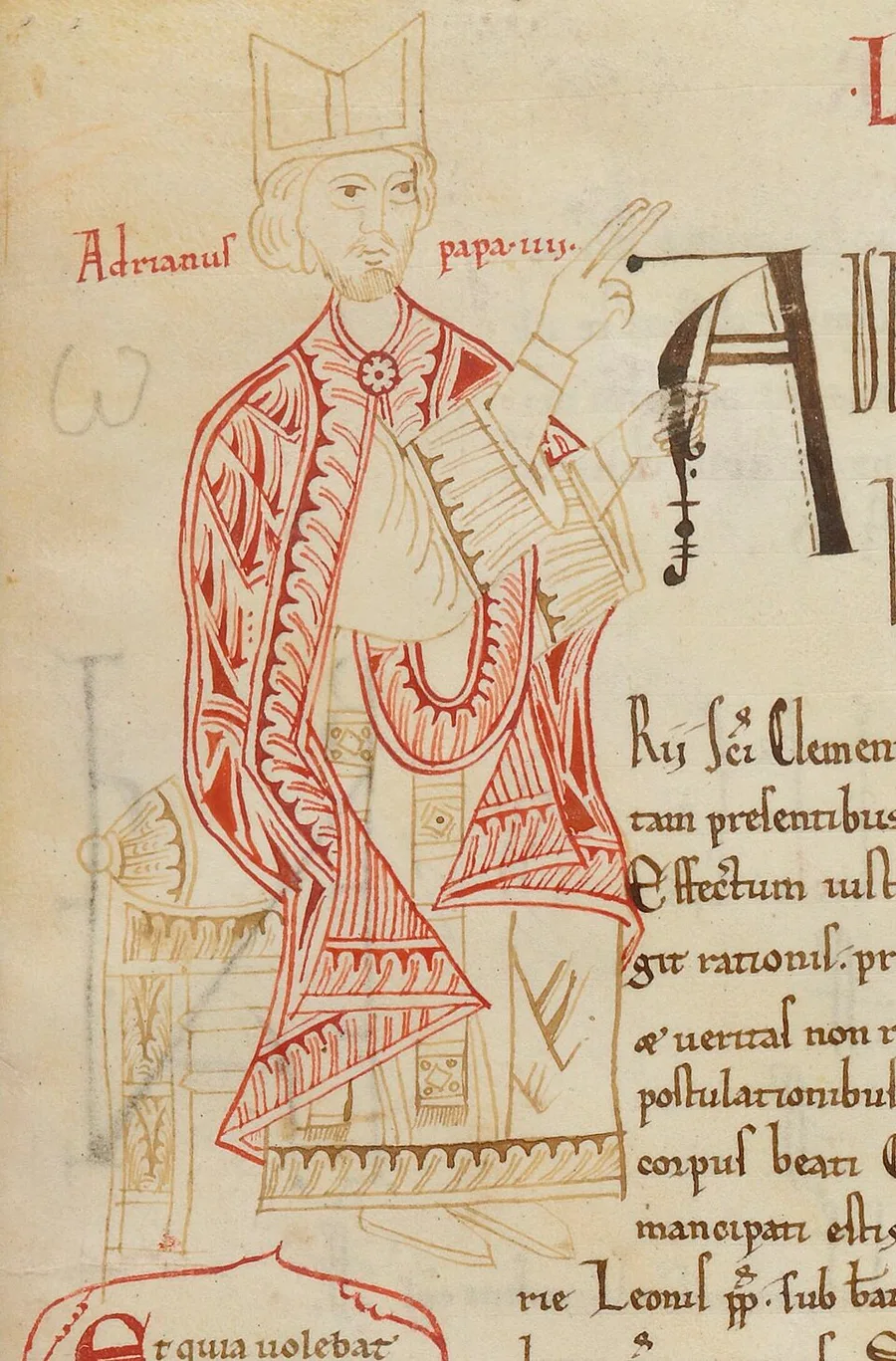 Adrian IV, Chartularium monasterii Casauriensis (c. 1150-1200), Bibliothèque nationale de France (Gallica) A near-contemporary manuscript miniature of Adrian IV — the English cardinal Nicholas Breakspear, sent north as papal legate in 1152, who detached the Norwegian church from Lund and raised Nidaros to an archbishopric two years before he became the only English pope. English cardinal (c. 1100–1159) and, as Pope Adrian IV (1154–1159),
the only Englishman to have held the papacy. In 1152 — two years
before his election to the throne of Saint Peter — Breakspear was
sent as papal legate to Scandinavia and reorganised the Norwegian
church around a new archdiocese at Nidaros, raising the bishop of
Nidaros to archbishop and giving Norway its own ecclesiastical
province independent of Lund. The province stretched from
Trondheim to the Faroes, Greenland, and the Norse colonies of the
British Isles. Died at Anagni in 1159.
Also discussed in The King Who Became a Saint — how the Nordmen came to ChristThe Crusades?!!!! — sixty ships from Bergen, bound for the Holy Land , sent by the Pope as papal legate, convened the Norwegian bishops at Nidaros and detached them from the Danish metropolitan see at Lund
Adrian IV, Chartularium monasterii Casauriensis (c. 1150-1200), Bibliothèque nationale de France (Gallica) A near-contemporary manuscript miniature of Adrian IV — the English cardinal Nicholas Breakspear, sent north as papal legate in 1152, who detached the Norwegian church from Lund and raised Nidaros to an archbishopric two years before he became the only English pope. English cardinal (c. 1100–1159) and, as Pope Adrian IV (1154–1159),
the only Englishman to have held the papacy. In 1152 — two years
before his election to the throne of Saint Peter — Breakspear was
sent as papal legate to Scandinavia and reorganised the Norwegian
church around a new archdiocese at Nidaros, raising the bishop of
Nidaros to archbishop and giving Norway its own ecclesiastical
province independent of Lund. The province stretched from
Trondheim to the Faroes, Greenland, and the Norse colonies of the
British Isles. Died at Anagni in 1159.
Also discussed in The King Who Became a Saint — how the Nordmen came to ChristThe Crusades?!!!! — sixty ships from Bergen, bound for the Holy Land , sent by the Pope as papal legate, convened the Norwegian bishops at Nidaros and detached them from the Danish metropolitan see at Lund 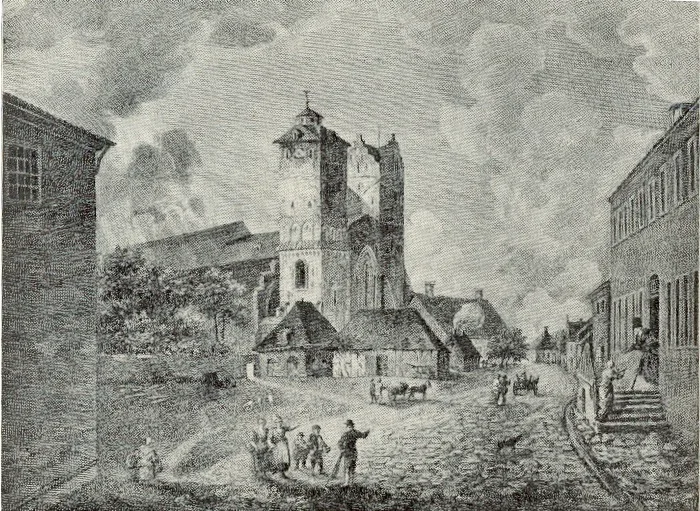 Johan Fredrik Martin after Elias Martin, Lund Cathedral (1782) This 1782 engraving shows Lund Cathedral, the archiepiscopal seat that governed the Norwegian church as suffragan bishoprics from 1104 until Nicholas Breakspear's 1152 mission split off the independent province of Nidaros. Cathedral city in what is now southern Sweden, just inside the
Skåne region (which was Danish territory until 1658). The seat
of the Scandinavian archdiocese from 1104, when Pope Paschal II
detached the Scandinavian church from the German metropolitan
see at Hamburg-Bremen. From 1104 to 1152 the Norwegian bishops
were suffragans of the Lund archbishopric. The 1152 mission of
Nicholas Breakspear created the independent Norwegian province
at Nidaros, separating the Norwegian church from Lund — though
Lund remained the senior Scandinavian see and the metropolitan
of the Danish and Swedish churches through the medieval period.
Also discussed in The Crusades?!!!! — sixty ships from Bergen, bound for the Holy LandThe Long Fall — the sudden loss of Norwegian nobility, the end of the kings, and half of Norway gone forever . He established an independent ecclesiastical province under an archbishop in Trondheim
Johan Fredrik Martin after Elias Martin, Lund Cathedral (1782) This 1782 engraving shows Lund Cathedral, the archiepiscopal seat that governed the Norwegian church as suffragan bishoprics from 1104 until Nicholas Breakspear's 1152 mission split off the independent province of Nidaros. Cathedral city in what is now southern Sweden, just inside the
Skåne region (which was Danish territory until 1658). The seat
of the Scandinavian archdiocese from 1104, when Pope Paschal II
detached the Scandinavian church from the German metropolitan
see at Hamburg-Bremen. From 1104 to 1152 the Norwegian bishops
were suffragans of the Lund archbishopric. The 1152 mission of
Nicholas Breakspear created the independent Norwegian province
at Nidaros, separating the Norwegian church from Lund — though
Lund remained the senior Scandinavian see and the metropolitan
of the Danish and Swedish churches through the medieval period.
Also discussed in The Crusades?!!!! — sixty ships from Bergen, bound for the Holy LandThe Long Fall — the sudden loss of Norwegian nobility, the end of the kings, and half of Norway gone forever . He established an independent ecclesiastical province under an archbishop in Trondheim 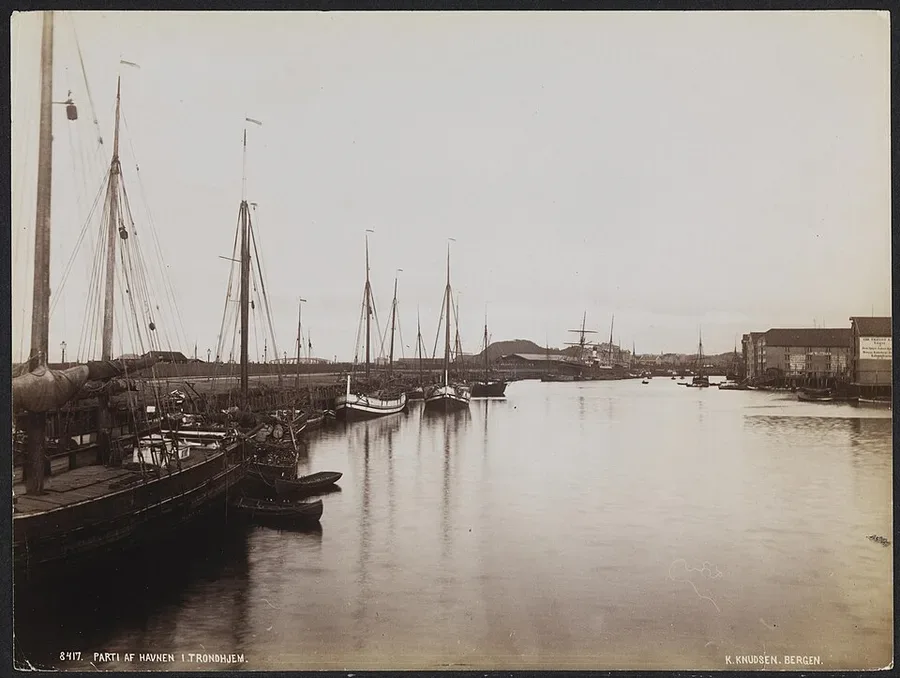 Knud Knudsen, Parti af Havnen i Trondhjem (1888-1894), National Library of Norway Knud Knudsen's photograph of Trondheim harbour in the early 1890s. Founded by Olav Tryggvason in 997 as Nidaros, the city was Norway's medieval capital and the seat of the archbishopric and the Olav cult that anchored the country's Christianity. Norway's third-largest city, founded by Olav Tryggvason in 997 as
Nidaros at the mouth of the Nid River on the inner Trondheim
Fjord. Capital of the Norwegian kingdom for much of the medieval
period; seat of the Norwegian archbishopric from 1153 and of the
Olav cult that anchored medieval Norwegian Christianity. Renamed
Trondheim in 1931 — after a controversial one-year spell
officially named Nidaros from 1930 — replacing the Danish-era
spelling Trondhjem and reviving the medieval Old Norse district
name (Þrándheimr). About two hundred thousand people in the municipality
today. Home to Nidaros Cathedral, NTNU (the Norwegian University
of Science and Technology), and the Trondheim Fjord harbour.
On the trip Day 3 of the trip routes the Gråhårsklubben (the Oldsters) through
Trondheim. The visit centres on Nidaros Cathedral — the building
the Olav devotion raised, and the architectural inheritance of
Bishop Grimkell's pronouncement on a summer day in 1031.
Trondheim Also discussed in The King Who Became a Saint — how the Nordmen came to ChristThe Crusades?!!!! — sixty ships from Bergen, bound for the Holy LandThe Golden Age — a North Atlantic empire … reaching farther than you thinkThe Long Fall — the sudden loss of Norwegian nobility, the end of the kings, and half of Norway gone foreverThe 400-Year Night — when the Northern Lion lay dormantThe Reformation, 1537 — one church eradicated and another imposedLutheran Norway and Pietism — a farmer named Hans Nielsen Hauge and a lay revival that could not be silencedWorld War II — the King’s “No” and the Nazis in NorwayBefore There Was Norway — petty kingdoms at the edge of the worldDriving in Norway — tolls, ferries, and a near-zero alcohol limitEveryday etiquette — quiet voices, wide space, no smiling🚨 Emergencies - important numbers, hospitals, and what you can doLanguage basics — just enough Norwegian to be polite , with four suffragan dioceses inside Norway — Oslo
Knud Knudsen, Parti af Havnen i Trondhjem (1888-1894), National Library of Norway Knud Knudsen's photograph of Trondheim harbour in the early 1890s. Founded by Olav Tryggvason in 997 as Nidaros, the city was Norway's medieval capital and the seat of the archbishopric and the Olav cult that anchored the country's Christianity. Norway's third-largest city, founded by Olav Tryggvason in 997 as
Nidaros at the mouth of the Nid River on the inner Trondheim
Fjord. Capital of the Norwegian kingdom for much of the medieval
period; seat of the Norwegian archbishopric from 1153 and of the
Olav cult that anchored medieval Norwegian Christianity. Renamed
Trondheim in 1931 — after a controversial one-year spell
officially named Nidaros from 1930 — replacing the Danish-era
spelling Trondhjem and reviving the medieval Old Norse district
name (Þrándheimr). About two hundred thousand people in the municipality
today. Home to Nidaros Cathedral, NTNU (the Norwegian University
of Science and Technology), and the Trondheim Fjord harbour.
On the trip Day 3 of the trip routes the Gråhårsklubben (the Oldsters) through
Trondheim. The visit centres on Nidaros Cathedral — the building
the Olav devotion raised, and the architectural inheritance of
Bishop Grimkell's pronouncement on a summer day in 1031.
Trondheim Also discussed in The King Who Became a Saint — how the Nordmen came to ChristThe Crusades?!!!! — sixty ships from Bergen, bound for the Holy LandThe Golden Age — a North Atlantic empire … reaching farther than you thinkThe Long Fall — the sudden loss of Norwegian nobility, the end of the kings, and half of Norway gone foreverThe 400-Year Night — when the Northern Lion lay dormantThe Reformation, 1537 — one church eradicated and another imposedLutheran Norway and Pietism — a farmer named Hans Nielsen Hauge and a lay revival that could not be silencedWorld War II — the King’s “No” and the Nazis in NorwayBefore There Was Norway — petty kingdoms at the edge of the worldDriving in Norway — tolls, ferries, and a near-zero alcohol limitEveryday etiquette — quiet voices, wide space, no smiling🚨 Emergencies - important numbers, hospitals, and what you can doLanguage basics — just enough Norwegian to be polite , with four suffragan dioceses inside Norway — Oslo 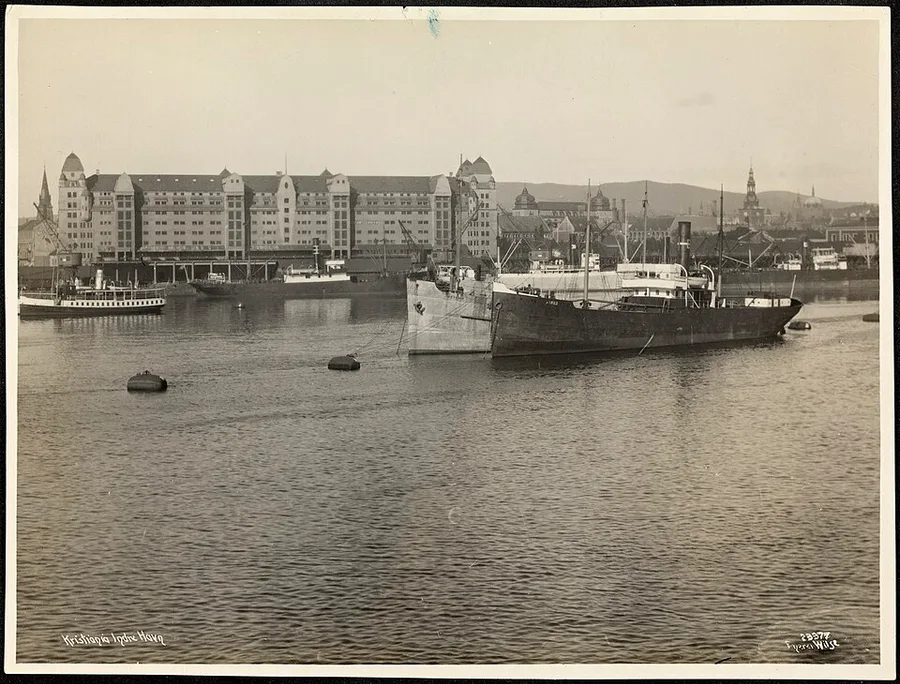 Anders Beer Wilse, Kristiania Indre Havn (1923), National Library of Norway Wilse's 1923 photograph of the inner harbor at Bjørvika, two years before Kristiania took back its old name Oslo — steamers at the quays beneath the spires of the city that grew from a medieval royal seat into Norway's capital. Capital of modern Norway, at the head of the Oslofjord on
the country's southeastern coast. Founded according to the
sagas by Harald Hardrada about 1049 and known through the
medieval period as a secondary royal seat behind Bergen and
Nidaros. Hákon V moved the royal residence permanently to
Oslo about 1300 and built Akershus Fortress to guard the
harbour. After a fire in 1624 the medieval town was
abandoned and Christian IV rebuilt the city to the west
under the new name Christiania (later Kristiania); the
name Oslo was restored in 1925. The original medieval
street pattern survives as the Gamlebyen district east of
the modern centre.
On the trip Days 1–2 belong to Oslo, with both groups together —
Roseslottet and the harbourside museums on Day 1, then the
Day-2 e-bike tour through Akershus Fortress, up Karl Johans
gate, and out to Vigeland Park.
Oslo Also discussed in The Long Fall — the sudden loss of Norwegian nobility, the end of the kings, and half of Norway gone foreverThe 400-Year Night — when the Northern Lion lay dormantThe Reformation, 1537 — one church eradicated and another imposedLutheran Norway and Pietism — a farmer named Hans Nielsen Hauge and a lay revival that could not be silencedThe Constitution That Saved a Nation — five radical weeks at Eidsvoll, 1814800,000 Norwegians Leave — the century that built a Second NorwayThe Quiet Revolution — how Norway won its independence without a warWorld War II — the King’s “No” and the Nazis in NorwayAlcohol and Vinmonopolet — when and where to buy a drinkEveryday etiquette — quiet voices, wide space, no smiling🚨 Emergencies - important numbers, hospitals, and what you can doLanding in Norway — off the plane in Oslo, where to go, step by stepMoney — currency, cards, prices, and tipping , Bergen
Anders Beer Wilse, Kristiania Indre Havn (1923), National Library of Norway Wilse's 1923 photograph of the inner harbor at Bjørvika, two years before Kristiania took back its old name Oslo — steamers at the quays beneath the spires of the city that grew from a medieval royal seat into Norway's capital. Capital of modern Norway, at the head of the Oslofjord on
the country's southeastern coast. Founded according to the
sagas by Harald Hardrada about 1049 and known through the
medieval period as a secondary royal seat behind Bergen and
Nidaros. Hákon V moved the royal residence permanently to
Oslo about 1300 and built Akershus Fortress to guard the
harbour. After a fire in 1624 the medieval town was
abandoned and Christian IV rebuilt the city to the west
under the new name Christiania (later Kristiania); the
name Oslo was restored in 1925. The original medieval
street pattern survives as the Gamlebyen district east of
the modern centre.
On the trip Days 1–2 belong to Oslo, with both groups together —
Roseslottet and the harbourside museums on Day 1, then the
Day-2 e-bike tour through Akershus Fortress, up Karl Johans
gate, and out to Vigeland Park.
Oslo Also discussed in The Long Fall — the sudden loss of Norwegian nobility, the end of the kings, and half of Norway gone foreverThe 400-Year Night — when the Northern Lion lay dormantThe Reformation, 1537 — one church eradicated and another imposedLutheran Norway and Pietism — a farmer named Hans Nielsen Hauge and a lay revival that could not be silencedThe Constitution That Saved a Nation — five radical weeks at Eidsvoll, 1814800,000 Norwegians Leave — the century that built a Second NorwayThe Quiet Revolution — how Norway won its independence without a warWorld War II — the King’s “No” and the Nazis in NorwayAlcohol and Vinmonopolet — when and where to buy a drinkEveryday etiquette — quiet voices, wide space, no smiling🚨 Emergencies - important numbers, hospitals, and what you can doLanding in Norway — off the plane in Oslo, where to go, step by stepMoney — currency, cards, prices, and tipping , Bergen 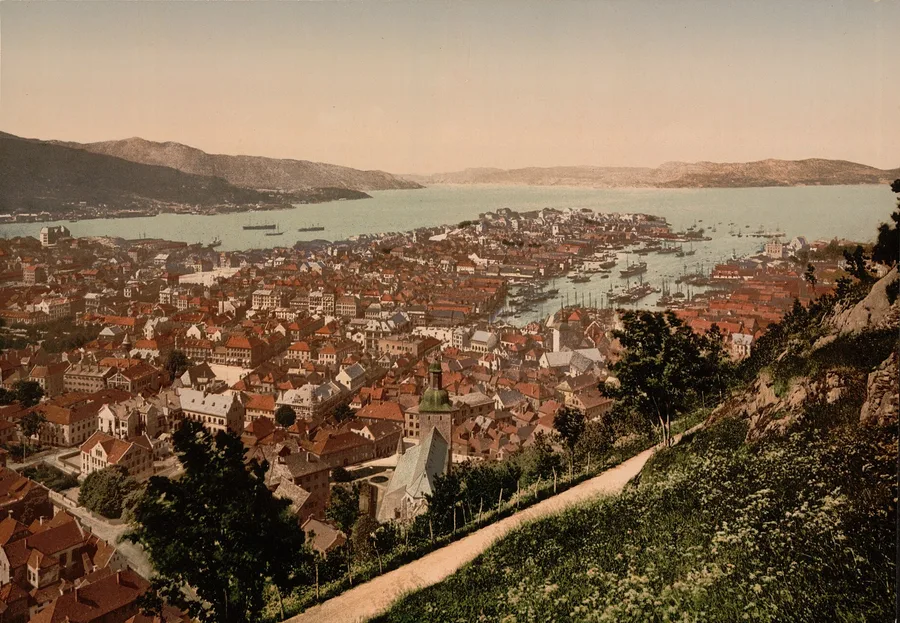 Photochrom print, General view from Fjeldveien, Bergen (c. 1890–1900), Library of Congress Bergen in the 1890s from the Fjellveien path on Fløyfjellet — the whole city between its mountains, Vågen harbour still crowded with sailing ships at its heart. For four centuries Norway's largest city, and the wharf through which the entire western export economy ran. Norway's western trading capital, founded around 1070 on the
inner Byfjorden. For four centuries the largest city in the
country and the wharf through which the entire western export
economy ran — dried cod from the Lofoten fisheries, stockpiled
and traded by the Hanseatic merchants at Bryggen from 1360 to
1754. Norway's commercial and intellectual heart through the
Hanseatic period; overtaken in size by Christiania (Oslo) in the
1830s. The painted wooden Bryggen wharf is on the UNESCO World
Heritage list and substantially what it was in the late
seventeenth century.
In this article Saint Sunniva's relics were translated to the Christ Church in
Bergen by the late eleventh century, anchoring the secondary
western saint-cult of medieval Norway. The ecclesiastical
province Nicholas Breakspear organized in 1152 included Bergen
as a suffragan diocese under the new archbishopric at Nidaros.
On the trip The Ungdommene (the Youngsters) reach Bergen late on Day 3
via the Norway-in-a-Nutshell train-and-ferry route from
Oslo. On the Day 4 morning they walk Bryggen and ride the
funicular up Mount Fløyen before flying back to Oslo and driving
on to Lillehammer that evening — a day ahead of the Gråhårsklubben
(the Oldsters), who spend the split days north in Trondheim and
the heritage country of Stjørdal, Hegra, and Kylloplass and come
south on Day 5.
Bergen Also discussed in The Germans Who "Ruled" Bergen — the Hanseatic merchants on Bryggen WharfBefore There Was Norway — petty kingdoms at the edge of the worldThe King Who Became a Saint — how the Nordmen came to ChristThe Long Fall — the sudden loss of Norwegian nobility, the end of the kings, and half of Norway gone foreverThe Golden Age — a North Atlantic empire … reaching farther than you thinkThe 400-Year Night — when the Northern Lion lay dormantThe Crusades?!!!! — sixty ships from Bergen, bound for the Holy LandThe Reformation, 1537 — one church eradicated and another imposedWorld War II — the King’s “No” and the Nazis in NorwayKraken — the island-sized beast, logged as factSjøormer — the serpents in the deep lakes and fjordsPesta — an old woman walking from farm to farmFossegrimen — the waterfall fiddler who teaches you to playAlcohol and Vinmonopolet — when and where to buy a drinkEveryday etiquette — quiet voices, wide space, no smilingFood and dining customs — having patience, free water, brunost on everything🚨 Emergencies - important numbers, hospitals, and what you can doLanguage basics — just enough Norwegian to be politeWhat to wear — the layering system, on the ground , Stavanger
Photochrom print, General view from Fjeldveien, Bergen (c. 1890–1900), Library of Congress Bergen in the 1890s from the Fjellveien path on Fløyfjellet — the whole city between its mountains, Vågen harbour still crowded with sailing ships at its heart. For four centuries Norway's largest city, and the wharf through which the entire western export economy ran. Norway's western trading capital, founded around 1070 on the
inner Byfjorden. For four centuries the largest city in the
country and the wharf through which the entire western export
economy ran — dried cod from the Lofoten fisheries, stockpiled
and traded by the Hanseatic merchants at Bryggen from 1360 to
1754. Norway's commercial and intellectual heart through the
Hanseatic period; overtaken in size by Christiania (Oslo) in the
1830s. The painted wooden Bryggen wharf is on the UNESCO World
Heritage list and substantially what it was in the late
seventeenth century.
In this article Saint Sunniva's relics were translated to the Christ Church in
Bergen by the late eleventh century, anchoring the secondary
western saint-cult of medieval Norway. The ecclesiastical
province Nicholas Breakspear organized in 1152 included Bergen
as a suffragan diocese under the new archbishopric at Nidaros.
On the trip The Ungdommene (the Youngsters) reach Bergen late on Day 3
via the Norway-in-a-Nutshell train-and-ferry route from
Oslo. On the Day 4 morning they walk Bryggen and ride the
funicular up Mount Fløyen before flying back to Oslo and driving
on to Lillehammer that evening — a day ahead of the Gråhårsklubben
(the Oldsters), who spend the split days north in Trondheim and
the heritage country of Stjørdal, Hegra, and Kylloplass and come
south on Day 5.
Bergen Also discussed in The Germans Who "Ruled" Bergen — the Hanseatic merchants on Bryggen WharfBefore There Was Norway — petty kingdoms at the edge of the worldThe King Who Became a Saint — how the Nordmen came to ChristThe Long Fall — the sudden loss of Norwegian nobility, the end of the kings, and half of Norway gone foreverThe Golden Age — a North Atlantic empire … reaching farther than you thinkThe 400-Year Night — when the Northern Lion lay dormantThe Crusades?!!!! — sixty ships from Bergen, bound for the Holy LandThe Reformation, 1537 — one church eradicated and another imposedWorld War II — the King’s “No” and the Nazis in NorwayKraken — the island-sized beast, logged as factSjøormer — the serpents in the deep lakes and fjordsPesta — an old woman walking from farm to farmFossegrimen — the waterfall fiddler who teaches you to playAlcohol and Vinmonopolet — when and where to buy a drinkEveryday etiquette — quiet voices, wide space, no smilingFood and dining customs — having patience, free water, brunost on everything🚨 Emergencies - important numbers, hospitals, and what you can doLanguage basics — just enough Norwegian to be politeWhat to wear — the layering system, on the ground , Stavanger 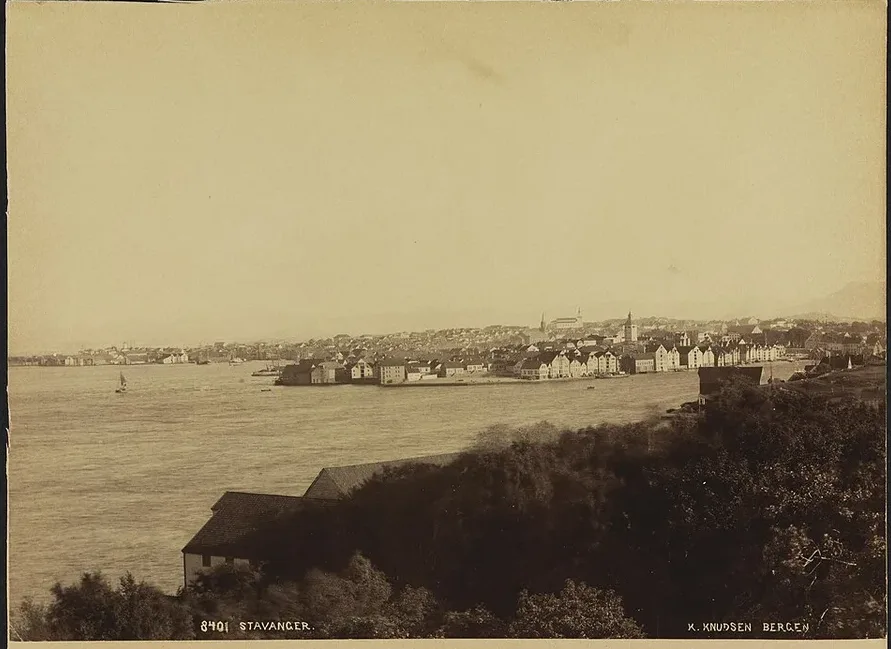 Knud Knudsen, Stavanger (1888-1894), National Library of Norway Stavanger in the late 1880s — the low wooden harbour town, church towers on the skyline, that the emigrant ships had been sailing from for two generations by the time Knudsen photographed it. City on the southwestern Norwegian coast in Rogaland; modern
Norway's fourth-largest city and the operational capital of the
Norwegian petroleum economy since the 1970s. The traditional site
of the sea-battle of Hafrsfjord that completed Harald Fairhair's
consolidation lies at the city's southwestern edge, marked by the
Sverd i fjell monument. The Norwegian Petroleum Directorate, the
safety regulator (Havtil), and Equinor (formerly Statoil) are all
headquartered in or around the city. Population around one hundred
and forty thousand in the municipality; metropolitan area roughly
twice that.
Stavanger In this article Long before the oil economy, Stavanger was a cathedral town —
one of the five mainland sees of the medieval Norwegian church,
its Anglo-Norman cathedral begun in the early 1100s. Its bishop,
Jón Birgisson, left this chair in 1152 to become the first
archbishop of Nidaros.
Also discussed in Before There Was Norway — petty kingdoms at the edge of the worldThe Viking Age — longships, legends, and the first "Norway"The 400-Year Night — when the Northern Lion lay dormantThe 'Lucky Country' — the discovery that changed everything800,000 Norwegians Leave — the century that built a Second NorwayWorld War II — the King’s “No” and the Nazis in Norway , and Hamar
Knud Knudsen, Stavanger (1888-1894), National Library of Norway Stavanger in the late 1880s — the low wooden harbour town, church towers on the skyline, that the emigrant ships had been sailing from for two generations by the time Knudsen photographed it. City on the southwestern Norwegian coast in Rogaland; modern
Norway's fourth-largest city and the operational capital of the
Norwegian petroleum economy since the 1970s. The traditional site
of the sea-battle of Hafrsfjord that completed Harald Fairhair's
consolidation lies at the city's southwestern edge, marked by the
Sverd i fjell monument. The Norwegian Petroleum Directorate, the
safety regulator (Havtil), and Equinor (formerly Statoil) are all
headquartered in or around the city. Population around one hundred
and forty thousand in the municipality; metropolitan area roughly
twice that.
Stavanger In this article Long before the oil economy, Stavanger was a cathedral town —
one of the five mainland sees of the medieval Norwegian church,
its Anglo-Norman cathedral begun in the early 1100s. Its bishop,
Jón Birgisson, left this chair in 1152 to become the first
archbishop of Nidaros.
Also discussed in Before There Was Norway — petty kingdoms at the edge of the worldThe Viking Age — longships, legends, and the first "Norway"The 400-Year Night — when the Northern Lion lay dormantThe 'Lucky Country' — the discovery that changed everything800,000 Norwegians Leave — the century that built a Second NorwayWorld War II — the King’s “No” and the Nazis in Norway , and Hamar 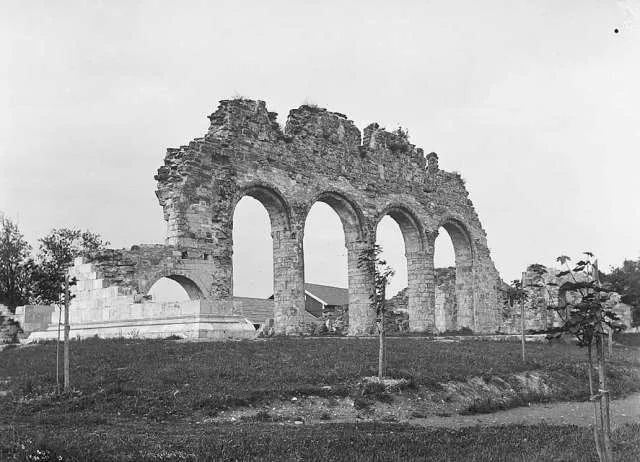 Axel Lindahl, the cathedral ruins in Hamar (c. 1880-1890), Norwegian Museum of Cultural History Hamar's medieval cathedral, seat of the diocese Nicholas Breakspear established in 1152, stood until Swedish forces burned it in 1567; this 1880s photograph shows the roofless nave arches before the ruins were enclosed under their present protective canopy. City on the western shore of Lake Mjøsa in the inland east of
Norway. Founded as a market town and episcopal seat by the papal
legate Nicholas Breakspear in 1152, when it was also made one of
the four Norwegian suffragan dioceses of the new Nidaros
archdiocese. The medieval cathedral was destroyed by Swedish
forces in 1567; the surviving ruins on the Hamar peninsula are
preserved under a protective glass-and-steel canopy. The modern
city has around thirty thousand people and is the seat of the
Eidsivating Court of Appeal — the inheritance of the medieval
inland law-tradition.
Hamar Also discussed in The Reformation, 1537 — one church eradicated and another imposedThe 400-Year Night — when the Northern Lion lay dormant — and six more across the Norse Atlantic: two in Iceland
Axel Lindahl, the cathedral ruins in Hamar (c. 1880-1890), Norwegian Museum of Cultural History Hamar's medieval cathedral, seat of the diocese Nicholas Breakspear established in 1152, stood until Swedish forces burned it in 1567; this 1880s photograph shows the roofless nave arches before the ruins were enclosed under their present protective canopy. City on the western shore of Lake Mjøsa in the inland east of
Norway. Founded as a market town and episcopal seat by the papal
legate Nicholas Breakspear in 1152, when it was also made one of
the four Norwegian suffragan dioceses of the new Nidaros
archdiocese. The medieval cathedral was destroyed by Swedish
forces in 1567; the surviving ruins on the Hamar peninsula are
preserved under a protective glass-and-steel canopy. The modern
city has around thirty thousand people and is the seat of the
Eidsivating Court of Appeal — the inheritance of the medieval
inland law-tradition.
Hamar Also discussed in The Reformation, 1537 — one church eradicated and another imposedThe 400-Year Night — when the Northern Lion lay dormant — and six more across the Norse Atlantic: two in Iceland 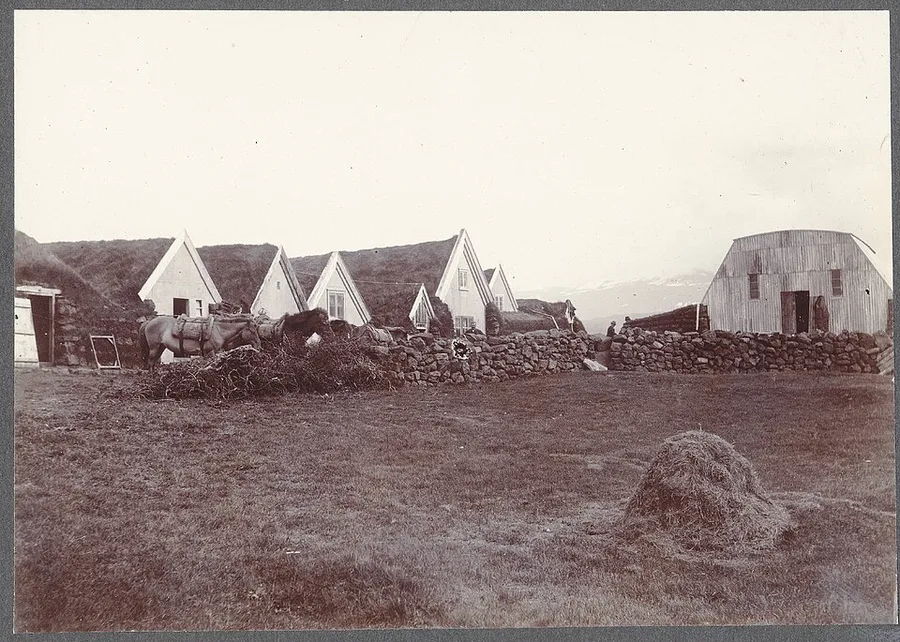 Frederick W. W. Howell, Galtalækur and Hekla (c. 1900), Fiske Icelandic Collection, Cornell University Library A turf-walled farm under Hekla, photographed about 1900 — Iceland as the settlers from Norway made it: a country of farms without a king or towns, governed by the annual open-air Alþing and remembered in the sagas their descendants wrote. The North Atlantic island settled from Norway in the ninth and
tenth centuries by chieftains and their followings who refused to
accept Harald Fairhair's authority on the Norwegian mainland and
emigrated rather than submit. They built a country without a king,
governed by an annual open-air assembly at Þingvellir called the
Alþing — the oldest parliament in the world by date of founding. Three centuries after the migration, their descendants
(notably Snorri Sturluson) composed the prose sagas that became
almost the only literary memory of the Norwegian petty kingdoms.
In this article Iceland held two of the eleven sees of the medieval Norwegian
church province — Skálholt in the south and Hólar in the north —
both answering to the archbishop at Nidaros from 1152 until the
Reformation.
Also discussed in Before There Was Norway — petty kingdoms at the edge of the worldThe Viking Age — longships, legends, and the first "Norway"Worshiping Odin and Thor — the lived religion of pre-Christian NorwayThe King Who Became a Saint — how the Nordmen came to ChristThe Golden Age — a North Atlantic empire … reaching farther than you thinkThe 400-Year Night — when the Northern Lion lay dormant ( Skálholt
Frederick W. W. Howell, Galtalækur and Hekla (c. 1900), Fiske Icelandic Collection, Cornell University Library A turf-walled farm under Hekla, photographed about 1900 — Iceland as the settlers from Norway made it: a country of farms without a king or towns, governed by the annual open-air Alþing and remembered in the sagas their descendants wrote. The North Atlantic island settled from Norway in the ninth and
tenth centuries by chieftains and their followings who refused to
accept Harald Fairhair's authority on the Norwegian mainland and
emigrated rather than submit. They built a country without a king,
governed by an annual open-air assembly at Þingvellir called the
Alþing — the oldest parliament in the world by date of founding. Three centuries after the migration, their descendants
(notably Snorri Sturluson) composed the prose sagas that became
almost the only literary memory of the Norwegian petty kingdoms.
In this article Iceland held two of the eleven sees of the medieval Norwegian
church province — Skálholt in the south and Hólar in the north —
both answering to the archbishop at Nidaros from 1152 until the
Reformation.
Also discussed in Before There Was Norway — petty kingdoms at the edge of the worldThe Viking Age — longships, legends, and the first "Norway"Worshiping Odin and Thor — the lived religion of pre-Christian NorwayThe King Who Became a Saint — how the Nordmen came to ChristThe Golden Age — a North Atlantic empire … reaching farther than you thinkThe 400-Year Night — when the Northern Lion lay dormant ( Skálholt 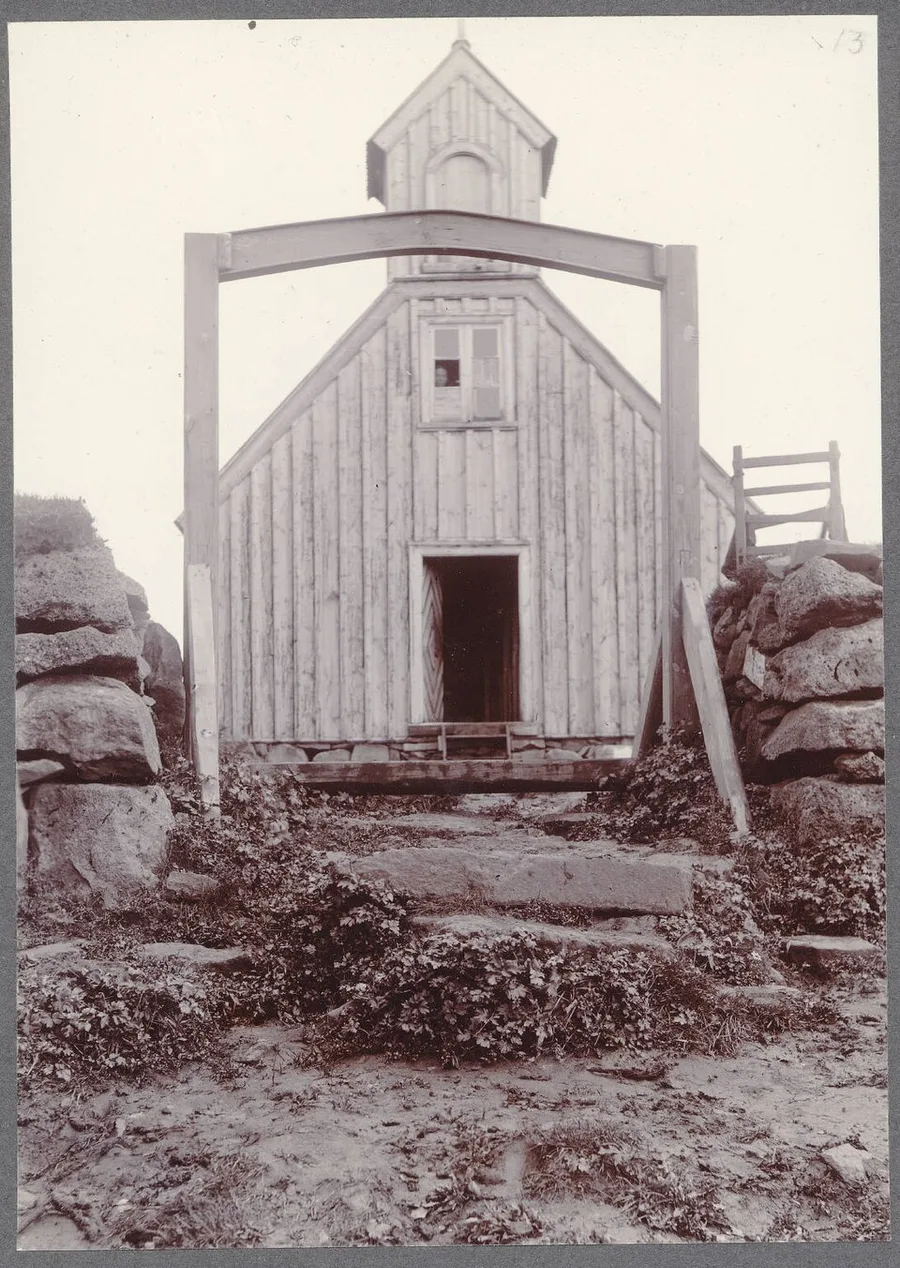 Frederick W. W. Howell, Skálholt Church. Entrance. (c. 1900), Fiske Icelandic Collection, Cornell University Library Frederick Howell's circa-1900 photograph shows the church at Skálholt, Iceland's first and senior bishopric, founded in 1056 and placed under the new Norwegian archdiocese of Nidaros in 1152 alongside its northern counterpart at Hólar. Cathedral see and historical centre of southern Iceland, founded
as the first Icelandic episcopal seat in 1056. One of the two
Icelandic suffragan dioceses (with Hólar) under the new Norwegian
archdiocese of Nidaros from 1152. For seven centuries Skálholt
was the spiritual and cultural capital of Iceland; the see was
abolished and the cathedral school moved to Reykjavík in 1801.
The site today preserves a modern reconstruction of the medieval
cathedral and a small museum.
and Hólar
Frederick W. W. Howell, Skálholt Church. Entrance. (c. 1900), Fiske Icelandic Collection, Cornell University Library Frederick Howell's circa-1900 photograph shows the church at Skálholt, Iceland's first and senior bishopric, founded in 1056 and placed under the new Norwegian archdiocese of Nidaros in 1152 alongside its northern counterpart at Hólar. Cathedral see and historical centre of southern Iceland, founded
as the first Icelandic episcopal seat in 1056. One of the two
Icelandic suffragan dioceses (with Hólar) under the new Norwegian
archdiocese of Nidaros from 1152. For seven centuries Skálholt
was the spiritual and cultural capital of Iceland; the see was
abolished and the cathedral school moved to Reykjavík in 1801.
The site today preserves a modern reconstruction of the medieval
cathedral and a small museum.
and Hólar 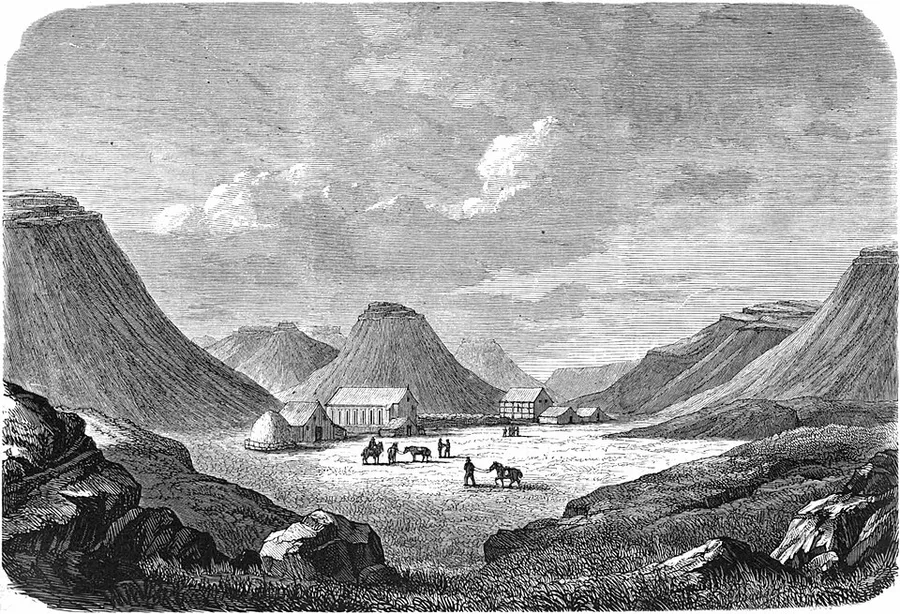 Unknown artist, Det gamle islandske bispesæde Hólum i Hjaltadal (1870), Nordiske Billeder This 1870 print shows Hólar, seat of the second Icelandic diocese under the Norwegian archbishopric of Nidaros from 1152 — a bishopric that also ran Iceland's first printing press from 1530. Cathedral see in northern Iceland, founded in 1106 as the second
Icelandic episcopal seat after Skálholt in the south. One of the
two Icelandic suffragan dioceses under the new Norwegian
archdiocese of Nidaros from 1152. Hosted the first printing press
in Iceland from 1530. The see was abolished in 1801; today Hólar
is a small village of around a hundred residents, with the
eighteenth-century stone cathedral still standing on the original
site.
), and one each in Greenland
Unknown artist, Det gamle islandske bispesæde Hólum i Hjaltadal (1870), Nordiske Billeder This 1870 print shows Hólar, seat of the second Icelandic diocese under the Norwegian archbishopric of Nidaros from 1152 — a bishopric that also ran Iceland's first printing press from 1530. Cathedral see in northern Iceland, founded in 1106 as the second
Icelandic episcopal seat after Skálholt in the south. One of the
two Icelandic suffragan dioceses under the new Norwegian
archdiocese of Nidaros from 1152. Hosted the first printing press
in Iceland from 1530. The see was abolished in 1801; today Hólar
is a small village of around a hundred residents, with the
eighteenth-century stone cathedral still standing on the original
site.
), and one each in Greenland 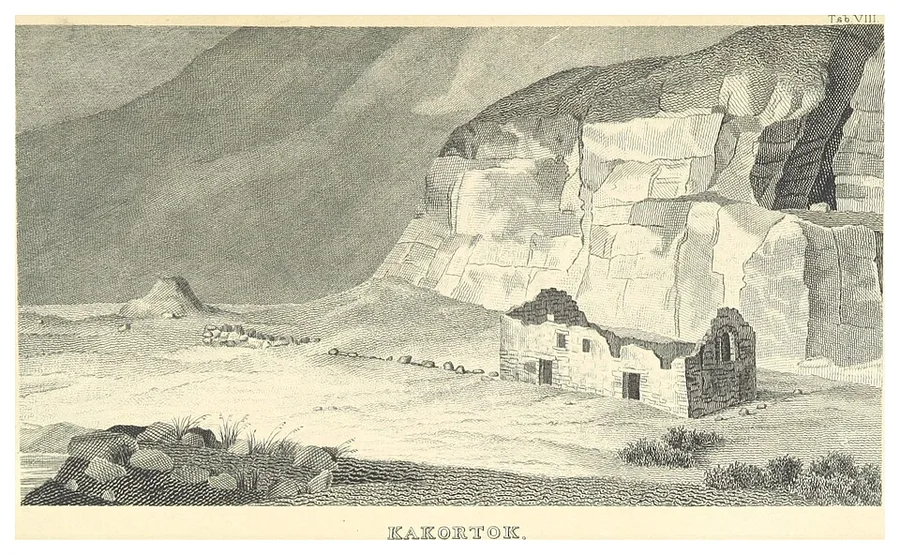 Grønlands historiske Mindesmærker vol. 3 (1845), plate VIII, British Library The stone church at Hvalsey, the best-preserved building of Norse Greenland — drawn in 1845 for the Danish survey that went looking for the lost colony. A wedding held here in 1408 is the last event anyone recorded before the settlements Erik the Red founded fell silent. The world's largest island, lying between the Arctic and Atlantic
Oceans west of Iceland. Colonised by Norse settlers led by Erik the
Red beginning in 985 — the name "Greenland" was Erik's marketing,
chosen to attract colonists to a marginally agricultural land. The
Norse Eastern and Western Settlements on the southwestern coast
sustained perhaps two or three thousand people at peak across four
centuries before steadily diminishing in the cooling climate of the
Little Ice Age and disappearing by around 1450. Today a self-
governing territory within the Kingdom of Denmark.
Also discussed in The Viking Age — longships, legends, and the first "Norway"The King Who Became a Saint — how the Nordmen came to ChristThe Golden Age — a North Atlantic empire … reaching farther than you thinkThe Long Fall — the sudden loss of Norwegian nobility, the end of the kings, and half of Norway gone foreverThe 400-Year Night — when the Northern Lion lay dormant ( Garðar
Grønlands historiske Mindesmærker vol. 3 (1845), plate VIII, British Library The stone church at Hvalsey, the best-preserved building of Norse Greenland — drawn in 1845 for the Danish survey that went looking for the lost colony. A wedding held here in 1408 is the last event anyone recorded before the settlements Erik the Red founded fell silent. The world's largest island, lying between the Arctic and Atlantic
Oceans west of Iceland. Colonised by Norse settlers led by Erik the
Red beginning in 985 — the name "Greenland" was Erik's marketing,
chosen to attract colonists to a marginally agricultural land. The
Norse Eastern and Western Settlements on the southwestern coast
sustained perhaps two or three thousand people at peak across four
centuries before steadily diminishing in the cooling climate of the
Little Ice Age and disappearing by around 1450. Today a self-
governing territory within the Kingdom of Denmark.
Also discussed in The Viking Age — longships, legends, and the first "Norway"The King Who Became a Saint — how the Nordmen came to ChristThe Golden Age — a North Atlantic empire … reaching farther than you thinkThe Long Fall — the sudden loss of Norwegian nobility, the end of the kings, and half of Norway gone foreverThe 400-Year Night — when the Northern Lion lay dormant ( Garðar 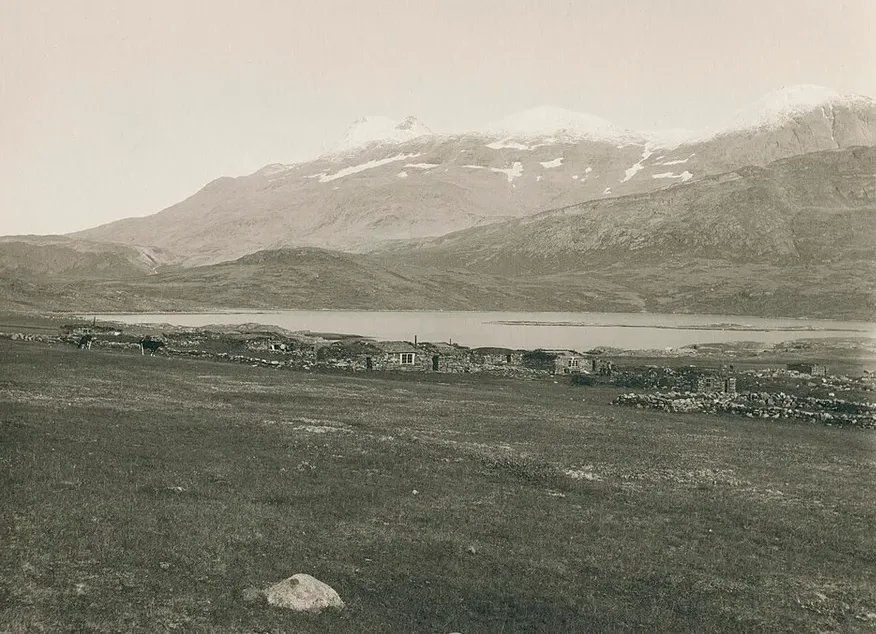 Th. N. Krabbe, The settlement Igaliko (c. 1889–1910), National Museum of Denmark Igaliku village, photographed around 1900, stands directly on the old bishopric ground of Garðar — its stone houses were built largely from the fallen red sandstone of the Norse cathedral, and the fjord and mountains behind are the view the medieval bishops of Greenland knew. Cathedral see of medieval Norse Greenland, established around 1124
on a farm in the Eastern Settlement (modern Igaliku in southern
Greenland). One of the suffragan dioceses under the new Norwegian
archdiocese of Nidaros from 1152 — the westernmost see in Western
Christendom. The medieval cathedral, built of red sandstone, was
about 27 metres long. The see was abandoned as the Norse colony
disappeared across the fifteenth century; its last documented
bishop appointed by Rome (in absentia), Vincentius Kampe, was
named in 1519 and the vacant see finally lapsed around 1537, the
year the Reformation broke the medieval Norwegian church.
), the Faroe Islands
Th. N. Krabbe, The settlement Igaliko (c. 1889–1910), National Museum of Denmark Igaliku village, photographed around 1900, stands directly on the old bishopric ground of Garðar — its stone houses were built largely from the fallen red sandstone of the Norse cathedral, and the fjord and mountains behind are the view the medieval bishops of Greenland knew. Cathedral see of medieval Norse Greenland, established around 1124
on a farm in the Eastern Settlement (modern Igaliku in southern
Greenland). One of the suffragan dioceses under the new Norwegian
archdiocese of Nidaros from 1152 — the westernmost see in Western
Christendom. The medieval cathedral, built of red sandstone, was
about 27 metres long. The see was abandoned as the Norse colony
disappeared across the fifteenth century; its last documented
bishop appointed by Rome (in absentia), Vincentius Kampe, was
named in 1519 and the vacant see finally lapsed around 1537, the
year the Reformation broke the medieval Norwegian church.
), the Faroe Islands 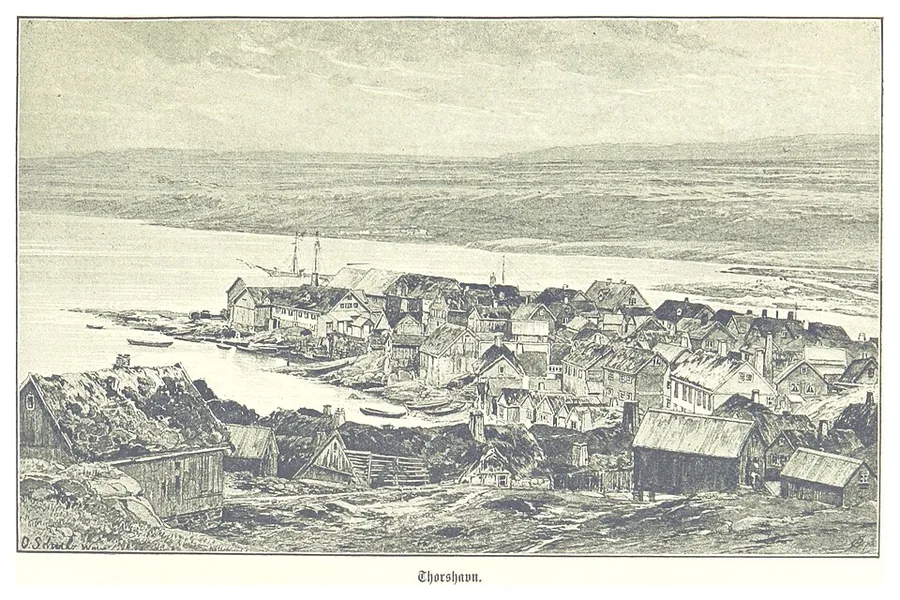 O. Schulz, Thorshavn, from A. Baumgartner, Nordische Fahrten: Island und die Färöer (1889), British Library Tórshavn, the Faroes' harbour town, engraved in 1889: turf-roofed houses crowd toward Tinganes, the low point where the Norse settlers' assembly met from around 900 and where the islands' government still sits. Archipelago of eighteen volcanic islands in the North Atlantic
between Norway, Iceland, and Scotland. Settled by Norse colonists
beginning in the early ninth century, the Faroes were under
Norwegian sovereignty by 1035; passed with Norway to Denmark in
1380 and remained under Danish rule after Norway's independence
in 1814. Today a self-governing nation within the Kingdom of
Denmark, with about fifty-three thousand people speaking Faroese
(a North Germanic language closely related to Icelandic and to
the western Norwegian dialects of Old Norse). The devotion to
Saint Olav was carried across the Faroes by the medieval Norwegian
archbishopric of Nidaros, and Olsok is still observed there.
Also discussed in The King Who Became a Saint — how the Nordmen came to ChristThe Golden Age — a North Atlantic empire … reaching farther than you thinkThe 400-Year Night — when the Northern Lion lay dormant , Orkney
O. Schulz, Thorshavn, from A. Baumgartner, Nordische Fahrten: Island und die Färöer (1889), British Library Tórshavn, the Faroes' harbour town, engraved in 1889: turf-roofed houses crowd toward Tinganes, the low point where the Norse settlers' assembly met from around 900 and where the islands' government still sits. Archipelago of eighteen volcanic islands in the North Atlantic
between Norway, Iceland, and Scotland. Settled by Norse colonists
beginning in the early ninth century, the Faroes were under
Norwegian sovereignty by 1035; passed with Norway to Denmark in
1380 and remained under Danish rule after Norway's independence
in 1814. Today a self-governing nation within the Kingdom of
Denmark, with about fifty-three thousand people speaking Faroese
(a North Germanic language closely related to Icelandic and to
the western Norwegian dialects of Old Norse). The devotion to
Saint Olav was carried across the Faroes by the medieval Norwegian
archbishopric of Nidaros, and Olsok is still observed there.
Also discussed in The King Who Became a Saint — how the Nordmen came to ChristThe Golden Age — a North Atlantic empire … reaching farther than you thinkThe 400-Year Night — when the Northern Lion lay dormant , Orkney 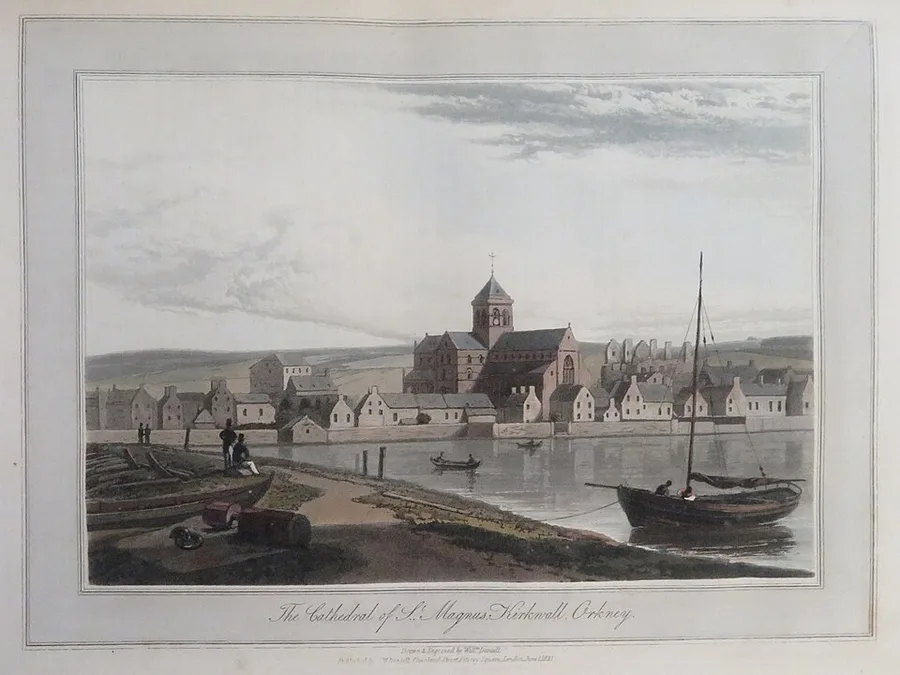 William Daniell, The Cathedral of St Magnus, Kirkwall (1821), A Voyage Round Great Britain William Daniell's 1821 view shows St Magnus Cathedral in Kirkwall, seat of the diocese of Orkney — a suffragan bishopric under the Norwegian archbishopric of Nidaros from 1152 until the Scottish crown absorbed the earldom in 1468. Archipelago of around seventy islands off the northeastern coast
of Scotland, settled heavily by Norse from the ninth century
onward and ruled as the Earldom of Orkney under the Norwegian
crown until 1468, when the islands were pledged to Scotland as
surety for the dowry of a Norwegian princess and never redeemed.
The diocese of Orkney was one of the suffragan dioceses under
the Norwegian archdiocese of Nidaros from 1152 onward, with the
cathedral at Kirkwall — St. Magnus Cathedral, founded 1137 by
Earl Rognvald in honour of his martyred uncle Magnus Erlendsson —
one of the most northerly Romanesque cathedrals in Europe.
Hákon IV of Norway died at the Bishop's Palace in Kirkwall in
December 1263 after the unsuccessful Scottish campaign.
Also discussed in The Golden Age — a North Atlantic empire … reaching farther than you think , and the Sudreyjar
William Daniell, The Cathedral of St Magnus, Kirkwall (1821), A Voyage Round Great Britain William Daniell's 1821 view shows St Magnus Cathedral in Kirkwall, seat of the diocese of Orkney — a suffragan bishopric under the Norwegian archbishopric of Nidaros from 1152 until the Scottish crown absorbed the earldom in 1468. Archipelago of around seventy islands off the northeastern coast
of Scotland, settled heavily by Norse from the ninth century
onward and ruled as the Earldom of Orkney under the Norwegian
crown until 1468, when the islands were pledged to Scotland as
surety for the dowry of a Norwegian princess and never redeemed.
The diocese of Orkney was one of the suffragan dioceses under
the Norwegian archdiocese of Nidaros from 1152 onward, with the
cathedral at Kirkwall — St. Magnus Cathedral, founded 1137 by
Earl Rognvald in honour of his martyred uncle Magnus Erlendsson —
one of the most northerly Romanesque cathedrals in Europe.
Hákon IV of Norway died at the Bishop's Palace in Kirkwall in
December 1263 after the unsuccessful Scottish campaign.
Also discussed in The Golden Age — a North Atlantic empire … reaching farther than you think , and the Sudreyjar 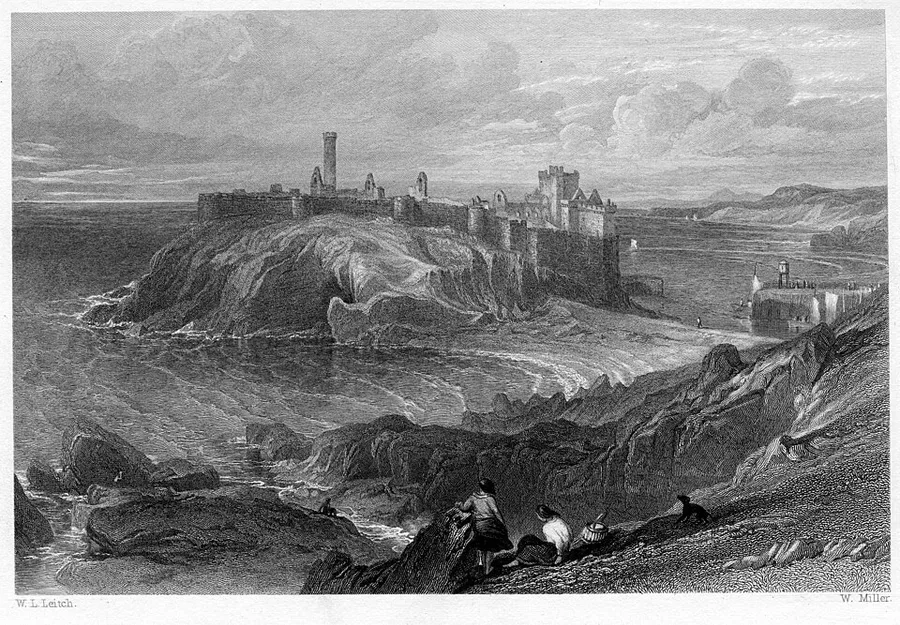 William Miller after William Leighton Leitch, Peel Castle, Isle of Man (1845), Waverley Novels (Abbotsford Edition) Peel Castle on St Patrick's Isle held the cathedral of the medieval diocese of Sudreyjar — the 'southern isles' see stretching across the Hebrides and Man — a Nidaros suffragan bishopric until Norway ceded the islands to Scotland under the 1266 Treaty of Perth. Old Norse for "southern isles" — the diocese encompassing the
southern Hebrides off the western coast of Scotland and the Isle
of Man in the Irish Sea. One of the suffragan dioceses under the
new Norwegian archdiocese of Nidaros from 1152 to 1266, when
Norwegian sovereignty over the Hebrides and Man was ceded to
Scotland under the Treaty of Perth. The diocese (the modern
Diocese of Sodor and Man) survives in the Church of England as
one of its smallest, comprising the Isle of Man alone.
Also discussed in The Golden Age — a North Atlantic empire … reaching farther than you think (the southern Hebrides and the Isle of Man). Jón Birgisson
William Miller after William Leighton Leitch, Peel Castle, Isle of Man (1845), Waverley Novels (Abbotsford Edition) Peel Castle on St Patrick's Isle held the cathedral of the medieval diocese of Sudreyjar — the 'southern isles' see stretching across the Hebrides and Man — a Nidaros suffragan bishopric until Norway ceded the islands to Scotland under the 1266 Treaty of Perth. Old Norse for "southern isles" — the diocese encompassing the
southern Hebrides off the western coast of Scotland and the Isle
of Man in the Irish Sea. One of the suffragan dioceses under the
new Norwegian archdiocese of Nidaros from 1152 to 1266, when
Norwegian sovereignty over the Hebrides and Man was ceded to
Scotland under the Treaty of Perth. The diocese (the modern
Diocese of Sodor and Man) survives in the Church of England as
one of its smallest, comprising the Isle of Man alone.
Also discussed in The Golden Age — a North Atlantic empire … reaching farther than you think (the southern Hebrides and the Isle of Man). Jón Birgisson 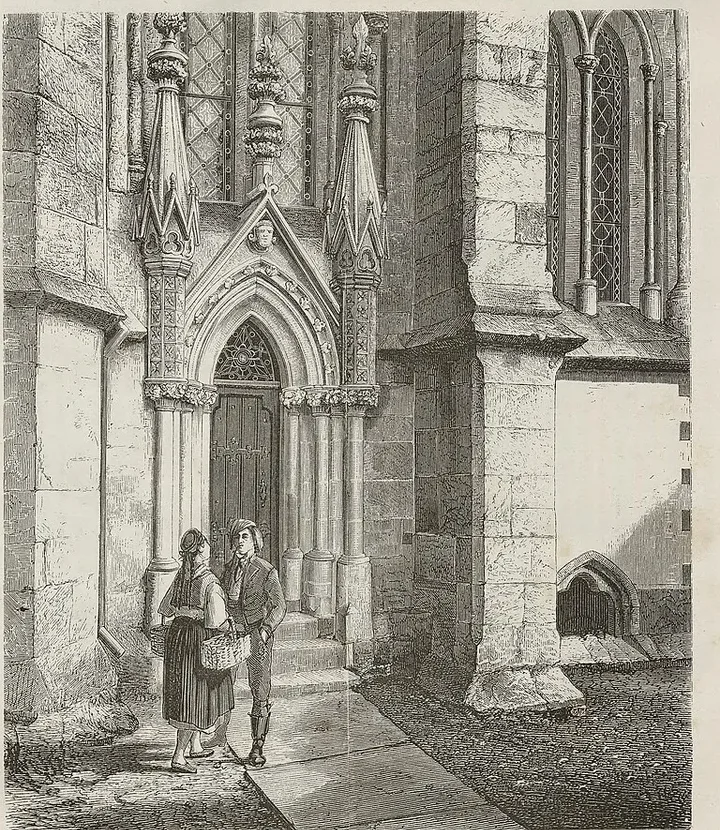 Unknown artist, Stavanger domkirke, in Nordiska taflor (Albert Bonnier, 1870) - Nasjonalbiblioteket No portrait of Jón survives. The plate shows the ornate choir entrance of Stavanger Cathedral, begun in the early 1100s — the church Jón led as Bishop of Stavanger before Nicholas Breakspear raised him to the new archbishop's chair at Nidaros in 1152. First Archbishop of Nidaros, installed by Nicholas Breakspear at
the 1152 council establishing the Norwegian ecclesiastical province
independent of the Danish metropolitan see at Lund. Previously
Bishop of Stavanger. Ruled the new archbishopric from Nidaros
(Trondheim) until his death around 1157. The four-hundred-year
structure of the medieval Norwegian church that Breakspear
designed and Jón Birgisson inherited would last almost unchanged
until the 1537 Reformation.
, the previous bishop of Stavanger, was installed as the first archbishop. The structure Breakspear set lasted, almost unchanged, for nearly four hundred years. He was elected Pope two years later, the only Englishman ever to hold the office, and ruled the Western Church as Adrian IV.
Unknown artist, Stavanger domkirke, in Nordiska taflor (Albert Bonnier, 1870) - Nasjonalbiblioteket No portrait of Jón survives. The plate shows the ornate choir entrance of Stavanger Cathedral, begun in the early 1100s — the church Jón led as Bishop of Stavanger before Nicholas Breakspear raised him to the new archbishop's chair at Nidaros in 1152. First Archbishop of Nidaros, installed by Nicholas Breakspear at
the 1152 council establishing the Norwegian ecclesiastical province
independent of the Danish metropolitan see at Lund. Previously
Bishop of Stavanger. Ruled the new archbishopric from Nidaros
(Trondheim) until his death around 1157. The four-hundred-year
structure of the medieval Norwegian church that Breakspear
designed and Jón Birgisson inherited would last almost unchanged
until the 1537 Reformation.
, the previous bishop of Stavanger, was installed as the first archbishop. The structure Breakspear set lasted, almost unchanged, for nearly four hundred years. He was elected Pope two years later, the only Englishman ever to hold the office, and ruled the Western Church as Adrian IV.
The Norwegian church Breakspear organized was small by European measures and uneven in reach. It had at its peak roughly thirteen hundred parishes — against the tens of thousands in England and the German lands — and around thirty monasteries. Its bishops travelled to Rome on long sea-and-land journeys that took months in each direction. Its parish priests in remote inland districts might not see a bishop in their lifetime. The surviving correspondence between Trondheim and Rome includes long pleading letters about the difficulty of collecting the annual papal tribute from farmers who had no coin.
But within Norway, this church was the country’s first national administration of any kind. It kept land records, supplied the only Latin-literate clerks the kingdom had, ran the only schools, and collected the tithe across every district. By the eve of the Reformation it owned around forty per cent of Norway’s productive farmland. There had been kings in Norway before the church. There had not been a working national administration.
What the church wrote
The literate culture the medieval Norwegian church produced was small, mostly in Latin, and almost entirely clerical. Norway never developed a vernacular literary class on the scale of England or France; the country’s literate population in the high Middle Ages would have fit inside one large continental cathedral chapter. But the writing that did survive is substantial. The richest single document is the Konungs skuggsjá 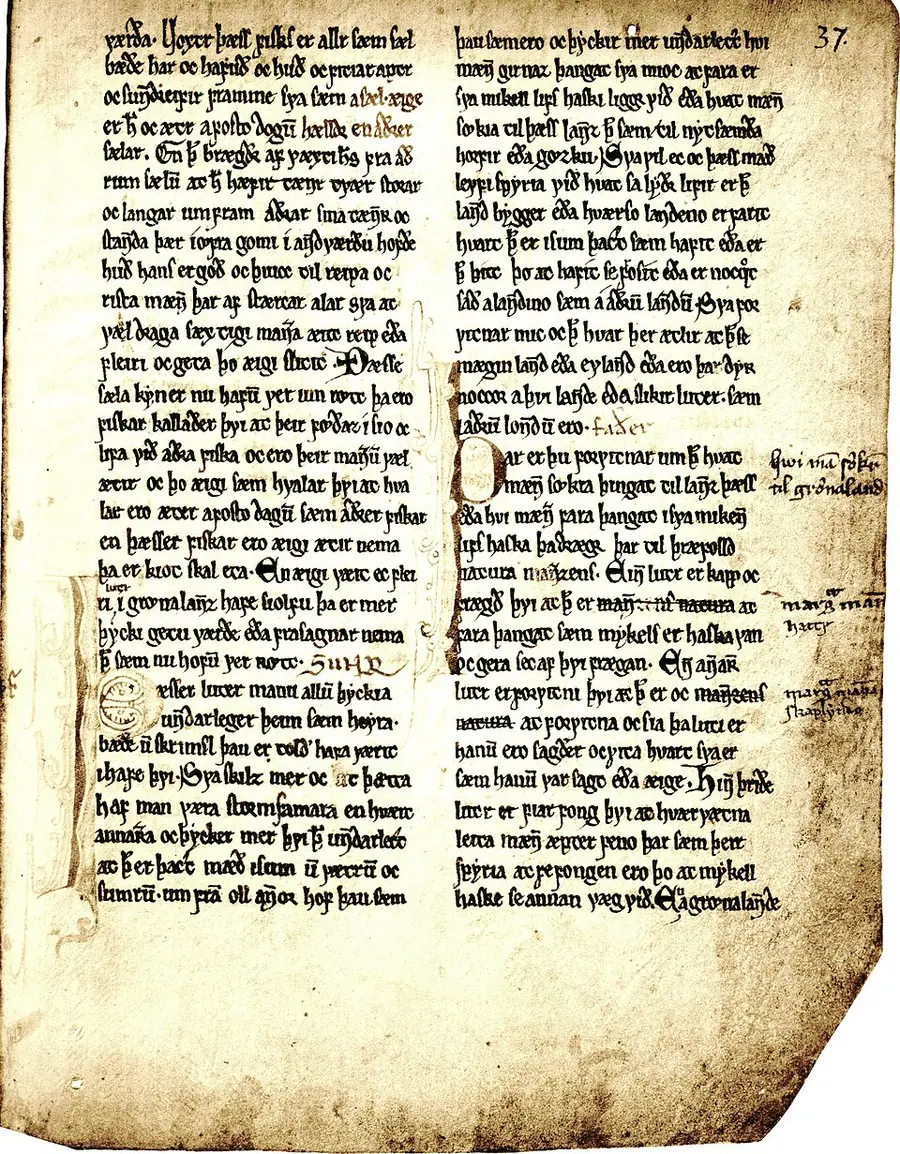 Konungs skuggsjá manuscript leaf, reproduced in Kristian Kålund, Palæografisk Atlas (1905) A leaf of the anonymous mid-13th-century text staged as a father-son dialogue on law, manners, and the natural world — the King's Mirror survives only through manuscript and print copies, not one showcase original, so a page like this stands for the whole copying tradition. The King's Mirror — the richest single Old Norwegian literary
document of the medieval Norwegian church period. Composed
anonymously around 1250 during the reign of Hákon IV as a long
conversation between father and son, the Konungs skuggsjá
covers law, courtly manners, geography, natural science, and
theology in a single sustained voice — a Norwegian contribution
to the medieval European mirror-for-princes genre. Particularly
important as one of the few medieval Scandinavian sources
containing detailed observations of the Atlantic — including
the earliest known European descriptions of Greenland's ice
floes, the aurora borealis, and the natural history of the
northern seas.
Also discussed in The Golden Age — a North Atlantic empire … reaching farther than you think , the King’s Mirror, composed in Old Norwegian around 1250, during the reign of Hákon IV Hákonarson
Konungs skuggsjá manuscript leaf, reproduced in Kristian Kålund, Palæografisk Atlas (1905) A leaf of the anonymous mid-13th-century text staged as a father-son dialogue on law, manners, and the natural world — the King's Mirror survives only through manuscript and print copies, not one showcase original, so a page like this stands for the whole copying tradition. The King's Mirror — the richest single Old Norwegian literary
document of the medieval Norwegian church period. Composed
anonymously around 1250 during the reign of Hákon IV as a long
conversation between father and son, the Konungs skuggsjá
covers law, courtly manners, geography, natural science, and
theology in a single sustained voice — a Norwegian contribution
to the medieval European mirror-for-princes genre. Particularly
important as one of the few medieval Scandinavian sources
containing detailed observations of the Atlantic — including
the earliest known European descriptions of Greenland's ice
floes, the aurora borealis, and the natural history of the
northern seas.
Also discussed in The Golden Age — a North Atlantic empire … reaching farther than you think , the King’s Mirror, composed in Old Norwegian around 1250, during the reign of Hákon IV Hákonarson 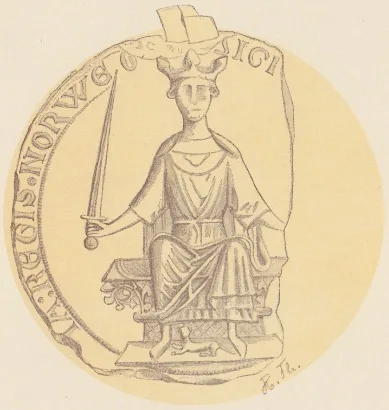 Drawing by Hakon Thorsen after the 1247/48 seal of Håkon IV, in Chr. Brinchmann, Norske Konge-sigiller (1924) The great seal Håkon IV affixed to royal charters — a crowned king enthroned with a sword, the authority behind the "Golden Age" reign that brought Iceland under the Norwegian crown and produced the Konungs skuggsjá. King of Norway 1217–1263, bynamed Hákon the Old in later
tradition. His reign opened the Golden Age of medieval Norway —
the country's last sustained period as an independent international
power before the dynastic absorption into Denmark a century later.
Brought the long civil war period to an end, extended Norwegian
sovereignty to Iceland (which acknowledged him as king in 1262)
and the Hebrides and Isle of Man, codified Norwegian law, and
presided over the literary court that produced the Konungs
skuggsjá (The King's Mirror) around 1250. Died on Orkney in
December 1263 returning from his unsuccessful Scottish campaign.
Also discussed in The Golden Age — a North Atlantic empire … reaching farther than you thinkThe Long Fall — the sudden loss of Norwegian nobility, the end of the kings, and half of Norway gone foreverThe Germans Who "Ruled" Bergen — the Hanseatic merchants on Bryggen Wharf , as a long conversation between father and son covering law, courtly manners, geography, natural science, and theology in a single sustained voice.
Drawing by Hakon Thorsen after the 1247/48 seal of Håkon IV, in Chr. Brinchmann, Norske Konge-sigiller (1924) The great seal Håkon IV affixed to royal charters — a crowned king enthroned with a sword, the authority behind the "Golden Age" reign that brought Iceland under the Norwegian crown and produced the Konungs skuggsjá. King of Norway 1217–1263, bynamed Hákon the Old in later
tradition. His reign opened the Golden Age of medieval Norway —
the country's last sustained period as an independent international
power before the dynastic absorption into Denmark a century later.
Brought the long civil war period to an end, extended Norwegian
sovereignty to Iceland (which acknowledged him as king in 1262)
and the Hebrides and Isle of Man, codified Norwegian law, and
presided over the literary court that produced the Konungs
skuggsjá (The King's Mirror) around 1250. Died on Orkney in
December 1263 returning from his unsuccessful Scottish campaign.
Also discussed in The Golden Age — a North Atlantic empire … reaching farther than you thinkThe Long Fall — the sudden loss of Norwegian nobility, the end of the kings, and half of Norway gone foreverThe Germans Who "Ruled" Bergen — the Hanseatic merchants on Bryggen Wharf , as a long conversation between father and son covering law, courtly manners, geography, natural science, and theology in a single sustained voice.
The legal codification that ran alongside it produced the four great regional law-codes: the Gulating 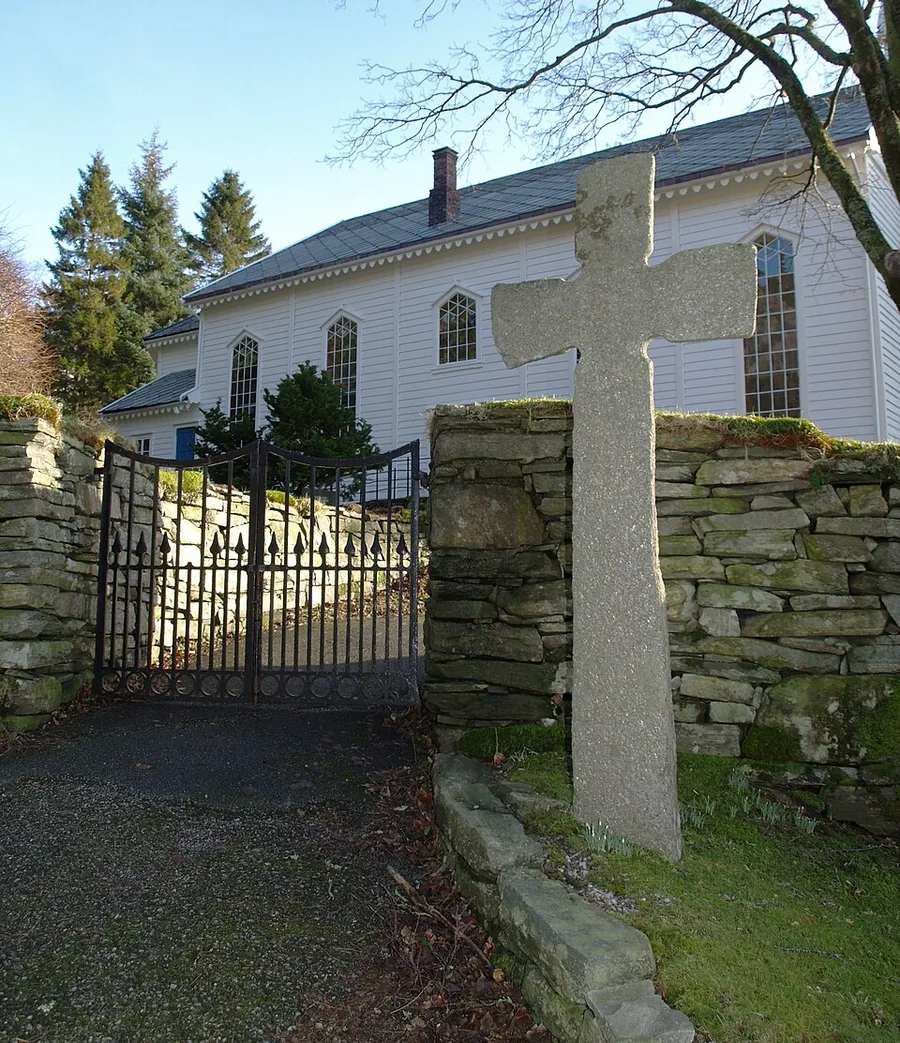 Jeblad, Steinkorset ved porten til Eivindvik kirke (2008), Wikimedia Commons, CC BY-SA 3.0 The early-medieval stone cross at Eivindvik, by the church gate at Gulen. The law assemblies raised no buildings that survive; this weathered cross, standing near the Gulating's traditional meeting ground, is what still marks the shore where western Norway's freemen gathered. The regional thing-law assembly of southwestern Norway, meeting
traditionally at Gulen in present-day Sogn og Fjordane. One of the
four great medieval Norwegian regional law traditions; its
jurisdiction covered the western coast from Agder to Sunnmøre and
produced the Gulatingslova, recorded in writing by the twelfth
century. The Gulating tradition was rolled into Magnus Lagabøte's
Landslov of 1274. The modern Gulating Court of Appeal in Bergen
inherits the name.
Also discussed in Before There Was Norway — petty kingdoms at the edge of the worldThe King Who Became a Saint — how the Nordmen came to ChristThe Golden Age — a North Atlantic empire … reaching farther than you think in the west, the Frostating
Jeblad, Steinkorset ved porten til Eivindvik kirke (2008), Wikimedia Commons, CC BY-SA 3.0 The early-medieval stone cross at Eivindvik, by the church gate at Gulen. The law assemblies raised no buildings that survive; this weathered cross, standing near the Gulating's traditional meeting ground, is what still marks the shore where western Norway's freemen gathered. The regional thing-law assembly of southwestern Norway, meeting
traditionally at Gulen in present-day Sogn og Fjordane. One of the
four great medieval Norwegian regional law traditions; its
jurisdiction covered the western coast from Agder to Sunnmøre and
produced the Gulatingslova, recorded in writing by the twelfth
century. The Gulating tradition was rolled into Magnus Lagabøte's
Landslov of 1274. The modern Gulating Court of Appeal in Bergen
inherits the name.
Also discussed in Before There Was Norway — petty kingdoms at the edge of the worldThe King Who Became a Saint — how the Nordmen came to ChristThe Golden Age — a North Atlantic empire … reaching farther than you think in the west, the Frostating 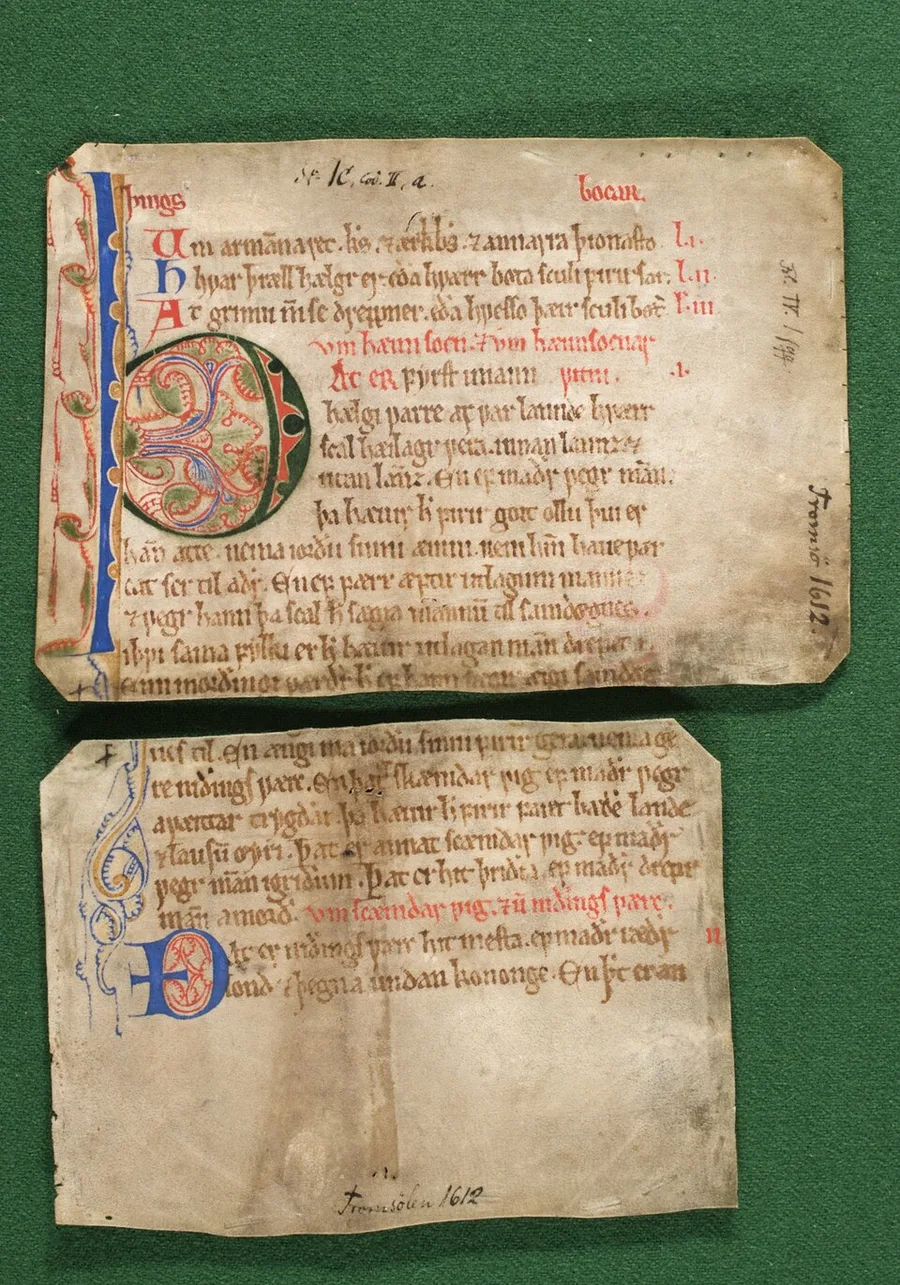 Frostatingslova fragment (c. 1260), National Archives of Norway (Riksarkivet), CC BY-SA 4.0 Two parchment leaves of the Frostatingslova, c. 1260 — the written law code of the central-Norway thing assembly that met at Frosta on the Trondheim Fjord, its customary law far older than the ink. The regional thing-law assembly of central Norway, meeting at
Frosta on the Trondheim Fjord. Jurisdiction covered Trøndelag and
the surrounding northern districts. Its codification, the
Frostatingslova, dates to the twelfth century in its surviving
form but preserves substantially older customary law. Rolled into
Magnus Lagabøte's Landslov of 1274. The modern Frostating Court
of Appeal in Trondheim carries the name.
Also discussed in Before There Was Norway — petty kingdoms at the edge of the worldWorshiping Odin and Thor — the lived religion of pre-Christian NorwayThe King Who Became a Saint — how the Nordmen came to ChristThe Golden Age — a North Atlantic empire … reaching farther than you think in Trøndelag, the Eidsivating
Frostatingslova fragment (c. 1260), National Archives of Norway (Riksarkivet), CC BY-SA 4.0 Two parchment leaves of the Frostatingslova, c. 1260 — the written law code of the central-Norway thing assembly that met at Frosta on the Trondheim Fjord, its customary law far older than the ink. The regional thing-law assembly of central Norway, meeting at
Frosta on the Trondheim Fjord. Jurisdiction covered Trøndelag and
the surrounding northern districts. Its codification, the
Frostatingslova, dates to the twelfth century in its surviving
form but preserves substantially older customary law. Rolled into
Magnus Lagabøte's Landslov of 1274. The modern Frostating Court
of Appeal in Trondheim carries the name.
Also discussed in Before There Was Norway — petty kingdoms at the edge of the worldWorshiping Odin and Thor — the lived religion of pre-Christian NorwayThe King Who Became a Saint — how the Nordmen came to ChristThe Golden Age — a North Atlantic empire … reaching farther than you think in Trøndelag, the Eidsivating 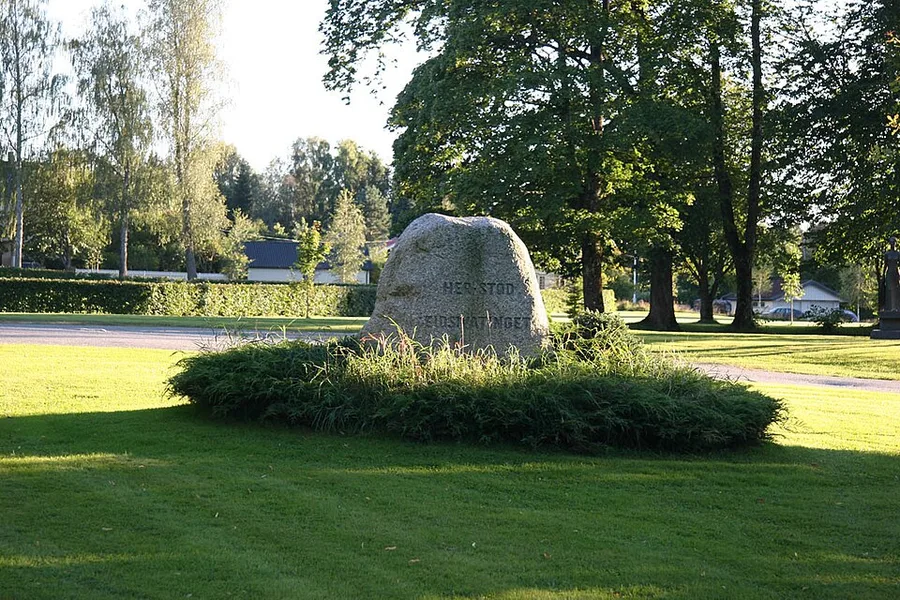 Photo: Harry Wad, Eidsivating memorial stone at Eidsvoll (2007), CC BY 2.5 A memorial stone at Eidsvoll reading 'Her stod Eidsivatinget' — 'here stood the Eidsivating' — planted on the ground where the inland district's law-assembly once gathered, since nothing of the meeting itself survives. The regional thing-law assembly of the inland east of Norway,
meeting traditionally at Eidsvoll — the same Eidsvoll where, eight
centuries later, the Norwegian Constitution was written and signed
in 1814. Jurisdiction covered the inland districts of Hedmark,
Romerike, and the surrounding interior. Its Eidsivatingslova
was rolled into Magnus Lagabøte's Landslov of 1274. The modern
Eidsivating Court of Appeal carries the name; its seat is at
Hamar.
Also discussed in Before There Was Norway — petty kingdoms at the edge of the worldThe Golden Age — a North Atlantic empire … reaching farther than you think in the inland, the Borgarting
Photo: Harry Wad, Eidsivating memorial stone at Eidsvoll (2007), CC BY 2.5 A memorial stone at Eidsvoll reading 'Her stod Eidsivatinget' — 'here stood the Eidsivating' — planted on the ground where the inland district's law-assembly once gathered, since nothing of the meeting itself survives. The regional thing-law assembly of the inland east of Norway,
meeting traditionally at Eidsvoll — the same Eidsvoll where, eight
centuries later, the Norwegian Constitution was written and signed
in 1814. Jurisdiction covered the inland districts of Hedmark,
Romerike, and the surrounding interior. Its Eidsivatingslova
was rolled into Magnus Lagabøte's Landslov of 1274. The modern
Eidsivating Court of Appeal carries the name; its seat is at
Hamar.
Also discussed in Before There Was Norway — petty kingdoms at the edge of the worldThe Golden Age — a North Atlantic empire … reaching farther than you think in the inland, the Borgarting 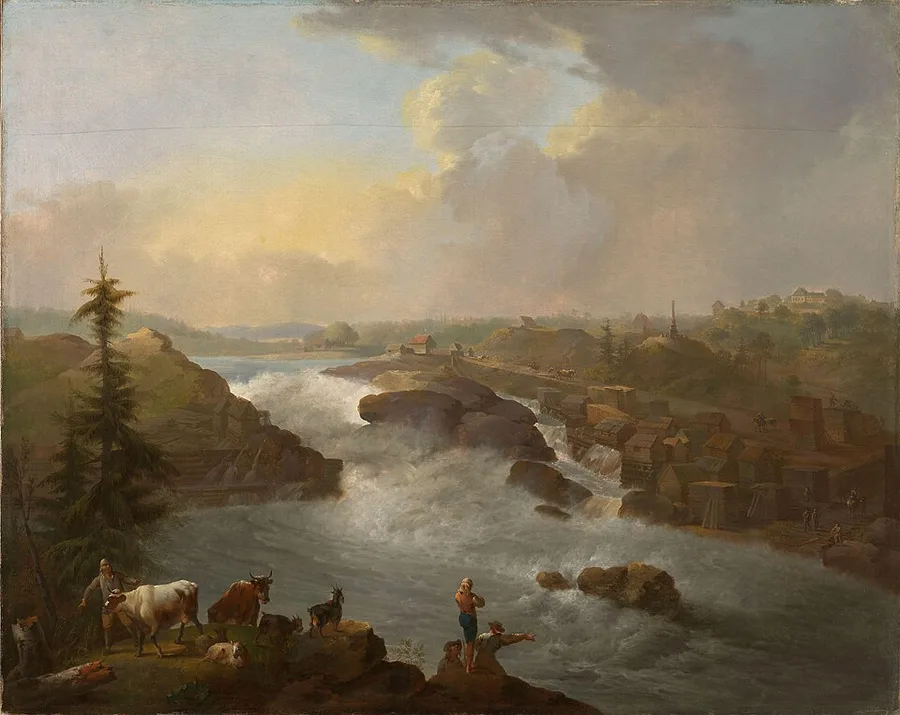 Christian August Lorentzen, The Waterfall Sarpsfossen (1795), Nasjonalmuseet Sarpsfossen, the great falls at Borg — the place that named the assembly. The Borgarting's thing-men met at the town King Olaf Haraldsson founded beside this waterfall in 1016; Lorentzen painted the falls as the sawmill town of the Danish era had grown around them. The regional thing-law assembly of southeastern Norway, meeting
at Borg (modern Sarpsborg). Jurisdiction covered the southeast
including Vestfold and Østfold. Its surviving Borgartingslova
preserves the regional legal tradition of the southeastern petty
kingdoms; rolled into Magnus Lagabøte's Landslov of 1274. The
modern Borgarting Court of Appeal in Oslo carries the name.
Also discussed in Before There Was Norway — petty kingdoms at the edge of the worldThe Golden Age — a North Atlantic empire … reaching farther than you think in the southeast. Each had begun as a pre-Christian assembly tradition and been gradually amended with Christian provisions at the regional negotiating sessions where each provincial church accepted its place in the wider system. Theodoricus Monachus
Christian August Lorentzen, The Waterfall Sarpsfossen (1795), Nasjonalmuseet Sarpsfossen, the great falls at Borg — the place that named the assembly. The Borgarting's thing-men met at the town King Olaf Haraldsson founded beside this waterfall in 1016; Lorentzen painted the falls as the sawmill town of the Danish era had grown around them. The regional thing-law assembly of southeastern Norway, meeting
at Borg (modern Sarpsborg). Jurisdiction covered the southeast
including Vestfold and Østfold. Its surviving Borgartingslova
preserves the regional legal tradition of the southeastern petty
kingdoms; rolled into Magnus Lagabøte's Landslov of 1274. The
modern Borgarting Court of Appeal in Oslo carries the name.
Also discussed in Before There Was Norway — petty kingdoms at the edge of the worldThe Golden Age — a North Atlantic empire … reaching farther than you think in the southeast. Each had begun as a pre-Christian assembly tradition and been gradually amended with Christian provisions at the regional negotiating sessions where each provincial church accepted its place in the wider system. Theodoricus Monachus 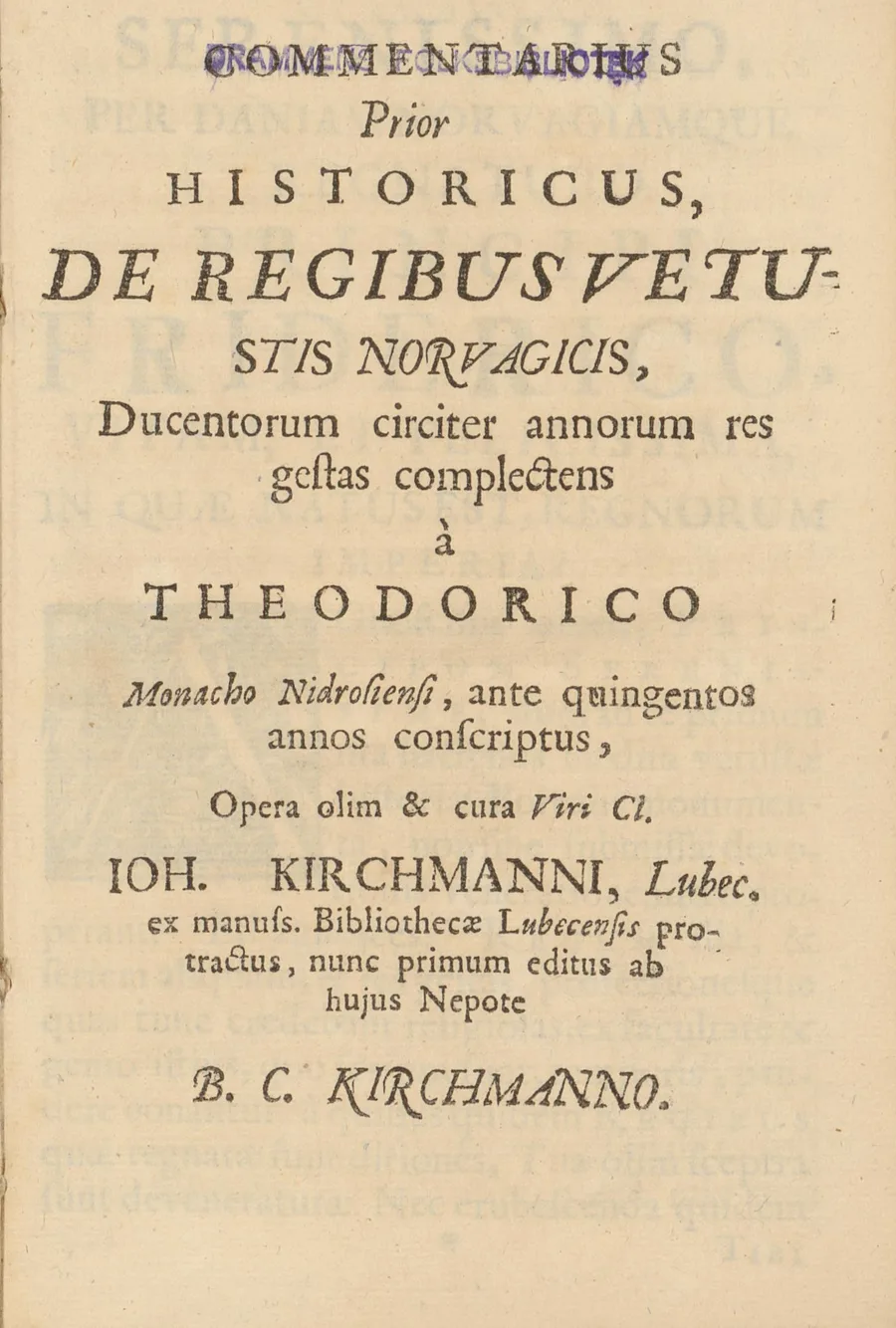 Editio princeps of Theodoricus, in Commentarii historici duo (Amsterdam, 1684), National Library of Norway No likeness of Theodoricus exists and the medieval codex of his history is lost; this 1684 Amsterdam title page is where his work enters print — "by Theodoric, monk of Nidaros, written five hundred years ago," drawn from a Lübeck manuscript that has since vanished too. Norwegian monk and historian, active in the late twelfth century
(probably c. 1175–c. 1185). Author of Historia de antiquitate
regum Norwagiensium ("History of the Antiquity of the Norwegian
Kings"), a short Latin history covering the Norwegian kings from
Harald Fairhair to the death of Sigurd the Crusader (d. 1130). One of the earliest
written accounts of Olav II Haraldsson's sainthood; pre-dates
Snorri Sturluson's Heimskringla by half a century. Almost
certainly a Premonstratensian or Augustinian canon attached to
the cathedral at Nidaros, though the precise identification has
not been settled.
Also discussed in The King Who Became a Saint — how the Nordmen came to ChristThe Crusades?!!!! — sixty ships from Bergen, bound for the Holy Land ’s Historia de antiquitate regum Norwagiensium and the anonymous Historia Norwegie
Editio princeps of Theodoricus, in Commentarii historici duo (Amsterdam, 1684), National Library of Norway No likeness of Theodoricus exists and the medieval codex of his history is lost; this 1684 Amsterdam title page is where his work enters print — "by Theodoric, monk of Nidaros, written five hundred years ago," drawn from a Lübeck manuscript that has since vanished too. Norwegian monk and historian, active in the late twelfth century
(probably c. 1175–c. 1185). Author of Historia de antiquitate
regum Norwagiensium ("History of the Antiquity of the Norwegian
Kings"), a short Latin history covering the Norwegian kings from
Harald Fairhair to the death of Sigurd the Crusader (d. 1130). One of the earliest
written accounts of Olav II Haraldsson's sainthood; pre-dates
Snorri Sturluson's Heimskringla by half a century. Almost
certainly a Premonstratensian or Augustinian canon attached to
the cathedral at Nidaros, though the precise identification has
not been settled.
Also discussed in The King Who Became a Saint — how the Nordmen came to ChristThe Crusades?!!!! — sixty ships from Bergen, bound for the Holy Land ’s Historia de antiquitate regum Norwagiensium and the anonymous Historia Norwegie 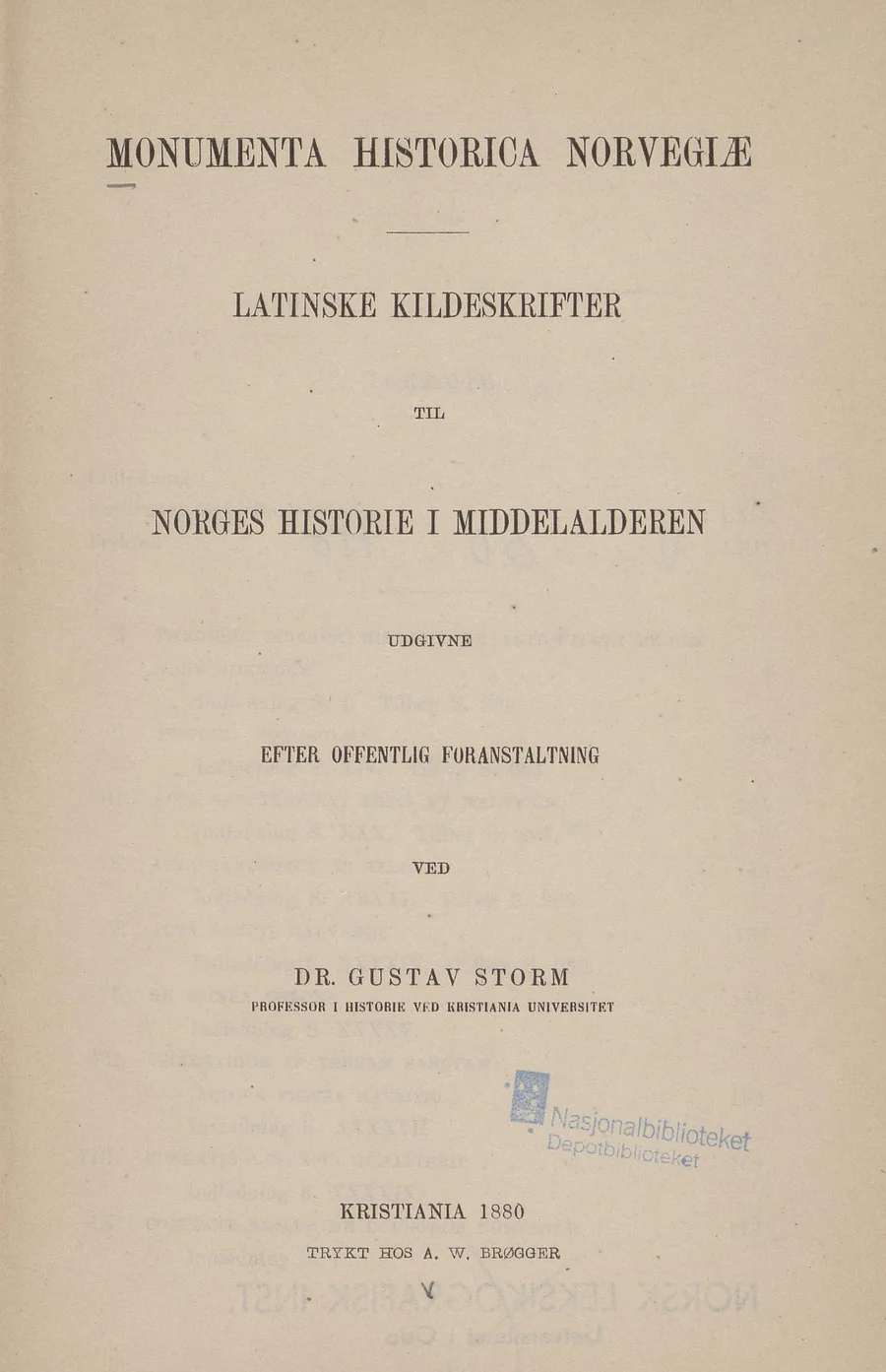 Title page, Gustav Storm (ed.), Monumenta historica Norvegiæ (Kristiania, 1880), National Library of Norway The sole medieval manuscript of the anonymous history sits in Edinburgh, so the text is read here — in Storm's 1880 Monumenta historica Norvegiæ, the standard edition that prints the Historia Norwegie beside the era's other Latin sources on Norway. Anonymous Latin history of Norway composed in the late twelfth
century — alongside Theodoricus monachus's Historia de
antiquitate regum Norwagiensium, one of the first Latin
histories the country produced of itself. Covers Norwegian
geography, the petty kingdoms, and the kings down to about
1015; survives in a single fourteenth-century manuscript
preserved in Edinburgh. The opening geographic section
contains some of the earliest detailed descriptions in Latin
of the Norwegian coast, the Sámi, and the Atlantic settlements
in Iceland and Greenland — a valuable supplement to the
Norse-language saga record of the same period.
, both from the late twelfth century, gave the country its first Latin histories of itself. And Snorri Sturluson
Title page, Gustav Storm (ed.), Monumenta historica Norvegiæ (Kristiania, 1880), National Library of Norway The sole medieval manuscript of the anonymous history sits in Edinburgh, so the text is read here — in Storm's 1880 Monumenta historica Norvegiæ, the standard edition that prints the Historia Norwegie beside the era's other Latin sources on Norway. Anonymous Latin history of Norway composed in the late twelfth
century — alongside Theodoricus monachus's Historia de
antiquitate regum Norwagiensium, one of the first Latin
histories the country produced of itself. Covers Norwegian
geography, the petty kingdoms, and the kings down to about
1015; survives in a single fourteenth-century manuscript
preserved in Edinburgh. The opening geographic section
contains some of the earliest detailed descriptions in Latin
of the Norwegian coast, the Sámi, and the Atlantic settlements
in Iceland and Greenland — a valuable supplement to the
Norse-language saga record of the same period.
, both from the late twelfth century, gave the country its first Latin histories of itself. And Snorri Sturluson 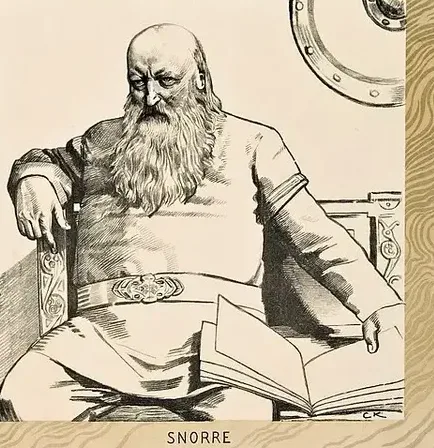 Christian Krohg, Snorre Sturlason (1899), from Norges Kongesagaer; scan: National Library of Norway Christian Krohg's portrait of Snorri from the 1899 folk edition of Heimskringla — the historian seated with a great open book across his knees. No contemporary likeness of Snorri exists; Krohg's drawing is the face Norway gave its most important medieval source. Thirteenth-century Icelandic chieftain, poet, and historian.
Composed the Heimskringla and the Prose Edda in the 1220s
from oral tradition and skaldic verse — three hundred years after
the Viking-age events he describes. The single richest source for
Norway's pre-conversion centuries and also the most aware
Christian-Icelandic editor of them. Modern scholarship accepts
what other sources independently confirm and treats his richest
expansions as the work of a poet writing about a kingdom he had
never seen. Assassinated at Reykholt on 23 September 1241 by
agents of King Hákon IV after a falling-out at court.
In this article Snorri's Heimskringla is the latest of the great medieval
Norwegian-Icelandic literary works this article surveys — the
masterwork of the Catholic age's clerical literary tradition,
composed at almost the same moment as the courtly Konungs
skuggsjá.
Also discussed in The Viking Age — longships, legends, and the first "Norway"Before There Was Norway — petty kingdoms at the edge of the worldWorshiping Odin and Thor — the lived religion of pre-Christian NorwayThe King Who Became a Saint — how the Nordmen came to ChristThe Golden Age — a North Atlantic empire … reaching farther than you thinkThe Crusades?!!!! — sixty ships from Bergen, bound for the Holy LandNordisk Mytologi — Odin, the giants, and Ragnarok ’s Heimskringla
Christian Krohg, Snorre Sturlason (1899), from Norges Kongesagaer; scan: National Library of Norway Christian Krohg's portrait of Snorri from the 1899 folk edition of Heimskringla — the historian seated with a great open book across his knees. No contemporary likeness of Snorri exists; Krohg's drawing is the face Norway gave its most important medieval source. Thirteenth-century Icelandic chieftain, poet, and historian.
Composed the Heimskringla and the Prose Edda in the 1220s
from oral tradition and skaldic verse — three hundred years after
the Viking-age events he describes. The single richest source for
Norway's pre-conversion centuries and also the most aware
Christian-Icelandic editor of them. Modern scholarship accepts
what other sources independently confirm and treats his richest
expansions as the work of a poet writing about a kingdom he had
never seen. Assassinated at Reykholt on 23 September 1241 by
agents of King Hákon IV after a falling-out at court.
In this article Snorri's Heimskringla is the latest of the great medieval
Norwegian-Icelandic literary works this article surveys — the
masterwork of the Catholic age's clerical literary tradition,
composed at almost the same moment as the courtly Konungs
skuggsjá.
Also discussed in The Viking Age — longships, legends, and the first "Norway"Before There Was Norway — petty kingdoms at the edge of the worldWorshiping Odin and Thor — the lived religion of pre-Christian NorwayThe King Who Became a Saint — how the Nordmen came to ChristThe Golden Age — a North Atlantic empire … reaching farther than you thinkThe Crusades?!!!! — sixty ships from Bergen, bound for the Holy LandNordisk Mytologi — Odin, the giants, and Ragnarok ’s Heimskringla 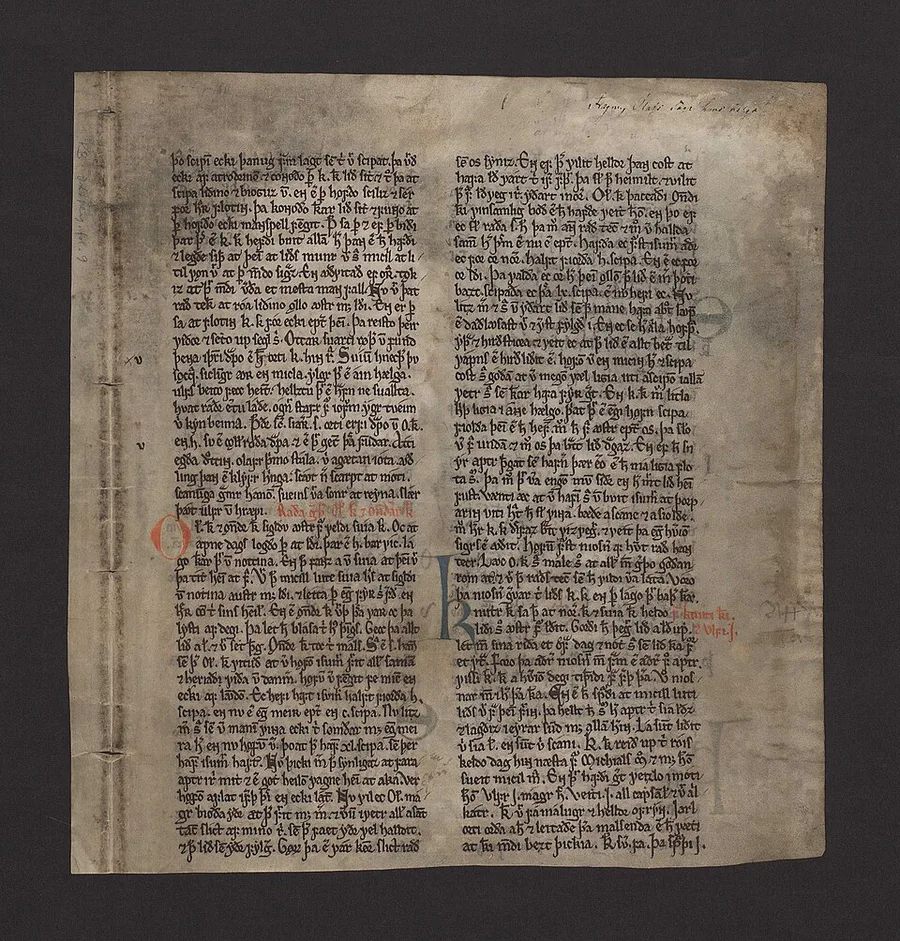 Kringlublaðið (the Kringla leaf), Lbs fragm 82, c. 1260 — National and University Library of Iceland This single surviving vellum leaf is all that remains of the original Kringla manuscript — the best medieval copy of Heimskringla — after the rest burned in Copenhagen's 1728 fire. Snorri Sturluson's prose history of the kings of Norway, composed
in the 1220s. Sixteen sagas running from the semi-mythical Yngling
line through to the late twelfth century. The single most extensive
medieval source for Norway's Viking and Christianization centuries
— trusted on the broad shape of political history, questioned in
the literary expansions, and written by a Christian Icelander
three hundred years after the events.
In this article The masterwork of the medieval Norwegian-Icelandic literary
tradition this article surveys, composed in the same generation
as the courtly Konungs skuggsjá and the anonymous Historia
Norwegie.
Also discussed in The Viking Age — longships, legends, and the first "Norway"Worshiping Odin and Thor — the lived religion of pre-Christian NorwayThe King Who Became a Saint — how the Nordmen came to ChristThe Golden Age — a North Atlantic empire … reaching farther than you thinkThe Crusades?!!!! — sixty ships from Bergen, bound for the Holy Land , written in the early thirteenth century, recorded the country’s whole saga-history in a single Icelandic king-collection. The books these writers produced were largely the books the cathedral schools and the monasteries could afford to copy.
Kringlublaðið (the Kringla leaf), Lbs fragm 82, c. 1260 — National and University Library of Iceland This single surviving vellum leaf is all that remains of the original Kringla manuscript — the best medieval copy of Heimskringla — after the rest burned in Copenhagen's 1728 fire. Snorri Sturluson's prose history of the kings of Norway, composed
in the 1220s. Sixteen sagas running from the semi-mythical Yngling
line through to the late twelfth century. The single most extensive
medieval source for Norway's Viking and Christianization centuries
— trusted on the broad shape of political history, questioned in
the literary expansions, and written by a Christian Icelander
three hundred years after the events.
In this article The masterwork of the medieval Norwegian-Icelandic literary
tradition this article surveys, composed in the same generation
as the courtly Konungs skuggsjá and the anonymous Historia
Norwegie.
Also discussed in The Viking Age — longships, legends, and the first "Norway"Worshiping Odin and Thor — the lived religion of pre-Christian NorwayThe King Who Became a Saint — how the Nordmen came to ChristThe Golden Age — a North Atlantic empire … reaching farther than you thinkThe Crusades?!!!! — sixty ships from Bergen, bound for the Holy Land , written in the early thirteenth century, recorded the country’s whole saga-history in a single Icelandic king-collection. The books these writers produced were largely the books the cathedral schools and the monasteries could afford to copy.
Three regional saints
The medieval Norwegian church developed its devotional life around three saints. Saint Olav was the national figure. His shrine at Nidaros anchored the pilgrim road system of medieval Norway, which ran inward toward the cathedral from every direction of the country and from across the Norse Atlantic. Two other saints had followings of their own, each anchoring a regional cathedral see.
On the western coast, the veneration of Saint Sunniva 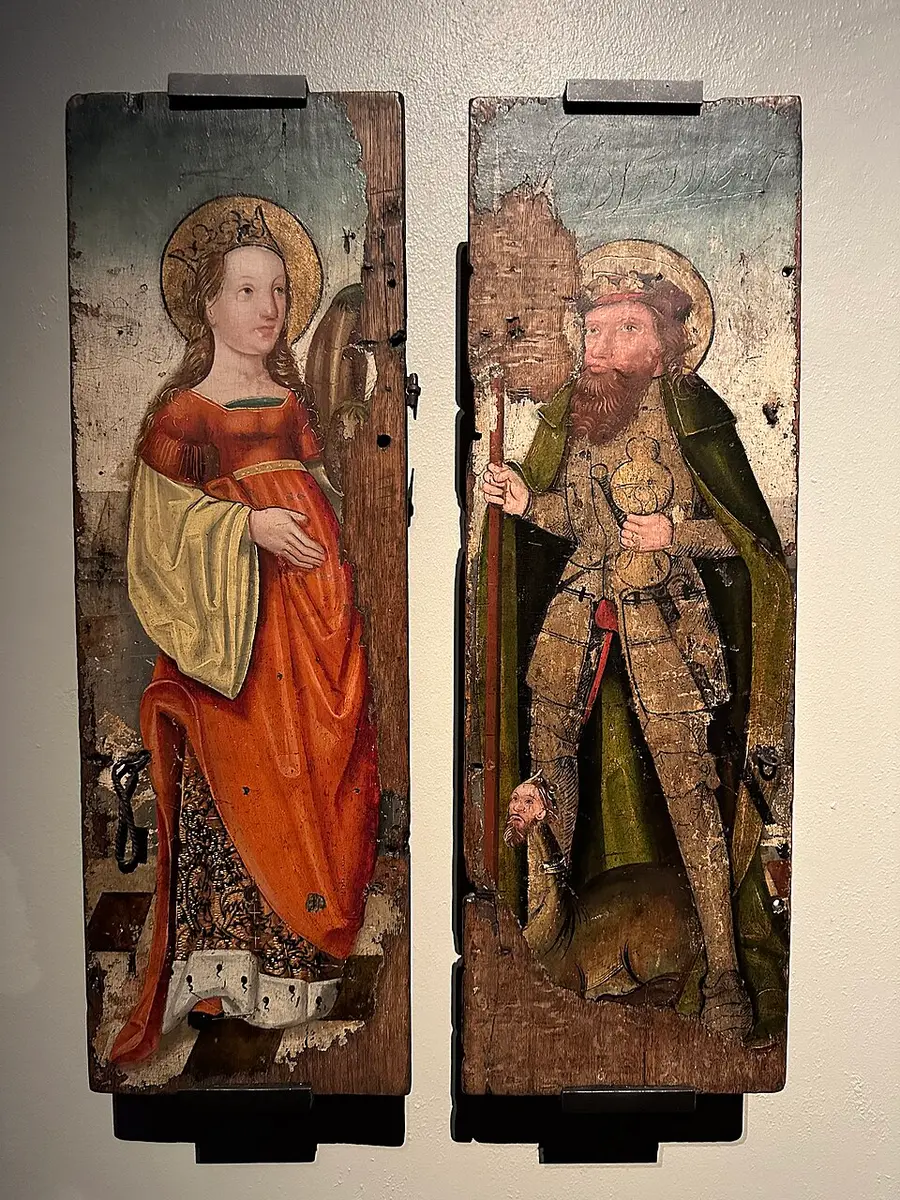 Unknown medieval carver, shrine doors from Bygland Church (after 1470); photo: Wolfmann, Museum of Cultural History, Oslo, CC BY-SA 4.0 Carved after 1470 for a country church in Bygland, these shrine doors pair Sunniva beside Olav — the two saints whose cults anchored medieval Norwegian devotion on opposite coasts. Patron saint of the western Norwegian coast and of the medieval
Bergen diocese. By the legend the medieval church transmitted,
Sunniva was an Irish princess of the tenth century who fled an
unwanted marriage to a pagan king by setting out to sea in a
rudderless boat with her brother Alban and a party of companions.
They washed ashore on the island of Selja in Nordfjord, where
they were killed in the caves they had taken refuge in — by
hostile locals in some versions of the legend, by a rockfall in
others. Her veneration was established at Selja by the late
eleventh century. A Benedictine monastery was founded on the
island around 1100. Her relics were later translated to the new
Christ Church in Bergen; she remained the principal saint of the
western coast until the Reformation.
Also discussed in The Reformation, 1537 — one church eradicated and another imposed anchored the see of Bergen. By the legend the medieval church transmitted, Sunniva had been an Irish princess of the tenth century who fled an unwanted marriage to a pagan king by setting out to sea in a rudderless boat with her brother Alban and a party of companions. They washed ashore on the island of Selja
Unknown medieval carver, shrine doors from Bygland Church (after 1470); photo: Wolfmann, Museum of Cultural History, Oslo, CC BY-SA 4.0 Carved after 1470 for a country church in Bygland, these shrine doors pair Sunniva beside Olav — the two saints whose cults anchored medieval Norwegian devotion on opposite coasts. Patron saint of the western Norwegian coast and of the medieval
Bergen diocese. By the legend the medieval church transmitted,
Sunniva was an Irish princess of the tenth century who fled an
unwanted marriage to a pagan king by setting out to sea in a
rudderless boat with her brother Alban and a party of companions.
They washed ashore on the island of Selja in Nordfjord, where
they were killed in the caves they had taken refuge in — by
hostile locals in some versions of the legend, by a rockfall in
others. Her veneration was established at Selja by the late
eleventh century. A Benedictine monastery was founded on the
island around 1100. Her relics were later translated to the new
Christ Church in Bergen; she remained the principal saint of the
western coast until the Reformation.
Also discussed in The Reformation, 1537 — one church eradicated and another imposed anchored the see of Bergen. By the legend the medieval church transmitted, Sunniva had been an Irish princess of the tenth century who fled an unwanted marriage to a pagan king by setting out to sea in a rudderless boat with her brother Alban and a party of companions. They washed ashore on the island of Selja 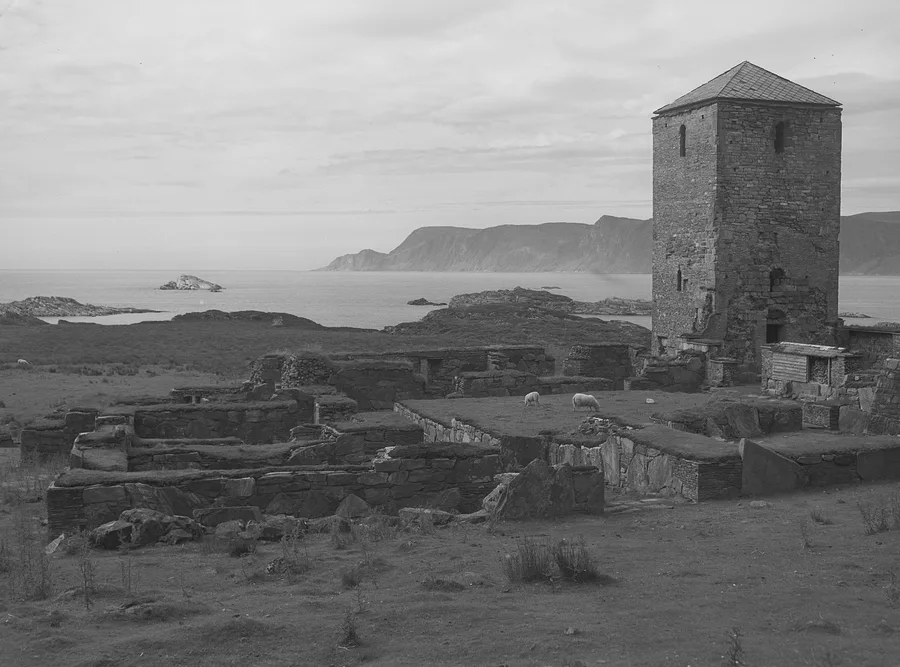 Photographer unknown, Selja kloster (1948), Mittet & Co. / National Library of Norway The island the legend chose: the monastery tower and walls stand on the shore terrace where Sunniva's veneration began, the open sea past Stad behind — the landscape pilgrims crossed to reach one of Norway's earliest holy places. Small island in Nordfjord on the western coast of Norway, in
modern Stad municipality (Vestland County). Site of the legendary
martyrdom of Saint Sunniva and her Irish companions at the end
of the tenth century, in caves where they had taken refuge after
their boat washed ashore. The veneration was established at Selja
by the late eleventh century; a Benedictine monastery was founded
on the island around 1100. The medieval monastic ruins, the
twelfth-century stone church, and the natural cave traditionally
identified as Sunniva's place of death are preserved as a
protected cultural-historic site.
Selja, Nordfjord Also discussed in The Reformation, 1537 — one church eradicated and another imposed in Nordfjord
Photographer unknown, Selja kloster (1948), Mittet & Co. / National Library of Norway The island the legend chose: the monastery tower and walls stand on the shore terrace where Sunniva's veneration began, the open sea past Stad behind — the landscape pilgrims crossed to reach one of Norway's earliest holy places. Small island in Nordfjord on the western coast of Norway, in
modern Stad municipality (Vestland County). Site of the legendary
martyrdom of Saint Sunniva and her Irish companions at the end
of the tenth century, in caves where they had taken refuge after
their boat washed ashore. The veneration was established at Selja
by the late eleventh century; a Benedictine monastery was founded
on the island around 1100. The medieval monastic ruins, the
twelfth-century stone church, and the natural cave traditionally
identified as Sunniva's place of death are preserved as a
protected cultural-historic site.
Selja, Nordfjord Also discussed in The Reformation, 1537 — one church eradicated and another imposed in Nordfjord 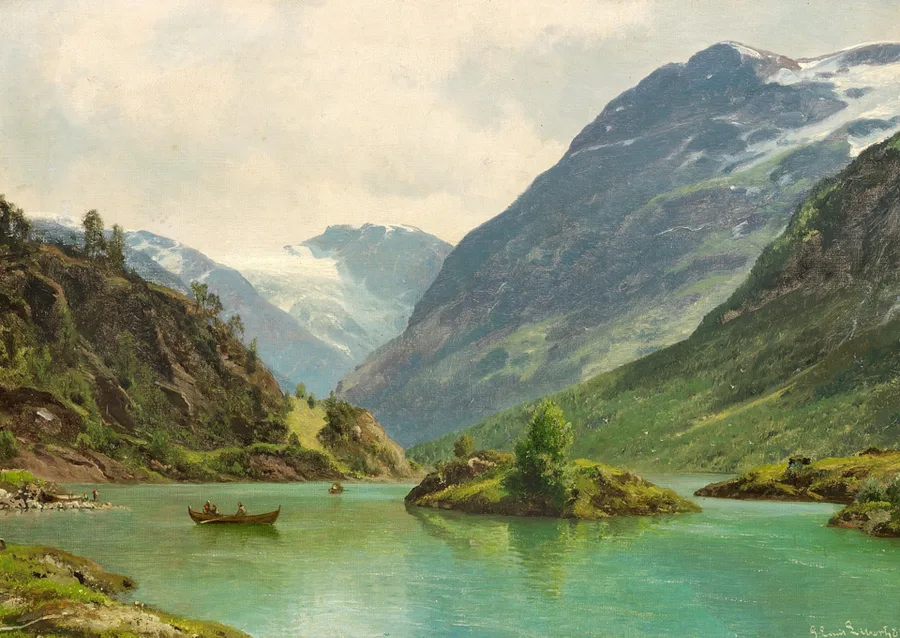 Georg Emil Libert, Loenvandet ved Nordfjord i Norge. Regndag (1885), via Bruun Rasmussen Kunstauktioner Georg Emil Libert's 1885 view of Lake Loen shows the calm inland water of Nordfjord, the fjord whose outer mouth opens onto Selja island — the legendary site of Saint Sunniva's martyrdom and a principal medieval pilgrimage destination on Norway's western coast. Long fjord on the western coast of Norway, reaching about a
hundred kilometres inland from the open Atlantic into the
Jostedalsbreen glacier district. In the petty-kingdom era the
spine of the small kingdom of Fjordane (now folded into Vestland).
The mouth of the fjord opens onto the island of Selja, site of
the legendary martyrdom of Saint Sunniva and one of the principal
medieval pilgrimage destinations of the western coast.
Nordfjord . There they were killed — by hostile locals in some versions of the legend, by a rockfall in others — in the caves where they had taken refuge. Her veneration was established at Selja by the late eleventh century. A Benedictine order
Georg Emil Libert, Loenvandet ved Nordfjord i Norge. Regndag (1885), via Bruun Rasmussen Kunstauktioner Georg Emil Libert's 1885 view of Lake Loen shows the calm inland water of Nordfjord, the fjord whose outer mouth opens onto Selja island — the legendary site of Saint Sunniva's martyrdom and a principal medieval pilgrimage destination on Norway's western coast. Long fjord on the western coast of Norway, reaching about a
hundred kilometres inland from the open Atlantic into the
Jostedalsbreen glacier district. In the petty-kingdom era the
spine of the small kingdom of Fjordane (now folded into Vestland).
The mouth of the fjord opens onto the island of Selja, site of
the legendary martyrdom of Saint Sunniva and one of the principal
medieval pilgrimage destinations of the western coast.
Nordfjord . There they were killed — by hostile locals in some versions of the legend, by a rockfall in others — in the caves where they had taken refuge. Her veneration was established at Selja by the late eleventh century. A Benedictine order 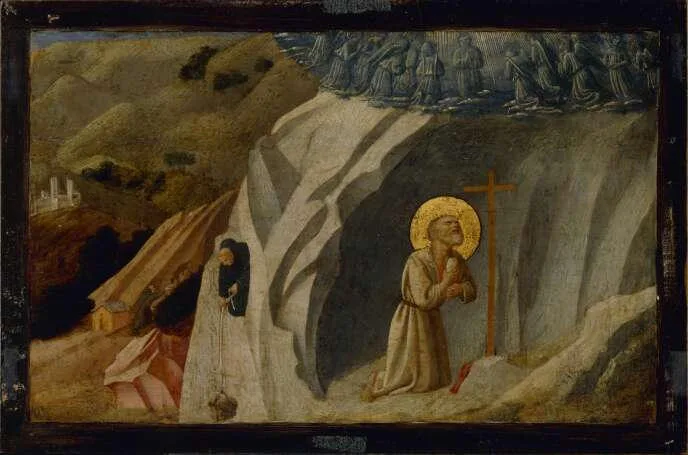 Fra Angelico, Saint Benedict at Subiaco (c. 1430-35), Musée Condé, Chantilly Saint Benedict of Nursia, whose 6th-century Rule shaped all Western monasticism — the Benedictines were the first monastic order in Norway, founding houses such as Nidarholm and Munkeliv. The oldest of the major Western Christian monastic orders, named
for its founder Saint Benedict of Nursia (c. 480–547) and
governed by his Rule — the foundational text of Western
monasticism, balancing prayer, manual labour, and study within
a settled communal life. The Benedictine houses in medieval
Norway included Munkeliv at Bergen (founded by King Eystein I
in the early twelfth century) and the abbey on Selja island.
Each Benedictine monastery was largely autonomous within the
shared Rule, in contrast to the centralised orders that
followed (Cistercians, Premonstratensians, mendicants).
Selja Monastery
Fra Angelico, Saint Benedict at Subiaco (c. 1430-35), Musée Condé, Chantilly Saint Benedict of Nursia, whose 6th-century Rule shaped all Western monasticism — the Benedictines were the first monastic order in Norway, founding houses such as Nidarholm and Munkeliv. The oldest of the major Western Christian monastic orders, named
for its founder Saint Benedict of Nursia (c. 480–547) and
governed by his Rule — the foundational text of Western
monasticism, balancing prayer, manual labour, and study within
a settled communal life. The Benedictine houses in medieval
Norway included Munkeliv at Bergen (founded by King Eystein I
in the early twelfth century) and the abbey on Selja island.
Each Benedictine monastery was largely autonomous within the
shared Rule, in contrast to the centralised orders that
followed (Cistercians, Premonstratensians, mendicants).
Selja Monastery 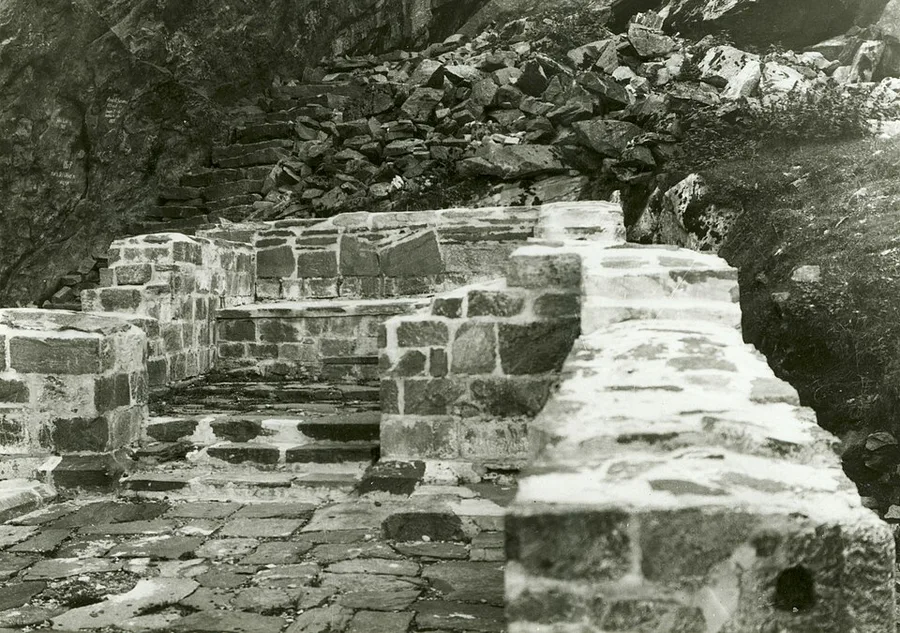 E. Reimers, Selja monastery ruins (1915), Riksantikvaren The ruins of Selja monastery, the Benedictine house on the holy island where St Sunniva was venerated — Norway's first bishopric was seated at Selja before it moved to Bergen. Benedictine monastery on the island of Selja in Nordfjord, founded
around 1100 in association with the established veneration of
Saint Sunniva at the site of her legendary martyrdom. Dedicated
to a saint also named Alban whom Norwegian tradition identified
with Sunniva's brother. The monastic community anchored the
pilgrimage to Selja that drew visitors from across the western
coast and beyond. Closed at the 1537 Reformation. The medieval
monastic ruins, the twelfth-century stone church, and the cave
traditionally identified as Sunniva's death-place are preserved
on the island today.
Also discussed in The Reformation, 1537 — one church eradicated and another imposed was founded on the island around 1100, dedicated to a saint also named Alban whom Norwegian tradition identified with her brother. Her relics were later translated to the new Christ Church in Bergen. She remained the principal saint of the western coast for the rest of the medieval period.
E. Reimers, Selja monastery ruins (1915), Riksantikvaren The ruins of Selja monastery, the Benedictine house on the holy island where St Sunniva was venerated — Norway's first bishopric was seated at Selja before it moved to Bergen. Benedictine monastery on the island of Selja in Nordfjord, founded
around 1100 in association with the established veneration of
Saint Sunniva at the site of her legendary martyrdom. Dedicated
to a saint also named Alban whom Norwegian tradition identified
with Sunniva's brother. The monastic community anchored the
pilgrimage to Selja that drew visitors from across the western
coast and beyond. Closed at the 1537 Reformation. The medieval
monastic ruins, the twelfth-century stone church, and the cave
traditionally identified as Sunniva's death-place are preserved
on the island today.
Also discussed in The Reformation, 1537 — one church eradicated and another imposed was founded on the island around 1100, dedicated to a saint also named Alban whom Norwegian tradition identified with her brother. Her relics were later translated to the new Christ Church in Bergen. She remained the principal saint of the western coast for the rest of the medieval period.
At Oslo, the principal saint was Saint Hallvard 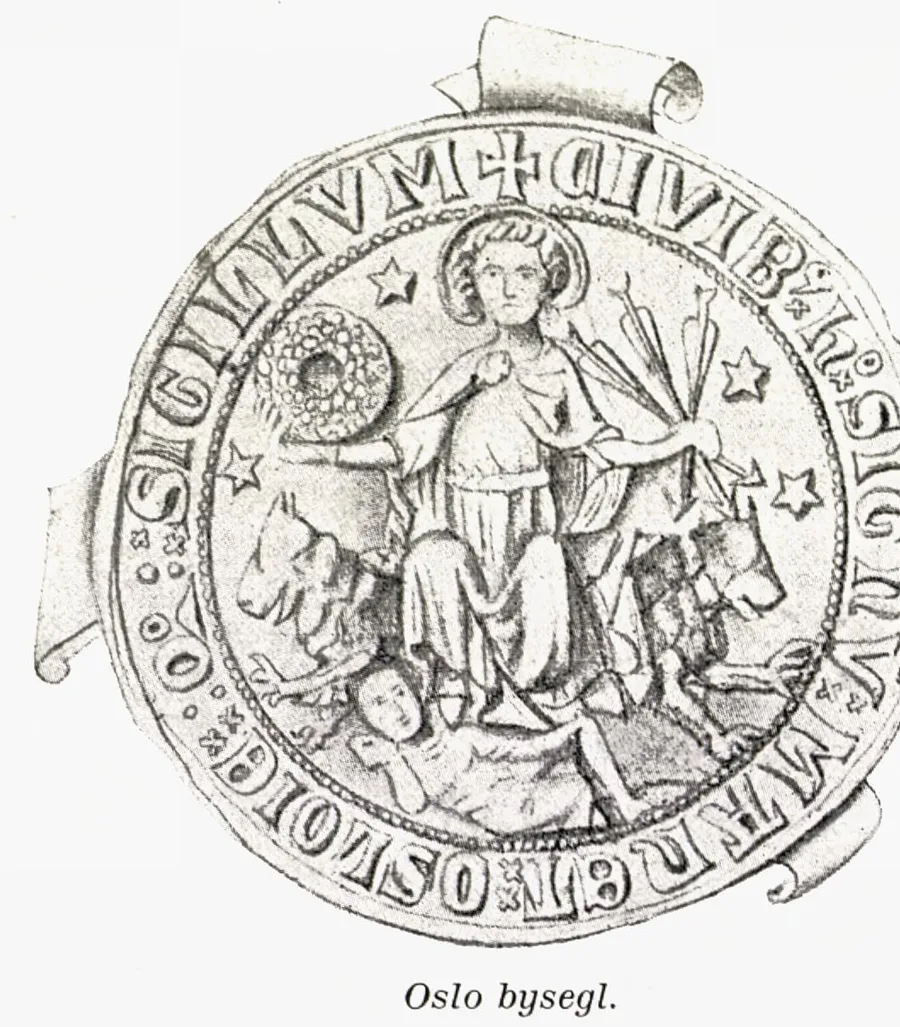 Oslo bysegl (medieval city seal, c. 1300), reproduced in Edvard Bull, Kristianias historie bd. 1 (1922) The city seal itself, in use from around 1300 — the earliest recorded image of Oslo's patron: Hallvard enthroned with the millstone and arrows of his martyrdom, the woman he died protecting at his feet. The same composition the modern city arms still carry. Patron saint of Oslo. By the medieval legend, Hallvard Vebjørnsson
was a young man of Vestfold, killed around 1043 while trying to
protect a pregnant woman from her pursuers. The killers tied a
millstone to his body and sank it in the fjord, but the body
rose back to the surface intact. His veneration was established
at Oslo shortly afterward, and Hallvard became the city's patron
saint. The medieval images of him — first recorded on the Oslo
city seal around 1300 — show him enthroned, the arrows of his
martyrdom in one hand and the millstone in the other, the woman
at his feet: the same image, saint with millstone and woman,
that is the modern Oslo coat of arms.
Also discussed in The Reformation, 1537 — one church eradicated and another imposed . He was a young man of Vestfold
Oslo bysegl (medieval city seal, c. 1300), reproduced in Edvard Bull, Kristianias historie bd. 1 (1922) The city seal itself, in use from around 1300 — the earliest recorded image of Oslo's patron: Hallvard enthroned with the millstone and arrows of his martyrdom, the woman he died protecting at his feet. The same composition the modern city arms still carry. Patron saint of Oslo. By the medieval legend, Hallvard Vebjørnsson
was a young man of Vestfold, killed around 1043 while trying to
protect a pregnant woman from her pursuers. The killers tied a
millstone to his body and sank it in the fjord, but the body
rose back to the surface intact. His veneration was established
at Oslo shortly afterward, and Hallvard became the city's patron
saint. The medieval images of him — first recorded on the Oslo
city seal around 1300 — show him enthroned, the arrows of his
martyrdom in one hand and the millstone in the other, the woman
at his feet: the same image, saint with millstone and woman,
that is the modern Oslo coat of arms.
Also discussed in The Reformation, 1537 — one church eradicated and another imposed . He was a young man of Vestfold  Edvard Munch, Summer in Asgardstrand (1889), Woll 185, private collection Munch's summer shore at Åsgårdstrand — the same Vestfold fjord shore the Yngling kings ruled from their halls at Borre, painted a millennium later. The quiet seaside town sits on the coast of what was the richest of the petty kingdoms. Coastal region on the western shore of the Oslofjord in southeastern
Norway, the richest of the petty-kingdom-era Norwegian polities.
Controlled the trade routes through the Skagerrak between the North
Sea and the Baltic; the wealth in its royal mounds at Borre marks it
as the dominant southern Norwegian power of the seventh through
ninth centuries. The Yngling dynasty held the throne here. Modern
Vestfold is the county containing Tønsberg, Sandefjord, and the
Borre Mound Cemetery archaeological site.
Vestfold Also discussed in Before There Was Norway — petty kingdoms at the edge of the worldThe Viking Age — longships, legends, and the first "Norway"The King Who Became a Saint — how the Nordmen came to Christ , killed around 1043 while trying to protect a pregnant woman from her pursuers. The killers had tied a millstone to his body and sunk it in the fjord, but the body had risen back to the surface intact. His veneration was established at Oslo shortly afterward, and Hallvard became the city’s patron saint. The medieval images of him show him enthroned, the arrows of his martyrdom in one hand and the millstone in the other, the woman at his feet. The same image — saint, millstone, woman — is the modern Oslo coat of arms
Edvard Munch, Summer in Asgardstrand (1889), Woll 185, private collection Munch's summer shore at Åsgårdstrand — the same Vestfold fjord shore the Yngling kings ruled from their halls at Borre, painted a millennium later. The quiet seaside town sits on the coast of what was the richest of the petty kingdoms. Coastal region on the western shore of the Oslofjord in southeastern
Norway, the richest of the petty-kingdom-era Norwegian polities.
Controlled the trade routes through the Skagerrak between the North
Sea and the Baltic; the wealth in its royal mounds at Borre marks it
as the dominant southern Norwegian power of the seventh through
ninth centuries. The Yngling dynasty held the throne here. Modern
Vestfold is the county containing Tønsberg, Sandefjord, and the
Borre Mound Cemetery archaeological site.
Vestfold Also discussed in Before There Was Norway — petty kingdoms at the edge of the worldThe Viking Age — longships, legends, and the first "Norway"The King Who Became a Saint — how the Nordmen came to Christ , killed around 1043 while trying to protect a pregnant woman from her pursuers. The killers had tied a millstone to his body and sunk it in the fjord, but the body had risen back to the surface intact. His veneration was established at Oslo shortly afterward, and Hallvard became the city’s patron saint. The medieval images of him show him enthroned, the arrows of his martyrdom in one hand and the millstone in the other, the woman at his feet. The same image — saint, millstone, woman — is the modern Oslo coat of arms 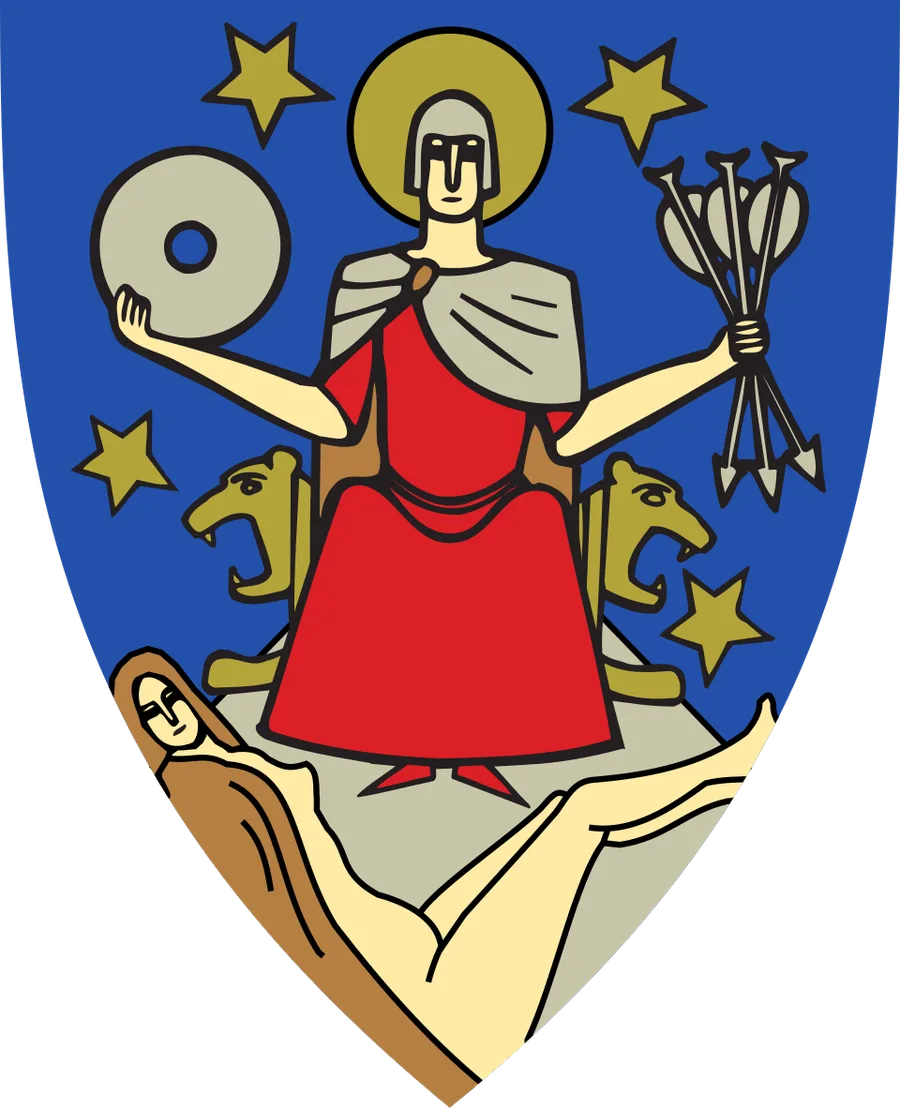 Oslo kommune, official coat of arms of Oslo (adopted 1924), CC BY-SA 4.0 The 1924 municipal arms restore Hallvard's medieval seal iconography almost verbatim — the enthroned saint, millstone, and arrows now stamped on every Oslo building, vehicle, and official document rather than a private devotional image. The municipal arms of Oslo: Saint Hallvard Vebjørnsson enthroned,
the arrows of his martyrdom in one hand and the millstone in the
other, a woman lying at his feet — the saint's iconography of his
medieval legend, in which the young man of Vestfold was killed
around 1043 while trying to protect a pregnant woman from her
pursuers and his body, sunk in the fjord with a millstone,
refused to stay submerged. The current municipal arms were
adopted in 1924, restoring the medieval Catholic iconography of
Oslo's patron saint after centuries in which the Lutheran city
used simpler heraldic forms. The arms appear on every Oslo
municipal document, building, and uniform.
.
Oslo kommune, official coat of arms of Oslo (adopted 1924), CC BY-SA 4.0 The 1924 municipal arms restore Hallvard's medieval seal iconography almost verbatim — the enthroned saint, millstone, and arrows now stamped on every Oslo building, vehicle, and official document rather than a private devotional image. The municipal arms of Oslo: Saint Hallvard Vebjørnsson enthroned,
the arrows of his martyrdom in one hand and the millstone in the
other, a woman lying at his feet — the saint's iconography of his
medieval legend, in which the young man of Vestfold was killed
around 1043 while trying to protect a pregnant woman from her
pursuers and his body, sunk in the fjord with a millstone,
refused to stay submerged. The current municipal arms were
adopted in 1924, restoring the medieval Catholic iconography of
Oslo's patron saint after centuries in which the Lutheran city
used simpler heraldic forms. The arms appear on every Oslo
municipal document, building, and uniform.
.
Olav at Nidaros, Sunniva at Selja and Bergen, Hallvard at Oslo: each carried a legend, a pilgrim traffic, an iconography in the medieval art that survives. Sunniva and Hallvard gave the western coast and the Oslo Fjord their own claim on the country’s Christian imagination.
The monastery network
Around thirty monasteries operated in medieval Norway at the institutional peak. The single largest concentration was at Bergen, where the Benedictine house at Munkeliv Abbey 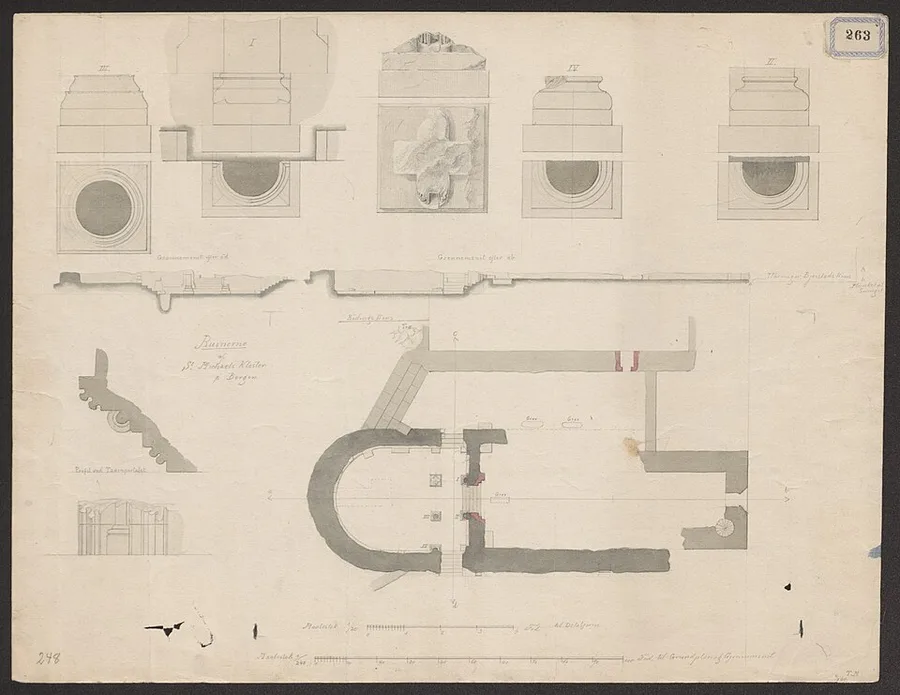 Henrik Thrap-Meyer, Ruins of St Michael's Monastery, Bergen (1860), Fortidsminneforeningen/Riksantikvaren Nothing of Munkeliv Abbey stands today — Bergen's great Benedictine (later Bridgettine) house burned for the last time in 1536 and was never rebuilt. This 1860 antiquarian survey drawing records what the excavation of its buried foundations found. Benedictine (later Bridgettine) monastery on the western shore
of the Vågen harbour at Bergen, founded in the early twelfth
century by King Eystein I. The largest medieval monastic
foundation in Norway. In the 1420s the house was transferred,
with papal approval, to the Swedish Bridgettine order as a
double house of monks and nuns — one of the few Bridgettine
foundations outside Sweden itself. The buildings were burned
in 1455 when the Kontor's merchants stormed the abbey in
fighting with the Norwegian crown; rebuilt over the following
decades — the Bridgettines returned in 1478 — then burned
again in 1536 and never rebuilt. The Munkeliv quarter of
modern Bergen preserves the name.
Also discussed in The Germans Who "Ruled" Bergen — the Hanseatic merchants on Bryggen WharfThe Reformation, 1537 — one church eradicated and another imposed on the western shore of the city had been established in the early twelfth century by King Eystein I Magnusson
Henrik Thrap-Meyer, Ruins of St Michael's Monastery, Bergen (1860), Fortidsminneforeningen/Riksantikvaren Nothing of Munkeliv Abbey stands today — Bergen's great Benedictine (later Bridgettine) house burned for the last time in 1536 and was never rebuilt. This 1860 antiquarian survey drawing records what the excavation of its buried foundations found. Benedictine (later Bridgettine) monastery on the western shore
of the Vågen harbour at Bergen, founded in the early twelfth
century by King Eystein I. The largest medieval monastic
foundation in Norway. In the 1420s the house was transferred,
with papal approval, to the Swedish Bridgettine order as a
double house of monks and nuns — one of the few Bridgettine
foundations outside Sweden itself. The buildings were burned
in 1455 when the Kontor's merchants stormed the abbey in
fighting with the Norwegian crown; rebuilt over the following
decades — the Bridgettines returned in 1478 — then burned
again in 1536 and never rebuilt. The Munkeliv quarter of
modern Bergen preserves the name.
Also discussed in The Germans Who "Ruled" Bergen — the Hanseatic merchants on Bryggen WharfThe Reformation, 1537 — one church eradicated and another imposed on the western shore of the city had been established in the early twelfth century by King Eystein I Magnusson 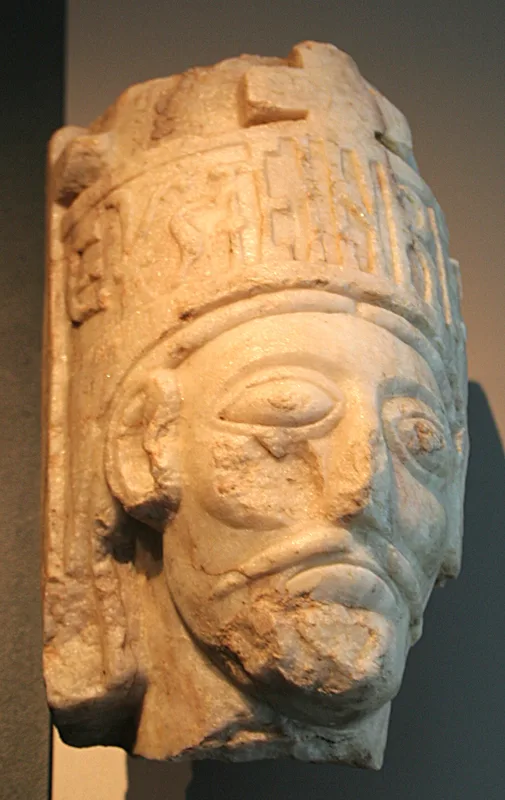 Unknown medieval sculptor, bust of King Eystein I ("EYSTEIN REX"); photo: Nina, University Museum of Bergen, CC BY 2.5 Excavated at Munkeliv Abbey in 1853, this marble head inscribed EYSTEIN REX is the oldest surviving portrait of a Norwegian king — a fitting likeness for the monastery's own founder. King of Norway 1103–1123, sharing the throne with his half-brothers
Sigurd the Crusader and (until 1115) Olav. Remembered chiefly as
a builder and administrator rather than a warrior — the foil to
Sigurd's military exploits in the Mediterranean. Founded the
Benedictine monastery of Munkeliv on the western shore of Bergen
in the early twelfth century, one of the earliest monasteries in
Norway. Sponsored road and harbour improvements across the country
and established the kongsgård (royal estate) infrastructure that
supported the medieval Norwegian court.
Also discussed in The Crusades?!!!! — sixty ships from Bergen, bound for the Holy LandThe Germans Who "Ruled" Bergen — the Hanseatic merchants on Bryggen Wharf . It was turned over to the Swedish Bridgettine order
Unknown medieval sculptor, bust of King Eystein I ("EYSTEIN REX"); photo: Nina, University Museum of Bergen, CC BY 2.5 Excavated at Munkeliv Abbey in 1853, this marble head inscribed EYSTEIN REX is the oldest surviving portrait of a Norwegian king — a fitting likeness for the monastery's own founder. King of Norway 1103–1123, sharing the throne with his half-brothers
Sigurd the Crusader and (until 1115) Olav. Remembered chiefly as
a builder and administrator rather than a warrior — the foil to
Sigurd's military exploits in the Mediterranean. Founded the
Benedictine monastery of Munkeliv on the western shore of Bergen
in the early twelfth century, one of the earliest monasteries in
Norway. Sponsored road and harbour improvements across the country
and established the kongsgård (royal estate) infrastructure that
supported the medieval Norwegian court.
Also discussed in The Crusades?!!!! — sixty ships from Bergen, bound for the Holy LandThe Germans Who "Ruled" Bergen — the Hanseatic merchants on Bryggen Wharf . It was turned over to the Swedish Bridgettine order 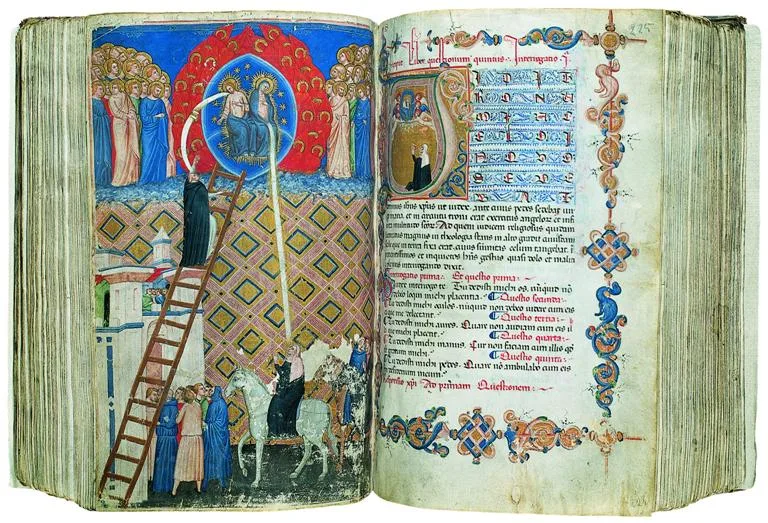 Illuminated manuscript of St Bridget's Revelationes (c. 1375), National Library of Wales Saint Bridget (Birgitta) of Sweden, whose Bridgettine order was the only monastic order of Scandinavian origin — it spread from Vadstena, and her Revelationes were among the most-copied texts of the late-medieval North. Western Christian religious order founded by Saint Bridget of
Sweden (c. 1303–1373), with its mother-house at Vadstena Abbey
in Sweden. Distinctive in the medieval Western Church for its
double monastery organisation — separate communities of monks
and nuns under a single abbess, sharing the same abbey church.
The Norwegian Munkeliv Abbey at Bergen was transferred from the
Benedictines to the Bridgettines in the 1420s with papal
approval — one of the few Bridgettine foundations outside Sweden
itself.
Also discussed in Lutheran Norway and Pietism — a farmer named Hans Nielsen Hauge and a lay revival that could not be silenced in the 1420s, with papal approval, as a double house of monks and nuns — one of the few Bridgettine foundations outside Sweden itself. The Benedictine monastery on Selja, founded around 1100, anchored the veneration of the western saints. The Augustinian canons
Illuminated manuscript of St Bridget's Revelationes (c. 1375), National Library of Wales Saint Bridget (Birgitta) of Sweden, whose Bridgettine order was the only monastic order of Scandinavian origin — it spread from Vadstena, and her Revelationes were among the most-copied texts of the late-medieval North. Western Christian religious order founded by Saint Bridget of
Sweden (c. 1303–1373), with its mother-house at Vadstena Abbey
in Sweden. Distinctive in the medieval Western Church for its
double monastery organisation — separate communities of monks
and nuns under a single abbess, sharing the same abbey church.
The Norwegian Munkeliv Abbey at Bergen was transferred from the
Benedictines to the Bridgettines in the 1420s with papal
approval — one of the few Bridgettine foundations outside Sweden
itself.
Also discussed in Lutheran Norway and Pietism — a farmer named Hans Nielsen Hauge and a lay revival that could not be silenced in the 1420s, with papal approval, as a double house of monks and nuns — one of the few Bridgettine foundations outside Sweden itself. The Benedictine monastery on Selja, founded around 1100, anchored the veneration of the western saints. The Augustinian canons 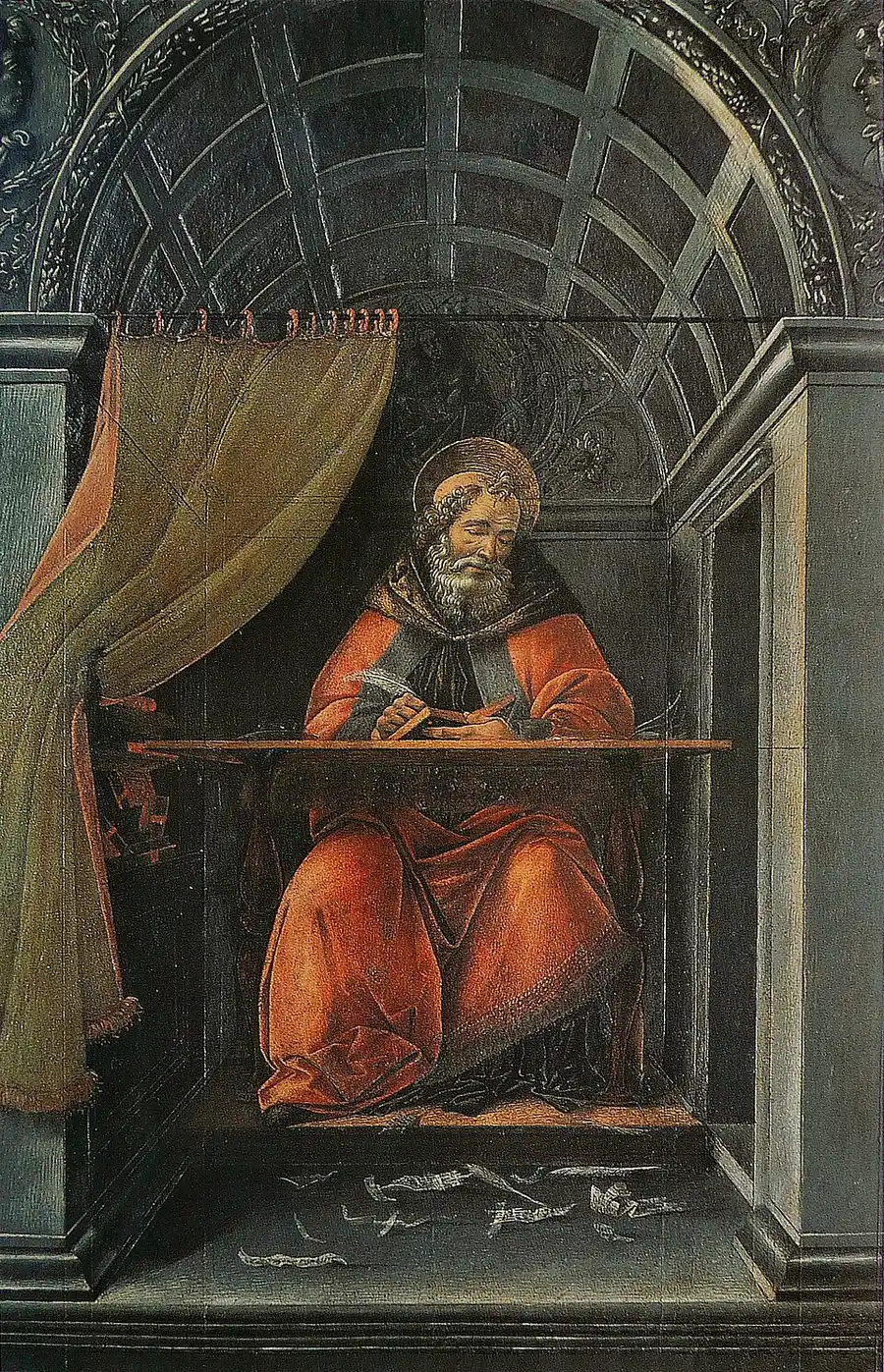 Sandro Botticelli, Saint Augustine in His Study (1490-94), Uffizi, Florence Saint Augustine of Hippo, whose Rule the Augustinian canons followed — the order that held Halsnøy, Utstein, and Kastelle, blending monastic life with cathedral and parish duties in Norway. Communities of priest-canons living under a version of the Rule
of Saint Augustine — a Western Christian religious order distinct
from the monastic orders (Benedictines, Cistercians) in that the
Augustinian canons retained their priestly ministry alongside the
communal life of prayer. Spread across Europe from the eleventh
century. The Augustinian houses in medieval Norway included
Halsnøy in Sunnhordland (founded 1163 by Magnus Erlingsson's
father Erling Skakke), Jonsklosteret on Heggen and the abbey at
Kastelle outside Konghelle. Several of the Norwegian cathedral
chapters were also organised as Augustinian communities.
at Halsnøy
Sandro Botticelli, Saint Augustine in His Study (1490-94), Uffizi, Florence Saint Augustine of Hippo, whose Rule the Augustinian canons followed — the order that held Halsnøy, Utstein, and Kastelle, blending monastic life with cathedral and parish duties in Norway. Communities of priest-canons living under a version of the Rule
of Saint Augustine — a Western Christian religious order distinct
from the monastic orders (Benedictines, Cistercians) in that the
Augustinian canons retained their priestly ministry alongside the
communal life of prayer. Spread across Europe from the eleventh
century. The Augustinian houses in medieval Norway included
Halsnøy in Sunnhordland (founded 1163 by Magnus Erlingsson's
father Erling Skakke), Jonsklosteret on Heggen and the abbey at
Kastelle outside Konghelle. Several of the Norwegian cathedral
chapters were also organised as Augustinian communities.
at Halsnøy 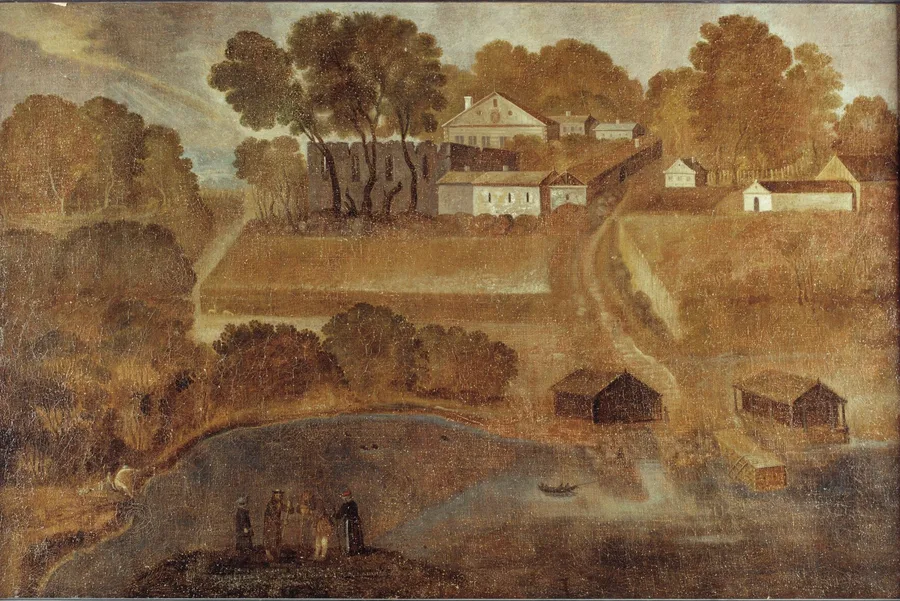 Elias Figenschou, Halsnøy kloster (1656), Skokloster Castle The earliest painted view of Halsnøy: in 1656, a century after the Reformation closed the abbey, the arcade of its medieval church still stood among the estate buildings — the island house Erling Skakke founded for Augustinian canons in 1163. Island in Sunnhordland, southern Vestland County, Norway. Site
of the Augustinian monastery of Halsnøy, founded in 1163 by
Magnus Erlingsson's father Erling Skakke. One of the principal
Augustinian houses of medieval Norway, with substantial
landholdings across the surrounding region. Closed at the 1537
Reformation; the surviving monastery house from the medieval
period is preserved as Halsnøy Kloster, now an open-air museum.
in Sunnhordland and the Premonstratensians
Elias Figenschou, Halsnøy kloster (1656), Skokloster Castle The earliest painted view of Halsnøy: in 1656, a century after the Reformation closed the abbey, the arcade of its medieval church still stood among the estate buildings — the island house Erling Skakke founded for Augustinian canons in 1163. Island in Sunnhordland, southern Vestland County, Norway. Site
of the Augustinian monastery of Halsnøy, founded in 1163 by
Magnus Erlingsson's father Erling Skakke. One of the principal
Augustinian houses of medieval Norway, with substantial
landholdings across the surrounding region. Closed at the 1537
Reformation; the surviving monastery house from the medieval
period is preserved as Halsnøy Kloster, now an open-air museum.
in Sunnhordland and the Premonstratensians 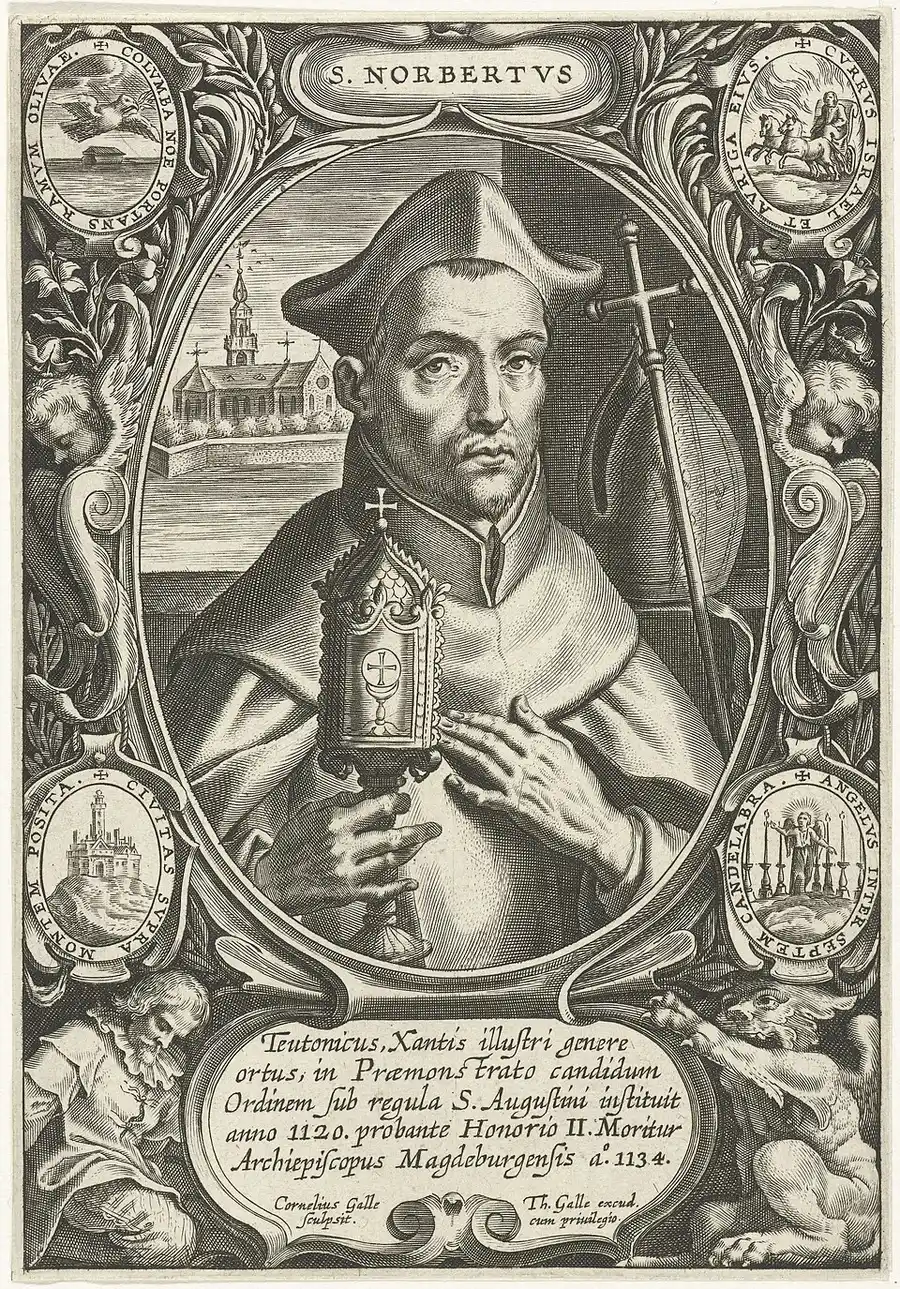 Cornelis Galle I after Rubens, Saint Norbert of Xanten (c. 1600), Rijksmuseum (CC0) Saint Norbert of Xanten, founder of the Premonstratensian canons — the white-robed order that staffed Tønsberg's and Dragsmark's houses in medieval Norway. Order of Western Christian canons founded by Saint Norbert of
Xanten in 1120 at Prémontré in northern France — a reformed
Augustinian community combining the canon's preaching ministry
with a stricter monastic discipline modelled on the Cistercians.
Spread across Western Europe in the twelfth century. The principal
Norwegian Premonstratensian house was the St. Olav's Abbey at
Tønsberg, founded in the late twelfth century, with substantial
landholdings across the southeastern districts. Closed at the
1537 Reformation.
at Tønsberg
Cornelis Galle I after Rubens, Saint Norbert of Xanten (c. 1600), Rijksmuseum (CC0) Saint Norbert of Xanten, founder of the Premonstratensian canons — the white-robed order that staffed Tønsberg's and Dragsmark's houses in medieval Norway. Order of Western Christian canons founded by Saint Norbert of
Xanten in 1120 at Prémontré in northern France — a reformed
Augustinian community combining the canon's preaching ministry
with a stricter monastic discipline modelled on the Cistercians.
Spread across Western Europe in the twelfth century. The principal
Norwegian Premonstratensian house was the St. Olav's Abbey at
Tønsberg, founded in the late twelfth century, with substantial
landholdings across the southeastern districts. Closed at the
1537 Reformation.
at Tønsberg 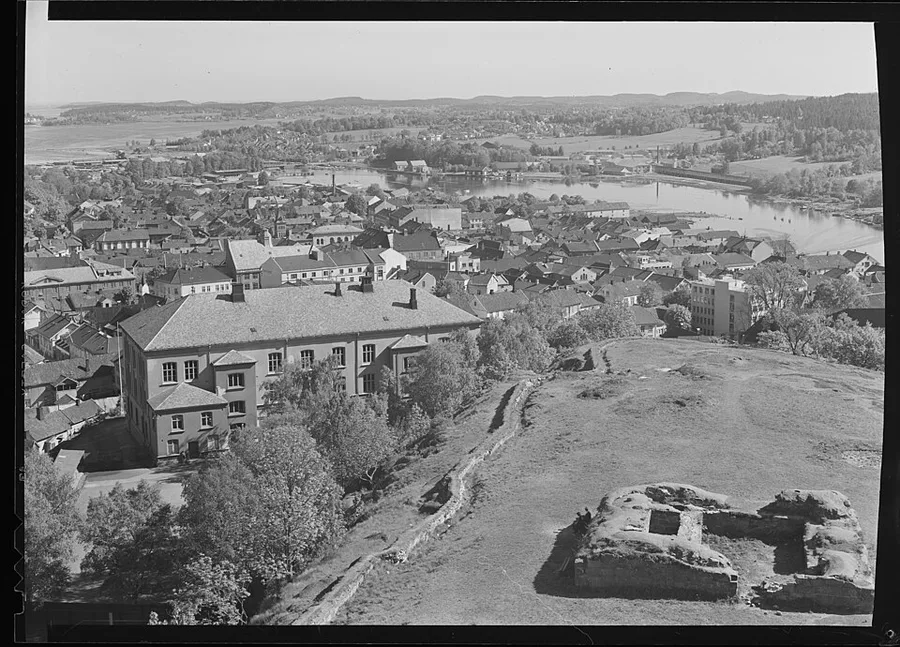 Mittet & Co., photograph of Tønsberg (c. 1939-1949), National Library of Norway Tunsberghus fortress crowned this hill from the twelfth century, part of the royal and monastic infrastructure — including the nearby Premonstratensian monastery of St. Olav — that made Tønsberg one of medieval Norway's oldest centers of Catholic and royal authority. City in Vestfold County, often cited as Norway's oldest town;
attested in the Heimskringla as a royal seat from the late
ninth century. Site of the medieval Premonstratensian monastery
of St. Olav, founded in the late twelfth century, and of the
royal fortress of Tunsberghus on the rocky hill above the town.
About fifty thousand people today; one of the principal
recreational and historical centres of the inner Oslofjord
region, with the Borre Mound Cemetery (the Yngling royal mounds)
just north of the city.
Tønsberg, Vestfold Also discussed in The Golden Age — a North Atlantic empire … reaching farther than you think ran their own networks in the southwestern districts.
Mittet & Co., photograph of Tønsberg (c. 1939-1949), National Library of Norway Tunsberghus fortress crowned this hill from the twelfth century, part of the royal and monastic infrastructure — including the nearby Premonstratensian monastery of St. Olav — that made Tønsberg one of medieval Norway's oldest centers of Catholic and royal authority. City in Vestfold County, often cited as Norway's oldest town;
attested in the Heimskringla as a royal seat from the late
ninth century. Site of the medieval Premonstratensian monastery
of St. Olav, founded in the late twelfth century, and of the
royal fortress of Tunsberghus on the rocky hill above the town.
About fifty thousand people today; one of the principal
recreational and historical centres of the inner Oslofjord
region, with the Borre Mound Cemetery (the Yngling royal mounds)
just north of the city.
Tønsberg, Vestfold Also discussed in The Golden Age — a North Atlantic empire … reaching farther than you think ran their own networks in the southwestern districts.
The Cistercian order 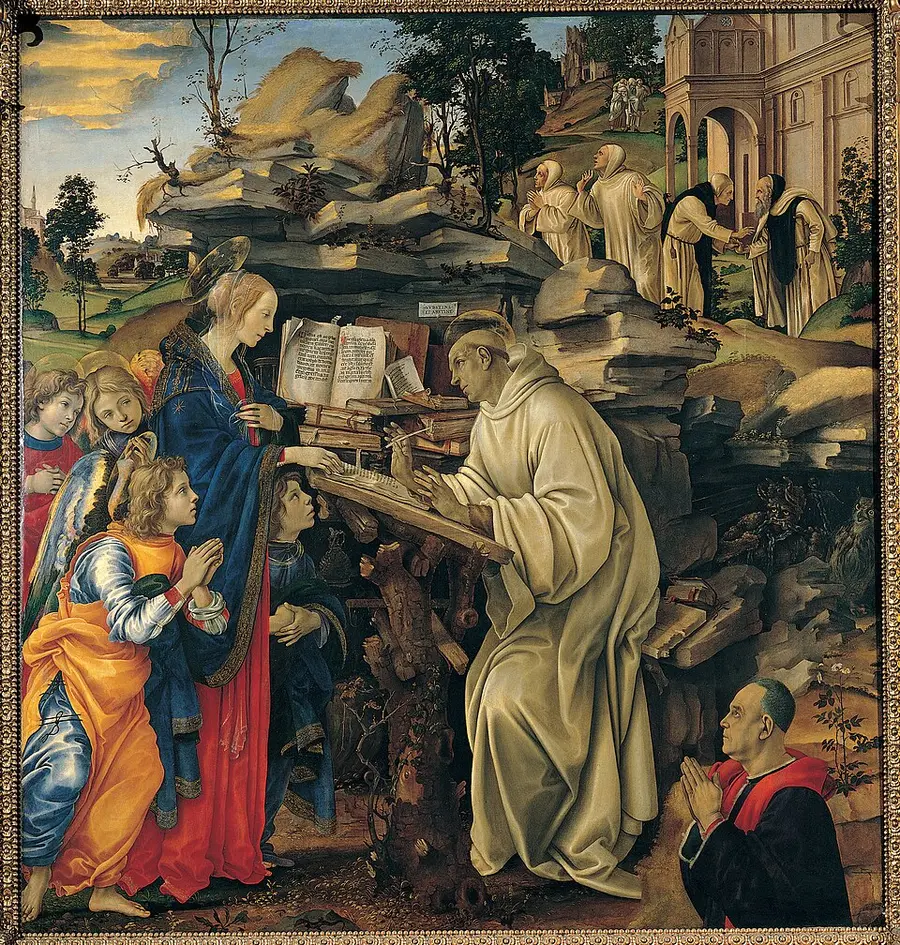 Filippino Lippi, The Vision of Saint Bernard (1486), Badia Fiorentina, Florence Saint Bernard of Clairvaux, driving force of the Cistercian order — the white-habited reform monks whose austere abbeys (Lyse, Hovedøya, Tautra) brought their architecture and estate farming to Norway from the 1140s. Reformed Benedictine order founded at Cîteaux in Burgundy in
1098 — Ordo Cisterciensis, "the Order of Cîteaux" — committed
to a strict literal observance of the Rule of Saint Benedict,
manual labour, plain architecture, remote rural sites, and a
tightly centralised structure that connected every house to
the mother of its founding lineage through annual visitations.
Spread explosively across Western Europe across the twelfth
century, with around seven hundred houses by 1200. The
Norwegian Cistercian foundations — Lyse outside Bergen (1146,
from Fountains), Hovedøya in Oslofjord (1147, from Kirkstead),
Tautra in the Trondheim Fjord (1207, from Lyse) — were
daughter-houses of the English Cistercian network.
arrived in Norway directly from England in the mid-twelfth century. Monks sent from Fountains Abbey
Filippino Lippi, The Vision of Saint Bernard (1486), Badia Fiorentina, Florence Saint Bernard of Clairvaux, driving force of the Cistercian order — the white-habited reform monks whose austere abbeys (Lyse, Hovedøya, Tautra) brought their architecture and estate farming to Norway from the 1140s. Reformed Benedictine order founded at Cîteaux in Burgundy in
1098 — Ordo Cisterciensis, "the Order of Cîteaux" — committed
to a strict literal observance of the Rule of Saint Benedict,
manual labour, plain architecture, remote rural sites, and a
tightly centralised structure that connected every house to
the mother of its founding lineage through annual visitations.
Spread explosively across Western Europe across the twelfth
century, with around seven hundred houses by 1200. The
Norwegian Cistercian foundations — Lyse outside Bergen (1146,
from Fountains), Hovedøya in Oslofjord (1147, from Kirkstead),
Tautra in the Trondheim Fjord (1207, from Lyse) — were
daughter-houses of the English Cistercian network.
arrived in Norway directly from England in the mid-twelfth century. Monks sent from Fountains Abbey  Anonymous, Ruins of Fountaine's Abbey, Yorkshire (1811), Yale Center for British Art An 1811 view of the ruined nave at Fountains Abbey, the Yorkshire mother-house whose monks and regular visitations connected Lyse Abbey near Bergen — Norway's first Cistercian house — to the wider English Cistercian network. Cistercian monastery in Yorkshire, northern England, founded in
1132 by thirteen Benedictine monks from St. Mary's Abbey in York
who broke from the older order to adopt the stricter Cistercian
rule. One of the largest and best-preserved monastic ruins in
Britain today. From Fountains, daughter-houses were founded
across the British Isles and the North Atlantic — including
Lyse Abbey near Bergen in 1146, the first Cistercian foundation
in Norway. The Cistercian network connected the Norwegian houses
tightly to the international order through regular visitations
from Fountains and the other English mother-houses.
in Yorkshire
Anonymous, Ruins of Fountaine's Abbey, Yorkshire (1811), Yale Center for British Art An 1811 view of the ruined nave at Fountains Abbey, the Yorkshire mother-house whose monks and regular visitations connected Lyse Abbey near Bergen — Norway's first Cistercian house — to the wider English Cistercian network. Cistercian monastery in Yorkshire, northern England, founded in
1132 by thirteen Benedictine monks from St. Mary's Abbey in York
who broke from the older order to adopt the stricter Cistercian
rule. One of the largest and best-preserved monastic ruins in
Britain today. From Fountains, daughter-houses were founded
across the British Isles and the North Atlantic — including
Lyse Abbey near Bergen in 1146, the first Cistercian foundation
in Norway. The Cistercian network connected the Norwegian houses
tightly to the international order through regular visitations
from Fountains and the other English mother-houses.
in Yorkshire  Detroit Publishing Co. photochrom, York from City Walls (c. 1890–1900), Library of Congress York from its medieval walls, the Minster rising over the rooftops in an 1890s photochrom. The city was Norse Jórvík, capital of the Danelaw, and the church metropolis of England's north — the Yorkshire of Norse place-names and of the great abbeys whose monks reached Norway. Historic county of northern England, the largest of the traditional
English counties. Under heavy Norse settlement and rule from the
late ninth century onward — the Norse-founded kingdom of York
(Jórvík) was the centre of the Danelaw — until reabsorbed into the
English kingdom in 954. Norse place-names ending in -by, -thorpe,
and -thwaite still mark Yorkshire's villages and fields. Site of
the Battle of Stamford Bridge (1066), where Harald Hardrada's last
Norse invasion of England ended.
Also discussed in The Viking Age — longships, legends, and the first "Norway" (modern-day northern England) founded Lyse Abbey
Detroit Publishing Co. photochrom, York from City Walls (c. 1890–1900), Library of Congress York from its medieval walls, the Minster rising over the rooftops in an 1890s photochrom. The city was Norse Jórvík, capital of the Danelaw, and the church metropolis of England's north — the Yorkshire of Norse place-names and of the great abbeys whose monks reached Norway. Historic county of northern England, the largest of the traditional
English counties. Under heavy Norse settlement and rule from the
late ninth century onward — the Norse-founded kingdom of York
(Jórvík) was the centre of the Danelaw — until reabsorbed into the
English kingdom in 954. Norse place-names ending in -by, -thorpe,
and -thwaite still mark Yorkshire's villages and fields. Site of
the Battle of Stamford Bridge (1066), where Harald Hardrada's last
Norse invasion of England ended.
Also discussed in The Viking Age — longships, legends, and the first "Norway" (modern-day northern England) founded Lyse Abbey  Joachim Frich, Lysekloster, from Norge fremstillet i Tegninger (Chr. Tønsberg, 1848), National Library of Norway The valley of Lysekloster near Bergen, where Cistercian monks from Fountains Abbey in Yorkshire founded Lyse Abbey in 1146. After the Reformation an estate rose on the site; Frich’s 1848 view looks across the lake to its buildings and church. Cistercian monastery in the parish of Os south of Bergen,
founded in 1146 by monks sent from Fountains Abbey in Yorkshire
— the first Cistercian foundation in Norway, a year before
Nicholas Breakspear's papal mission reorganised the country's
whole church. The abbey ran the surrounding agricultural estate
and connected the Norwegian Cistercian network to the English
mother-houses through regular visitations. Closed at the 1537
Reformation. The masonry foundations and a small fragment of
the church wall survive as a protected medieval ruin in the
modern Lysekloster area.
outside Bergen in 1146, six years before Nicholas Breakspear’s papal mission would reorganize the country’s whole church. The following year, monks from Kirkstead Abbey
Joachim Frich, Lysekloster, from Norge fremstillet i Tegninger (Chr. Tønsberg, 1848), National Library of Norway The valley of Lysekloster near Bergen, where Cistercian monks from Fountains Abbey in Yorkshire founded Lyse Abbey in 1146. After the Reformation an estate rose on the site; Frich’s 1848 view looks across the lake to its buildings and church. Cistercian monastery in the parish of Os south of Bergen,
founded in 1146 by monks sent from Fountains Abbey in Yorkshire
— the first Cistercian foundation in Norway, a year before
Nicholas Breakspear's papal mission reorganised the country's
whole church. The abbey ran the surrounding agricultural estate
and connected the Norwegian Cistercian network to the English
mother-houses through regular visitations. Closed at the 1537
Reformation. The masonry foundations and a small fragment of
the church wall survive as a protected medieval ruin in the
modern Lysekloster area.
outside Bergen in 1146, six years before Nicholas Breakspear’s papal mission would reorganize the country’s whole church. The following year, monks from Kirkstead Abbey  Kelly (Wikimedia Commons), South view, Kirkstead Abbey ruin (2017) The single surviving fragment of Kirkstead's medieval church — the southeast corner of the south transept — is essentially all that still stands. The Buck brothers engraved the ruin in 1726, but no freely licensed scan of their plate exists, so this photograph shows the one piece left to see. Cistercian monastery in Lincolnshire, eastern England, founded in
1139 by Hugh Brito, lord of Tattershall — a daughter-house of
Fountains Abbey. In 1147 a party of monks sent from Kirkstead
founded Hovedøya Abbey on a small wooded island in the inner
Oslofjord, the first Cistercian house in eastern Norway. The
English Reformation suppressed Kirkstead in 1537 (the same year
as the Norwegian Reformation that ended Hovedøya). Only a single
fragment of the medieval Kirkstead church survives today,
preserved as a protected ancient monument.
in Lincolnshire
Kelly (Wikimedia Commons), South view, Kirkstead Abbey ruin (2017) The single surviving fragment of Kirkstead's medieval church — the southeast corner of the south transept — is essentially all that still stands. The Buck brothers engraved the ruin in 1726, but no freely licensed scan of their plate exists, so this photograph shows the one piece left to see. Cistercian monastery in Lincolnshire, eastern England, founded in
1139 by Hugh Brito, lord of Tattershall — a daughter-house of
Fountains Abbey. In 1147 a party of monks sent from Kirkstead
founded Hovedøya Abbey on a small wooded island in the inner
Oslofjord, the first Cistercian house in eastern Norway. The
English Reformation suppressed Kirkstead in 1537 (the same year
as the Norwegian Reformation that ended Hovedøya). Only a single
fragment of the medieval Kirkstead church survives today,
preserved as a protected ancient monument.
in Lincolnshire  Peter De Wint, Lincoln Cathedral from the North East (early 19th c.), Usher Gallery, Lincoln Lincoln Cathedral rising over the county's rooftops, painted by Peter De Wint, the artist most identified with Lincolnshire — the county whose fenland abbeys, Kirkstead among them, sent monks across the North Sea to the Oslofjord in 1147. Historic county of eastern England, covering the flat lowlands
and fenlands between the Humber estuary and the Wash. Home to
several major medieval monasteries — including Kirkstead Abbey
(Cistercian, 1139), Crowland (Benedictine), and Bardney — and
to the Romanesque-Gothic Lincoln Cathedral, one of the tallest
buildings in medieval Europe. Kirkstead's daughter-house at
Hovedøya in the Oslofjord, founded 1147, was one of the
principal Cistercian connections between medieval Norway and
the wider English Cistercian network.
(modern-day eastern England) took possession of Hovedøya
Peter De Wint, Lincoln Cathedral from the North East (early 19th c.), Usher Gallery, Lincoln Lincoln Cathedral rising over the county's rooftops, painted by Peter De Wint, the artist most identified with Lincolnshire — the county whose fenland abbeys, Kirkstead among them, sent monks across the North Sea to the Oslofjord in 1147. Historic county of eastern England, covering the flat lowlands
and fenlands between the Humber estuary and the Wash. Home to
several major medieval monasteries — including Kirkstead Abbey
(Cistercian, 1139), Crowland (Benedictine), and Bardney — and
to the Romanesque-Gothic Lincoln Cathedral, one of the tallest
buildings in medieval Europe. Kirkstead's daughter-house at
Hovedøya in the Oslofjord, founded 1147, was one of the
principal Cistercian connections between medieval Norway and
the wider English Cistercian network.
(modern-day eastern England) took possession of Hovedøya 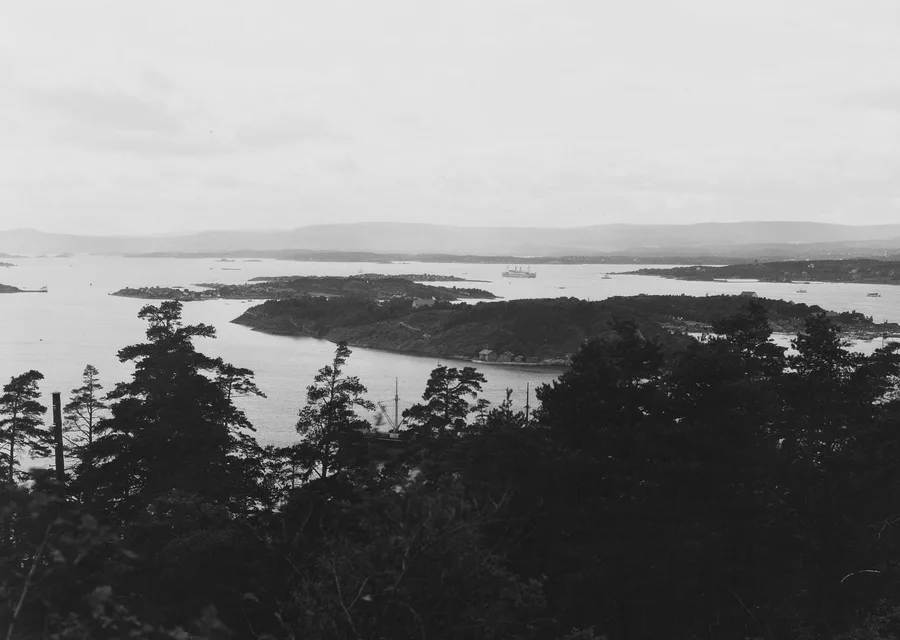 Anders Beer Wilse, Hovedøen fra Ekeberg (early 1900s), National Library of Norway The wooded island lying just off Oslo's harbour, photographed from the Ekeberg slope — close enough to the medieval town for the Cistercians to plant their abbey there in 1147, and for Oslo families to reach its ruins by summer ferry today. Wooded island of about a square kilometre in the inner Oslofjord,
just south of central Oslo. Site of the Cistercian abbey founded
in 1147 by monks sent from Kirkstead Abbey in Lincolnshire,
England. The abbey ran until the 1537 Reformation; the stripped
masonry ruins are preserved as a public park reached by summer
ferry from the Aker Brygge harbour in central Oslo and walked
through by Oslo families today. The island also hosts a small
beach and is one of the most visited recreational destinations
for Oslo residents.
Hovedøya, Oslo Also discussed in The Reformation, 1537 — one church eradicated and another imposed , the small wooded island in the inner Oslo Fjord just south of the modern city centre, and raised the Hovedøya Abbey
Anders Beer Wilse, Hovedøen fra Ekeberg (early 1900s), National Library of Norway The wooded island lying just off Oslo's harbour, photographed from the Ekeberg slope — close enough to the medieval town for the Cistercians to plant their abbey there in 1147, and for Oslo families to reach its ruins by summer ferry today. Wooded island of about a square kilometre in the inner Oslofjord,
just south of central Oslo. Site of the Cistercian abbey founded
in 1147 by monks sent from Kirkstead Abbey in Lincolnshire,
England. The abbey ran until the 1537 Reformation; the stripped
masonry ruins are preserved as a public park reached by summer
ferry from the Aker Brygge harbour in central Oslo and walked
through by Oslo families today. The island also hosts a small
beach and is one of the most visited recreational destinations
for Oslo residents.
Hovedøya, Oslo Also discussed in The Reformation, 1537 — one church eradicated and another imposed , the small wooded island in the inner Oslo Fjord just south of the modern city centre, and raised the Hovedøya Abbey 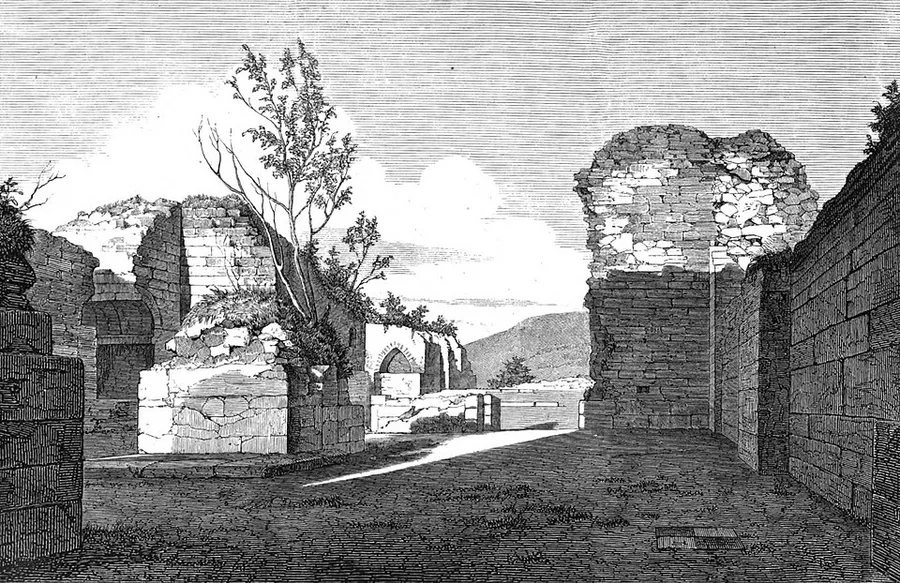 Klosterruinen paa Hovedøen, from Nordiske Billeder (Copenhagen, 1870) The Cistercian abbey ruins on Hovedøya, founded 1147 by monks from Kirkstead in Lincolnshire — dissolved at the Reformation and left as the roofless walls this 1870 print records. Cistercian monastery on Hovedøya island in the inner Oslofjord,
founded in 1147 by monks sent from Kirkstead Abbey in
Lincolnshire, England — the first Cistercian foundation in
eastern Norway. The abbey ran the surrounding agricultural
estates across the eastern lowlands and connected the
eastern Norwegian Cistercian network to the English mother-
houses. Closed at the 1537 Reformation. The stripped masonry
ruins of the church and cloister are preserved as a public park
on Hovedøya, reached by summer ferry from the Aker Brygge
harbour in central Oslo and walked through by Oslo families today.
Hovedøya Abbey, Oslo whose stripped masonry ruins Oslo families walk through today, arriving on summer ferries. The Cistercian network connected the Norwegian houses tightly to the international order: regular visitations from the mother-houses in Yorkshire and Burgundy
Klosterruinen paa Hovedøen, from Nordiske Billeder (Copenhagen, 1870) The Cistercian abbey ruins on Hovedøya, founded 1147 by monks from Kirkstead in Lincolnshire — dissolved at the Reformation and left as the roofless walls this 1870 print records. Cistercian monastery on Hovedøya island in the inner Oslofjord,
founded in 1147 by monks sent from Kirkstead Abbey in
Lincolnshire, England — the first Cistercian foundation in
eastern Norway. The abbey ran the surrounding agricultural
estates across the eastern lowlands and connected the
eastern Norwegian Cistercian network to the English mother-
houses. Closed at the 1537 Reformation. The stripped masonry
ruins of the church and cloister are preserved as a public park
on Hovedøya, reached by summer ferry from the Aker Brygge
harbour in central Oslo and walked through by Oslo families today.
Hovedøya Abbey, Oslo whose stripped masonry ruins Oslo families walk through today, arriving on summer ferries. The Cistercian network connected the Norwegian houses tightly to the international order: regular visitations from the mother-houses in Yorkshire and Burgundy 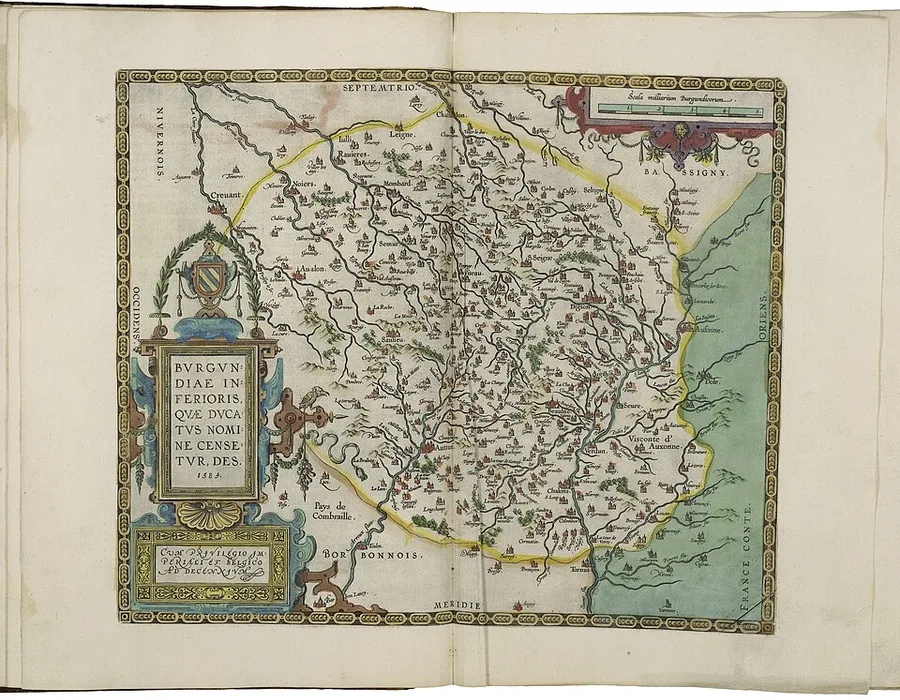 Abraham Ortelius, Map of the Duchy of Burgundy (c. 1608), Theatrum Orbis Terrarum Ortelius's map of Burgundy locates the region around Dijon that held Cîteaux and Clairvaux, the Cistercian mother-houses whose visitations reached the Norwegian daughter-abbeys at Lyse, Hovedøya, and Tautra alongside the English Cistercian connections at Fountains and Kirkstead. Historic region of eastern France centred on Dijon. In the
twelfth century home to the great Cistercian mother-houses of
Cîteaux (founded 1098) and Clairvaux (founded 1115 by Bernard
of Clairvaux) — the cradle of the Cistercian reform that spread
rapidly across Western Europe. The Norwegian Cistercian abbeys
(Lyse outside Bergen, Hovedøya in Oslofjord, Tautra in the
Trondheim Fjord) received regular visitations from the mother-
houses in Burgundy alongside the English Cistercian
connections at Fountains and Kirkstead.
(modern-day eastern France), trained monks circulating among the abbeys, and a single set of architectural and liturgical conventions that ran from Norway down through England, France, and southern Italy.
Abraham Ortelius, Map of the Duchy of Burgundy (c. 1608), Theatrum Orbis Terrarum Ortelius's map of Burgundy locates the region around Dijon that held Cîteaux and Clairvaux, the Cistercian mother-houses whose visitations reached the Norwegian daughter-abbeys at Lyse, Hovedøya, and Tautra alongside the English Cistercian connections at Fountains and Kirkstead. Historic region of eastern France centred on Dijon. In the
twelfth century home to the great Cistercian mother-houses of
Cîteaux (founded 1098) and Clairvaux (founded 1115 by Bernard
of Clairvaux) — the cradle of the Cistercian reform that spread
rapidly across Western Europe. The Norwegian Cistercian abbeys
(Lyse outside Bergen, Hovedøya in Oslofjord, Tautra in the
Trondheim Fjord) received regular visitations from the mother-
houses in Burgundy alongside the English Cistercian
connections at Fountains and Kirkstead.
(modern-day eastern France), trained monks circulating among the abbeys, and a single set of architectural and liturgical conventions that ran from Norway down through England, France, and southern Italy.
The Norwegian monasteries were never numerous or wealthy by continental standards. But each was a literate, internationally-connected outpost in a thinly-settled country whose largest towns at this period had populations measured in the low thousands.
The stave churches
The most distinctive physical inheritance of the medieval Norwegian church is the Stave church 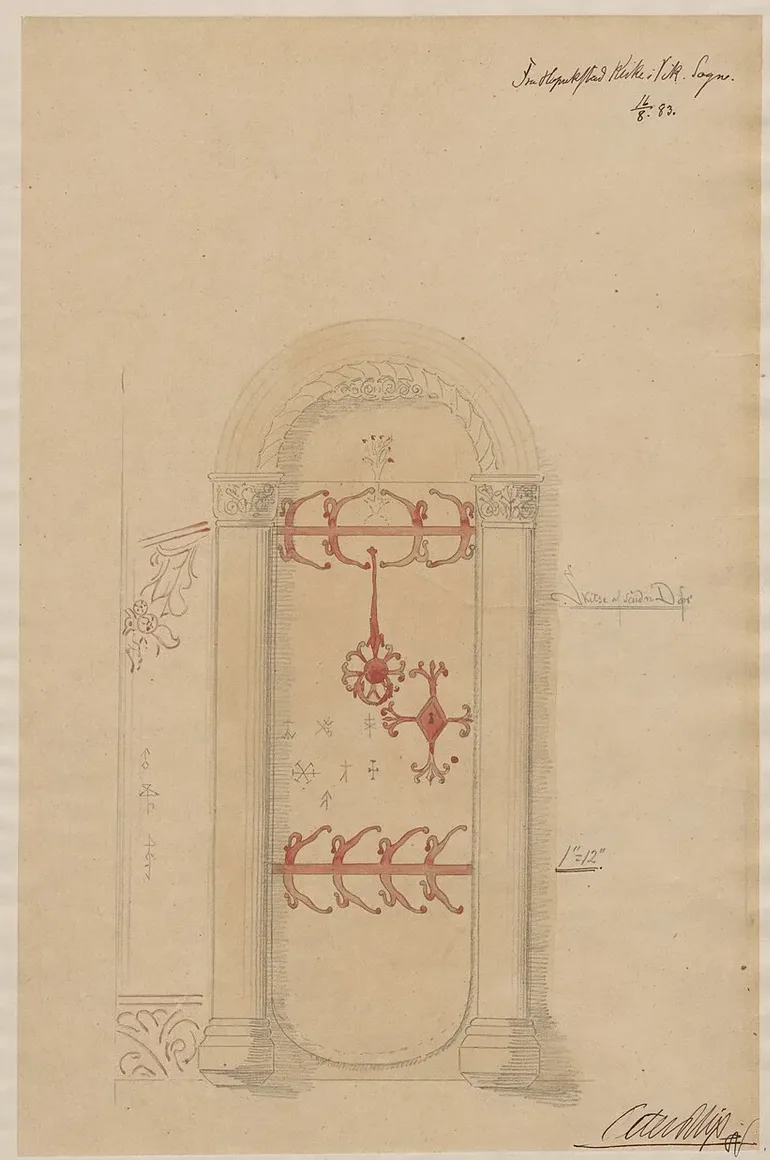 Peter Andreas Blix, elevation of the south portal, Hopperstad Stave Church (1883), Norwegian Directorate for Cultural Heritage A restoration architect's 1883 measured elevation of a stave-church portal — the stav-and-sill construction shared by every surviving example — drawn not from any of the six churches named elsewhere on this page but from Hopperstad, a seventh, so this card stays about the building type rather than one building. The distinctive Norwegian medieval wooden church type — Norwegian
stavkirke — built between roughly 1100 and 1350 across the
country. The defining structural element was the stav: an
upright pine pillar set on a sill of stone above the wet ground,
supporting the wall and roof through horizontal beams and braced
corner-pieces. The load-bearing skeleton was worked entirely in
timber joinery, with only minor iron for door fittings and
shingles. Between one and two thousand stave churches were built
across Norway; twenty-eight survive into the present — more than
the rest of the world combined. The technique was a Norwegian
adaptation of Viking-era timber building to the requirements of
a Christian church.
. The technique was a Norwegian adaptation of Viking-era timber building to the requirements of a Christian church. The defining structural element was the stav, the upright pine pillar set on a sill of stone above the wet ground, supporting the wall and the roof through a system of horizontal beams and braced corner-pieces. The walls were panels of vertical pine planks tongued into the beams. The roof stepped upward in raised tiers toward a central spire. The load-bearing skeleton was worked entirely in timber joinery; only minor iron was used, for door fittings and shingles. The whole construction was the work of the same village-level carpenters whose grandfathers had built longships, and the gable-ends of the most elaborate examples carry dragon-head finials that echo the longship prows directly.
Peter Andreas Blix, elevation of the south portal, Hopperstad Stave Church (1883), Norwegian Directorate for Cultural Heritage A restoration architect's 1883 measured elevation of a stave-church portal — the stav-and-sill construction shared by every surviving example — drawn not from any of the six churches named elsewhere on this page but from Hopperstad, a seventh, so this card stays about the building type rather than one building. The distinctive Norwegian medieval wooden church type — Norwegian
stavkirke — built between roughly 1100 and 1350 across the
country. The defining structural element was the stav: an
upright pine pillar set on a sill of stone above the wet ground,
supporting the wall and roof through horizontal beams and braced
corner-pieces. The load-bearing skeleton was worked entirely in
timber joinery, with only minor iron for door fittings and
shingles. Between one and two thousand stave churches were built
across Norway; twenty-eight survive into the present — more than
the rest of the world combined. The technique was a Norwegian
adaptation of Viking-era timber building to the requirements of
a Christian church.
. The technique was a Norwegian adaptation of Viking-era timber building to the requirements of a Christian church. The defining structural element was the stav, the upright pine pillar set on a sill of stone above the wet ground, supporting the wall and the roof through a system of horizontal beams and braced corner-pieces. The walls were panels of vertical pine planks tongued into the beams. The roof stepped upward in raised tiers toward a central spire. The load-bearing skeleton was worked entirely in timber joinery; only minor iron was used, for door fittings and shingles. The whole construction was the work of the same village-level carpenters whose grandfathers had built longships, and the gable-ends of the most elaborate examples carry dragon-head finials that echo the longship prows directly.
Between one and two thousand stave churches were built across Norway between roughly 1100 and 1350. Twenty-eight survive into the present — more than the rest of the world combined, since no other country built them in comparable numbers, and the handful built elsewhere have largely been lost. The oldest of the survivors, Urnes Stave Church 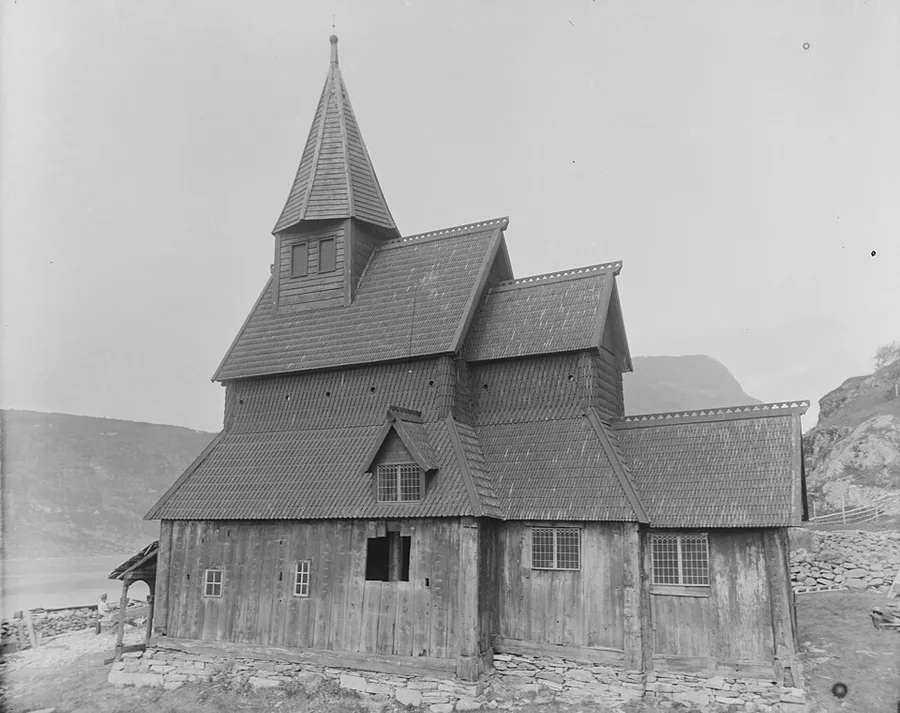 Marthinius Skøien, Urnes stavkirke (1880s–1900s), National Library of Norway The oldest of the twenty-eight surviving stave churches, photographed on its Sognefjord terrace around 1900 — the building itself, whose reused eleventh-century portal carving carries the last Viking-Age decorative style into a Christian church. The oldest of the twenty-eight surviving Norwegian stave
churches, on the Ornes peninsula of the inner Sognefjord. Built
around 1130, with elaborate eleventh-century portal carving
reused from an earlier church on the same site — the Urnes
style it preserved is the latest Viking-Age decorative
tradition, organised on the new building as a Christian
Tree-of-Life. Inscribed on the UNESCO World Heritage list in
1979, alongside Bryggen in Bergen, as one of Norway's first two
World Heritage sites. Still in use as a parish church.
Urnes Stave Church, Sognefjord on the inner Sognefjord
Marthinius Skøien, Urnes stavkirke (1880s–1900s), National Library of Norway The oldest of the twenty-eight surviving stave churches, photographed on its Sognefjord terrace around 1900 — the building itself, whose reused eleventh-century portal carving carries the last Viking-Age decorative style into a Christian church. The oldest of the twenty-eight surviving Norwegian stave
churches, on the Ornes peninsula of the inner Sognefjord. Built
around 1130, with elaborate eleventh-century portal carving
reused from an earlier church on the same site — the Urnes
style it preserved is the latest Viking-Age decorative
tradition, organised on the new building as a Christian
Tree-of-Life. Inscribed on the UNESCO World Heritage list in
1979, alongside Bryggen in Bergen, as one of Norway's first two
World Heritage sites. Still in use as a parish church.
Urnes Stave Church, Sognefjord on the inner Sognefjord 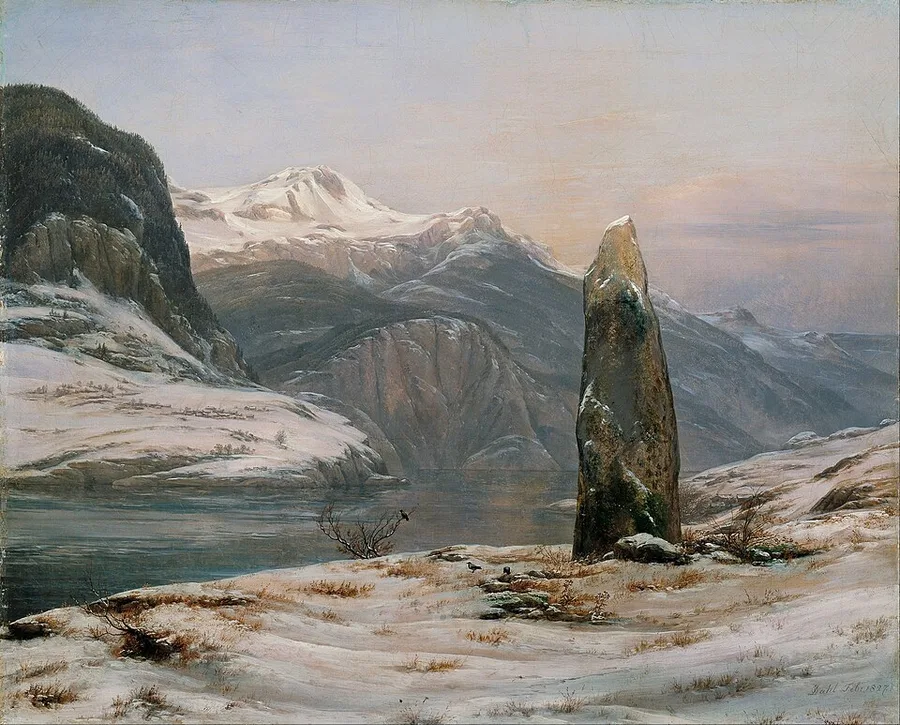 Johan Christian Dahl, Vinter ved Sognefjorden (1827), Nasjonalmuseet J.C. Dahl's Vinter ved Sognefjorden (1827) — an ancient standing stone (bautastein) dark against the frozen shore, the still fjord and pale mountains behind. Dahl put an iron-age monument in the foreground of Norway's longest fjord: water and stone from the centuries when Sogn was a kingdom of its own. Norway's longest and deepest fjord, reaching two hundred and five
kilometres inland from the western coast north of Bergen — the
second-longest fjord in the world after Scoresby Sund in Greenland. In the
petty-kingdom era it was the spine of the small Norwegian kingdom
of Sogn. Its inner branches include the Aurlandsfjord and the
Nærøyfjord — the latter a UNESCO World Heritage site. Communities along the Sognefjord
historically had more regular contact with distant coastal trading
partners than with neighbours one valley over — the geography that
shaped why Norway's petty kingdoms organised by waterway rather than
by overland adjacency.
Sognefjord Also discussed in Before There Was Norway — petty kingdoms at the edge of the world800,000 Norwegians Leave — the century that built a Second Norway , was built around 1130, with elaborate eleventh-century portal carving reused from an earlier church on the same site. It is one of Norway’s first two UNESCO World Heritage sites, inscribed in 1979 alongside Bryggen in Bergen. The best preserved, Borgund Stave Church
Johan Christian Dahl, Vinter ved Sognefjorden (1827), Nasjonalmuseet J.C. Dahl's Vinter ved Sognefjorden (1827) — an ancient standing stone (bautastein) dark against the frozen shore, the still fjord and pale mountains behind. Dahl put an iron-age monument in the foreground of Norway's longest fjord: water and stone from the centuries when Sogn was a kingdom of its own. Norway's longest and deepest fjord, reaching two hundred and five
kilometres inland from the western coast north of Bergen — the
second-longest fjord in the world after Scoresby Sund in Greenland. In the
petty-kingdom era it was the spine of the small Norwegian kingdom
of Sogn. Its inner branches include the Aurlandsfjord and the
Nærøyfjord — the latter a UNESCO World Heritage site. Communities along the Sognefjord
historically had more regular contact with distant coastal trading
partners than with neighbours one valley over — the geography that
shaped why Norway's petty kingdoms organised by waterway rather than
by overland adjacency.
Sognefjord Also discussed in Before There Was Norway — petty kingdoms at the edge of the world800,000 Norwegians Leave — the century that built a Second Norway , was built around 1130, with elaborate eleventh-century portal carving reused from an earlier church on the same site. It is one of Norway’s first two UNESCO World Heritage sites, inscribed in 1979 alongside Bryggen in Bergen. The best preserved, Borgund Stave Church 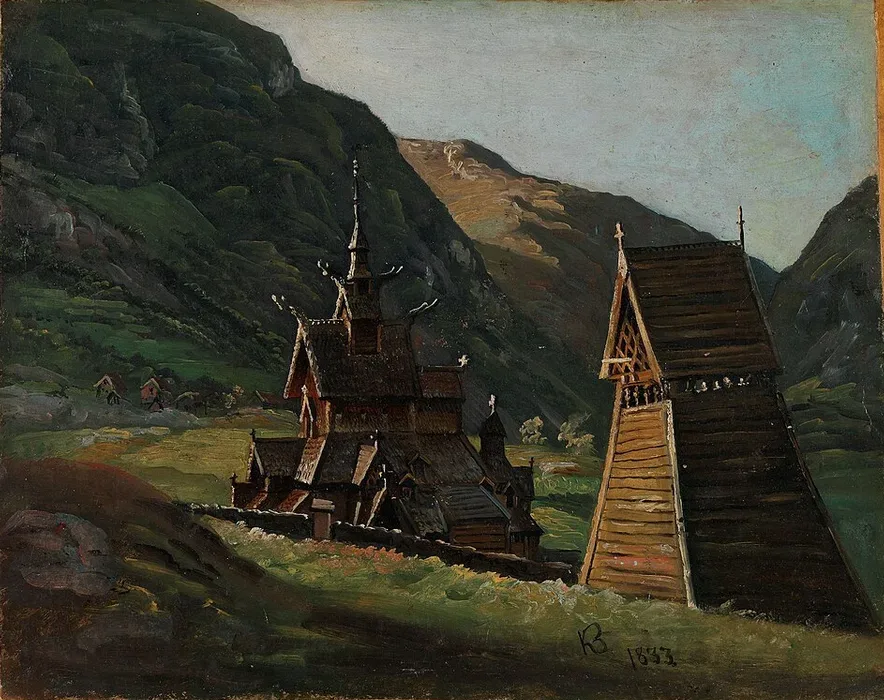 Knud Baade, Borgund Stave Church in Lærdal (1833), Nasjonalmuseet Knud Baade's 1833 painting shows Borgund exactly as textbooks describe it — the tiered dark-shingled roofline and dragon-head gable finials that make this the canonical stave-church silhouette, painted only decades after antiquarians rediscovered the type. The best-preserved of the twenty-eight surviving Norwegian stave
churches, in the Lærdal valley of Vestland County. Felled in the
winter of 1180–81 by dendrochronological dating and built up
shortly afterward; every component is still in its original
place. The canonical example used in textbooks of medieval
Norwegian timber building, with all the classic stave-church
features visible — the stave skeleton, the raised-tier roof,
the dragon-head gable finials, the interlace carving on the
portals. No longer in regular parish use; preserved as a museum
with a separate modern parish church standing alongside.
Borgund Stave Church, Lærdal in the Lærdal
Knud Baade, Borgund Stave Church in Lærdal (1833), Nasjonalmuseet Knud Baade's 1833 painting shows Borgund exactly as textbooks describe it — the tiered dark-shingled roofline and dragon-head gable finials that make this the canonical stave-church silhouette, painted only decades after antiquarians rediscovered the type. The best-preserved of the twenty-eight surviving Norwegian stave
churches, in the Lærdal valley of Vestland County. Felled in the
winter of 1180–81 by dendrochronological dating and built up
shortly afterward; every component is still in its original
place. The canonical example used in textbooks of medieval
Norwegian timber building, with all the classic stave-church
features visible — the stave skeleton, the raised-tier roof,
the dragon-head gable finials, the interlace carving on the
portals. No longer in regular parish use; preserved as a museum
with a separate modern parish church standing alongside.
Borgund Stave Church, Lærdal in the Lærdal 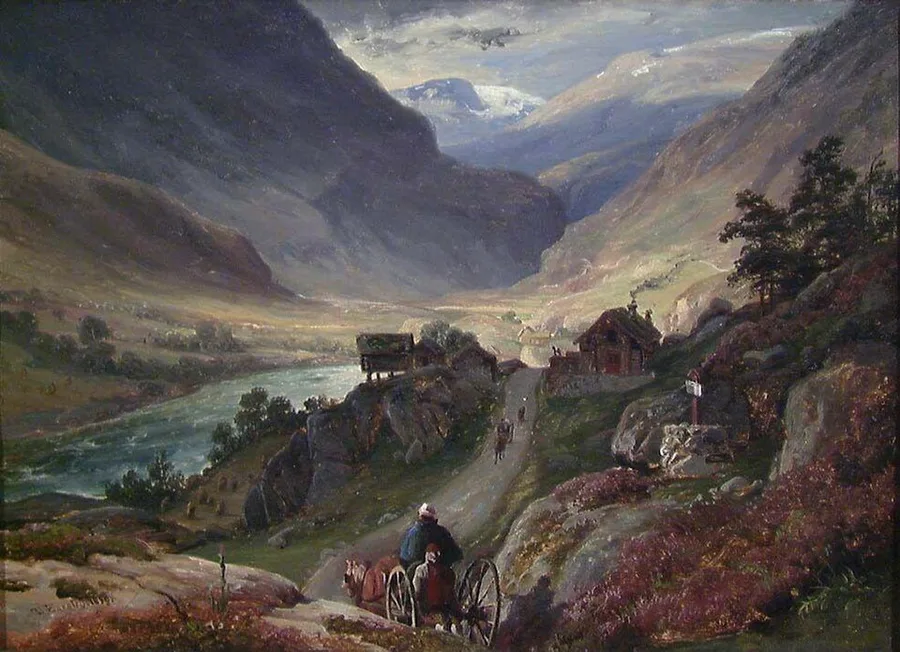 Thomas Fearnley, Steep Roads in Lærdal (1839), Nasjonalmuseet Thomas Fearnley's 1839 view of a steep Lærdal hillside road captures the terrain of the valley that carries travelers past Borgund Stave Church, the best-preserved of Norway's surviving stave churches. Long valley running inland from the inner Sognefjord on the
western Norwegian coast, in Vestland County. Home to Borgund
Stave Church — felled in the winter of 1180–81 by
dendrochronological dating, the best-preserved stave church
in Norway. The Lærdal valley historically formed one of the
principal east-west passages across the Norwegian central
highland, with the medieval king's road running through it.
The Lærdal Tunnel that opened in 2000 — at twenty-five
kilometres the world's longest road tunnel — runs from the
inner end of the valley to Aurland on the way to the
Sognefjord.
Lærdal valley , was felled in the winter of 1180–81 by dendrochronological dating, and built up shortly afterward; every component is still in its original place. The largest, Heddal Stave Church
Thomas Fearnley, Steep Roads in Lærdal (1839), Nasjonalmuseet Thomas Fearnley's 1839 view of a steep Lærdal hillside road captures the terrain of the valley that carries travelers past Borgund Stave Church, the best-preserved of Norway's surviving stave churches. Long valley running inland from the inner Sognefjord on the
western Norwegian coast, in Vestland County. Home to Borgund
Stave Church — felled in the winter of 1180–81 by
dendrochronological dating, the best-preserved stave church
in Norway. The Lærdal valley historically formed one of the
principal east-west passages across the Norwegian central
highland, with the medieval king's road running through it.
The Lærdal Tunnel that opened in 2000 — at twenty-five
kilometres the world's longest road tunnel — runs from the
inner end of the valley to Aurland on the way to the
Sognefjord.
Lærdal valley , was felled in the winter of 1180–81 by dendrochronological dating, and built up shortly afterward; every component is still in its original place. The largest, Heddal Stave Church 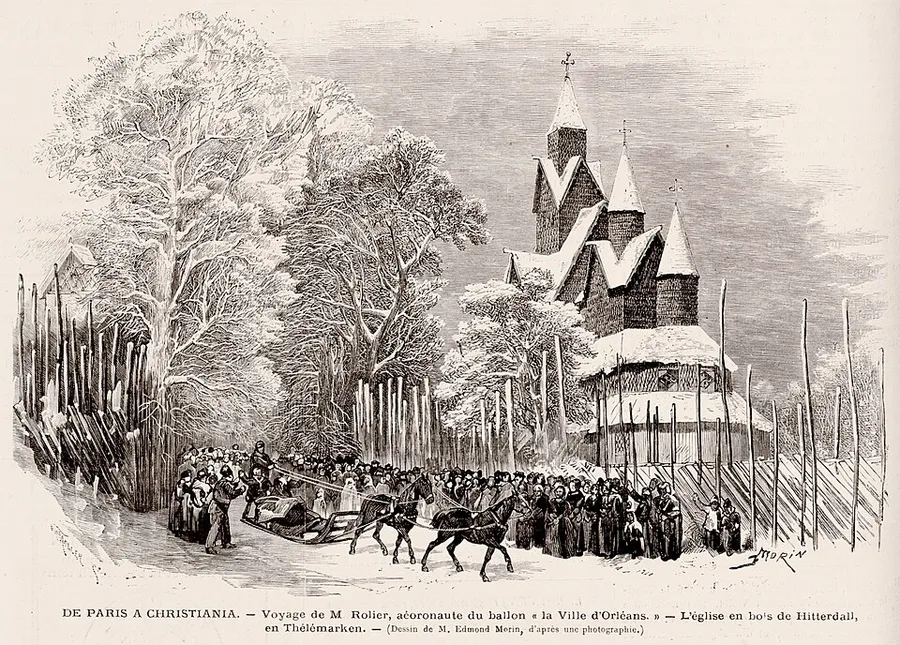 Edmond Morin, L’église en bois de Hitterdall, Le Monde illustré (22 Feb 1873), via Gallica/BnF Heddal appears here because a hot-air balloon that escaped besieged Paris in 1870 drifted off course and crash-landed in Norway — this French magazine's account of the balloonists' snowy trek illustrated Norway's largest stave church as one of the sights along their route. The largest of the twenty-eight surviving Norwegian stave
churches, in Notodden municipality in Telemark. Built in the
early thirteenth century. Stands nearly thirty metres tall —
larger than most country parish churches even in the modern
period — with a triple-aisled plan and elaborate raised-tier
roofing toward a central spire. Still in use as a parish church
of the Church of Norway, with a separate visitor centre on the
grounds.
Heddal Stave Church, Telemark in Telemark
Edmond Morin, L’église en bois de Hitterdall, Le Monde illustré (22 Feb 1873), via Gallica/BnF Heddal appears here because a hot-air balloon that escaped besieged Paris in 1870 drifted off course and crash-landed in Norway — this French magazine's account of the balloonists' snowy trek illustrated Norway's largest stave church as one of the sights along their route. The largest of the twenty-eight surviving Norwegian stave
churches, in Notodden municipality in Telemark. Built in the
early thirteenth century. Stands nearly thirty metres tall —
larger than most country parish churches even in the modern
period — with a triple-aisled plan and elaborate raised-tier
roofing toward a central spire. Still in use as a parish church
of the Church of Norway, with a separate visitor centre on the
grounds.
Heddal Stave Church, Telemark in Telemark 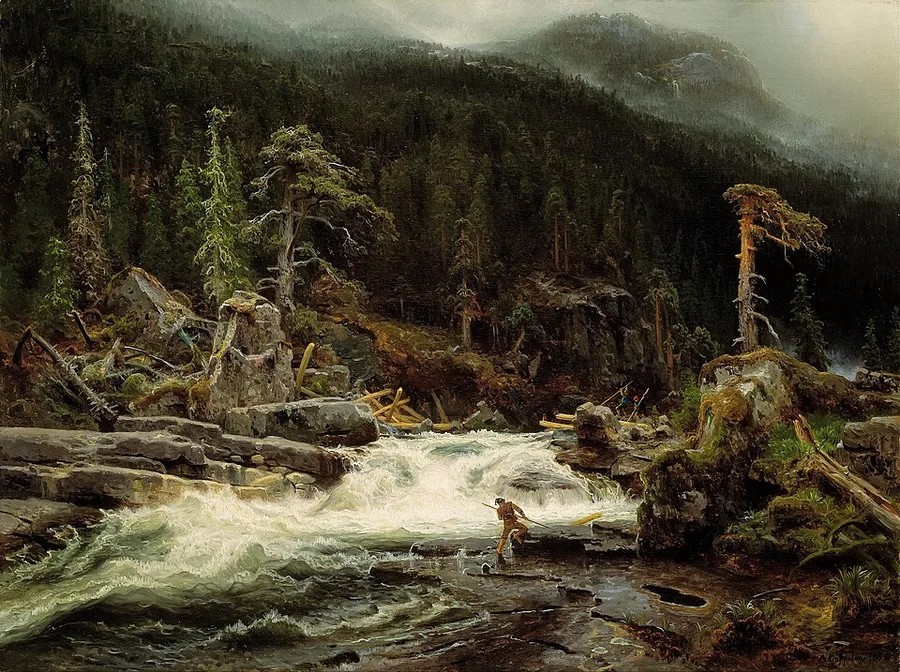 August Cappelen, Foss i nedre Telemark (1852), National Museum of Art, Architecture and Design August Cappelen's 1852 painting of a waterfall gorge in lower Telemark — dark forest closing over white water, log-drivers small at its edge. This is the upland valley country of the Norwegian interior, the kind of forest that has swallowed whole farms when their people vanished from the registers. Historic region and county in the inland-southern part of
Norway, between the southeastern coast and the central
Hardangervidda plateau. Home to Heddal Stave Church — the
largest of the twenty-eight surviving Norwegian stave churches,
standing nearly thirty metres tall — and to the heavy-water
production facility at Vemork whose sabotage by Norwegian
commandos in February 1943 disrupted the German atomic-weapons
programme. The name Telemark also gives the world the modern
ski-turn technique developed there in the nineteenth century.
In the folklore record Telemark is the deepest vein of all —
the landscape of the ballad collectors, the hardingfele
legends, and the lake serpent of Seljord.
Telemark Also discussed in World War II — the King’s “No” and the Nazis in NorwayThe Long Fall — the sudden loss of Norwegian nobility, the end of the kings, and half of Norway gone foreverFossegrimen — the waterfall fiddler who teaches you to playTroll — the monsters of the mountainsUtburd — the unbaptized child that will not restÅsgårdsreien — the storm that rides through the winter skyHuldra — the girl in the forest with a secretSjøormer — the serpents in the deep lakes and fjords , stands nearly thirty metres tall.
August Cappelen, Foss i nedre Telemark (1852), National Museum of Art, Architecture and Design August Cappelen's 1852 painting of a waterfall gorge in lower Telemark — dark forest closing over white water, log-drivers small at its edge. This is the upland valley country of the Norwegian interior, the kind of forest that has swallowed whole farms when their people vanished from the registers. Historic region and county in the inland-southern part of
Norway, between the southeastern coast and the central
Hardangervidda plateau. Home to Heddal Stave Church — the
largest of the twenty-eight surviving Norwegian stave churches,
standing nearly thirty metres tall — and to the heavy-water
production facility at Vemork whose sabotage by Norwegian
commandos in February 1943 disrupted the German atomic-weapons
programme. The name Telemark also gives the world the modern
ski-turn technique developed there in the nineteenth century.
In the folklore record Telemark is the deepest vein of all —
the landscape of the ballad collectors, the hardingfele
legends, and the lake serpent of Seljord.
Telemark Also discussed in World War II — the King’s “No” and the Nazis in NorwayThe Long Fall — the sudden loss of Norwegian nobility, the end of the kings, and half of Norway gone foreverFossegrimen — the waterfall fiddler who teaches you to playTroll — the monsters of the mountainsUtburd — the unbaptized child that will not restÅsgårdsreien — the storm that rides through the winter skyHuldra — the girl in the forest with a secretSjøormer — the serpents in the deep lakes and fjords , stands nearly thirty metres tall.
Most of the lost stave churches were demolished or sold for materials in the eighteenth or nineteenth centuries, replaced by larger congregational buildings in dimension-cut timber or stone. Some burned in accidental fires. One, Fantoft Stave Church 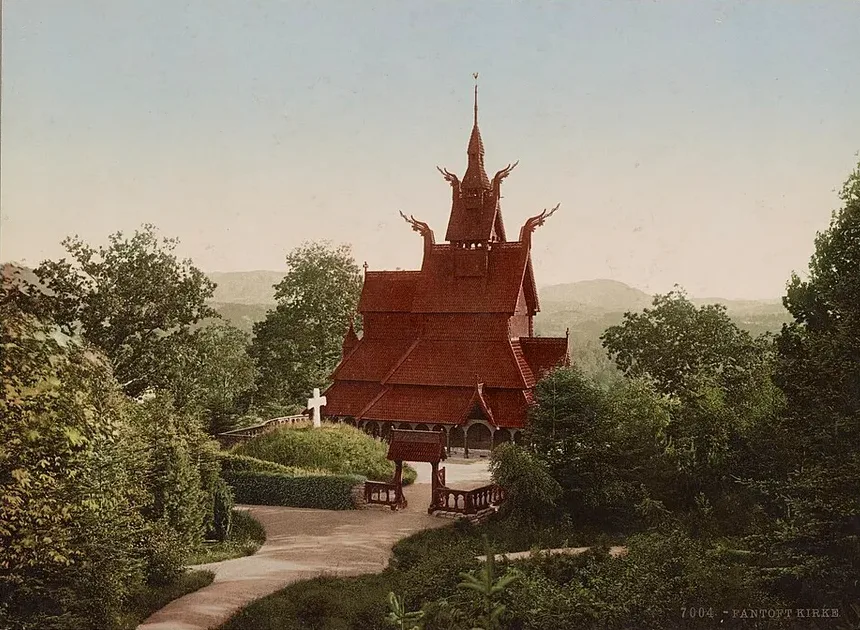 Fantoft Kirke, Library of Congress Prints and Photographs Division (c. 1880s-90s) This photograph shows the ORIGINAL Fantoft church — the medieval building moved here from Sogn in 1883 and burned by an arsonist in 1992. What stands on the site today is a careful post-1997 replica; this image predates the fire by roughly a century. Reconstructed stave church on the Fantoft estate in the southern
outskirts of Bergen. Originally built around 1150 in the Sogn
district and moved to Fantoft in 1883 to save it from demolition;
destroyed by arson on 6 June 1992, the first and most prominent
of a series of church-burnings across Norway in the 1992–96
period associated with the early Norwegian black-metal
subculture. Varg Vikernes was charged with the Fantoft fire but
found not guilty of that count (he was convicted of other church
burnings); no one has ever been convicted of the Fantoft arson.
Rebuilt afterwards as a careful replica using the same medieval
techniques; reopened in 1997. The replica is open to visitors as
a museum.
outside Bergen, was burned down in 1992 by an arsonist associated with the early Norwegian black-metal subculture, and rebuilt afterwards as a careful replica.
Fantoft Kirke, Library of Congress Prints and Photographs Division (c. 1880s-90s) This photograph shows the ORIGINAL Fantoft church — the medieval building moved here from Sogn in 1883 and burned by an arsonist in 1992. What stands on the site today is a careful post-1997 replica; this image predates the fire by roughly a century. Reconstructed stave church on the Fantoft estate in the southern
outskirts of Bergen. Originally built around 1150 in the Sogn
district and moved to Fantoft in 1883 to save it from demolition;
destroyed by arson on 6 June 1992, the first and most prominent
of a series of church-burnings across Norway in the 1992–96
period associated with the early Norwegian black-metal
subculture. Varg Vikernes was charged with the Fantoft fire but
found not guilty of that count (he was convicted of other church
burnings); no one has ever been convicted of the Fantoft arson.
Rebuilt afterwards as a careful replica using the same medieval
techniques; reopened in 1997. The replica is open to visitors as
a museum.
outside Bergen, was burned down in 1992 by an arsonist associated with the early Norwegian black-metal subculture, and rebuilt afterwards as a careful replica.
Building on what came before, not erasing it
The conversion that brought the Western Church to Norway was not, as a matter of historical record, a gentle one: the eleventh-century kings broke chieftains, burned cult-sites, and forced baptisms across the country. But what the Church built afterwards, once it was here, fused with what it found.
The general habit of the Western Church, wherever it went, was to build on the ground it inherited rather than clear it. The basilica of Saint Peter in Rome stands on the Vatican Hill where Peter was killed at the foot of a pagan circus; the church raised itself on top of the very ground of the martyrdom rather than beside it. The Pantheon was reconsecrated as a church. Pope Gregory the Great 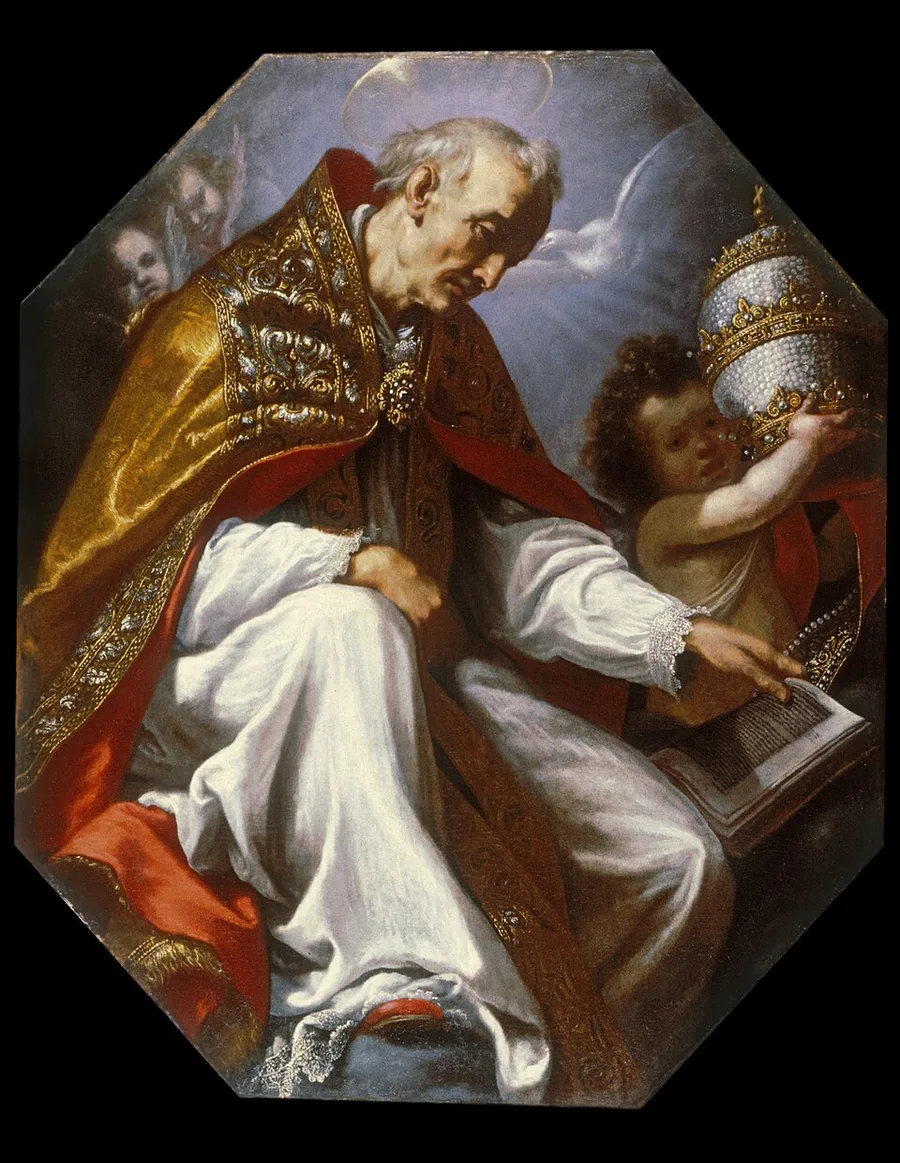 Jacopo Vignali, Saint Gregory the Great (c. 1630), Walters Art Museum Pope Gregory I, whose 601 letter to the missionary Mellitus set the model of converting pagan temples and festivals to Christian use rather than destroying them — the same missionary method later applied to Norway's own conversion five centuries afterward. Pope from 590 to 604 (Gregory I), one of the four Latin Doctors
of the Western Church and the architect of medieval Catholic
missionary practice. His 601 letter to the missionary Mellitus
in England — Epistolae XI.56 — set out the foundational
Catholic principle of inculturation: pagan temples should be
converted to Christian use rather than destroyed, and the local
festival days should be kept in the Christian calendar under new
names. The instruction shaped the way medieval Christianity
spread across pagan Europe — including the Norwegian conversion
five centuries later. Gregory also dispatched the original Roman
mission to the Anglo-Saxons in 596, established the Gregorian
chant tradition, and wrote the Pastoral Rule that became the
medieval handbook for bishops.
, in the seventh century, set Catholic inculturation principle
Jacopo Vignali, Saint Gregory the Great (c. 1630), Walters Art Museum Pope Gregory I, whose 601 letter to the missionary Mellitus set the model of converting pagan temples and festivals to Christian use rather than destroying them — the same missionary method later applied to Norway's own conversion five centuries afterward. Pope from 590 to 604 (Gregory I), one of the four Latin Doctors
of the Western Church and the architect of medieval Catholic
missionary practice. His 601 letter to the missionary Mellitus
in England — Epistolae XI.56 — set out the foundational
Catholic principle of inculturation: pagan temples should be
converted to Christian use rather than destroyed, and the local
festival days should be kept in the Christian calendar under new
names. The instruction shaped the way medieval Christianity
spread across pagan Europe — including the Norwegian conversion
five centuries later. Gregory also dispatched the original Roman
mission to the Anglo-Saxons in 596, established the Gregorian
chant tradition, and wrote the Pastoral Rule that became the
medieval handbook for bishops.
, in the seventh century, set Catholic inculturation principle 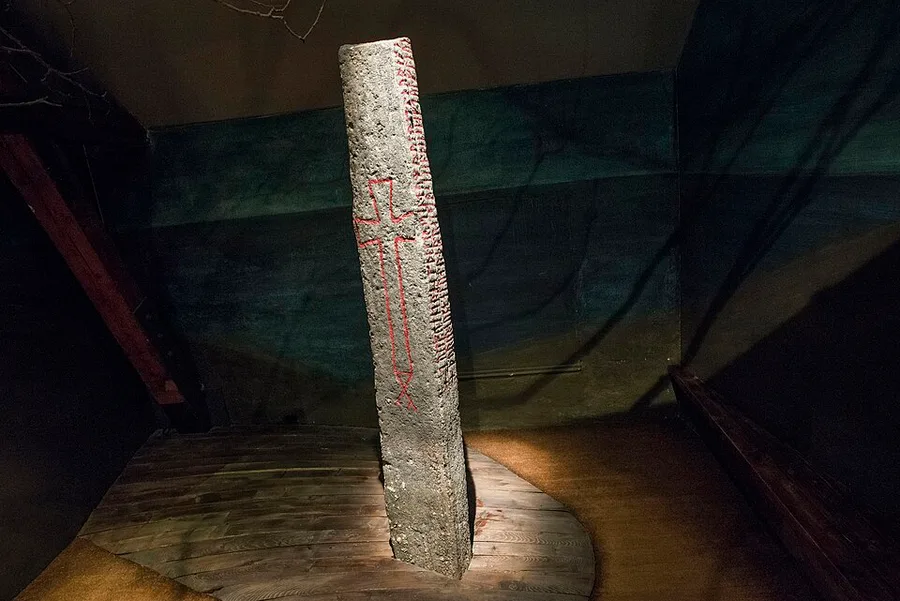 NTNU Vitenskapsmuseet / photo Åge Hojem, Kulisteinen (photographed 2016), CC BY 2.0 Raised around 1034 and inscribed that 'twelve winters had Christianity been in Norway,' the Kuli Stone puts a Christian cross and message onto the old runestone form — the same instinct behind Gregory's inculturation principle of converting an existing pagan vehicle to carry the new faith rather than discarding it. The foundational Catholic missionary principle that pagan sacred
ground and pagan festival days should be converted to Christian
use rather than destroyed. Set out by Pope Gregory the Great in
a 601 letter to the missionary Mellitus in England: pagan temples
should not be destroyed "but the idols only which are in them,"
and the pagan festivals should be kept under new Christian names.
The principle shaped how medieval Christianity spread across
pagan Europe — including the Norwegian conversion, visible in
the stave churches raised on older cult sites and the
Christianisation of the pre-Christian festival calendar.
down deliberately when he instructed the English missionaries to convert the pagan temples to Christian use rather than destroy them, and to keep the local festival days in the Christian calendar under new names. The same instinct ran through everything the medieval Norwegian church built and lived.
NTNU Vitenskapsmuseet / photo Åge Hojem, Kulisteinen (photographed 2016), CC BY 2.0 Raised around 1034 and inscribed that 'twelve winters had Christianity been in Norway,' the Kuli Stone puts a Christian cross and message onto the old runestone form — the same instinct behind Gregory's inculturation principle of converting an existing pagan vehicle to carry the new faith rather than discarding it. The foundational Catholic missionary principle that pagan sacred
ground and pagan festival days should be converted to Christian
use rather than destroyed. Set out by Pope Gregory the Great in
a 601 letter to the missionary Mellitus in England: pagan temples
should not be destroyed "but the idols only which are in them,"
and the pagan festivals should be kept under new Christian names.
The principle shaped how medieval Christianity spread across
pagan Europe — including the Norwegian conversion, visible in
the stave churches raised on older cult sites and the
Christianisation of the pre-Christian festival calendar.
down deliberately when he instructed the English missionaries to convert the pagan temples to Christian use rather than destroy them, and to keep the local festival days in the Christian calendar under new names. The same instinct ran through everything the medieval Norwegian church built and lived.
The stave churches were the clearest case. They were not a foreign architectural form imported into a country that had no architecture of its own. They were Christian buildings raised by Viking-trained carpenters using a Viking-trained timber tradition, on parish ground that had often been holy under the older religion. The dragon-heads on the gables of the most elaborate examples were not concealed; they were raised on the new building, doing the same boundary-warding work they had done on a longship-prow. The interlace carving on the north portal of Urnes — the same visual language the Viking-age artists had been speaking — was organised on the church as a Christian Tree of Life. The skills of the longship-builders went into the church. The carving grammar of the older artists went into the church. The wood-building tradition of pre-Christian Norway was not replaced. It was given a new vocabulary.
The agricultural-liturgical calendar showed the same logic. The midsummer fires of pre-Christian Norway became Saint John’s Eve. The autumn slaughter feasts became All Saints and All Souls. The Yule of the pre-Christian farmstead became Christmas. The seasonal year of an agricultural country was rewritten in the calendar of an agricultural Christianity — the same year, the same farm, a new theological language.
Faith on the farm
Inside that calendar, the medieval Christianity Norwegians actually lived ran through the working year of a farm. Candlemas at the start of February signalled the lengthening of the days and the start of the lambing. The Feast of the Annunciation at the end of March marked the beginning of the spring work. Saint John’s Eve at midsummer was the bonfire-and-celebration night when the long days began to shorten again. The Olsok  Åsen Museum og Historielag (1930), CC BY 2.0 A crowd gathers at Stiklestad on 29 July 1930 — Olsok itself, the anniversary of Olav's death — photographed decades before the Cultural Centre or the annual play existed, when the observance was simply people turning up at the site on the day. The feast day of Saint Olav — Olav's wake, observed on 29 July,
the anniversary of the king's death at Stiklestad in 1030. Across
the medieval period Olsok was the great summer holiday of the
Norse Atlantic, kept across Norway, Iceland, the Faroes, Greenland,
and the Norse colonies of the British Isles. The Reformation
stripped the religious content from the Norwegian observance after
1537, but the day persisted as a folk holiday and was made the
national flag-day of Norway in 1948. Today Olsok centres on the
Stiklestad commemoration, with the open-air Spelet om Heilag
Olav drawing audiences in the tens of thousands.
On the trip Day 4 of the trip is olsok itself — 29 July. The Gråhårsklubben (the Oldsters) spend it in the Stjørdal heritage country and return to Trondheim for the night, with the Olavsfest filling the city around the cathedral. Also discussed in The King Who Became a Saint — how the Nordmen came to ChristThe Reformation, 1537 — one church eradicated and another imposedTradisjoner — celebrations across the Norwegian year feast on the twenty-ninth of July, the anniversary of Olav’s death, anchored the high season of pilgrimage and was kept on the same day on a Norwegian farm as it was in the cathedral. The autumn slaughter feasts coincided with All Saints and All Souls at the start of November. The Advent fasts and the Christmas-tide feast closed the year.
Åsen Museum og Historielag (1930), CC BY 2.0 A crowd gathers at Stiklestad on 29 July 1930 — Olsok itself, the anniversary of Olav's death — photographed decades before the Cultural Centre or the annual play existed, when the observance was simply people turning up at the site on the day. The feast day of Saint Olav — Olav's wake, observed on 29 July,
the anniversary of the king's death at Stiklestad in 1030. Across
the medieval period Olsok was the great summer holiday of the
Norse Atlantic, kept across Norway, Iceland, the Faroes, Greenland,
and the Norse colonies of the British Isles. The Reformation
stripped the religious content from the Norwegian observance after
1537, but the day persisted as a folk holiday and was made the
national flag-day of Norway in 1948. Today Olsok centres on the
Stiklestad commemoration, with the open-air Spelet om Heilag
Olav drawing audiences in the tens of thousands.
On the trip Day 4 of the trip is olsok itself — 29 July. The Gråhårsklubben (the Oldsters) spend it in the Stjørdal heritage country and return to Trondheim for the night, with the Olavsfest filling the city around the cathedral. Also discussed in The King Who Became a Saint — how the Nordmen came to ChristThe Reformation, 1537 — one church eradicated and another imposedTradisjoner — celebrations across the Norwegian year feast on the twenty-ninth of July, the anniversary of Olav’s death, anchored the high season of pilgrimage and was kept on the same day on a Norwegian farm as it was in the cathedral. The autumn slaughter feasts coincided with All Saints and All Souls at the start of November. The Advent fasts and the Christmas-tide feast closed the year.
The everyday surface of religion lay underneath the great feasts. Painted images of the saints stood on the medieval altar-pieces in the village church, some still in place today in the stave churches that survive. Stone crosses marked the wayside along the pilgrim roads, the older ones predating the parish churches they stood beside. The small reliquary-cases in the cathedral side-chapels held splinters of bone from named saints. In the forests, holy springs drew pilgrims who reported healing and dropped coins into the water. These were the things a Norwegian Christian saw, did, and was surrounded by, week to week and year to year, through the entire five-century span of the medieval church.
The end
The medieval Norwegian church had been weakened for nearly two centuries by the time the The Reformation 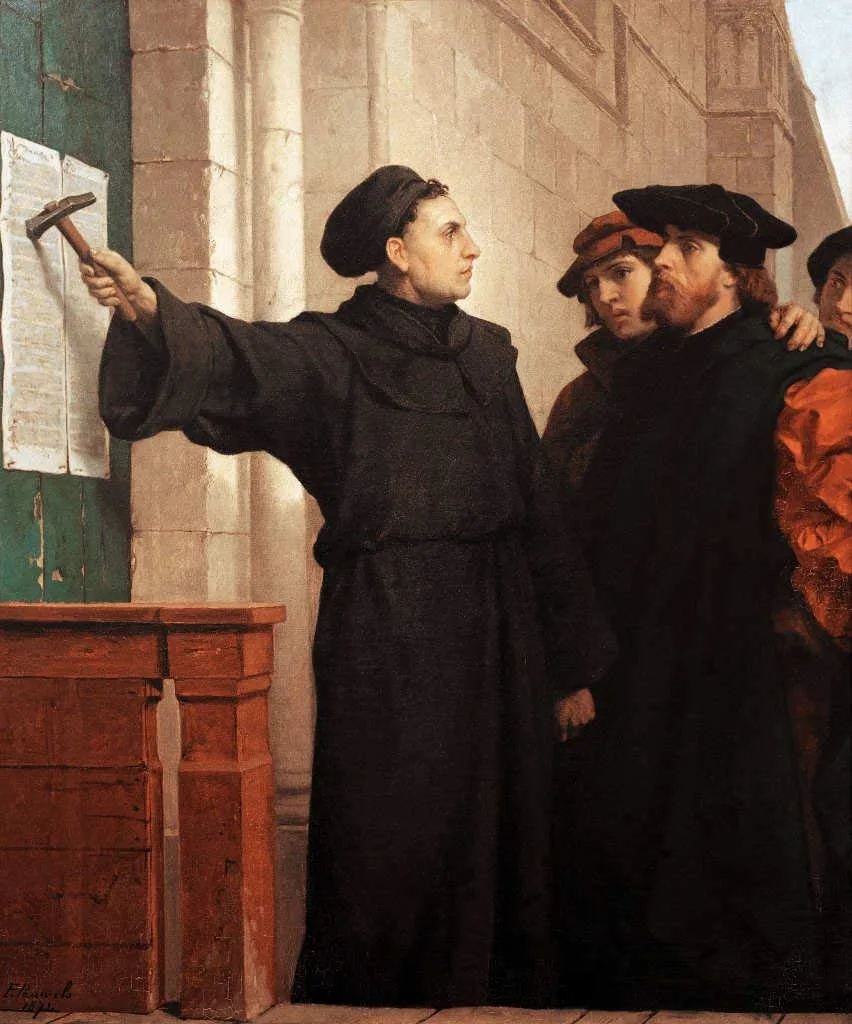 Ferdinand Pauwels, Luther hammers his 95 theses to the door (1872) Pauwels's 1872 history painting stages the 1517 act that began the Lutheran Reformation — the settlement Christian III of Denmark imposed on Norway by royal decree twenty years later, with no Norwegian reformer or domestic movement behind it. The Lutheran religious settlement imposed on Norway in 1537 by
royal decree from Copenhagen. Christian III of Denmark abolished
the Catholic ecclesiastical structure, dissolved the monasteries,
ordered the saints' relics destroyed, and replaced the Latin
liturgy with Danish-language Lutheran services. Unlike the
Reformation elsewhere in northern Europe, Norway's arrived from
outside — no Norwegian Luther, no Norwegian reformers, no
domestic religious movement behind it. The country changed
denomination because the king in Copenhagen ordered it.
In this article The end of the five-century Catholic age this article covers.
Within a generation the institutional infrastructure was broken
— the monasteries dissolved, the saints' shrines destroyed.
What survived was the buildings, including most of the twenty-
eight stave churches still standing today.
Also discussed in The Reformation, 1537 — one church eradicated and another imposedThe King Who Became a Saint — how the Nordmen came to ChristThe Germans Who "Ruled" Bergen — the Hanseatic merchants on Bryggen WharfThe 400-Year Night — when the Northern Lion lay dormantLutheran Norway and Pietism — a farmer named Hans Nielsen Hauge and a lay revival that could not be silencedThe Long Fall — the sudden loss of Norwegian nobility, the end of the kings, and half of Norway gone foreverStatskirken — the state church and what's left of it arrived. The Black Death of 1349 broke it at the parish level; the Kalmar Union
Ferdinand Pauwels, Luther hammers his 95 theses to the door (1872) Pauwels's 1872 history painting stages the 1517 act that began the Lutheran Reformation — the settlement Christian III of Denmark imposed on Norway by royal decree twenty years later, with no Norwegian reformer or domestic movement behind it. The Lutheran religious settlement imposed on Norway in 1537 by
royal decree from Copenhagen. Christian III of Denmark abolished
the Catholic ecclesiastical structure, dissolved the monasteries,
ordered the saints' relics destroyed, and replaced the Latin
liturgy with Danish-language Lutheran services. Unlike the
Reformation elsewhere in northern Europe, Norway's arrived from
outside — no Norwegian Luther, no Norwegian reformers, no
domestic religious movement behind it. The country changed
denomination because the king in Copenhagen ordered it.
In this article The end of the five-century Catholic age this article covers.
Within a generation the institutional infrastructure was broken
— the monasteries dissolved, the saints' shrines destroyed.
What survived was the buildings, including most of the twenty-
eight stave churches still standing today.
Also discussed in The Reformation, 1537 — one church eradicated and another imposedThe King Who Became a Saint — how the Nordmen came to ChristThe Germans Who "Ruled" Bergen — the Hanseatic merchants on Bryggen WharfThe 400-Year Night — when the Northern Lion lay dormantLutheran Norway and Pietism — a farmer named Hans Nielsen Hauge and a lay revival that could not be silencedThe Long Fall — the sudden loss of Norwegian nobility, the end of the kings, and half of Norway gone foreverStatskirken — the state church and what's left of it arrived. The Black Death of 1349 broke it at the parish level; the Kalmar Union 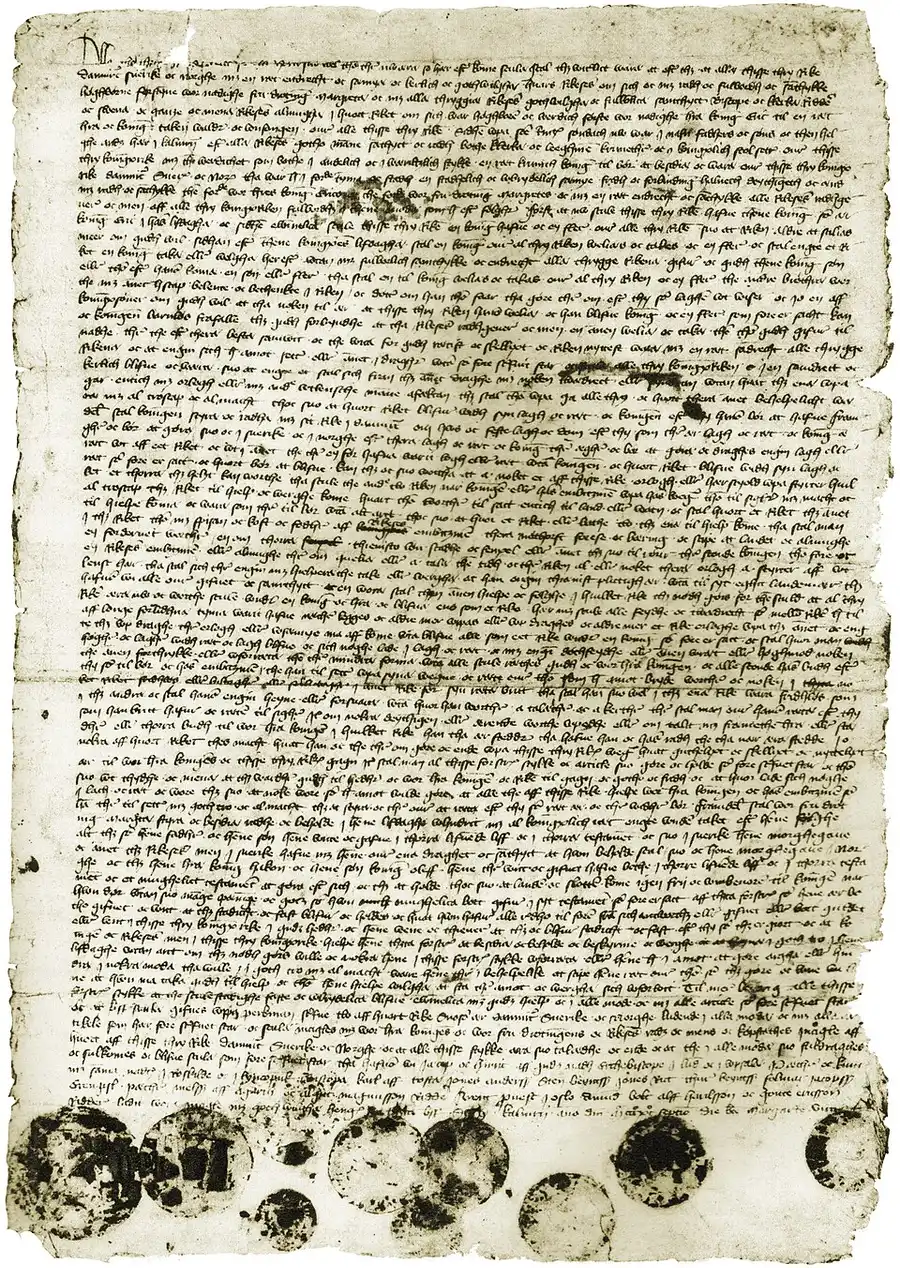 Union letter of Kalmar (1397) The 1397 union letter drafted at Kalmar bound Denmark, Sweden, and Norway under a single crown for 126 years — a realignment that gradually placed senior Norwegian clergy appointments under Danish control, one of the political conditions that made the imposed 1537 Reformation possible. Personal union of the three Scandinavian kingdoms — Denmark,
Sweden, and Norway — under a single monarch, established at
Kalmar (in modern southeastern Sweden) in 1397 by Margaret of
Denmark. Lasted 126 years until Gustav Vasa's revolt of 1523
took Sweden out of the union. Denmark and Norway remained joined
as the Dano-Norwegian union (1523–1814), with Norway treated as
a Danish province governed from Copenhagen. The Kalmar Union
shifted Scandinavian political power decisively to Copenhagen
and gradually placed the senior Norwegian clergy under Danish
appointment — one of the long political conditions for the
imposed Lutheran Reformation in Norway in 1537.
Also discussed in The Long Fall — the sudden loss of Norwegian nobility, the end of the kings, and half of Norway gone foreverThe 400-Year Night — when the Northern Lion lay dormant of 1397, and the slow shift of Scandinavian power to Copenhagen
Union letter of Kalmar (1397) The 1397 union letter drafted at Kalmar bound Denmark, Sweden, and Norway under a single crown for 126 years — a realignment that gradually placed senior Norwegian clergy appointments under Danish control, one of the political conditions that made the imposed 1537 Reformation possible. Personal union of the three Scandinavian kingdoms — Denmark,
Sweden, and Norway — under a single monarch, established at
Kalmar (in modern southeastern Sweden) in 1397 by Margaret of
Denmark. Lasted 126 years until Gustav Vasa's revolt of 1523
took Sweden out of the union. Denmark and Norway remained joined
as the Dano-Norwegian union (1523–1814), with Norway treated as
a Danish province governed from Copenhagen. The Kalmar Union
shifted Scandinavian political power decisively to Copenhagen
and gradually placed the senior Norwegian clergy under Danish
appointment — one of the long political conditions for the
imposed Lutheran Reformation in Norway in 1537.
Also discussed in The Long Fall — the sudden loss of Norwegian nobility, the end of the kings, and half of Norway gone foreverThe 400-Year Night — when the Northern Lion lay dormant of 1397, and the slow shift of Scandinavian power to Copenhagen 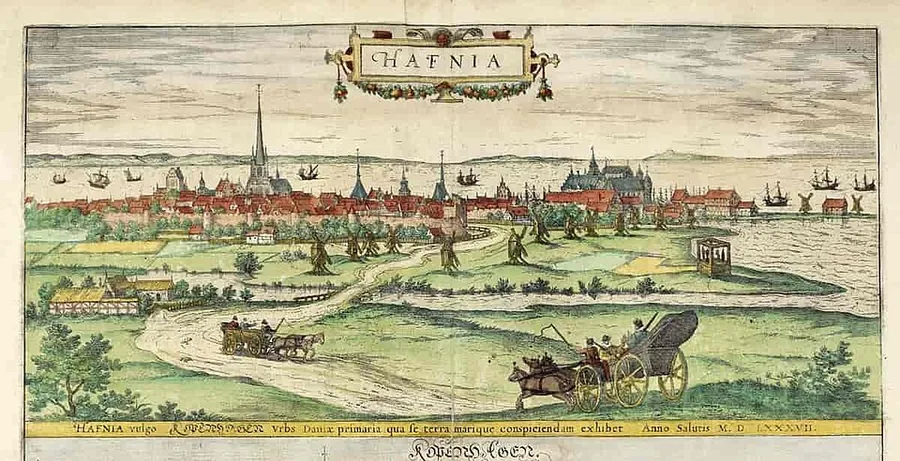 Georg Braun & Frans Hogenberg, view of Copenhagen from Vesterbro (1587), Civitates Orbis Terrarum Braun & Hogenberg's 1587 prospect of Copenhagen, capital of the Danish-Norwegian union from which the 1537 Reformation was imposed on Norway and to which the melted-down silver of Olav's shrine was sent after Nidaros Cathedral was stripped. Capital of Denmark, on the eastern coast of the island of Zealand
across the Øresund strait from Sweden. Founded as a fishing town
in the early medieval period, formal city in 1167, royal capital
from the early fifteenth century. The administrative centre of the
Danish kingdom and, from 1380 to 1814, of the Danish-Norwegian
union — the place where the 1537 Lutheran Reformation in Norway
was decided and from which the silver of the Olafskrinet was
sent to the Copenhagen mint after the destruction of the shrine
at Nidaros.
Also discussed in The King Who Became a Saint — how the Nordmen came to ChristThe 400-Year Night — when the Northern Lion lay dormantThe Reformation, 1537 — one church eradicated and another imposedWorld War II — the King’s “No” and the Nazis in Norway across the century that followed, placed the senior Norwegian clergy under increasing Danish appointment. By the early sixteenth century the institution was a Danish-administered shell of what it had been at its peak.
Georg Braun & Frans Hogenberg, view of Copenhagen from Vesterbro (1587), Civitates Orbis Terrarum Braun & Hogenberg's 1587 prospect of Copenhagen, capital of the Danish-Norwegian union from which the 1537 Reformation was imposed on Norway and to which the melted-down silver of Olav's shrine was sent after Nidaros Cathedral was stripped. Capital of Denmark, on the eastern coast of the island of Zealand
across the Øresund strait from Sweden. Founded as a fishing town
in the early medieval period, formal city in 1167, royal capital
from the early fifteenth century. The administrative centre of the
Danish kingdom and, from 1380 to 1814, of the Danish-Norwegian
union — the place where the 1537 Lutheran Reformation in Norway
was decided and from which the silver of the Olafskrinet was
sent to the Copenhagen mint after the destruction of the shrine
at Nidaros.
Also discussed in The King Who Became a Saint — how the Nordmen came to ChristThe 400-Year Night — when the Northern Lion lay dormantThe Reformation, 1537 — one church eradicated and another imposedWorld War II — the King’s “No” and the Nazis in Norway across the century that followed, placed the senior Norwegian clergy under increasing Danish appointment. By the early sixteenth century the institution was a Danish-administered shell of what it had been at its peak.
The formal end came in 1537. The Lutheran settlement imposed from Copenhagen dissolved the monasteries, took their lands, removed or whitewashed the saints’ images, closed the pilgrim routes, and replaced the Latin liturgy with Danish-language Lutheran services. The last Catholic archbishop of Nidaros, Olav Engelbrektsson 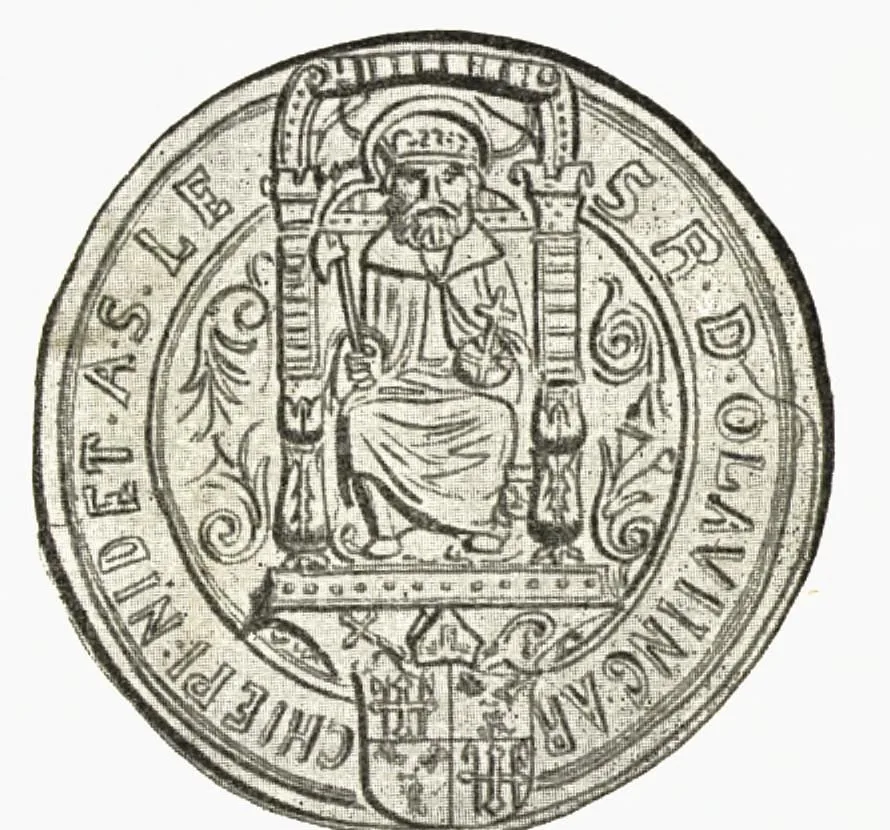 Seal of Archbishop Olav Engelbrektsson (1527), reproduced in A. Chr. Bang, Den norske kirkes historie (1912) No painted portrait of the last Catholic archbishop survives; his 1527 seal stands in — Saint Olav enthroned with his axe, the archbishop's own arms beneath. This is the instrument that authenticated Olav's letters through the years he led the resistance to the Danish Reformation. The last Catholic Archbishop of Nidaros (1523–1537) and the last
archbishop of the medieval Norwegian church. Led the political
resistance to the Danish-imposed Lutheran Reformation across
the 1530s; chaired the Norwegian Council of the Realm in
effective opposition to King Christian III. When the Reformation
was imposed by Danish military pressure in 1537, Olav fled
Norway with the cathedral's treasure and sailed to the
Netherlands. He died at the town of Lier in Brabant (modern-day
Belgium) on 7 February 1538, never having returned to Norway.
Five centuries of Catholic Norwegian Christianity formally ended
with his exile.
Also discussed in The Reformation, 1537 — one church eradicated and another imposed , sailed for the Netherlands and died at Lier in Brabant (modern-day Belgium) the following winter, never having returned. Five centuries of Catholic Norwegian Christianity formally ended inside two years.
Seal of Archbishop Olav Engelbrektsson (1527), reproduced in A. Chr. Bang, Den norske kirkes historie (1912) No painted portrait of the last Catholic archbishop survives; his 1527 seal stands in — Saint Olav enthroned with his axe, the archbishop's own arms beneath. This is the instrument that authenticated Olav's letters through the years he led the resistance to the Danish Reformation. The last Catholic Archbishop of Nidaros (1523–1537) and the last
archbishop of the medieval Norwegian church. Led the political
resistance to the Danish-imposed Lutheran Reformation across
the 1530s; chaired the Norwegian Council of the Realm in
effective opposition to King Christian III. When the Reformation
was imposed by Danish military pressure in 1537, Olav fled
Norway with the cathedral's treasure and sailed to the
Netherlands. He died at the town of Lier in Brabant (modern-day
Belgium) on 7 February 1538, never having returned to Norway.
Five centuries of Catholic Norwegian Christianity formally ended
with his exile.
Also discussed in The Reformation, 1537 — one church eradicated and another imposed , sailed for the Netherlands and died at Lier in Brabant (modern-day Belgium) the following winter, never having returned. Five centuries of Catholic Norwegian Christianity formally ended inside two years.
What stayed
What survived the formal end was the masonry, the timber, and the parish boundaries. Almost every Catholic church standing in Norway in 1537 continued in use under the new Lutheran establishment, because Norway had too little stone and too little capital to rebuild from scratch and the new state church needed buildings to hold its services in. The stave churches went on in the same way. The parish lines that the medieval church had drawn, and the liturgical calendar that had run through them, stayed in place — adjusted for the new theology, but recognisable. The country’s church-going Lutheran centuries took place inside the structures the medieval centuries had built.
The cathedral that the veneration of Olav had raised at Nidaros, with its octagonal east end over the shrine site itself. The stave church at Borgund in the Lærdal valley, every component still where it was placed in 1181. The small island ruin of Hovedøya in the Oslo Fjord. The eleventh-century carving on the north portal of Urnes, overlooking the inner Sognefjord. These are the buildings of the medieval Norwegian church. Most of the masonry is still there. Most of the timber is still there.
Sources & further reading
Primary sources
- Konungs skuggsjá (The King’s Mirror), c. 1250. The major Old Norwegian didactic mirror-for-princes; the richest single literary document of the medieval Norwegian church. English translation by Laurence Marcellus Larson, The King’s Mirror (American-Scandinavian Foundation, 1917).
- Theodoricus monachus, Historia de antiquitate regum Norwagiensium, late twelfth century. English translation by David and Ian McDougall, The Ancient History of the Norwegian Kings (Viking Society for Northern Research, 1998).
- Historia Norwegie, anonymous, late twelfth century. Critical edition with English translation by Inger Ekrem and Lars Boje Mortensen, Historia Norwegie (Museum Tusculanum Press, 2003).
- Snorri Sturluson, Heimskringla, c. 1230. The Icelandic king-collection whose Saga of Olav the Holy records the conversion in narrative form. English translation by Alison Finlay and Anthony Faulkes, 3 vols. (Viking Society for Northern Research, 2011–2015).
- Diplomatarium Norvegicum, 23 vols. The standard collection of medieval Norwegian documents — charters, letters, ecclesiastical correspondence — online at https://www.dokpro.uio.no/dipl_norv/diplom_field_eng.html.
- Pope Gregory the Great, letter to Mellitus (Epistolae, XI.56), 601. The famous papal instruction that pagan temples be converted to Christian use rather than destroyed — the foundational document of the Catholic inculturation principle.
Modern scholarship
- Sverre Bagge, Cross and Scepter: The Rise of the Scandinavian Kingdoms from the Vikings to the Reformation (Princeton University Press, 2014). The standard modern synthesis on medieval Scandinavian political-religious formation.
- Knut Helle, ed., The Cambridge History of Scandinavia, Volume 1: Prehistory to 1520 (Cambridge University Press, 2003). The reference treatment of the medieval Norwegian church.
- Leif Anker, The Norwegian Stave Churches (ARFO, 2005). The standard modern survey of the stave-church tradition, with architectural, archaeological, and dating evidence for each surviving example.
- Margrete Syrstad Andås, Øystein Ekroll, Andreas Haug, and Nils Holger Petersen, eds., The Medieval Cathedral of Trondheim: Architectural and Ritual Constructions in their European Context (Brepols, 2007). The scholarly volume on Nidaros Cathedral’s medieval construction and liturgical use.
- Brenda Bolton and Anne Duggan, eds., Adrian IV, the English Pope (1154–1159): Studies and Texts (Ashgate, 2003). The standard collection on Nicholas Breakspear and the 1152 Norwegian mission.
- Erik Gunnes, Erkebiskop Øystein: Statsmann og kirkebygger (Aschehoug, 1996). The standard Norwegian biography of the twelfth-century archbishop who consolidated the institutional reach of the Nidaros province.
- Ole Jørgen Benedictow, The Black Death in Norway 1348–1349 (Solum, 2002). The detailed study of the plague’s arrival, mortality, and impact on the Norwegian church.
- Lars Hamre, Norsk politisk historie 1513–1537 (Det Norske Samlaget, 1998). The standard treatment of the political background to the Reformation, including the fall of Olav Engelbrektsson.
Reference
- Store norske leksikon (snl.no). The Norwegian peer-reviewed encyclopedia. See in particular Nidaros erkebispestol, stavkirker, Sankt Sunniva, Hallvard Vebjørnsson, Munkeliv kloster, Lyse kloster, Hovedøya kloster, Konungs skuggsjá, Kalmarunionen, and Olav Engelbrektsson.
Visit
- Nidaros Cathedral
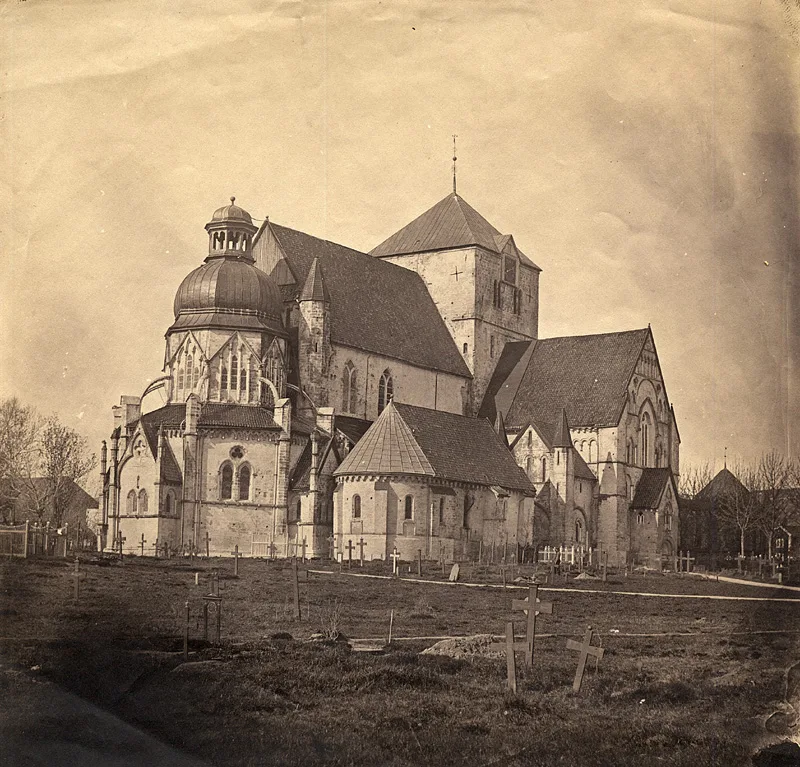 Unknown photographer, Nidaros Cathedral from the northeast (1857), Wikimedia Commons One of the earliest surviving photographs of Norway, taken in 1857 — decades before the west front's twentieth-century reconstruction — showing the cathedral over Olav's grave much as centuries of fire, neglect, and weather had left it. The principal cathedral of Norway and the burial place of Saint
Olav, on the bank of the Nid River in Trondheim. Built and rebuilt
in stages from the late eleventh through the early fourteenth
centuries around the shrine site at the cathedral's east end. The
octagonal east end, raised directly over Olav's grave, was the
devotional core of the medieval building. Substantially damaged
by fires and the 1531 lightning strike, then by neglect across the
Lutheran centuries. The west front a visitor sees today is a
nineteenth- and twentieth-century reconstruction, completed only
in 1983. The cathedral is the coronation and consecration church
of Norwegian kings; Haakon VII was crowned there in 1906, Olav V
consecrated in 1958, Harald V in 1991.
On the trip Day 3 of the trip brings the Gråhårsklubben (the Oldsters) to
Nidaros Cathedral. The shrine is gone but
the spot is marked on the cathedral floor in the octagonal east
end. The west front is the twentieth-century reconstruction of
the face the medieval pilgrims saw. The pilgrim road comes in
past the south door — the same door medieval pilgrims walked
through.
Nidaros Cathedral, Trondheim Also discussed in The King Who Became a Saint — how the Nordmen came to ChristThe Crusades?!!!! — sixty ships from Bergen, bound for the Holy LandThe Golden Age — a North Atlantic empire … reaching farther than you thinkThe Long Fall — the sudden loss of Norwegian nobility, the end of the kings, and half of Norway gone foreverThe 400-Year Night — when the Northern Lion lay dormantThe Reformation, 1537 — one church eradicated and another imposedLutheran Norway and Pietism — a farmer named Hans Nielsen Hauge and a lay revival that could not be silencedThe Quiet Revolution — how Norway won its independence without a warTradisjoner — celebrations across the Norwegian year , Trondheim. The cathedral over Olav’s burial place; the central building of the medieval Norwegian church and the seat of the archbishopric Breakspear organized in 1152.
Unknown photographer, Nidaros Cathedral from the northeast (1857), Wikimedia Commons One of the earliest surviving photographs of Norway, taken in 1857 — decades before the west front's twentieth-century reconstruction — showing the cathedral over Olav's grave much as centuries of fire, neglect, and weather had left it. The principal cathedral of Norway and the burial place of Saint
Olav, on the bank of the Nid River in Trondheim. Built and rebuilt
in stages from the late eleventh through the early fourteenth
centuries around the shrine site at the cathedral's east end. The
octagonal east end, raised directly over Olav's grave, was the
devotional core of the medieval building. Substantially damaged
by fires and the 1531 lightning strike, then by neglect across the
Lutheran centuries. The west front a visitor sees today is a
nineteenth- and twentieth-century reconstruction, completed only
in 1983. The cathedral is the coronation and consecration church
of Norwegian kings; Haakon VII was crowned there in 1906, Olav V
consecrated in 1958, Harald V in 1991.
On the trip Day 3 of the trip brings the Gråhårsklubben (the Oldsters) to
Nidaros Cathedral. The shrine is gone but
the spot is marked on the cathedral floor in the octagonal east
end. The west front is the twentieth-century reconstruction of
the face the medieval pilgrims saw. The pilgrim road comes in
past the south door — the same door medieval pilgrims walked
through.
Nidaros Cathedral, Trondheim Also discussed in The King Who Became a Saint — how the Nordmen came to ChristThe Crusades?!!!! — sixty ships from Bergen, bound for the Holy LandThe Golden Age — a North Atlantic empire … reaching farther than you thinkThe Long Fall — the sudden loss of Norwegian nobility, the end of the kings, and half of Norway gone foreverThe 400-Year Night — when the Northern Lion lay dormantThe Reformation, 1537 — one church eradicated and another imposedLutheran Norway and Pietism — a farmer named Hans Nielsen Hauge and a lay revival that could not be silencedThe Quiet Revolution — how Norway won its independence without a warTradisjoner — celebrations across the Norwegian year , Trondheim. The cathedral over Olav’s burial place; the central building of the medieval Norwegian church and the seat of the archbishopric Breakspear organized in 1152. - Urnes Stave Church, on the Ornes peninsula of the inner Sognefjord. One of the country’s first two UNESCO World Heritage sites (inscribed 1979) and the surviving exemplar of the earliest stave-church carving tradition.
- Borgund Stave Church, Lærdal. Felled in the winter of 1180–81. The best-preserved of the twenty-eight survivors; the canonical example used in textbooks of medieval Norwegian timber building.
- Heddal Stave Church, Notodden in Telemark. The largest of the surviving stave churches, standing nearly thirty metres tall.
- Lom Stave Church
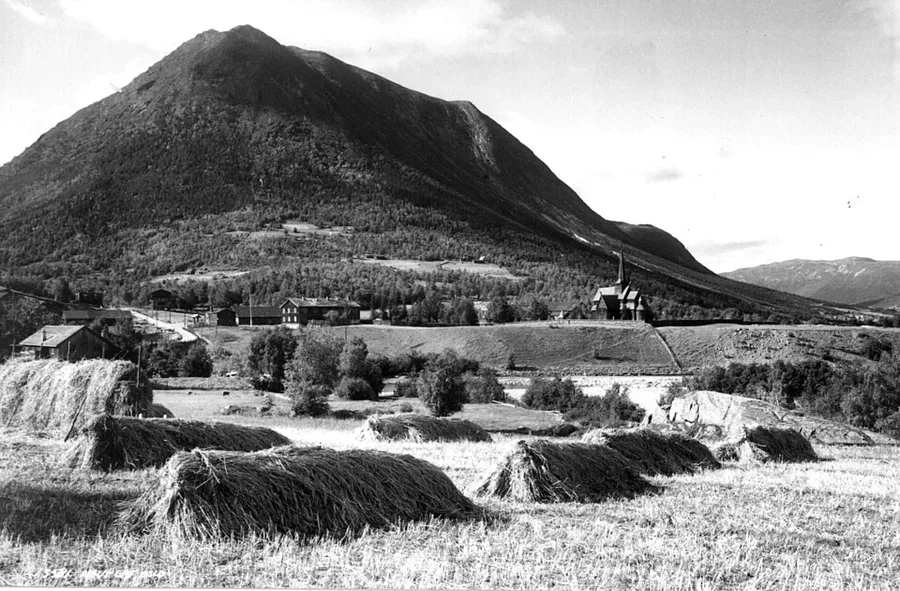 Hermann Christian Neupert, Lom stave church and fields (1935), Norwegian Museum of Cultural History A 1935 photograph of the church that stood on the Gudbrandsdalen pilgrim road for eight centuries, shown still working farmland at its foot — the haystacks and parsonage roofs give scale to a triple-aisled building that is otherwise hard to picture from description alone. Stave church in the upper Gudbrandsdalen valley, in Lom
municipality of Innlandet County, on the medieval Gudbrandsdalsleden
pilgrim road north to Trondheim. Built in the mid-twelfth century
(dendrochronologically dated to around 1158); one of the largest
and oldest of the surviving stave churches, with a
triple-aisled plan and elaborate dragon-head finials. Still in
use as a parish church. The Lom area also contains several other
surviving medieval timber buildings, the highest concentration of
pre-1700 wooden architecture in Norway.
Lom Stave Church, Gudbrandsdalen , in the upper Gudbrandsdalen
Hermann Christian Neupert, Lom stave church and fields (1935), Norwegian Museum of Cultural History A 1935 photograph of the church that stood on the Gudbrandsdalen pilgrim road for eight centuries, shown still working farmland at its foot — the haystacks and parsonage roofs give scale to a triple-aisled building that is otherwise hard to picture from description alone. Stave church in the upper Gudbrandsdalen valley, in Lom
municipality of Innlandet County, on the medieval Gudbrandsdalsleden
pilgrim road north to Trondheim. Built in the mid-twelfth century
(dendrochronologically dated to around 1158); one of the largest
and oldest of the surviving stave churches, with a
triple-aisled plan and elaborate dragon-head finials. Still in
use as a parish church. The Lom area also contains several other
surviving medieval timber buildings, the highest concentration of
pre-1700 wooden architecture in Norway.
Lom Stave Church, Gudbrandsdalen , in the upper Gudbrandsdalen 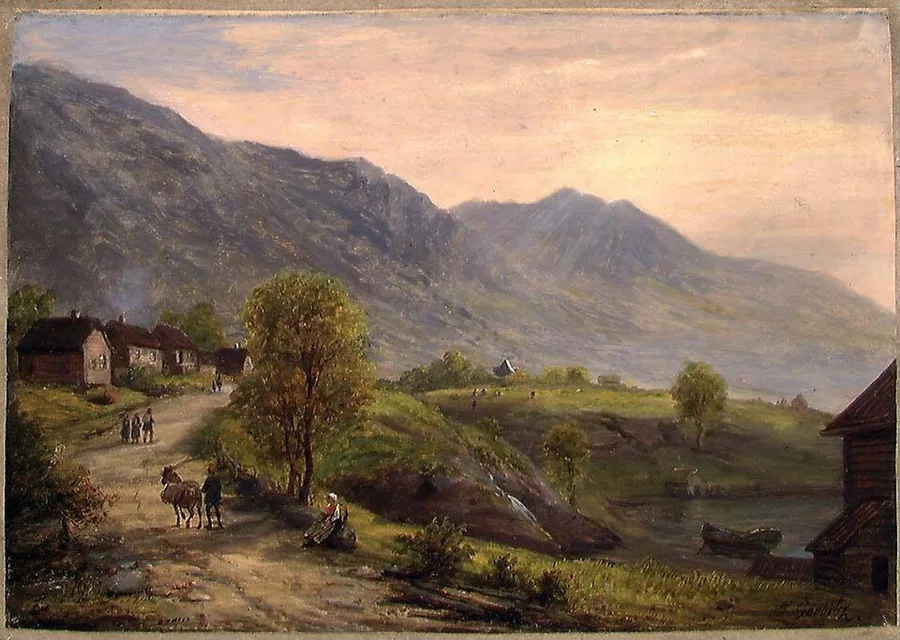 Johan Gørbitz, Fra Fåvang i Gudbrandsdalen (before 1858), National Museum of Art, Architecture and Design Johan Gørbitz's painting of travellers on the valley road at Fåvang. The Gudbrandsdalen was the central overland artery between Oslo and Trondheim, and the Gudbrandsdalsleden pilgrim road to Nidaros ran its length past stave churches like Lom. Long inland valley running about 230 kilometres northwest
through the central Norwegian highland from Lake Mjøsa toward
the Dovre mountain pass, the central traffic artery between
Oslo and Trondheim across both medieval and modern eras. The
Gudbrandsdalsleden pilgrim road to Nidaros runs along the
valley; Lom Stave Church and several other surviving stave
churches stand on its slopes; Lillehammer sits at its
southern entrance. The dialect spoken in the valley is one of
the most distinctive in modern Norwegian.
On the trip The Gråhårsklubben (the Oldsters) drive the length of the
Gudbrandsdalen twice — north up the E6 on Day 3, on the long
road from Oslo to Trondheim, and south again on Day 5 to the
reunion in Lillehammer, the town at the valley's southern
entrance.
Gudbrandsdalen Also discussed in The Long Fall — the sudden loss of Norwegian nobility, the end of the kings, and half of Norway gone foreverThe Reformation, 1537 — one church eradicated and another imposedStedssagn — local legends, told as warnings valley on the pilgrim road north to Trondheim. Built in the late twelfth century; one of the largest of the type with a triple-aisled plan.
Johan Gørbitz, Fra Fåvang i Gudbrandsdalen (before 1858), National Museum of Art, Architecture and Design Johan Gørbitz's painting of travellers on the valley road at Fåvang. The Gudbrandsdalen was the central overland artery between Oslo and Trondheim, and the Gudbrandsdalsleden pilgrim road to Nidaros ran its length past stave churches like Lom. Long inland valley running about 230 kilometres northwest
through the central Norwegian highland from Lake Mjøsa toward
the Dovre mountain pass, the central traffic artery between
Oslo and Trondheim across both medieval and modern eras. The
Gudbrandsdalsleden pilgrim road to Nidaros runs along the
valley; Lom Stave Church and several other surviving stave
churches stand on its slopes; Lillehammer sits at its
southern entrance. The dialect spoken in the valley is one of
the most distinctive in modern Norwegian.
On the trip The Gråhårsklubben (the Oldsters) drive the length of the
Gudbrandsdalen twice — north up the E6 on Day 3, on the long
road from Oslo to Trondheim, and south again on Day 5 to the
reunion in Lillehammer, the town at the valley's southern
entrance.
Gudbrandsdalen Also discussed in The Long Fall — the sudden loss of Norwegian nobility, the end of the kings, and half of Norway gone foreverThe Reformation, 1537 — one church eradicated and another imposedStedssagn — local legends, told as warnings valley on the pilgrim road north to Trondheim. Built in the late twelfth century; one of the largest of the type with a triple-aisled plan. - Hovedøya Abbey ruins, Oslo. The stripped masonry of the Cistercian house founded from Kirkstead Abbey in 1147. Reached by summer ferry from the Aker Brygge harbour in central Oslo.
- Selja Monastery ruins, on the island of Selja in Nordfjord. The site of Saint Sunniva’s legend and of the Benedictine monastery founded around 1100.