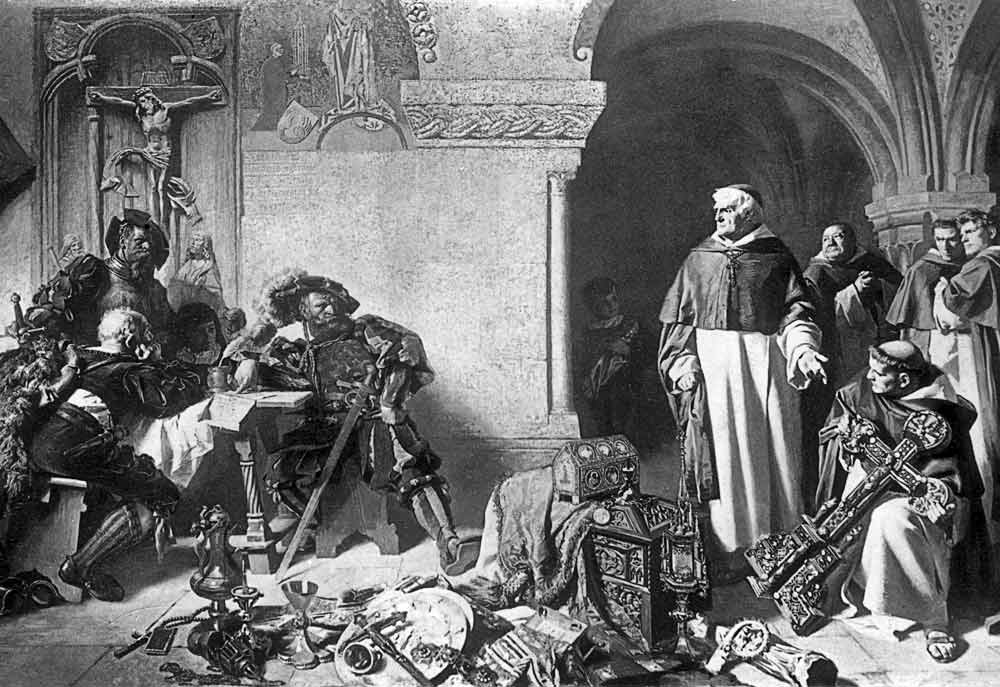
The Reformation, 1537 — one church eradicated and another imposed
Norway became Lutheran by royal decree from Copenhagen in 1537 — without a Norwegian Reformation movement of its own, at the cost of monasteries dissolved, the saints' shrines melted down, and the pilgrim routes to Nidaros silent for more than four centuries.
On Easter Sunday, the first of April 1537, the last Catholic Archbishop of Nidaros Cathedral 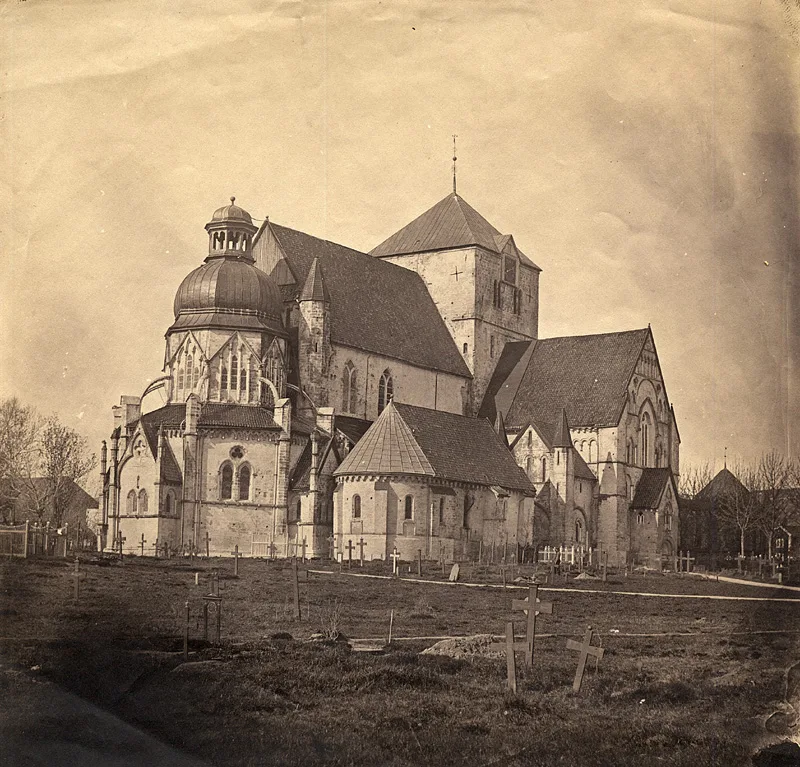 Unknown photographer, Nidaros Cathedral from the northeast (1857), Wikimedia Commons One of the earliest surviving photographs of Norway, taken in 1857 — decades before the west front's twentieth-century reconstruction — showing the cathedral over Olav's grave much as centuries of fire, neglect, and weather had left it. The principal cathedral of Norway and the burial place of Saint
Olav, on the bank of the Nid River in Trondheim. Built and rebuilt
in stages from the late eleventh through the early fourteenth
centuries around the shrine site at the cathedral's east end. The
octagonal east end, raised directly over Olav's grave, was the
devotional core of the medieval building. Substantially damaged
by fires and the 1531 lightning strike, then by neglect across the
Lutheran centuries. The west front a visitor sees today is a
nineteenth- and twentieth-century reconstruction, completed only
in 1983. The cathedral is the coronation and consecration church
of Norwegian kings; Haakon VII was crowned there in 1906, Olav V
consecrated in 1958, Harald V in 1991.
On the trip Day 3 of the trip brings the Gråhårsklubben (the Oldsters) to
Nidaros Cathedral. The shrine is gone but
the spot is marked on the cathedral floor in the octagonal east
end. The west front is the twentieth-century reconstruction of
the face the medieval pilgrims saw. The pilgrim road comes in
past the south door — the same door medieval pilgrims walked
through.
Nidaros Cathedral, Trondheim Also discussed in The King Who Became a Saint — how the Nordmen came to ChristA Catholic Norway — the faith that gave the kingdom its first institutions and the stave churchesThe Crusades?!!!! — sixty ships from Bergen, bound for the Holy LandThe Golden Age — a North Atlantic empire … reaching farther than you thinkThe Long Fall — the sudden loss of Norwegian nobility, the end of the kings, and half of Norway gone foreverThe 400-Year Night — when the Northern Lion lay dormantLutheran Norway and Pietism — a farmer named Hans Nielsen Hauge and a lay revival that could not be silencedThe Quiet Revolution — how Norway won its independence without a warTradisjoner — celebrations across the Norwegian year left the country. His name was Olav Engelbrektsson
Unknown photographer, Nidaros Cathedral from the northeast (1857), Wikimedia Commons One of the earliest surviving photographs of Norway, taken in 1857 — decades before the west front's twentieth-century reconstruction — showing the cathedral over Olav's grave much as centuries of fire, neglect, and weather had left it. The principal cathedral of Norway and the burial place of Saint
Olav, on the bank of the Nid River in Trondheim. Built and rebuilt
in stages from the late eleventh through the early fourteenth
centuries around the shrine site at the cathedral's east end. The
octagonal east end, raised directly over Olav's grave, was the
devotional core of the medieval building. Substantially damaged
by fires and the 1531 lightning strike, then by neglect across the
Lutheran centuries. The west front a visitor sees today is a
nineteenth- and twentieth-century reconstruction, completed only
in 1983. The cathedral is the coronation and consecration church
of Norwegian kings; Haakon VII was crowned there in 1906, Olav V
consecrated in 1958, Harald V in 1991.
On the trip Day 3 of the trip brings the Gråhårsklubben (the Oldsters) to
Nidaros Cathedral. The shrine is gone but
the spot is marked on the cathedral floor in the octagonal east
end. The west front is the twentieth-century reconstruction of
the face the medieval pilgrims saw. The pilgrim road comes in
past the south door — the same door medieval pilgrims walked
through.
Nidaros Cathedral, Trondheim Also discussed in The King Who Became a Saint — how the Nordmen came to ChristA Catholic Norway — the faith that gave the kingdom its first institutions and the stave churchesThe Crusades?!!!! — sixty ships from Bergen, bound for the Holy LandThe Golden Age — a North Atlantic empire … reaching farther than you thinkThe Long Fall — the sudden loss of Norwegian nobility, the end of the kings, and half of Norway gone foreverThe 400-Year Night — when the Northern Lion lay dormantLutheran Norway and Pietism — a farmer named Hans Nielsen Hauge and a lay revival that could not be silencedThe Quiet Revolution — how Norway won its independence without a warTradisjoner — celebrations across the Norwegian year left the country. His name was Olav Engelbrektsson 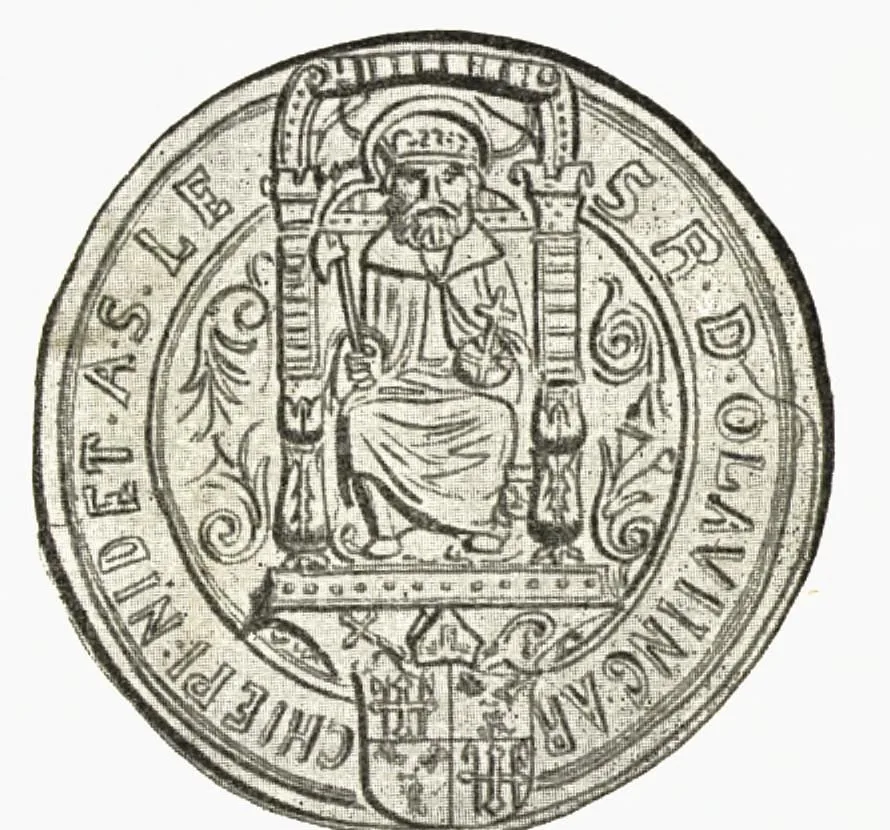 Seal of Archbishop Olav Engelbrektsson (1527), reproduced in A. Chr. Bang, Den norske kirkes historie (1912) No painted portrait of the last Catholic archbishop survives; his 1527 seal stands in — Saint Olav enthroned with his axe, the archbishop's own arms beneath. This is the instrument that authenticated Olav's letters through the years he led the resistance to the Danish Reformation. The last Catholic Archbishop of Nidaros (1523–1537) and the last
archbishop of the medieval Norwegian church. Led the political
resistance to the Danish-imposed Lutheran Reformation across
the 1530s; chaired the Norwegian Council of the Realm in
effective opposition to King Christian III. When the Reformation
was imposed by Danish military pressure in 1537, Olav fled
Norway with the cathedral's treasure and sailed to the
Netherlands. He died at the town of Lier in Brabant (modern-day
Belgium) on 7 February 1538, never having returned to Norway.
Five centuries of Catholic Norwegian Christianity formally ended
with his exile.
Also discussed in A Catholic Norway — the faith that gave the kingdom its first institutions and the stave churches . He was in his late fifties, had held the archbishopric for fourteen years, and had served as effective head of the Norwegian Council for four. He sailed with a fleet of small boats, his household and following, and the cathedral’s records and movable valuables — fleeing a Danish king who had just won a civil war and was now in the process of imposing Lutheran reform on every part of his kingdom. The silver shrine of Saint Olav
Seal of Archbishop Olav Engelbrektsson (1527), reproduced in A. Chr. Bang, Den norske kirkes historie (1912) No painted portrait of the last Catholic archbishop survives; his 1527 seal stands in — Saint Olav enthroned with his axe, the archbishop's own arms beneath. This is the instrument that authenticated Olav's letters through the years he led the resistance to the Danish Reformation. The last Catholic Archbishop of Nidaros (1523–1537) and the last
archbishop of the medieval Norwegian church. Led the political
resistance to the Danish-imposed Lutheran Reformation across
the 1530s; chaired the Norwegian Council of the Realm in
effective opposition to King Christian III. When the Reformation
was imposed by Danish military pressure in 1537, Olav fled
Norway with the cathedral's treasure and sailed to the
Netherlands. He died at the town of Lier in Brabant (modern-day
Belgium) on 7 February 1538, never having returned to Norway.
Five centuries of Catholic Norwegian Christianity formally ended
with his exile.
Also discussed in A Catholic Norway — the faith that gave the kingdom its first institutions and the stave churches . He was in his late fifties, had held the archbishopric for fourteen years, and had served as effective head of the Norwegian Council for four. He sailed with a fleet of small boats, his household and following, and the cathedral’s records and movable valuables — fleeing a Danish king who had just won a civil war and was now in the process of imposing Lutheran reform on every part of his kingdom. The silver shrine of Saint Olav 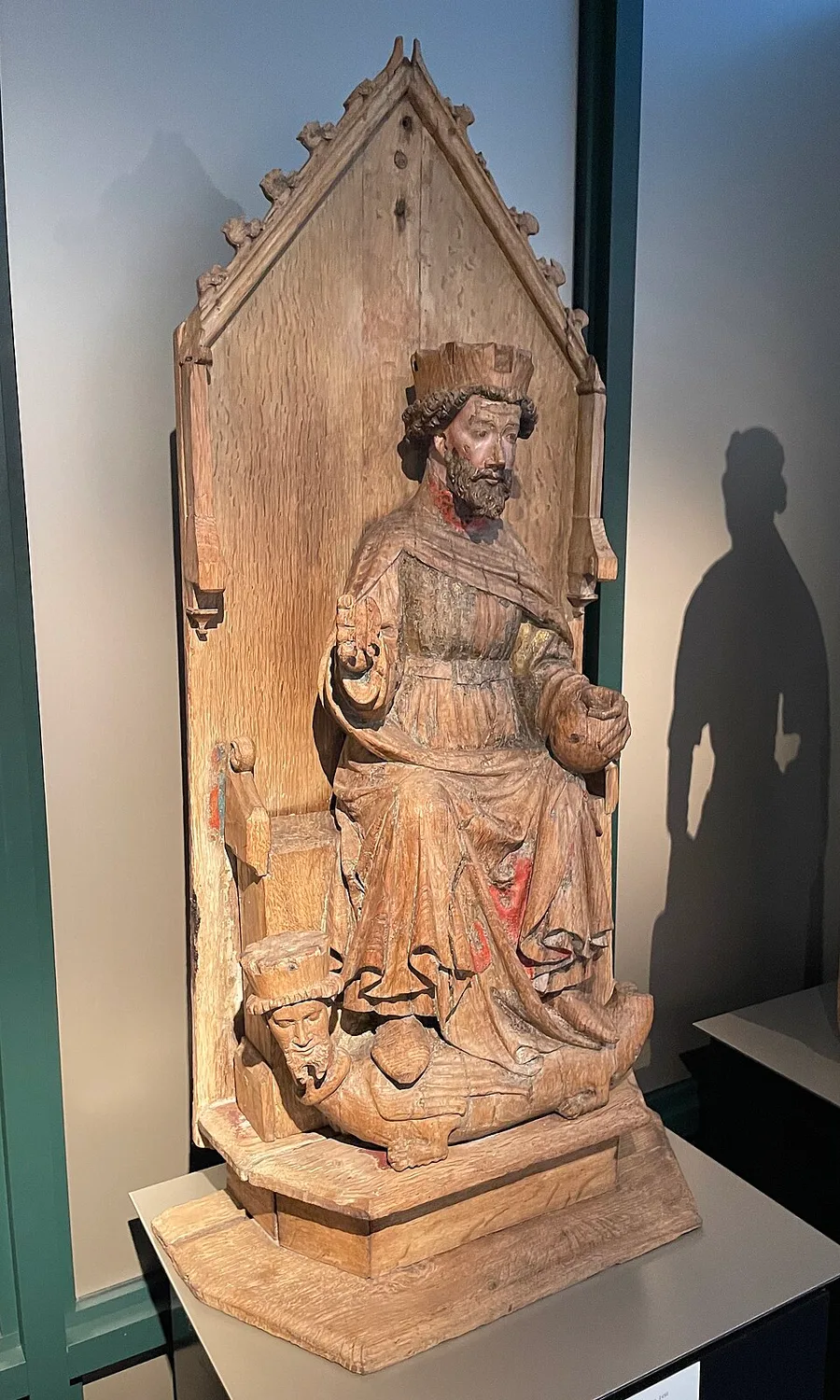 Saint Olav from Austevoll church (c. 1450), University Museum of Bergen; photo Wolfmann, Wikimedia Commons, CC BY-SA 4.0 Olav as medieval Norway saw him: the eternal king crowned and enthroned, trampling a dragon whose crowned human head stands for the heathendom he overcame. Carved around 1450 for Austevoll church south of Bergen — one of the polychrome Olav figures that stood in churches across Norway before the Reformation. Olav Haraldsson, king of Norway 1015–1028, killed at the Battle
of Stiklestad on 29 July 1030 and canonized one year and five days
later by his English bishop Grimkell. Rex Perpetuus Norvegiae —
the Eternal King of Norway. His shrine at Nidaros became the
northernmost pilgrimage destination in medieval Christendom and
the binding narrative of a converted country. The Norwegian Lion
on the modern coat of arms — a golden lion bearing a golden axe
on a red shield — is Saint Olav's iconography.
In this article The Olafskrinet — the silver shrine of Saint Olav at Nidaros
— was the single most valuable object destroyed by the 1537
settlement. The two silver coffins were stripped, the silver
shipped to Copenhagen for the royal coin-works, and the body
buried somewhere inside the cathedral in a spot no document
preserved.
On the trip The Gråhårsklubben (the Oldsters) visit Nidaros Cathedral on
Tuesday 28 July 2026 — the day before the 996th anniversary of
the Battle of Stiklestad. The Olafskrinet was broken up at the
1537 Reformation and the body buried somewhere inside the
cathedral in a spot no medieval source preserved. The building
is what the nine-and-a-half centuries of devotion built. The
pilgrim road, the Pilegrimsleden, runs past the cathedral's
south door — the same door the medieval pilgrims walked through.
Nidaros Cathedral, Trondheim Also discussed in The King Who Became a Saint — how the Nordmen came to ChristThe Viking Age — longships, legends, and the first "Norway"Worshiping Odin and Thor — the lived religion of pre-Christian NorwayA Catholic Norway — the faith that gave the kingdom its first institutions and the stave churchesLutheran Norway and Pietism — a farmer named Hans Nielsen Hauge and a lay revival that could not be silencedThe Crusades?!!!! — sixty ships from Bergen, bound for the Holy LandThe 400-Year Night — when the Northern Lion lay dormantThe Quiet Revolution — how Norway won its independence without a warWorld War II — the King’s “No” and the Nazis in Norway itself stayed behind at his fortress at Steinvikholm Castle
Saint Olav from Austevoll church (c. 1450), University Museum of Bergen; photo Wolfmann, Wikimedia Commons, CC BY-SA 4.0 Olav as medieval Norway saw him: the eternal king crowned and enthroned, trampling a dragon whose crowned human head stands for the heathendom he overcame. Carved around 1450 for Austevoll church south of Bergen — one of the polychrome Olav figures that stood in churches across Norway before the Reformation. Olav Haraldsson, king of Norway 1015–1028, killed at the Battle
of Stiklestad on 29 July 1030 and canonized one year and five days
later by his English bishop Grimkell. Rex Perpetuus Norvegiae —
the Eternal King of Norway. His shrine at Nidaros became the
northernmost pilgrimage destination in medieval Christendom and
the binding narrative of a converted country. The Norwegian Lion
on the modern coat of arms — a golden lion bearing a golden axe
on a red shield — is Saint Olav's iconography.
In this article The Olafskrinet — the silver shrine of Saint Olav at Nidaros
— was the single most valuable object destroyed by the 1537
settlement. The two silver coffins were stripped, the silver
shipped to Copenhagen for the royal coin-works, and the body
buried somewhere inside the cathedral in a spot no document
preserved.
On the trip The Gråhårsklubben (the Oldsters) visit Nidaros Cathedral on
Tuesday 28 July 2026 — the day before the 996th anniversary of
the Battle of Stiklestad. The Olafskrinet was broken up at the
1537 Reformation and the body buried somewhere inside the
cathedral in a spot no medieval source preserved. The building
is what the nine-and-a-half centuries of devotion built. The
pilgrim road, the Pilegrimsleden, runs past the cathedral's
south door — the same door the medieval pilgrims walked through.
Nidaros Cathedral, Trondheim Also discussed in The King Who Became a Saint — how the Nordmen came to ChristThe Viking Age — longships, legends, and the first "Norway"Worshiping Odin and Thor — the lived religion of pre-Christian NorwayA Catholic Norway — the faith that gave the kingdom its first institutions and the stave churchesLutheran Norway and Pietism — a farmer named Hans Nielsen Hauge and a lay revival that could not be silencedThe Crusades?!!!! — sixty ships from Bergen, bound for the Holy LandThe 400-Year Night — when the Northern Lion lay dormantThe Quiet Revolution — how Norway won its independence without a warWorld War II — the King’s “No” and the Nazis in Norway itself stayed behind at his fortress at Steinvikholm Castle 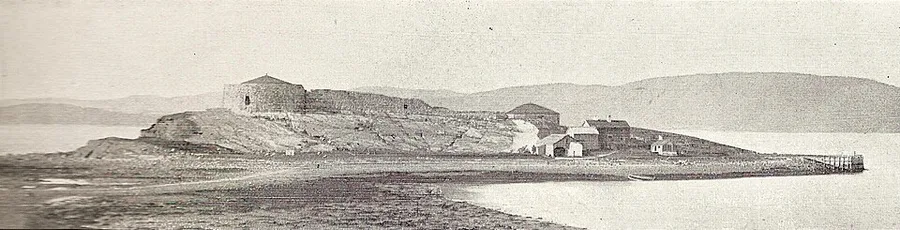 Fredrik B. Wallem, Steinvikholm (1917) Wallem's 1917 general view of Steinvikholm, Archbishop Olav Engelbrektsson's fortified seat, from which he fled at Easter 1537, abandoning it to Christian III's forces the following month. Stone fortress on a tidal island in the Trondheim Fjord,
about twenty kilometres east of Trondheim. Built between
1525 and 1532 by Archbishop Olav Engelbrektsson as the
fortified episcopal seat from which he intended to defend
Catholic Norway against the rising Lutheran tide. The largest
late-medieval fortification ever raised in Norway. In 1536
Engelbrektsson moved the silver shrine of Saint Olav —
the Olavskrinet — here from Nidaros for safekeeping; he
fled the country at Easter 1537, abandoning the fortress to
Christian III's forces, which took it in May 1537. The
empty shrine was sent to Copenhagen and melted down in
1540. The fortress was abandoned within a generation. Its
ruins are accessible by causeway at low tide.
.
Fredrik B. Wallem, Steinvikholm (1917) Wallem's 1917 general view of Steinvikholm, Archbishop Olav Engelbrektsson's fortified seat, from which he fled at Easter 1537, abandoning it to Christian III's forces the following month. Stone fortress on a tidal island in the Trondheim Fjord,
about twenty kilometres east of Trondheim. Built between
1525 and 1532 by Archbishop Olav Engelbrektsson as the
fortified episcopal seat from which he intended to defend
Catholic Norway against the rising Lutheran tide. The largest
late-medieval fortification ever raised in Norway. In 1536
Engelbrektsson moved the silver shrine of Saint Olav —
the Olavskrinet — here from Nidaros for safekeeping; he
fled the country at Easter 1537, abandoning the fortress to
Christian III's forces, which took it in May 1537. The
empty shrine was sent to Copenhagen and melted down in
1540. The fortress was abandoned within a generation. Its
ruins are accessible by causeway at low tide.
.
Engelbrektsson sailed south through the North Sea, landed on the coast of the Habsburg Netherlands 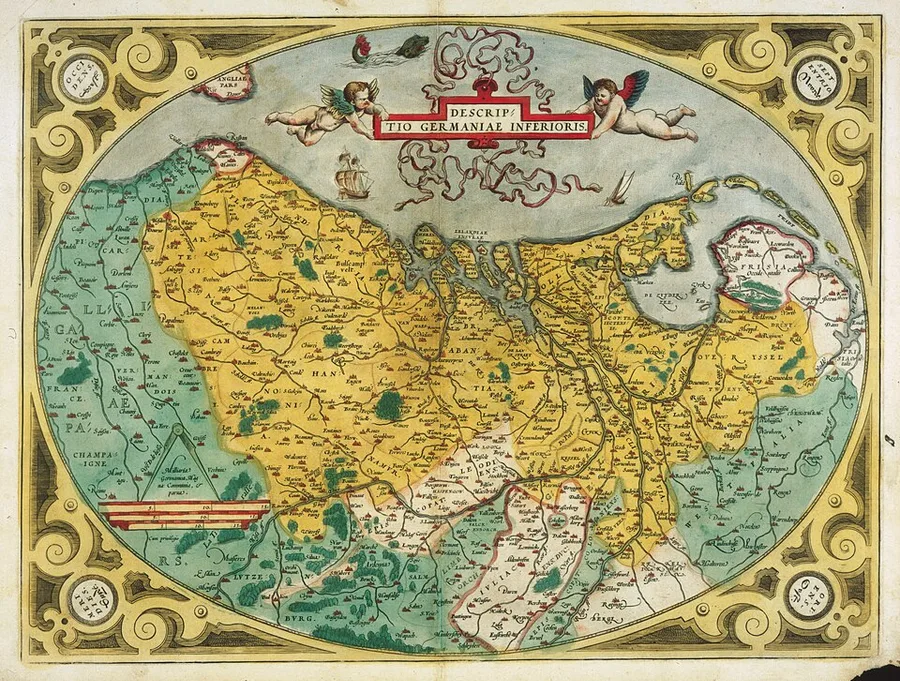 Abraham Ortelius, Descriptio Germaniae Inferioris (1573) Ortelius's 1573 map lays out the seventeen provinces Archbishop Olav Engelbrektsson sailed for in 1537, Brussels among them, the seat of the regent whose intervention he sought against Christian III. The seventeen provinces of the Low Countries — modern
Belgium, Luxembourg, Netherlands, and a strip of northern
France — ruled by the Habsburg dynasty between 1482 and
1581, when the northern seven provinces broke away in the
Dutch Revolt to form the Dutch Republic. Through the
sixteenth century the Habsburg Netherlands were governed
from Brussels by an imperial regent — Margaret of Austria
(1507–1530), Mary of Austria (1531–1555), Margaret of Parma
(1559–1567) — on behalf of the Emperor in Madrid or Vienna.
Archbishop Olav Engelbrektsson sailed here from Nidaros in
April 1537 with the records and movable treasures of the
Norwegian church, sought intervention against Christian III,
and died at Lier near Antwerp ten months later.
, took residence at Lier near Antwerp, and died there ten months later, on the seventh of February 1538. He was buried in the Sint-Gummaruskerk in Lier, where his grave was given a memorial marker during a state visit by Queen Sonja of Norway in the early 2000s.
Abraham Ortelius, Descriptio Germaniae Inferioris (1573) Ortelius's 1573 map lays out the seventeen provinces Archbishop Olav Engelbrektsson sailed for in 1537, Brussels among them, the seat of the regent whose intervention he sought against Christian III. The seventeen provinces of the Low Countries — modern
Belgium, Luxembourg, Netherlands, and a strip of northern
France — ruled by the Habsburg dynasty between 1482 and
1581, when the northern seven provinces broke away in the
Dutch Revolt to form the Dutch Republic. Through the
sixteenth century the Habsburg Netherlands were governed
from Brussels by an imperial regent — Margaret of Austria
(1507–1530), Mary of Austria (1531–1555), Margaret of Parma
(1559–1567) — on behalf of the Emperor in Madrid or Vienna.
Archbishop Olav Engelbrektsson sailed here from Nidaros in
April 1537 with the records and movable treasures of the
Norwegian church, sought intervention against Christian III,
and died at Lier near Antwerp ten months later.
, took residence at Lier near Antwerp, and died there ten months later, on the seventh of February 1538. He was buried in the Sint-Gummaruskerk in Lier, where his grave was given a memorial marker during a state visit by Queen Sonja of Norway in the early 2000s.
The departing archbishop was the last independent Catholic authority in Norway. His departure marked the practical end of the Norwegian Catholic age.
A Reformation by decree
The political mechanics were Danish. Christian III of Denmark-Norway 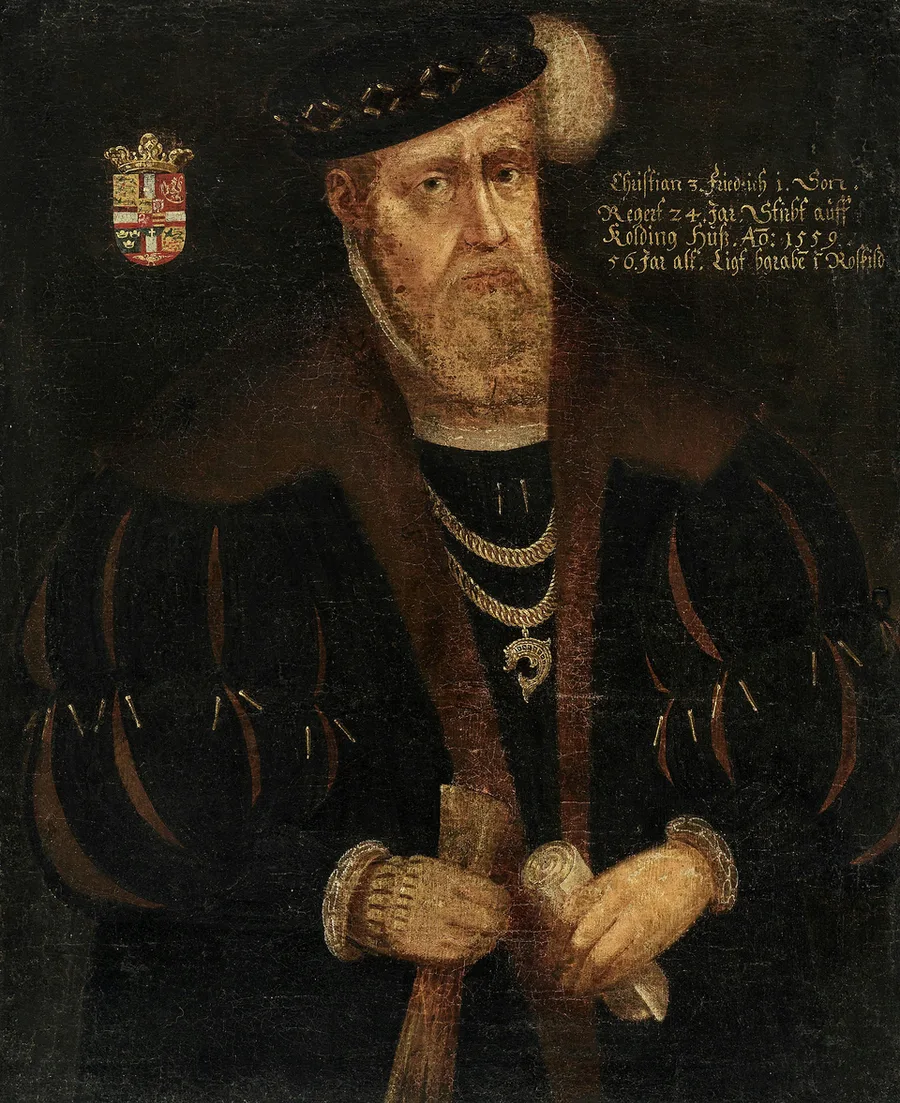 Jacob Binck, Portrait of Christian III (1550s) Jacob Binck's portrait of Christian III, whose 1536 Count's Feud victory and 1537 Kirkeordinansen imposed Lutheranism and dissolved Norway's separate council, folding the kingdom into Denmark for two and a half centuries. King of Denmark and Norway (1503–1559), reigned 1534–1559.
Came to the throne after the Count's Feud (1534–1536), the
civil war that established Lutheranism as the state religion
across his realm. By the Recess of Copenhagen in October
1536 he abolished the Norwegian Council of the Realm and
declared Norway a fully integrated part of the Danish
kingdom rather than a separate one in personal union. The
Reformation followed the next year, imposed across both
Denmark and Norway by royal decree. The last Catholic
archbishop of Nidaros, Olav Engelbrektsson, fled the country
in April 1537. Christian III's reign closed the medieval
Norwegian state as an institutionally distinct entity for
the next two and a half centuries.
Also discussed in The 400-Year Night — when the Northern Lion lay dormant , elected king in 1534 and victor in the two-year civil war called the Count's Feud
Jacob Binck, Portrait of Christian III (1550s) Jacob Binck's portrait of Christian III, whose 1536 Count's Feud victory and 1537 Kirkeordinansen imposed Lutheranism and dissolved Norway's separate council, folding the kingdom into Denmark for two and a half centuries. King of Denmark and Norway (1503–1559), reigned 1534–1559.
Came to the throne after the Count's Feud (1534–1536), the
civil war that established Lutheranism as the state religion
across his realm. By the Recess of Copenhagen in October
1536 he abolished the Norwegian Council of the Realm and
declared Norway a fully integrated part of the Danish
kingdom rather than a separate one in personal union. The
Reformation followed the next year, imposed across both
Denmark and Norway by royal decree. The last Catholic
archbishop of Nidaros, Olav Engelbrektsson, fled the country
in April 1537. Christian III's reign closed the medieval
Norwegian state as an institutionally distinct entity for
the next two and a half centuries.
Also discussed in The 400-Year Night — when the Northern Lion lay dormant , elected king in 1534 and victor in the two-year civil war called the Count's Feud 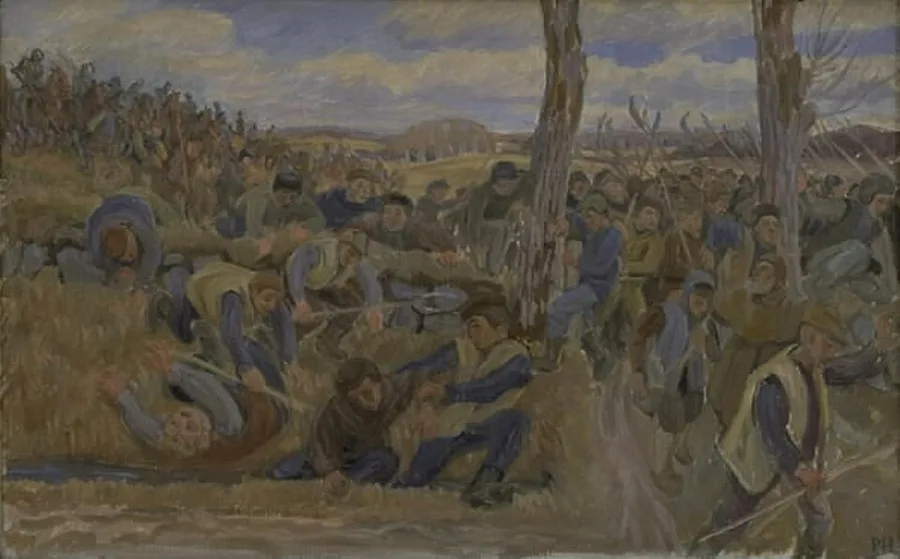 Peter Hansen, Grevens Fejde (1918), Statens Museum for Kunst (KMS3801) Danish painter Peter Hansen's Grevens Fejde depicts the 1534-36 civil war directly by name — the conflict between Christian II's Catholic-leaning partisans and Duke Christian's Lutheran faction whose victory cleared the way for the 1537 Reformation. Danish civil war of 1534–1536 (Danish Grevefejden), fought
between the supporters of the deposed Catholic king
Christian II and the supporters of the Lutheran-leaning
Duke Christian (later Christian III) of Schleswig-Holstein.
Named for Count Christopher of Oldenburg, who commanded the
Catholic-faction forces. Lübeck, the free peasantry of
Jutland, the burghers of Copenhagen and Malmö, and
Christian II's surviving partisans backed the Catholic side;
the rural nobility backed Christian III. The Lutheran side
won with the surrender of Copenhagen in July 1536. The
civil war paved the way for the Recess of Copenhagen of
October 1536, the arrest of the Catholic bishops, and the
imposition of Lutheran reform across the Danish-Norwegian
kingdom in 1537.
against the supporters of his deposed rival Christian II of Denmark-Norway
Peter Hansen, Grevens Fejde (1918), Statens Museum for Kunst (KMS3801) Danish painter Peter Hansen's Grevens Fejde depicts the 1534-36 civil war directly by name — the conflict between Christian II's Catholic-leaning partisans and Duke Christian's Lutheran faction whose victory cleared the way for the 1537 Reformation. Danish civil war of 1534–1536 (Danish Grevefejden), fought
between the supporters of the deposed Catholic king
Christian II and the supporters of the Lutheran-leaning
Duke Christian (later Christian III) of Schleswig-Holstein.
Named for Count Christopher of Oldenburg, who commanded the
Catholic-faction forces. Lübeck, the free peasantry of
Jutland, the burghers of Copenhagen and Malmö, and
Christian II's surviving partisans backed the Catholic side;
the rural nobility backed Christian III. The Lutheran side
won with the surrender of Copenhagen in July 1536. The
civil war paved the way for the Recess of Copenhagen of
October 1536, the arrest of the Catholic bishops, and the
imposition of Lutheran reform across the Danish-Norwegian
kingdom in 1537.
against the supporters of his deposed rival Christian II of Denmark-Norway 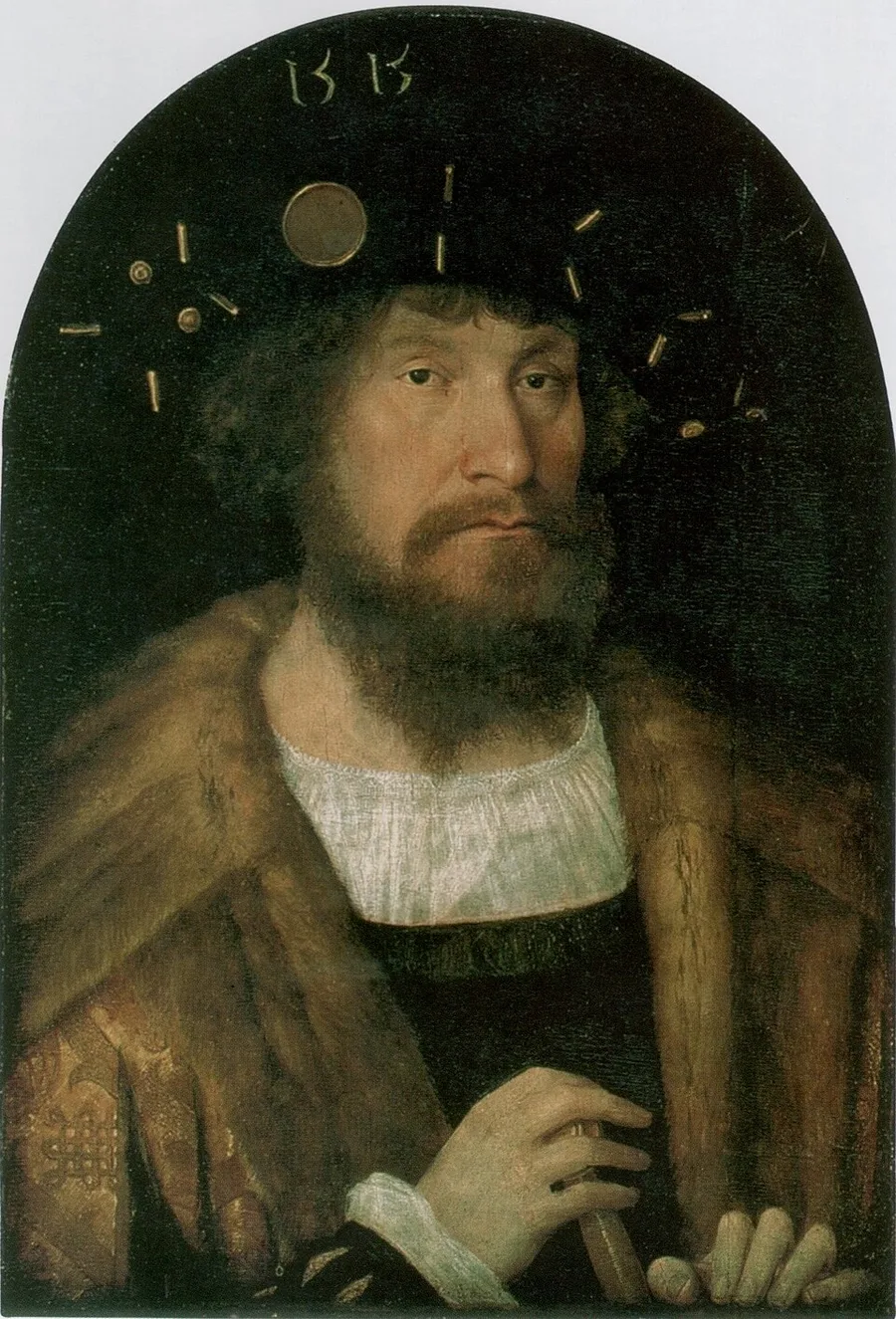 Michael Sittow, Christian II of Denmark (1515) Michael Sittow's 1515 portrait of Christian II, the deposed king whose Catholic-leaning partisans lost the Count's Feud and the Norwegian Reformation fight the 1537 Kirkeordinansen closed out for good. King of Denmark, Norway, and Sweden (1481–1559), reigned
1513–1523. Deposed after the Stockholm Bloodbath of
November 1520, in which his Danish forces executed roughly
eighty Swedish nobles and clergy in the capital square — the
outrage that triggered Gustav Vasa's Swedish revolt and the
end of the Kalmar Union. Driven from Denmark in 1523 by the
rebellion of his uncle Frederik I, he spent the next eight
years in exile at the Habsburg court before launching the
1531 invasion of Norway. Captured in 1532 and imprisoned at
Sønderborg Castle for his remaining twenty-seven years — his
cause the pretext for Lübeck's Count's Feud (1534–1536). His
deposed faction's partisans were the losing side at the
Norwegian Reformation, including Archbishop Olav Engelbrektsson.
, consolidated his hold on the Danish throne in October 1536 and began immediately to impose Lutheranism on his kingdoms. The Danish Reformation had been building for nearly two decades in the towns and university circles, under the influence of preachers trained in Wittenberg
Michael Sittow, Christian II of Denmark (1515) Michael Sittow's 1515 portrait of Christian II, the deposed king whose Catholic-leaning partisans lost the Count's Feud and the Norwegian Reformation fight the 1537 Kirkeordinansen closed out for good. King of Denmark, Norway, and Sweden (1481–1559), reigned
1513–1523. Deposed after the Stockholm Bloodbath of
November 1520, in which his Danish forces executed roughly
eighty Swedish nobles and clergy in the capital square — the
outrage that triggered Gustav Vasa's Swedish revolt and the
end of the Kalmar Union. Driven from Denmark in 1523 by the
rebellion of his uncle Frederik I, he spent the next eight
years in exile at the Habsburg court before launching the
1531 invasion of Norway. Captured in 1532 and imprisoned at
Sønderborg Castle for his remaining twenty-seven years — his
cause the pretext for Lübeck's Count's Feud (1534–1536). His
deposed faction's partisans were the losing side at the
Norwegian Reformation, including Archbishop Olav Engelbrektsson.
, consolidated his hold on the Danish throne in October 1536 and began immediately to impose Lutheranism on his kingdoms. The Danish Reformation had been building for nearly two decades in the towns and university circles, under the influence of preachers trained in Wittenberg 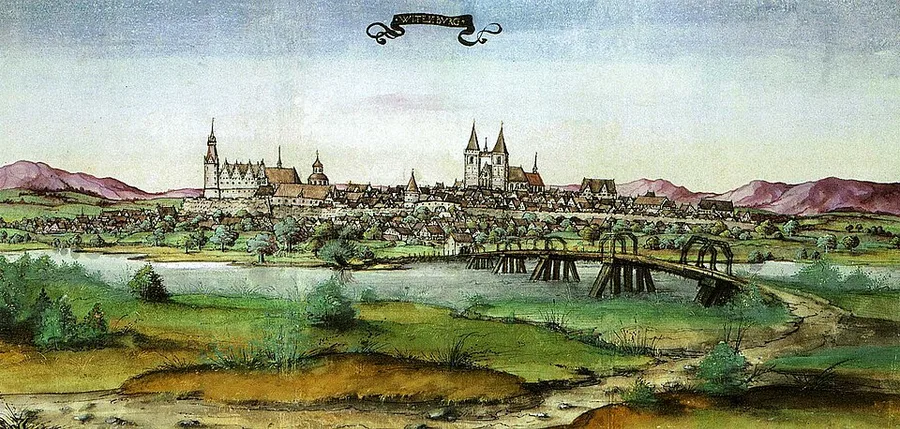 Unknown illustrator, Reisealbum des Pfalzgrafen Ottheinrich (1536), Universitätsbibliothek Würzburg This 1536 view shows the small Elbe-river town, university seat of Frederick the Wise, home to Luther and Melanchthon, from which the Wittenberg reform movement's ideas and pastors, including Johannes Bugenhagen, reached Denmark-Norway. Town on the Elbe in the duchy of Saxony in central Germany.
Seat of the University of Wittenberg, founded by Elector
Frederick the Wise in 1502, where Martin Luther took the
chair of biblical exegesis in 1512 and Philip Melanchthon
the chair of Greek in 1518. From this small university
town the central Reformation movement was launched —
Luther's Ninety-Five Theses posted on the door of the
Castle Church on 31 October 1517, the German New Testament
translated 1521–22 at the nearby Wartburg, the printing
presses that distributed the Lutheran tracts across northern
Europe. Johannes Bugenhagen, the principal architect of the
Lutheran church orders in Scandinavia, was Luther's pastor
at Wittenberg from 1521 onward.
by Martin Luther
Unknown illustrator, Reisealbum des Pfalzgrafen Ottheinrich (1536), Universitätsbibliothek Würzburg This 1536 view shows the small Elbe-river town, university seat of Frederick the Wise, home to Luther and Melanchthon, from which the Wittenberg reform movement's ideas and pastors, including Johannes Bugenhagen, reached Denmark-Norway. Town on the Elbe in the duchy of Saxony in central Germany.
Seat of the University of Wittenberg, founded by Elector
Frederick the Wise in 1502, where Martin Luther took the
chair of biblical exegesis in 1512 and Philip Melanchthon
the chair of Greek in 1518. From this small university
town the central Reformation movement was launched —
Luther's Ninety-Five Theses posted on the door of the
Castle Church on 31 October 1517, the German New Testament
translated 1521–22 at the nearby Wartburg, the printing
presses that distributed the Lutheran tracts across northern
Europe. Johannes Bugenhagen, the principal architect of the
Lutheran church orders in Scandinavia, was Luther's pastor
at Wittenberg from 1521 onward.
by Martin Luther 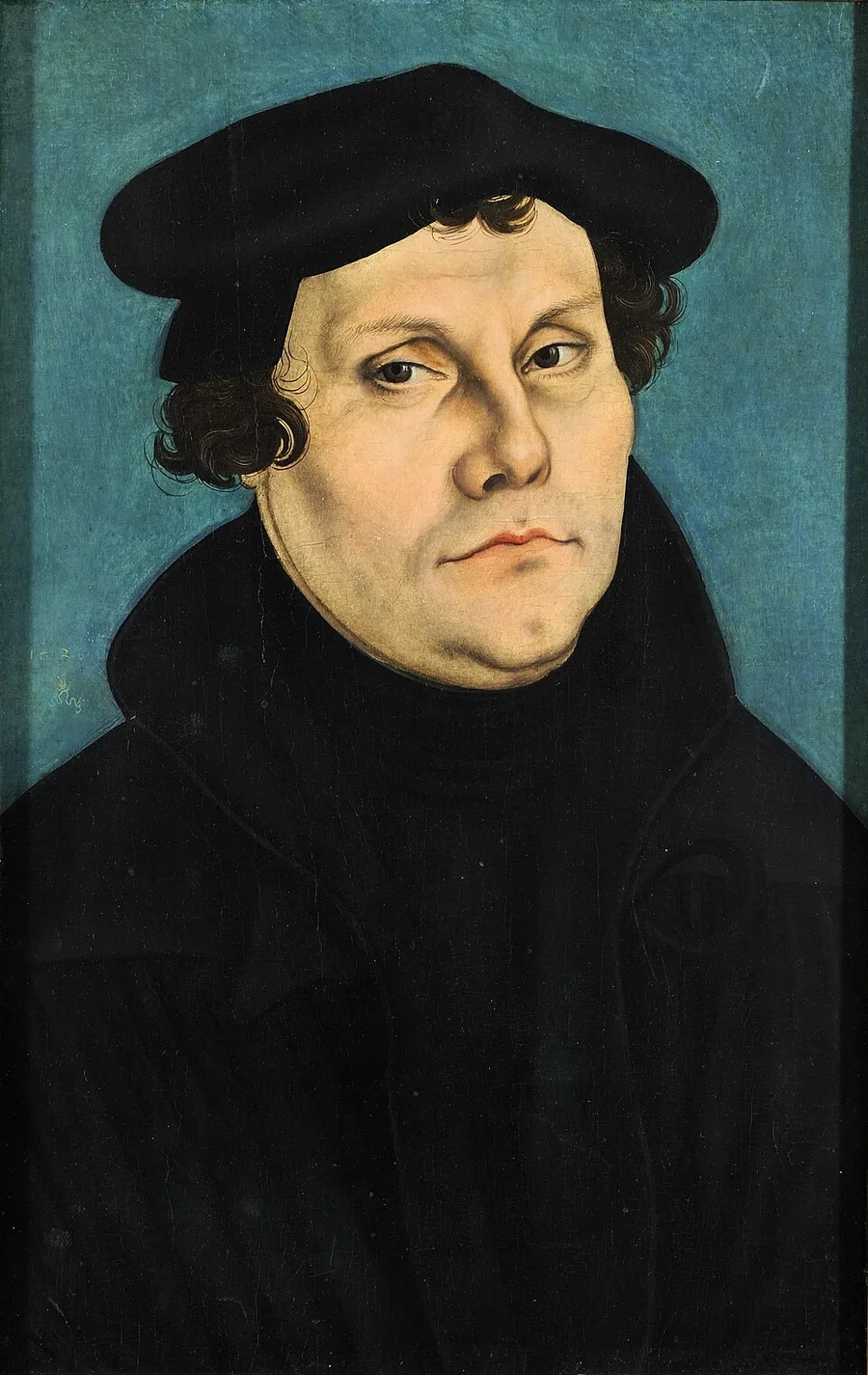 Lucas Cranach the Elder, Martin Luther (1528) Cranach's 1528 portrait of Martin Luther, whose Ninety-Five Theses and doctrine of justification by faith set off the ruptures with Rome that the 1537 Kirkeordinansen carried into Denmark-Norway a decade later. German theologian and Augustinian friar (1483–1546),
professor of biblical exegesis at Wittenberg. Originator of
the central Reformation ruptures with Rome through his
Ninety-Five Theses (October 1517), the Address to the
Christian Nobility (1520), and his refusal at the Diet of
Worms (April 1521) to recant his teachings on justification
by faith alone, scripture alone as the rule of teaching,
and the rejection of papal authority, indulgences, purgatory,
the Mass as sacrifice, and the invocation of saints. Held
throughout his life to a number of positions closer to
medieval Catholicism than to most later Protestant
tradition — the perpetual virginity of Mary, the bodily
Real Presence in the Eucharist, private confession, the
retention of liturgical vestments and ceremonial worship.
Also discussed in World War II — the King’s “No” and the Nazis in Norway ’s circle. Christian’s victory consolidated that movement into the official state religion. The Kirkeordinansen 1537
Lucas Cranach the Elder, Martin Luther (1528) Cranach's 1528 portrait of Martin Luther, whose Ninety-Five Theses and doctrine of justification by faith set off the ruptures with Rome that the 1537 Kirkeordinansen carried into Denmark-Norway a decade later. German theologian and Augustinian friar (1483–1546),
professor of biblical exegesis at Wittenberg. Originator of
the central Reformation ruptures with Rome through his
Ninety-Five Theses (October 1517), the Address to the
Christian Nobility (1520), and his refusal at the Diet of
Worms (April 1521) to recant his teachings on justification
by faith alone, scripture alone as the rule of teaching,
and the rejection of papal authority, indulgences, purgatory,
the Mass as sacrifice, and the invocation of saints. Held
throughout his life to a number of positions closer to
medieval Catholicism than to most later Protestant
tradition — the perpetual virginity of Mary, the bodily
Real Presence in the Eucharist, private confession, the
retention of liturgical vestments and ceremonial worship.
Also discussed in World War II — the King’s “No” and the Nazis in Norway ’s circle. Christian’s victory consolidated that movement into the official state religion. The Kirkeordinansen 1537 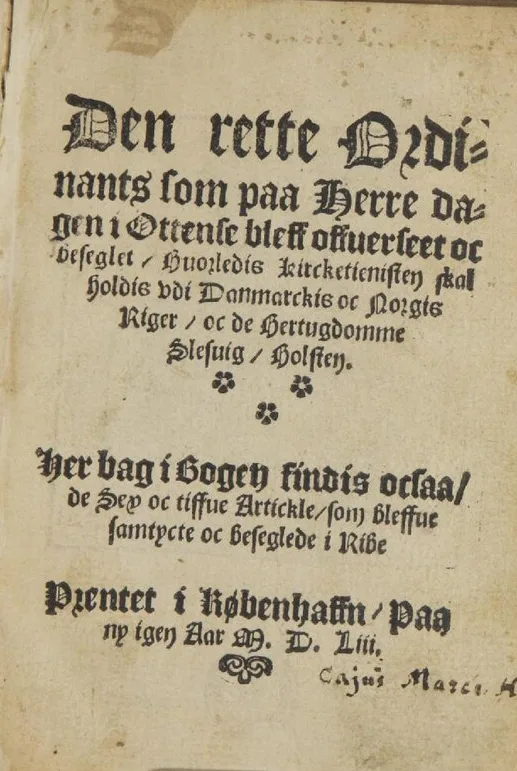 Title page, Den rette Ordinants (Copenhagen, 1553 printing), Royal Danish Library — via Wikimedia Commons The Ordinance as congregations met it: the "right Ordinance" reviewed and sealed at the Odense assembly of 1539 — the vernacular successor of the 1537 Latin text — in a 1553 Copenhagen reprint. Its title promises to govern church service "in Denmark's and Norway's realms." The Church Ordinance of 1537 — the constitutional document
that established the Lutheran state church in Denmark-Norway,
signed by Christian III at Copenhagen on 2 September 1537.
Drafted by the German Lutheran theologian Johannes
Bugenhagen and modelled on Bugenhagen's earlier ordinances
for the north German Lutheran cities. The Ordinance
replaced the Catholic structure across both halves of the
kingdom: the episcopate became a state office of
superintendents appointed by the crown, the monasteries
were dissolved and their lands transferred to royal
possession, the liturgy was translated into Danish, papal
taxation stopped, and clerical celibacy ended. Operated as
the constitution of the Danish-Norwegian church for the
next three centuries.
, drafted in Copenhagen
Title page, Den rette Ordinants (Copenhagen, 1553 printing), Royal Danish Library — via Wikimedia Commons The Ordinance as congregations met it: the "right Ordinance" reviewed and sealed at the Odense assembly of 1539 — the vernacular successor of the 1537 Latin text — in a 1553 Copenhagen reprint. Its title promises to govern church service "in Denmark's and Norway's realms." The Church Ordinance of 1537 — the constitutional document
that established the Lutheran state church in Denmark-Norway,
signed by Christian III at Copenhagen on 2 September 1537.
Drafted by the German Lutheran theologian Johannes
Bugenhagen and modelled on Bugenhagen's earlier ordinances
for the north German Lutheran cities. The Ordinance
replaced the Catholic structure across both halves of the
kingdom: the episcopate became a state office of
superintendents appointed by the crown, the monasteries
were dissolved and their lands transferred to royal
possession, the liturgy was translated into Danish, papal
taxation stopped, and clerical celibacy ended. Operated as
the constitution of the Danish-Norwegian church for the
next three centuries.
, drafted in Copenhagen 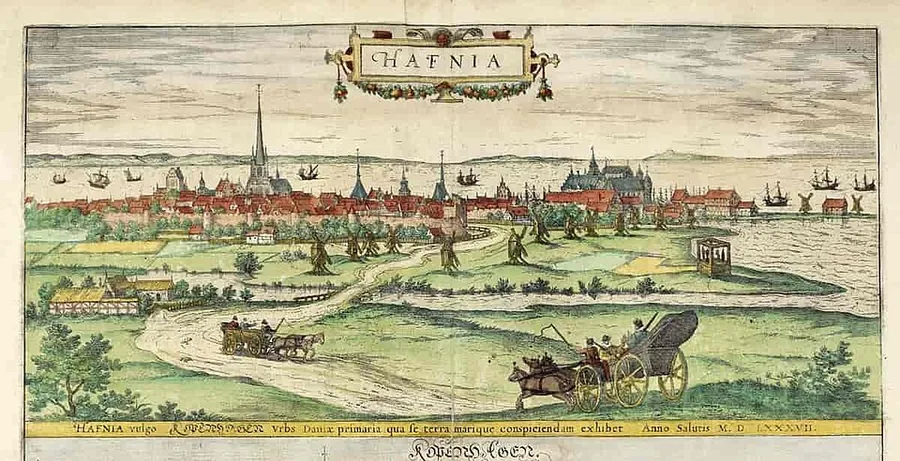 Georg Braun & Frans Hogenberg, view of Copenhagen from Vesterbro (1587), Civitates Orbis Terrarum Braun & Hogenberg's 1587 prospect of Copenhagen, capital of the Danish-Norwegian union from which the 1537 Reformation was imposed on Norway and to which the melted-down silver of Olav's shrine was sent after Nidaros Cathedral was stripped. Capital of Denmark, on the eastern coast of the island of Zealand
across the Øresund strait from Sweden. Founded as a fishing town
in the early medieval period, formal city in 1167, royal capital
from the early fifteenth century. The administrative centre of the
Danish kingdom and, from 1380 to 1814, of the Danish-Norwegian
union — the place where the 1537 Lutheran Reformation in Norway
was decided and from which the silver of the Olafskrinet was
sent to the Copenhagen mint after the destruction of the shrine
at Nidaros.
Also discussed in The King Who Became a Saint — how the Nordmen came to ChristA Catholic Norway — the faith that gave the kingdom its first institutions and the stave churchesThe 400-Year Night — when the Northern Lion lay dormantWorld War II — the King’s “No” and the Nazis in Norway by the German theologian Johannes Bugenhagen
Georg Braun & Frans Hogenberg, view of Copenhagen from Vesterbro (1587), Civitates Orbis Terrarum Braun & Hogenberg's 1587 prospect of Copenhagen, capital of the Danish-Norwegian union from which the 1537 Reformation was imposed on Norway and to which the melted-down silver of Olav's shrine was sent after Nidaros Cathedral was stripped. Capital of Denmark, on the eastern coast of the island of Zealand
across the Øresund strait from Sweden. Founded as a fishing town
in the early medieval period, formal city in 1167, royal capital
from the early fifteenth century. The administrative centre of the
Danish kingdom and, from 1380 to 1814, of the Danish-Norwegian
union — the place where the 1537 Lutheran Reformation in Norway
was decided and from which the silver of the Olafskrinet was
sent to the Copenhagen mint after the destruction of the shrine
at Nidaros.
Also discussed in The King Who Became a Saint — how the Nordmen came to ChristA Catholic Norway — the faith that gave the kingdom its first institutions and the stave churchesThe 400-Year Night — when the Northern Lion lay dormantWorld War II — the King’s “No” and the Nazis in Norway by the German theologian Johannes Bugenhagen 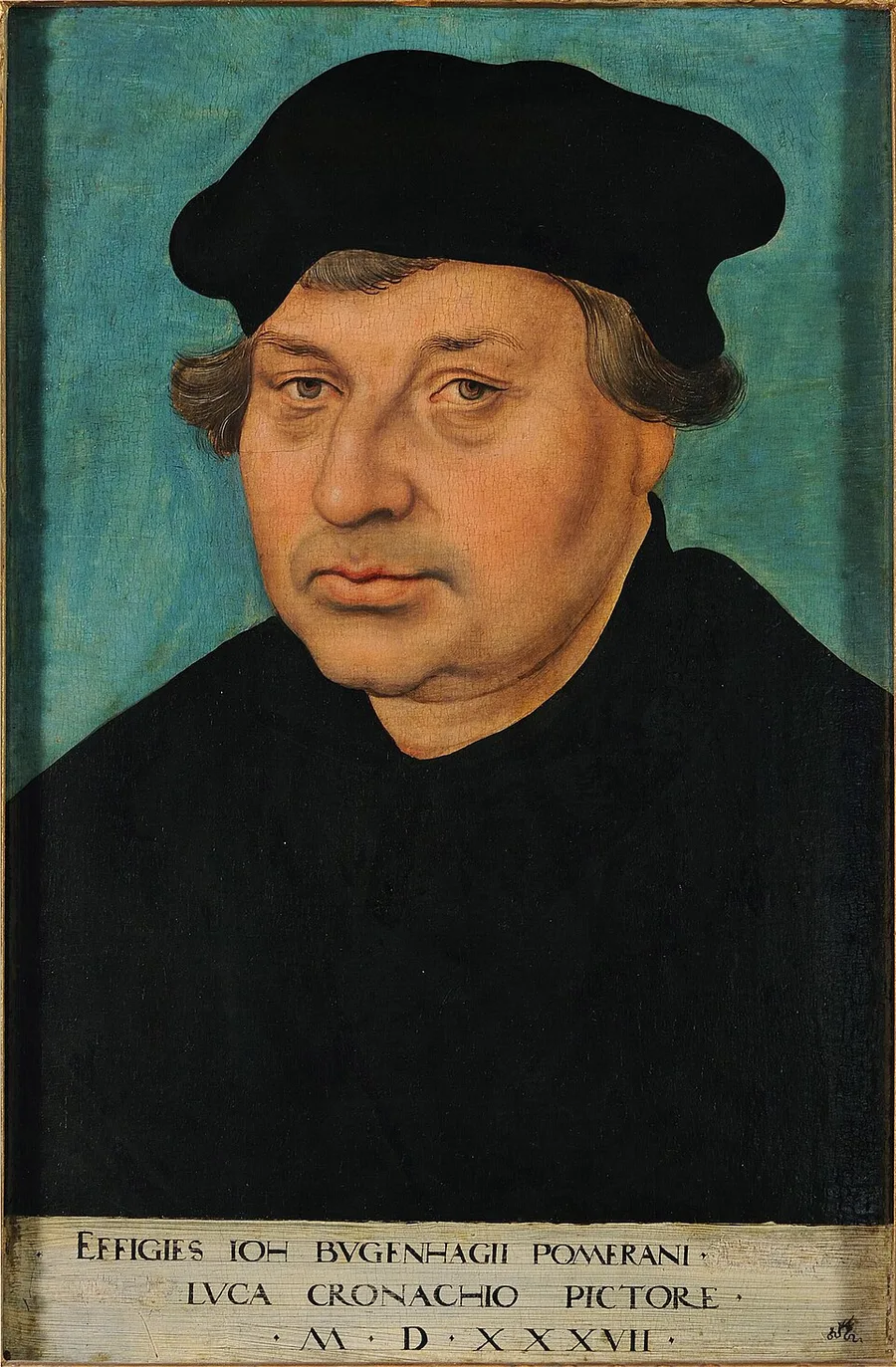 Lucas Cranach the Elder, Johannes Bugenhagen (1537) Cranach's 1537 portrait of Johannes Bugenhagen, the Wittenberg pastor who drafted the Kirkeordinansen that same year, the document that replaced Norway's Catholic episcopate with a crown-run Lutheran church. Pomeranian Lutheran theologian (1485–1558), called Doctor
Pomeranus. Close collaborator and personal pastor of Martin
Luther at Wittenberg from 1521 onward, the man who married
Luther to Katharina von Bora and who preached at Luther's
funeral in 1546. The principal Lutheran architect of the
Reformation church orders across northern Germany and
Scandinavia: he wrote the church ordinances for Hamburg
(1529), Lübeck (1531), Pomerania (1535), Denmark-Norway
(1537), and Holstein (1542). The Danish-Norwegian
Kirkeordinansen of 2 September 1537, drafted by Bugenhagen
while resident in Copenhagen at Christian III's invitation,
replaced the medieval Catholic structure across both halves
of the kingdom with a Lutheran establishment financed and
appointed through the crown.
working as Christian’s adviser, was promulgated on the second of September 1537 and replaced the Catholic ecclesiastical structure across the Danish kingdoms. The break with Rome had effectively come a year earlier — the Catholic bishops had been arrested in August 1536, and the Herredag Lords' Day — the highest assembly of the medieval and
early modern Danish-Norwegian state, convened irregularly
by the king to consult the realm councils, the senior
nobility, and the bishops on matters of constitutional or
diplomatic weight. The Herredag at Copenhagen in October
1536, convoked by the newly victorious Christian III to
consolidate his hold after the Count's Feud, formally
severed the Catholic ecclesiastical structure of his
kingdoms: the bishops who had been arrested in August were
stripped of office and lands, the realm councils accepted
the Lutheran direction of the crown, and the institutional
break with Rome was complete. The Kirkeordinansen of
September 1537 was the formal seal on a structural change
the October 1536 Herredag had already effected.
(royal-council assembly) at Copenhagen that October had severed the formal structure. The Ordinance was the formal seal on a break already complete.
Lucas Cranach the Elder, Johannes Bugenhagen (1537) Cranach's 1537 portrait of Johannes Bugenhagen, the Wittenberg pastor who drafted the Kirkeordinansen that same year, the document that replaced Norway's Catholic episcopate with a crown-run Lutheran church. Pomeranian Lutheran theologian (1485–1558), called Doctor
Pomeranus. Close collaborator and personal pastor of Martin
Luther at Wittenberg from 1521 onward, the man who married
Luther to Katharina von Bora and who preached at Luther's
funeral in 1546. The principal Lutheran architect of the
Reformation church orders across northern Germany and
Scandinavia: he wrote the church ordinances for Hamburg
(1529), Lübeck (1531), Pomerania (1535), Denmark-Norway
(1537), and Holstein (1542). The Danish-Norwegian
Kirkeordinansen of 2 September 1537, drafted by Bugenhagen
while resident in Copenhagen at Christian III's invitation,
replaced the medieval Catholic structure across both halves
of the kingdom with a Lutheran establishment financed and
appointed through the crown.
working as Christian’s adviser, was promulgated on the second of September 1537 and replaced the Catholic ecclesiastical structure across the Danish kingdoms. The break with Rome had effectively come a year earlier — the Catholic bishops had been arrested in August 1536, and the Herredag Lords' Day — the highest assembly of the medieval and
early modern Danish-Norwegian state, convened irregularly
by the king to consult the realm councils, the senior
nobility, and the bishops on matters of constitutional or
diplomatic weight. The Herredag at Copenhagen in October
1536, convoked by the newly victorious Christian III to
consolidate his hold after the Count's Feud, formally
severed the Catholic ecclesiastical structure of his
kingdoms: the bishops who had been arrested in August were
stripped of office and lands, the realm councils accepted
the Lutheran direction of the crown, and the institutional
break with Rome was complete. The Kirkeordinansen of
September 1537 was the formal seal on a structural change
the October 1536 Herredag had already effected.
(royal-council assembly) at Copenhagen that October had severed the formal structure. The Ordinance was the formal seal on a break already complete.
Before the Reformation, the Catholic Church in Christian III’s kingdoms held vast wealth. The Church’s institutions in Norway alone held roughly forty per cent of the country’s land-rent value, concentrated in monasteries, bishoprics, and the saints’ shrines. Papal taxation had been flowing out of Denmark and Norway to Rome since the twelfth century, and the appointment of bishops formally rested with the pope, with local cathedral chapters electing candidates and the crown often pressing in practice. Within five years of the Reformation, all of this had transferred. Church lands and monastery treasuries became crown property; the saints’ shrines were melted into Danish coin at the royal mint; papal taxation stopped at the border; the crown took the right of episcopal appointment to itself.
The doctrinal change to Lutheranism arrived alongside the largest single transfer of wealth and authority in the kingdoms’ history. Whatever the religious merits of the reform, the rulers who chose to adopt it stood to gain substantially, in entirely non-religious ways, by doing so.
In Norway the Reformation arrived almost entirely from outside. Beyond the German-speaking Hanseatic community at Bergen 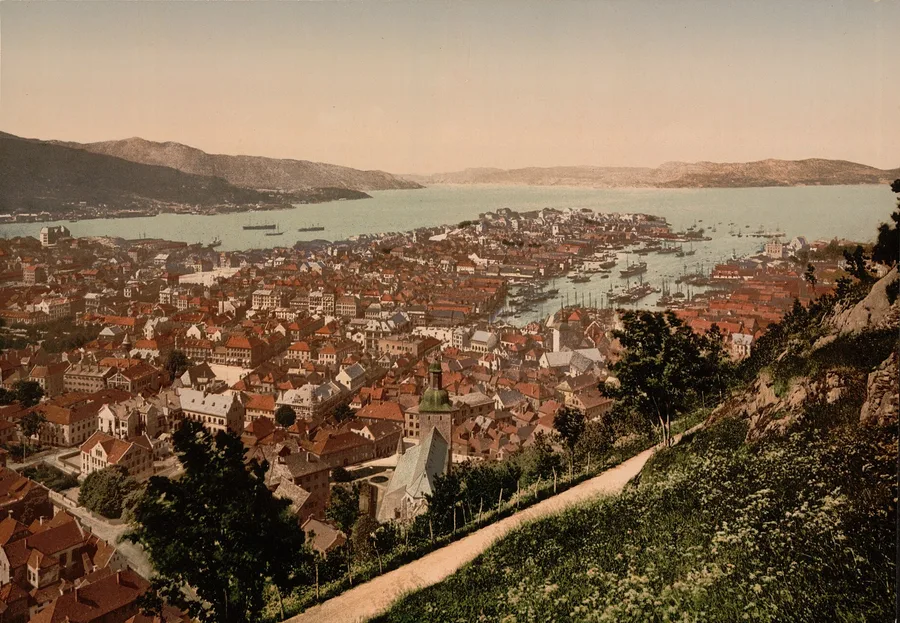 Photochrom print, General view from Fjeldveien, Bergen (c. 1890–1900), Library of Congress Bergen in the 1890s from the Fjellveien path on Fløyfjellet — the whole city between its mountains, Vågen harbour still crowded with sailing ships at its heart. For four centuries Norway's largest city, and the wharf through which the entire western export economy ran. Norway's western trading capital, founded around 1070 on the
inner Byfjorden. For four centuries the largest city in the
country and the wharf through which the entire western export
economy ran — dried cod from the Lofoten fisheries, stockpiled
and traded by the Hanseatic merchants at Bryggen from 1360 to
1754. Norway's commercial and intellectual heart through the
Hanseatic period; overtaken in size by Christiania (Oslo) in the
1830s. The painted wooden Bryggen wharf is on the UNESCO World
Heritage list and substantially what it was in the late
seventeenth century.
On the trip The Ungdommene (the Youngsters) reach Bergen late on Day 3
via the Norway-in-a-Nutshell train-and-ferry route from
Oslo. On the Day 4 morning they walk Bryggen and ride the
funicular up Mount Fløyen before flying back to Oslo and driving
on to Lillehammer that evening — a day ahead of the Gråhårsklubben
(the Oldsters), who spend the split days north in Trondheim and
the heritage country of Stjørdal, Hegra, and Kylloplass and come
south on Day 5.
Bergen Also discussed in The Germans Who "Ruled" Bergen — the Hanseatic merchants on Bryggen WharfBefore There Was Norway — petty kingdoms at the edge of the worldThe King Who Became a Saint — how the Nordmen came to ChristA Catholic Norway — the faith that gave the kingdom its first institutions and the stave churchesThe Long Fall — the sudden loss of Norwegian nobility, the end of the kings, and half of Norway gone foreverThe Golden Age — a North Atlantic empire … reaching farther than you thinkThe 400-Year Night — when the Northern Lion lay dormantThe Crusades?!!!! — sixty ships from Bergen, bound for the Holy LandWorld War II — the King’s “No” and the Nazis in NorwayKraken — the island-sized beast, logged as factSjøormer — the serpents in the deep lakes and fjordsPesta — an old woman walking from farm to farmFossegrimen — the waterfall fiddler who teaches you to playAlcohol and Vinmonopolet — when and where to buy a drinkEveryday etiquette — quiet voices, wide space, no smilingFood and dining customs — having patience, free water, brunost on everything🚨 Emergencies - important numbers, hospitals, and what you can doLanguage basics — just enough Norwegian to be politeWhat to wear — the layering system, on the ground , where Lutheran preaching had been heard since the 1520s, there was no Norwegian-language Lutheran movement comparable to the Danish one — no Norwegian Luther whose theological writing or popular preaching had prepared the country for the change. Engelbrektsson mounted a brief armed resistance from his fortress at Steinvikholm and sought intervention from the Habsburg court of Mary of Austria
Photochrom print, General view from Fjeldveien, Bergen (c. 1890–1900), Library of Congress Bergen in the 1890s from the Fjellveien path on Fløyfjellet — the whole city between its mountains, Vågen harbour still crowded with sailing ships at its heart. For four centuries Norway's largest city, and the wharf through which the entire western export economy ran. Norway's western trading capital, founded around 1070 on the
inner Byfjorden. For four centuries the largest city in the
country and the wharf through which the entire western export
economy ran — dried cod from the Lofoten fisheries, stockpiled
and traded by the Hanseatic merchants at Bryggen from 1360 to
1754. Norway's commercial and intellectual heart through the
Hanseatic period; overtaken in size by Christiania (Oslo) in the
1830s. The painted wooden Bryggen wharf is on the UNESCO World
Heritage list and substantially what it was in the late
seventeenth century.
On the trip The Ungdommene (the Youngsters) reach Bergen late on Day 3
via the Norway-in-a-Nutshell train-and-ferry route from
Oslo. On the Day 4 morning they walk Bryggen and ride the
funicular up Mount Fløyen before flying back to Oslo and driving
on to Lillehammer that evening — a day ahead of the Gråhårsklubben
(the Oldsters), who spend the split days north in Trondheim and
the heritage country of Stjørdal, Hegra, and Kylloplass and come
south on Day 5.
Bergen Also discussed in The Germans Who "Ruled" Bergen — the Hanseatic merchants on Bryggen WharfBefore There Was Norway — petty kingdoms at the edge of the worldThe King Who Became a Saint — how the Nordmen came to ChristA Catholic Norway — the faith that gave the kingdom its first institutions and the stave churchesThe Long Fall — the sudden loss of Norwegian nobility, the end of the kings, and half of Norway gone foreverThe Golden Age — a North Atlantic empire … reaching farther than you thinkThe 400-Year Night — when the Northern Lion lay dormantThe Crusades?!!!! — sixty ships from Bergen, bound for the Holy LandWorld War II — the King’s “No” and the Nazis in NorwayKraken — the island-sized beast, logged as factSjøormer — the serpents in the deep lakes and fjordsPesta — an old woman walking from farm to farmFossegrimen — the waterfall fiddler who teaches you to playAlcohol and Vinmonopolet — when and where to buy a drinkEveryday etiquette — quiet voices, wide space, no smilingFood and dining customs — having patience, free water, brunost on everything🚨 Emergencies - important numbers, hospitals, and what you can doLanguage basics — just enough Norwegian to be politeWhat to wear — the layering system, on the ground , where Lutheran preaching had been heard since the 1520s, there was no Norwegian-language Lutheran movement comparable to the Danish one — no Norwegian Luther whose theological writing or popular preaching had prepared the country for the change. Engelbrektsson mounted a brief armed resistance from his fortress at Steinvikholm and sought intervention from the Habsburg court of Mary of Austria 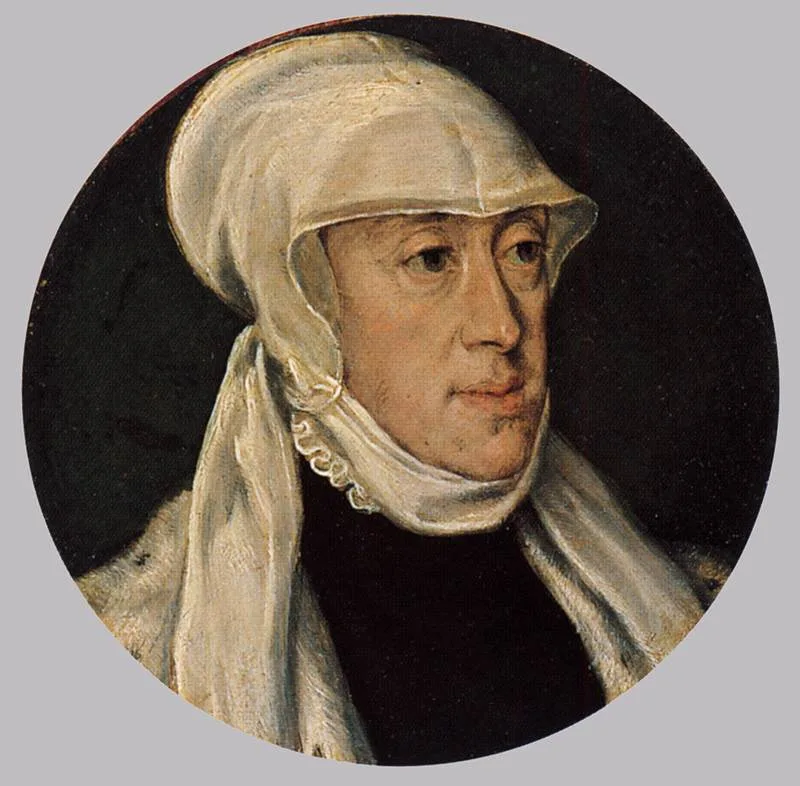 Anonymous (Low Countries), after Titian, Portrait of Mary of Hungary (1550-1560), Rijksmuseum Mary of Austria governed the Habsburg Netherlands from Brussels as regent when Archbishop Olav Engelbrektsson sailed there in 1537 seeking her intervention against Christian III's Lutheran reform of Norway, help that never came. Habsburg archduchess (1505–1558), sister of Emperor Charles
V and former Queen of Hungary. Governor of the Habsburg
Netherlands from 1531 to 1555 on her brother's behalf,
ruling Brussels and the seventeen provinces during the
decades that saw the Reformation crisis split central
Europe. The exiled Archbishop Olav Engelbrektsson, sailing
from Nidaros in April 1537 with the cathedral records and
movable treasures, sought her intervention against
Christian III of Denmark, who had imposed Lutheran reform
on the Danish-Norwegian kingdom. The diplomacy failed.
Engelbrektsson died at Lier near Antwerp in February 1538
before any Habsburg response was organised.
, regent of the Netherlands, before the diplomacy failed and the fortress fell. Below him, the Norwegian parish clergy were largely retained in their positions under the new Lutheran establishment, often with minimal retraining. The country changed its religious affiliation on the basis of a royal decree issued in a foreign capital, with the lay population participating only as the recipients of the new Danish-language Lutheran services.
Anonymous (Low Countries), after Titian, Portrait of Mary of Hungary (1550-1560), Rijksmuseum Mary of Austria governed the Habsburg Netherlands from Brussels as regent when Archbishop Olav Engelbrektsson sailed there in 1537 seeking her intervention against Christian III's Lutheran reform of Norway, help that never came. Habsburg archduchess (1505–1558), sister of Emperor Charles
V and former Queen of Hungary. Governor of the Habsburg
Netherlands from 1531 to 1555 on her brother's behalf,
ruling Brussels and the seventeen provinces during the
decades that saw the Reformation crisis split central
Europe. The exiled Archbishop Olav Engelbrektsson, sailing
from Nidaros in April 1537 with the cathedral records and
movable treasures, sought her intervention against
Christian III of Denmark, who had imposed Lutheran reform
on the Danish-Norwegian kingdom. The diplomacy failed.
Engelbrektsson died at Lier near Antwerp in February 1538
before any Habsburg response was organised.
, regent of the Netherlands, before the diplomacy failed and the fortress fell. Below him, the Norwegian parish clergy were largely retained in their positions under the new Lutheran establishment, often with minimal retraining. The country changed its religious affiliation on the basis of a royal decree issued in a foreign capital, with the lay population participating only as the recipients of the new Danish-language Lutheran services.
What was destroyed
The institutional Catholic infrastructure was dismantled. The medieval Norwegian church had built roughly thirty monasteries, nunneries, and friaries across the country over the past four centuries, and most of those still functioning in 1537 were dissolved in the decades that followed. Their lands, which collectively held a substantial share of the country’s productive surface, were transferred to the Danish crown and largely sold off or assigned to Danish-noble grant-holders. Hovedøya 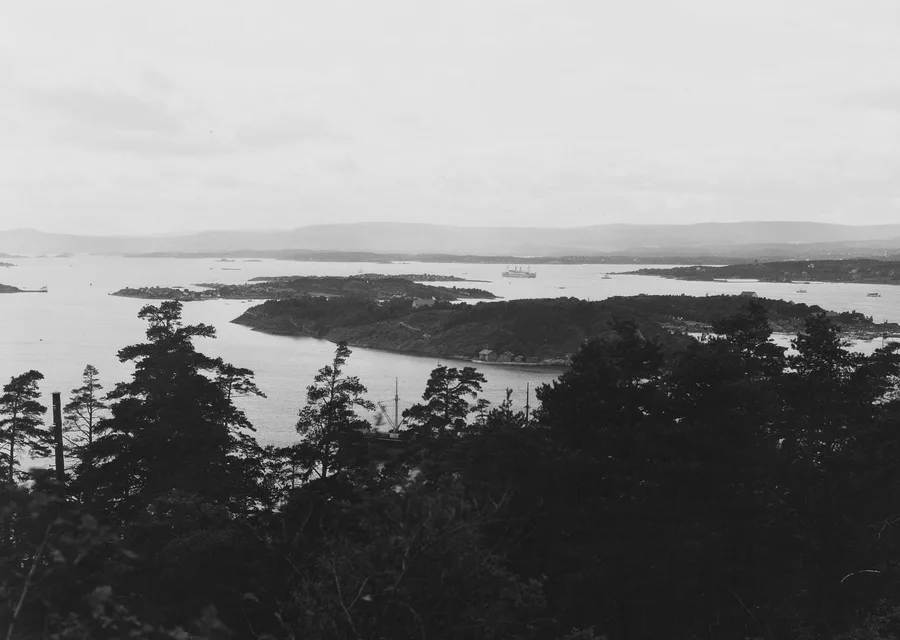 Anders Beer Wilse, Hovedøen fra Ekeberg (early 1900s), National Library of Norway The wooded island lying just off Oslo's harbour, photographed from the Ekeberg slope — close enough to the medieval town for the Cistercians to plant their abbey there in 1147, and for Oslo families to reach its ruins by summer ferry today. Wooded island of about a square kilometre in the inner Oslofjord,
just south of central Oslo. Site of the Cistercian abbey founded
in 1147 by monks sent from Kirkstead Abbey in Lincolnshire,
England. The abbey ran until the 1537 Reformation; the stripped
masonry ruins are preserved as a public park reached by summer
ferry from the Aker Brygge harbour in central Oslo and walked
through by Oslo families today. The island also hosts a small
beach and is one of the most visited recreational destinations
for Oslo residents.
Hovedøya, Oslo Also discussed in A Catholic Norway — the faith that gave the kingdom its first institutions and the stave churches in the Oslo Fjord — plundered and burned in 1532 by the commandant of Akershus Fortress
Anders Beer Wilse, Hovedøen fra Ekeberg (early 1900s), National Library of Norway The wooded island lying just off Oslo's harbour, photographed from the Ekeberg slope — close enough to the medieval town for the Cistercians to plant their abbey there in 1147, and for Oslo families to reach its ruins by summer ferry today. Wooded island of about a square kilometre in the inner Oslofjord,
just south of central Oslo. Site of the Cistercian abbey founded
in 1147 by monks sent from Kirkstead Abbey in Lincolnshire,
England. The abbey ran until the 1537 Reformation; the stripped
masonry ruins are preserved as a public park reached by summer
ferry from the Aker Brygge harbour in central Oslo and walked
through by Oslo families today. The island also hosts a small
beach and is one of the most visited recreational destinations
for Oslo residents.
Hovedøya, Oslo Also discussed in A Catholic Norway — the faith that gave the kingdom its first institutions and the stave churches in the Oslo Fjord — plundered and burned in 1532 by the commandant of Akershus Fortress 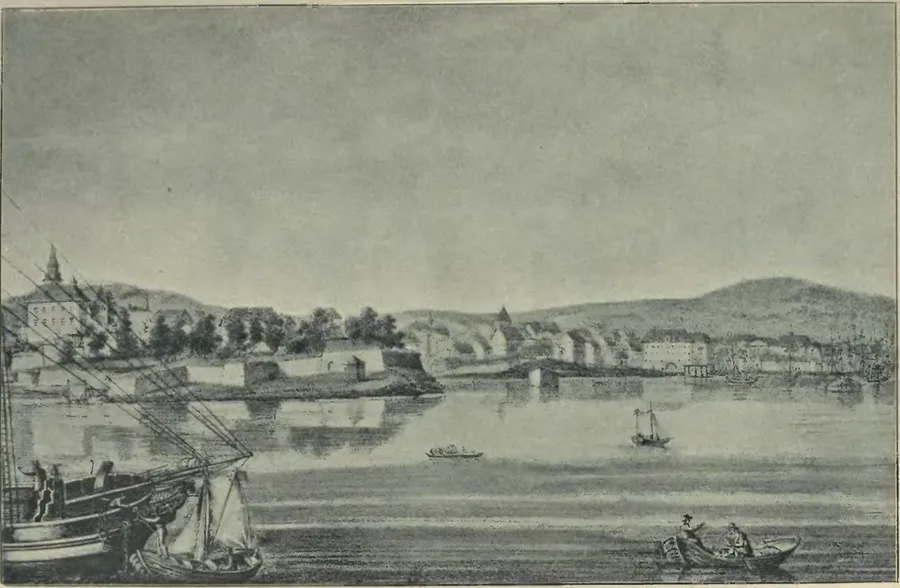 Peter Frederik Wergmann, Akershus Fortress (1831) Wergmann's 1831 view of Christiania harbor shows Akershus low on the point at center, the Danish crown's seat of authority in Norway from the late 1300s and the fortress the 1537 Reformation-era administration operated from. Medieval royal castle on a rocky promontory at the head of
the Oslofjord, begun by King Hákon V of Norway about 1299
shortly after he moved the royal residence permanently from
Bergen to Oslo. The castle commanded the seaward approach
to the medieval town and served as the royal seat of the
southeastern administration. From the late fourteenth century
onward — after the dynastic collapse following Olav IV's
death in 1387 — Akershus passed under Danish-appointed
governance and remained the seat of the Danish crown's
authority in Norway for the next four centuries. Today a
preserved fortress complex above central Oslo.
On the trip The Day-2 e-bike tour rides through the Akershus Fortress
grounds — the first stop on the morning's loop through
central Oslo, with both groups together.
Also discussed in The Long Fall — the sudden loss of Norwegian nobility, the end of the kings, and half of Norway gone foreverThe 400-Year Night — when the Northern Lion lay dormantWorld War II — the King’s “No” and the Nazis in Norway in a political reprisal against an abbot who had backed the deposed Christian II — was dismantled for stone after the Reformation, its masonry supplying the fortifications of Akershus. Munkeliv Abbey
Peter Frederik Wergmann, Akershus Fortress (1831) Wergmann's 1831 view of Christiania harbor shows Akershus low on the point at center, the Danish crown's seat of authority in Norway from the late 1300s and the fortress the 1537 Reformation-era administration operated from. Medieval royal castle on a rocky promontory at the head of
the Oslofjord, begun by King Hákon V of Norway about 1299
shortly after he moved the royal residence permanently from
Bergen to Oslo. The castle commanded the seaward approach
to the medieval town and served as the royal seat of the
southeastern administration. From the late fourteenth century
onward — after the dynastic collapse following Olav IV's
death in 1387 — Akershus passed under Danish-appointed
governance and remained the seat of the Danish crown's
authority in Norway for the next four centuries. Today a
preserved fortress complex above central Oslo.
On the trip The Day-2 e-bike tour rides through the Akershus Fortress
grounds — the first stop on the morning's loop through
central Oslo, with both groups together.
Also discussed in The Long Fall — the sudden loss of Norwegian nobility, the end of the kings, and half of Norway gone foreverThe 400-Year Night — when the Northern Lion lay dormantWorld War II — the King’s “No” and the Nazis in Norway in a political reprisal against an abbot who had backed the deposed Christian II — was dismantled for stone after the Reformation, its masonry supplying the fortifications of Akershus. Munkeliv Abbey 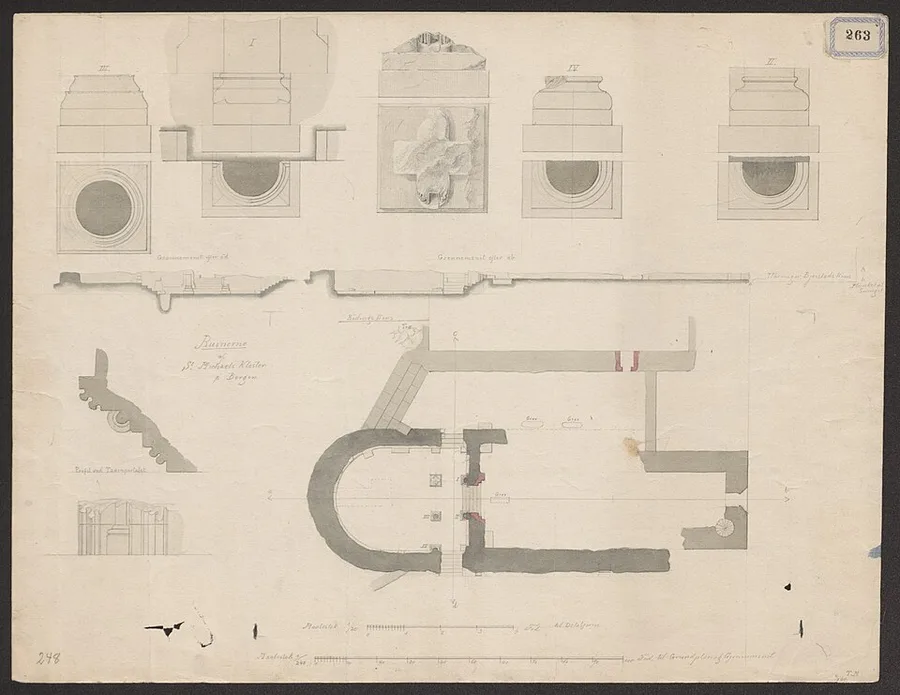 Henrik Thrap-Meyer, Ruins of St Michael's Monastery, Bergen (1860), Fortidsminneforeningen/Riksantikvaren Nothing of Munkeliv Abbey stands today — Bergen's great Benedictine (later Bridgettine) house burned for the last time in 1536 and was never rebuilt. This 1860 antiquarian survey drawing records what the excavation of its buried foundations found. Benedictine (later Bridgettine) monastery on the western shore
of the Vågen harbour at Bergen, founded in the early twelfth
century by King Eystein I. The largest medieval monastic
foundation in Norway. In the 1420s the house was transferred,
with papal approval, to the Swedish Bridgettine order as a
double house of monks and nuns — one of the few Bridgettine
foundations outside Sweden itself. The buildings were burned
in 1455 when the Kontor's merchants stormed the abbey in
fighting with the Norwegian crown; rebuilt over the following
decades — the Bridgettines returned in 1478 — then burned
again in 1536 and never rebuilt. The Munkeliv quarter of
modern Bergen preserves the name.
Also discussed in A Catholic Norway — the faith that gave the kingdom its first institutions and the stave churchesThe Germans Who "Ruled" Bergen — the Hanseatic merchants on Bryggen Wharf in Bergen was taken over by the bishop as his residence after Christ Church, Bergen
Henrik Thrap-Meyer, Ruins of St Michael's Monastery, Bergen (1860), Fortidsminneforeningen/Riksantikvaren Nothing of Munkeliv Abbey stands today — Bergen's great Benedictine (later Bridgettine) house burned for the last time in 1536 and was never rebuilt. This 1860 antiquarian survey drawing records what the excavation of its buried foundations found. Benedictine (later Bridgettine) monastery on the western shore
of the Vågen harbour at Bergen, founded in the early twelfth
century by King Eystein I. The largest medieval monastic
foundation in Norway. In the 1420s the house was transferred,
with papal approval, to the Swedish Bridgettine order as a
double house of monks and nuns — one of the few Bridgettine
foundations outside Sweden itself. The buildings were burned
in 1455 when the Kontor's merchants stormed the abbey in
fighting with the Norwegian crown; rebuilt over the following
decades — the Bridgettines returned in 1478 — then burned
again in 1536 and never rebuilt. The Munkeliv quarter of
modern Bergen preserves the name.
Also discussed in A Catholic Norway — the faith that gave the kingdom its first institutions and the stave churchesThe Germans Who "Ruled" Bergen — the Hanseatic merchants on Bryggen Wharf in Bergen was taken over by the bishop as his residence after Christ Church, Bergen 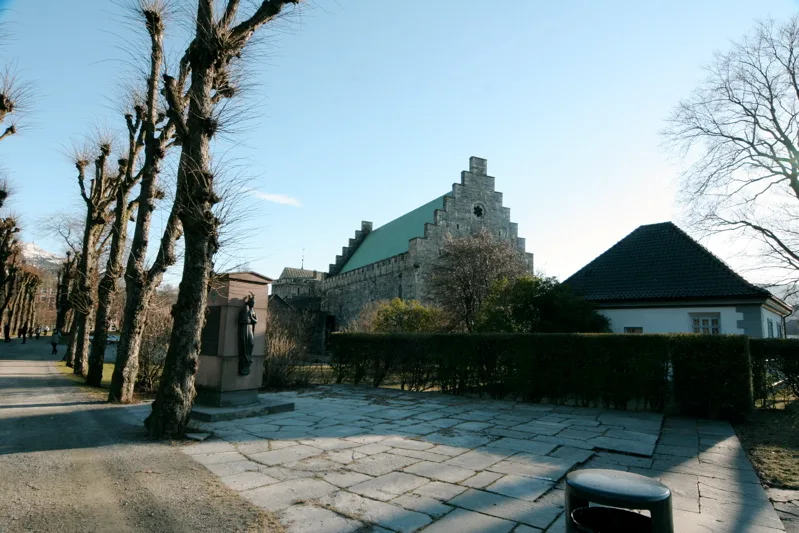 Photo: Nina Aldin Thune, CC BY-SA 3.0 Nothing of the cathedral stands — it was razed in 1531 to clear the fortress's field of fire. The paved plot and low hedges beside Håkon's Hall at Bergenhus mark its site: the footprint of the church where William of Sabina crowned Hákon IV in 1247. Cathedral of medieval Bergen, the seat of the bishop and
the coronation church of the Norwegian kings, located on the
Holmen headland above the Vågen harbour at what is today the
Bergenhus fortress. Begun in the twelfth century by Olav
Kyrre and completed under the early Sverre dynasty; Hákon IV
was crowned there by the papal legate William of Sabina in
1247. Reportedly the first church in Bergen at which the
plague-bearing ship's contagion took hold in the late summer
of 1349, killing the priests of the headland. The cathedral
was later moved to its present site away from the fortress;
the medieval Christ Church itself was demolished after the
Reformation, and only foundation traces remain today within
the Bergenhus complex.
Also discussed in The Long Fall — the sudden loss of Norwegian nobility, the end of the kings, and half of Norway gone forever on Holmen had been demolished in 1531 to clear ground for the Bergenhus Fortress
Photo: Nina Aldin Thune, CC BY-SA 3.0 Nothing of the cathedral stands — it was razed in 1531 to clear the fortress's field of fire. The paved plot and low hedges beside Håkon's Hall at Bergenhus mark its site: the footprint of the church where William of Sabina crowned Hákon IV in 1247. Cathedral of medieval Bergen, the seat of the bishop and
the coronation church of the Norwegian kings, located on the
Holmen headland above the Vågen harbour at what is today the
Bergenhus fortress. Begun in the twelfth century by Olav
Kyrre and completed under the early Sverre dynasty; Hákon IV
was crowned there by the papal legate William of Sabina in
1247. Reportedly the first church in Bergen at which the
plague-bearing ship's contagion took hold in the late summer
of 1349, killing the priests of the headland. The cathedral
was later moved to its present site away from the fortress;
the medieval Christ Church itself was demolished after the
Reformation, and only foundation traces remain today within
the Bergenhus complex.
Also discussed in The Long Fall — the sudden loss of Norwegian nobility, the end of the kings, and half of Norway gone forever on Holmen had been demolished in 1531 to clear ground for the Bergenhus Fortress 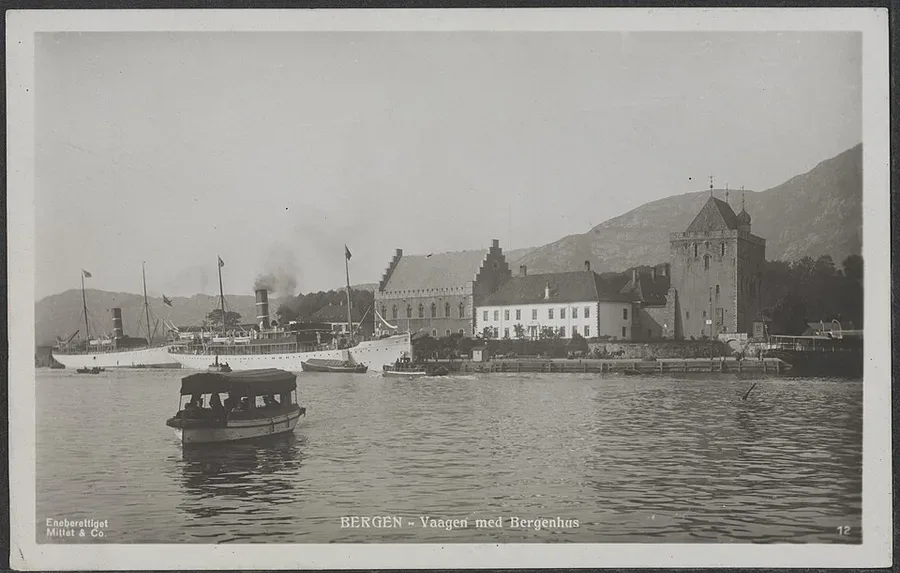 Mittet & Co. postcard, Vågen med Bergenhus (c. 1920-1930), National Library of Norway This 1920s postcard photograph shows Bergenhus much as it appeared for centuries at the entrance to Vågen — Håkonshallen and the Rosenkrantz Tower, the medieval royal seat that later passed under Danish-appointed governance. Medieval royal fortification at the entrance to the Vågen
harbour in Bergen, the royal seat of the Sverre dynasty
through the Norwegian Golden Age. The complex centres on
Håkonshallen — Hákon IV's stone great hall, built in the
1260s — and the Rosenkrantz Tower, a sixteenth-century
addition to a thirteenth-century base. Bergenhus was the
effective capital of medieval Norway until Hákon V moved
the royal seat to Oslo around 1300. From the late
fourteenth century onward the fortress passed under Danish-
appointed governance, where it remained until the 1814
dissolution. Today a preserved historic site at the
northern end of the Bryggen waterfront.
Also discussed in The Long Fall — the sudden loss of Norwegian nobility, the end of the kings, and half of Norway gone foreverThe Germans Who "Ruled" Bergen — the Hanseatic merchants on Bryggen Wharf . Selja
Mittet & Co. postcard, Vågen med Bergenhus (c. 1920-1930), National Library of Norway This 1920s postcard photograph shows Bergenhus much as it appeared for centuries at the entrance to Vågen — Håkonshallen and the Rosenkrantz Tower, the medieval royal seat that later passed under Danish-appointed governance. Medieval royal fortification at the entrance to the Vågen
harbour in Bergen, the royal seat of the Sverre dynasty
through the Norwegian Golden Age. The complex centres on
Håkonshallen — Hákon IV's stone great hall, built in the
1260s — and the Rosenkrantz Tower, a sixteenth-century
addition to a thirteenth-century base. Bergenhus was the
effective capital of medieval Norway until Hákon V moved
the royal seat to Oslo around 1300. From the late
fourteenth century onward the fortress passed under Danish-
appointed governance, where it remained until the 1814
dissolution. Today a preserved historic site at the
northern end of the Bryggen waterfront.
Also discussed in The Long Fall — the sudden loss of Norwegian nobility, the end of the kings, and half of Norway gone foreverThe Germans Who "Ruled" Bergen — the Hanseatic merchants on Bryggen Wharf . Selja 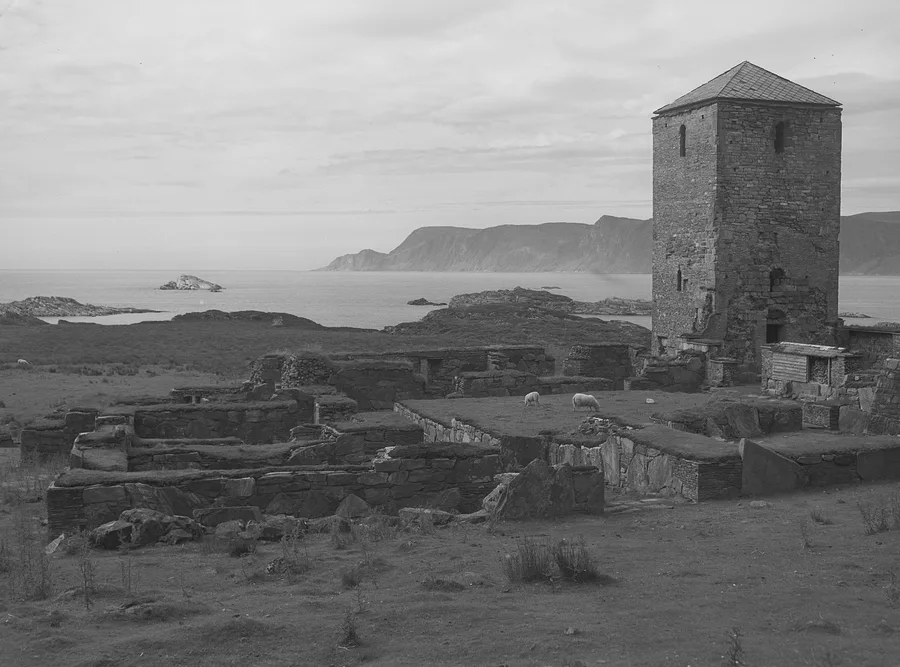 Photographer unknown, Selja kloster (1948), Mittet & Co. / National Library of Norway The island the legend chose: the monastery tower and walls stand on the shore terrace where Sunniva's veneration began, the open sea past Stad behind — the landscape pilgrims crossed to reach one of Norway's earliest holy places. Small island in Nordfjord on the western coast of Norway, in
modern Stad municipality (Vestland County). Site of the legendary
martyrdom of Saint Sunniva and her Irish companions at the end
of the tenth century, in caves where they had taken refuge after
their boat washed ashore. The veneration was established at Selja
by the late eleventh century; a Benedictine monastery was founded
on the island around 1100. The medieval monastic ruins, the
twelfth-century stone church, and the natural cave traditionally
identified as Sunniva's place of death are preserved as a
protected cultural-historic site.
Selja, Nordfjord Also discussed in A Catholic Norway — the faith that gave the kingdom its first institutions and the stave churches , the founding episcopal seat of the western coast, had seen its bishopric move to Bergen by 1170; its monastery had continued for centuries afterwards but had declined steadily through the late Middle Ages and was effectively defunct well before 1537. The smaller foundations across the country were absorbed in the same pattern.
Photographer unknown, Selja kloster (1948), Mittet & Co. / National Library of Norway The island the legend chose: the monastery tower and walls stand on the shore terrace where Sunniva's veneration began, the open sea past Stad behind — the landscape pilgrims crossed to reach one of Norway's earliest holy places. Small island in Nordfjord on the western coast of Norway, in
modern Stad municipality (Vestland County). Site of the legendary
martyrdom of Saint Sunniva and her Irish companions at the end
of the tenth century, in caves where they had taken refuge after
their boat washed ashore. The veneration was established at Selja
by the late eleventh century; a Benedictine monastery was founded
on the island around 1100. The medieval monastic ruins, the
twelfth-century stone church, and the natural cave traditionally
identified as Sunniva's place of death are preserved as a
protected cultural-historic site.
Selja, Nordfjord Also discussed in A Catholic Norway — the faith that gave the kingdom its first institutions and the stave churches , the founding episcopal seat of the western coast, had seen its bishopric move to Bergen by 1170; its monastery had continued for centuries afterwards but had declined steadily through the late Middle Ages and was effectively defunct well before 1537. The smaller foundations across the country were absorbed in the same pattern.
The shrines and reliquaries of the saints were the most visibly destroyed objects. The Olafskrinet 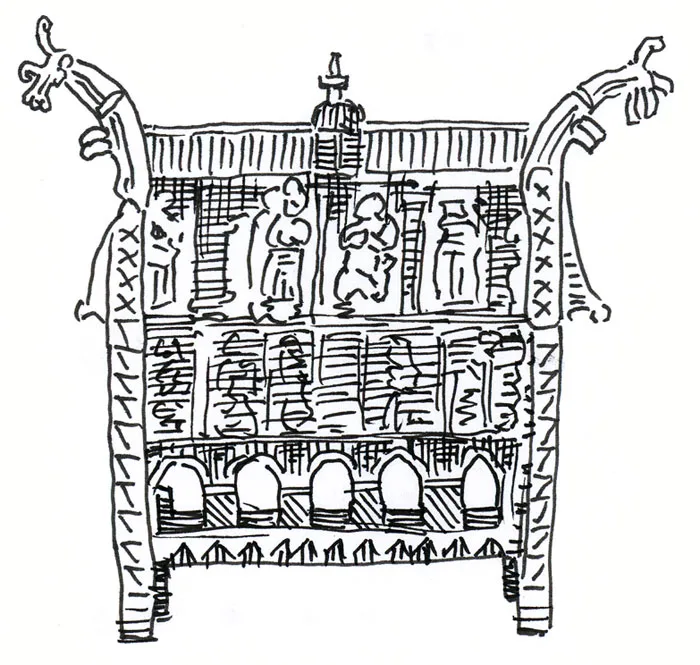 Finn Bjørklid, sketch of a presumed medieval Norwegian reliquary shrine, public domain No period depiction of Olav's actual shrine survives — the object itself was melted down in 1568. This modern line drawing reconstructs the general house-roofed casket form medieval sources describe, standing in for an object no image or fragment records directly. The silver reliquary shrine of Saint Olav at Nidaros Cathedral —
the principal devotional object of the medieval Norwegian church
and the centre of the pilgrim economy that funded the cathedral.
Commissioned across multiple decades of the eleventh and twelfth
centuries, the shrine stood on the high altar of the cathedral
through the medieval Catholic period. The Lutheran Reformation
imposed from Copenhagen in 1537 dissolved the cult of saints and
ordered the shrine destroyed; the silver was sent at once to the
Copenhagen mint. The body itself outlasted the silver by a
generation. The final destruction of the remaining shrine came in
1568; Olav was reburied somewhere within the cathedral after that,
in a location that has not been recovered since.
Also discussed in The King Who Became a Saint — how the Nordmen came to Christ at Nidaros — the silver shrine of Saint Olav, three nested coffins with the body of the king at the centre — had been moved to Engelbrektsson’s fortress at Steinvikholm in 1536 to keep it from being seized. When the fortress fell in May 1537, after Engelbrektsson had already fled, the shrine was captured. The two silver coffins were stripped at the royal mint in Copenhagen in 1540; roughly ninety-five kilograms of precious metal were melted down for Danish coinage.
Finn Bjørklid, sketch of a presumed medieval Norwegian reliquary shrine, public domain No period depiction of Olav's actual shrine survives — the object itself was melted down in 1568. This modern line drawing reconstructs the general house-roofed casket form medieval sources describe, standing in for an object no image or fragment records directly. The silver reliquary shrine of Saint Olav at Nidaros Cathedral —
the principal devotional object of the medieval Norwegian church
and the centre of the pilgrim economy that funded the cathedral.
Commissioned across multiple decades of the eleventh and twelfth
centuries, the shrine stood on the high altar of the cathedral
through the medieval Catholic period. The Lutheran Reformation
imposed from Copenhagen in 1537 dissolved the cult of saints and
ordered the shrine destroyed; the silver was sent at once to the
Copenhagen mint. The body itself outlasted the silver by a
generation. The final destruction of the remaining shrine came in
1568; Olav was reburied somewhere within the cathedral after that,
in a location that has not been recovered since.
Also discussed in The King Who Became a Saint — how the Nordmen came to Christ at Nidaros — the silver shrine of Saint Olav, three nested coffins with the body of the king at the centre — had been moved to Engelbrektsson’s fortress at Steinvikholm in 1536 to keep it from being seized. When the fortress fell in May 1537, after Engelbrektsson had already fled, the shrine was captured. The two silver coffins were stripped at the royal mint in Copenhagen in 1540; roughly ninety-five kilograms of precious metal were melted down for Danish coinage.
The innermost wooden coffin with the body of the saint was reburied at Nidaros at some point in the years that followed — sources disagree on whether it returned from Steinvikholm soon after the shrine’s destruction or remained at the fortress until 1564 — and was further disturbed during the Northern Seven Years’ War (1563–1570). No medieval or modern excavation has conclusively identified the spot since 1568. The body of Saint Olav has rested somewhere in or beneath Nidaros Cathedral, or in its surrounding ground, for the last four and a half centuries.
The shrine of Saint Sunniva 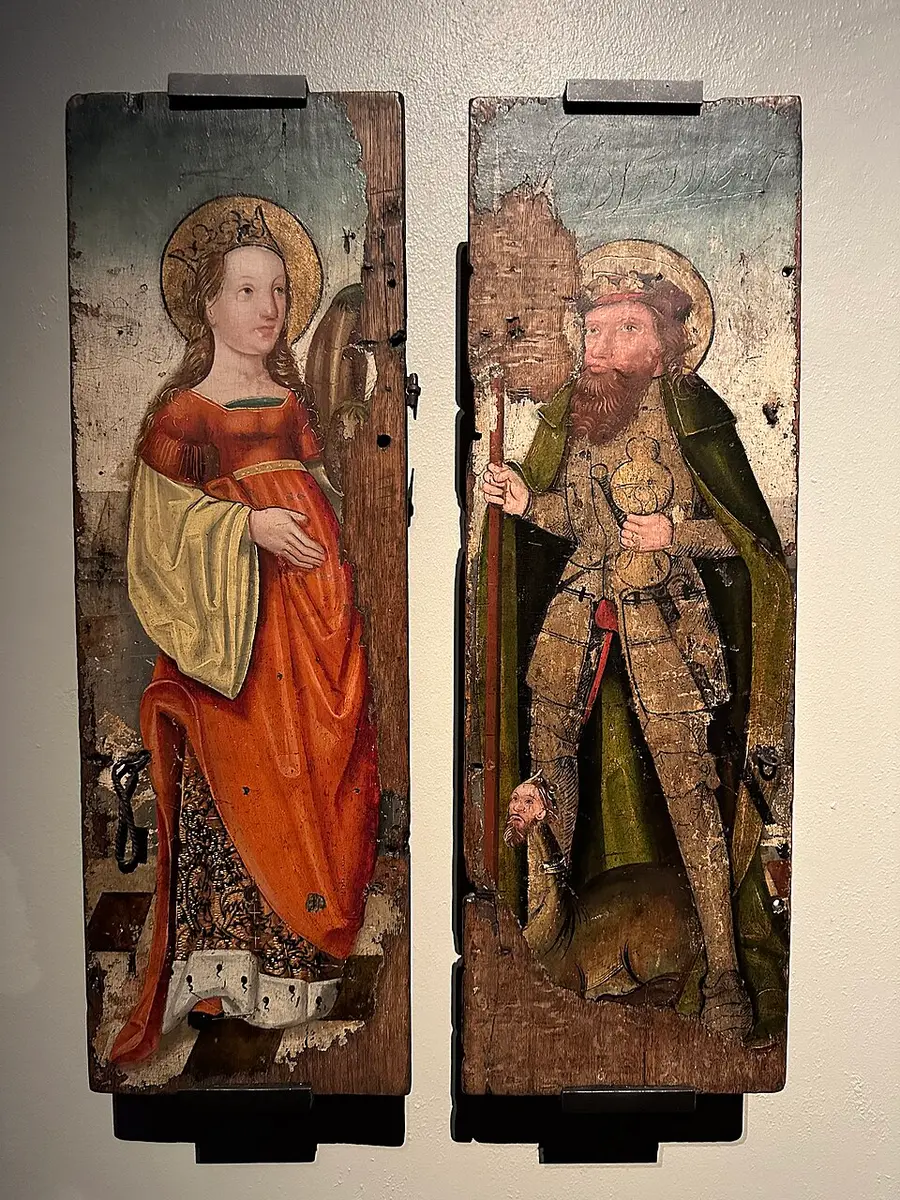 Unknown medieval carver, shrine doors from Bygland Church (after 1470); photo: Wolfmann, Museum of Cultural History, Oslo, CC BY-SA 4.0 Carved after 1470 for a country church in Bygland, these shrine doors pair Sunniva beside Olav — the two saints whose cults anchored medieval Norwegian devotion on opposite coasts. Patron saint of the western Norwegian coast and of the medieval
Bergen diocese. By the legend the medieval church transmitted,
Sunniva was an Irish princess of the tenth century who fled an
unwanted marriage to a pagan king by setting out to sea in a
rudderless boat with her brother Alban and a party of companions.
They washed ashore on the island of Selja in Nordfjord, where
they were killed in the caves they had taken refuge in — by
hostile locals in some versions of the legend, by a rockfall in
others. Her veneration was established at Selja by the late
eleventh century. A Benedictine monastery was founded on the
island around 1100. Her relics were later translated to the new
Christ Church in Bergen; she remained the principal saint of the
western coast until the Reformation.
Also discussed in A Catholic Norway — the faith that gave the kingdom its first institutions and the stave churches , moved out of Christ Church before its demolition and into other Bergen church buildings, was broken up and melted down. The shrine of Saint Hallvard
Unknown medieval carver, shrine doors from Bygland Church (after 1470); photo: Wolfmann, Museum of Cultural History, Oslo, CC BY-SA 4.0 Carved after 1470 for a country church in Bygland, these shrine doors pair Sunniva beside Olav — the two saints whose cults anchored medieval Norwegian devotion on opposite coasts. Patron saint of the western Norwegian coast and of the medieval
Bergen diocese. By the legend the medieval church transmitted,
Sunniva was an Irish princess of the tenth century who fled an
unwanted marriage to a pagan king by setting out to sea in a
rudderless boat with her brother Alban and a party of companions.
They washed ashore on the island of Selja in Nordfjord, where
they were killed in the caves they had taken refuge in — by
hostile locals in some versions of the legend, by a rockfall in
others. Her veneration was established at Selja by the late
eleventh century. A Benedictine monastery was founded on the
island around 1100. Her relics were later translated to the new
Christ Church in Bergen; she remained the principal saint of the
western coast until the Reformation.
Also discussed in A Catholic Norway — the faith that gave the kingdom its first institutions and the stave churches , moved out of Christ Church before its demolition and into other Bergen church buildings, was broken up and melted down. The shrine of Saint Hallvard 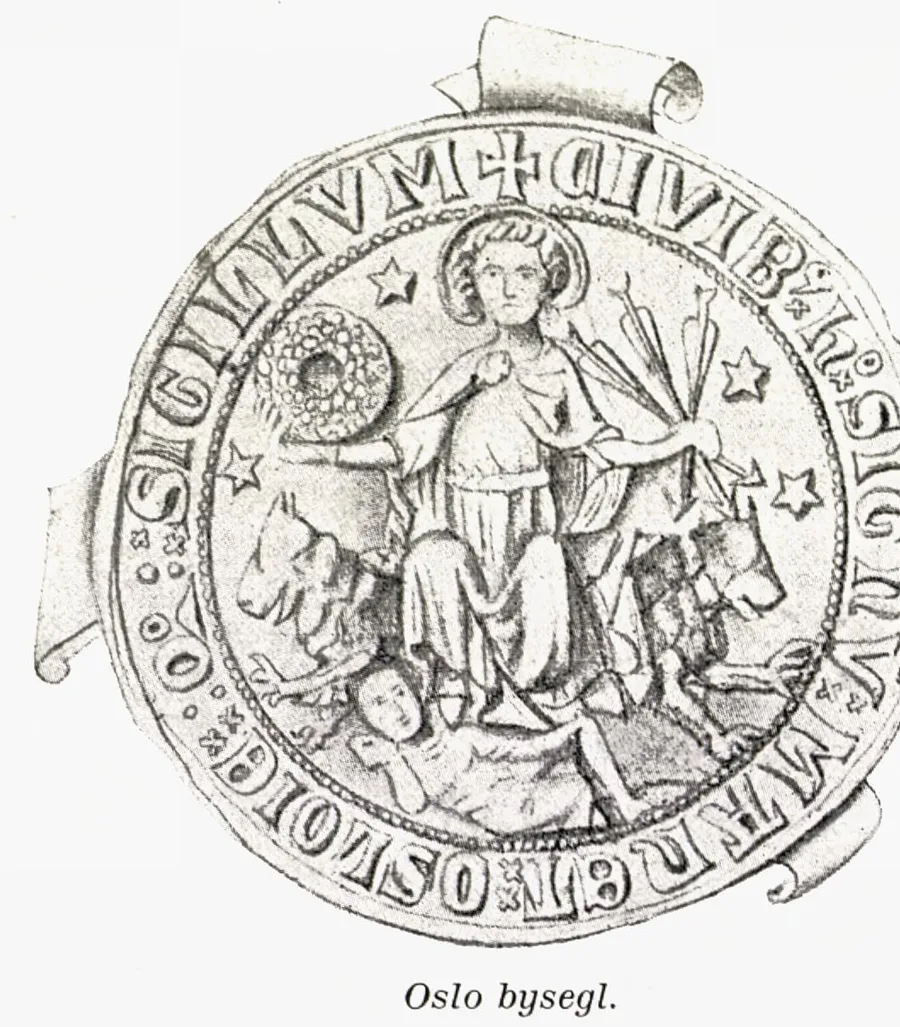 Oslo bysegl (medieval city seal, c. 1300), reproduced in Edvard Bull, Kristianias historie bd. 1 (1922) The city seal itself, in use from around 1300 — the earliest recorded image of Oslo's patron: Hallvard enthroned with the millstone and arrows of his martyrdom, the woman he died protecting at his feet. The same composition the modern city arms still carry. Patron saint of Oslo. By the medieval legend, Hallvard Vebjørnsson
was a young man of Vestfold, killed around 1043 while trying to
protect a pregnant woman from her pursuers. The killers tied a
millstone to his body and sank it in the fjord, but the body
rose back to the surface intact. His veneration was established
at Oslo shortly afterward, and Hallvard became the city's patron
saint. The medieval images of him — first recorded on the Oslo
city seal around 1300 — show him enthroned, the arrows of his
martyrdom in one hand and the millstone in the other, the woman
at his feet: the same image, saint with millstone and woman,
that is the modern Oslo coat of arms.
Also discussed in A Catholic Norway — the faith that gave the kingdom its first institutions and the stave churches at the Hallvardskirke in Oslo
Oslo bysegl (medieval city seal, c. 1300), reproduced in Edvard Bull, Kristianias historie bd. 1 (1922) The city seal itself, in use from around 1300 — the earliest recorded image of Oslo's patron: Hallvard enthroned with the millstone and arrows of his martyrdom, the woman he died protecting at his feet. The same composition the modern city arms still carry. Patron saint of Oslo. By the medieval legend, Hallvard Vebjørnsson
was a young man of Vestfold, killed around 1043 while trying to
protect a pregnant woman from her pursuers. The killers tied a
millstone to his body and sank it in the fjord, but the body
rose back to the surface intact. His veneration was established
at Oslo shortly afterward, and Hallvard became the city's patron
saint. The medieval images of him — first recorded on the Oslo
city seal around 1300 — show him enthroned, the arrows of his
martyrdom in one hand and the millstone in the other, the woman
at his feet: the same image, saint with millstone and woman,
that is the modern Oslo coat of arms.
Also discussed in A Catholic Norway — the faith that gave the kingdom its first institutions and the stave churches at the Hallvardskirke in Oslo 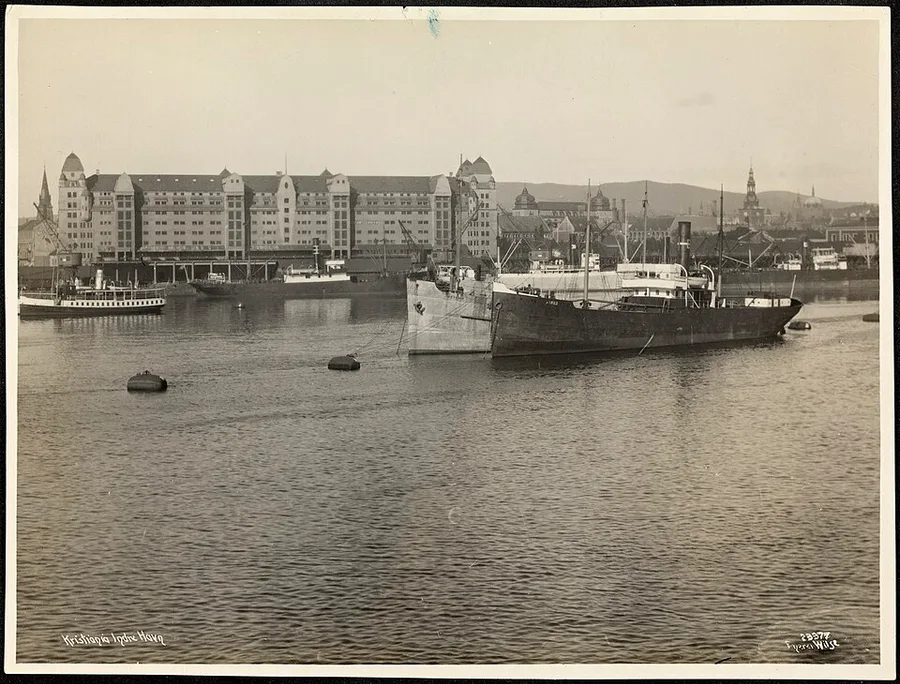 Anders Beer Wilse, Kristiania Indre Havn (1923), National Library of Norway Wilse's 1923 photograph of the inner harbor at Bjørvika, two years before Kristiania took back its old name Oslo — steamers at the quays beneath the spires of the city that grew from a medieval royal seat into Norway's capital. Capital of modern Norway, at the head of the Oslofjord on
the country's southeastern coast. Founded according to the
sagas by Harald Hardrada about 1049 and known through the
medieval period as a secondary royal seat behind Bergen and
Nidaros. Hákon V moved the royal residence permanently to
Oslo about 1300 and built Akershus Fortress to guard the
harbour. After a fire in 1624 the medieval town was
abandoned and Christian IV rebuilt the city to the west
under the new name Christiania (later Kristiania); the
name Oslo was restored in 1925. The original medieval
street pattern survives as the Gamlebyen district east of
the modern centre.
On the trip Days 1–2 belong to Oslo, with both groups together —
Roseslottet and the harbourside museums on Day 1, then the
Day-2 e-bike tour through Akershus Fortress, up Karl Johans
gate, and out to Vigeland Park.
Oslo Also discussed in The Long Fall — the sudden loss of Norwegian nobility, the end of the kings, and half of Norway gone foreverA Catholic Norway — the faith that gave the kingdom its first institutions and the stave churchesThe 400-Year Night — when the Northern Lion lay dormantLutheran Norway and Pietism — a farmer named Hans Nielsen Hauge and a lay revival that could not be silencedThe Constitution That Saved a Nation — five radical weeks at Eidsvoll, 1814800,000 Norwegians Leave — the century that built a Second NorwayThe Quiet Revolution — how Norway won its independence without a warWorld War II — the King’s “No” and the Nazis in NorwayAlcohol and Vinmonopolet — when and where to buy a drinkEveryday etiquette — quiet voices, wide space, no smiling🚨 Emergencies - important numbers, hospitals, and what you can doLanding in Norway — off the plane in Oslo, where to go, step by stepMoney — currency, cards, prices, and tipping was broken up and melted down. The reliquaries of the smaller saints across the country (the decorated containers that held their bones and other remains) shared the same fate — the silver and gold ones disappearing into the Danish royal accounts and the painted wood and bone ones either destroyed outright or hidden in private houses by Catholic-sympathetic farmers, to be rediscovered in much later centuries.
Anders Beer Wilse, Kristiania Indre Havn (1923), National Library of Norway Wilse's 1923 photograph of the inner harbor at Bjørvika, two years before Kristiania took back its old name Oslo — steamers at the quays beneath the spires of the city that grew from a medieval royal seat into Norway's capital. Capital of modern Norway, at the head of the Oslofjord on
the country's southeastern coast. Founded according to the
sagas by Harald Hardrada about 1049 and known through the
medieval period as a secondary royal seat behind Bergen and
Nidaros. Hákon V moved the royal residence permanently to
Oslo about 1300 and built Akershus Fortress to guard the
harbour. After a fire in 1624 the medieval town was
abandoned and Christian IV rebuilt the city to the west
under the new name Christiania (later Kristiania); the
name Oslo was restored in 1925. The original medieval
street pattern survives as the Gamlebyen district east of
the modern centre.
On the trip Days 1–2 belong to Oslo, with both groups together —
Roseslottet and the harbourside museums on Day 1, then the
Day-2 e-bike tour through Akershus Fortress, up Karl Johans
gate, and out to Vigeland Park.
Oslo Also discussed in The Long Fall — the sudden loss of Norwegian nobility, the end of the kings, and half of Norway gone foreverA Catholic Norway — the faith that gave the kingdom its first institutions and the stave churchesThe 400-Year Night — when the Northern Lion lay dormantLutheran Norway and Pietism — a farmer named Hans Nielsen Hauge and a lay revival that could not be silencedThe Constitution That Saved a Nation — five radical weeks at Eidsvoll, 1814800,000 Norwegians Leave — the century that built a Second NorwayThe Quiet Revolution — how Norway won its independence without a warWorld War II — the King’s “No” and the Nazis in NorwayAlcohol and Vinmonopolet — when and where to buy a drinkEveryday etiquette — quiet voices, wide space, no smiling🚨 Emergencies - important numbers, hospitals, and what you can doLanding in Norway — off the plane in Oslo, where to go, step by stepMoney — currency, cards, prices, and tipping was broken up and melted down. The reliquaries of the smaller saints across the country (the decorated containers that held their bones and other remains) shared the same fate — the silver and gold ones disappearing into the Danish royal accounts and the painted wood and bone ones either destroyed outright or hidden in private houses by Catholic-sympathetic farmers, to be rediscovered in much later centuries.
The pilgrim economy did not survive. The hostels along the Gudbrandsdalen 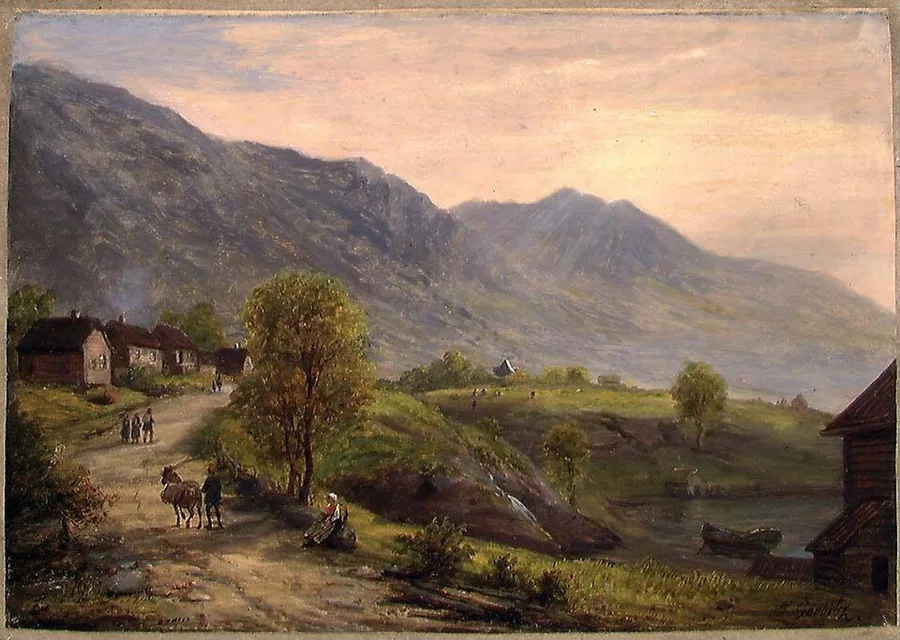 Johan Gørbitz, Fra Fåvang i Gudbrandsdalen (before 1858), National Museum of Art, Architecture and Design Johan Gørbitz's painting of travellers on the valley road at Fåvang. The Gudbrandsdalen was the central overland artery between Oslo and Trondheim, and the Gudbrandsdalsleden pilgrim road to Nidaros ran its length past stave churches like Lom. Long inland valley running about 230 kilometres northwest
through the central Norwegian highland from Lake Mjøsa toward
the Dovre mountain pass, the central traffic artery between
Oslo and Trondheim across both medieval and modern eras. The
Gudbrandsdalsleden pilgrim road to Nidaros runs along the
valley; Lom Stave Church and several other surviving stave
churches stand on its slopes; Lillehammer sits at its
southern entrance. The dialect spoken in the valley is one of
the most distinctive in modern Norwegian.
On the trip The Gråhårsklubben (the Oldsters) drive the length of the
Gudbrandsdalen twice — north up the E6 on Day 3, on the long
road from Oslo to Trondheim, and south again on Day 5 to the
reunion in Lillehammer, the town at the valley's southern
entrance.
Gudbrandsdalen Also discussed in A Catholic Norway — the faith that gave the kingdom its first institutions and the stave churchesThe Long Fall — the sudden loss of Norwegian nobility, the end of the kings, and half of Norway gone foreverStedssagn — local legends, told as warnings and the eastern Sweden route and the inland routes were no longer maintained, and the wayside crosses came down. The traffic to Nidaros, which had been substantial for four centuries — running at perhaps a few thousand pilgrims a year in normal seasons — fell off sharply after the Reformation and faded over the following generation. It did not resume in any organised form for the next four hundred and sixty years. The Olsok
Johan Gørbitz, Fra Fåvang i Gudbrandsdalen (before 1858), National Museum of Art, Architecture and Design Johan Gørbitz's painting of travellers on the valley road at Fåvang. The Gudbrandsdalen was the central overland artery between Oslo and Trondheim, and the Gudbrandsdalsleden pilgrim road to Nidaros ran its length past stave churches like Lom. Long inland valley running about 230 kilometres northwest
through the central Norwegian highland from Lake Mjøsa toward
the Dovre mountain pass, the central traffic artery between
Oslo and Trondheim across both medieval and modern eras. The
Gudbrandsdalsleden pilgrim road to Nidaros runs along the
valley; Lom Stave Church and several other surviving stave
churches stand on its slopes; Lillehammer sits at its
southern entrance. The dialect spoken in the valley is one of
the most distinctive in modern Norwegian.
On the trip The Gråhårsklubben (the Oldsters) drive the length of the
Gudbrandsdalen twice — north up the E6 on Day 3, on the long
road from Oslo to Trondheim, and south again on Day 5 to the
reunion in Lillehammer, the town at the valley's southern
entrance.
Gudbrandsdalen Also discussed in A Catholic Norway — the faith that gave the kingdom its first institutions and the stave churchesThe Long Fall — the sudden loss of Norwegian nobility, the end of the kings, and half of Norway gone foreverStedssagn — local legends, told as warnings and the eastern Sweden route and the inland routes were no longer maintained, and the wayside crosses came down. The traffic to Nidaros, which had been substantial for four centuries — running at perhaps a few thousand pilgrims a year in normal seasons — fell off sharply after the Reformation and faded over the following generation. It did not resume in any organised form for the next four hundred and sixty years. The Olsok 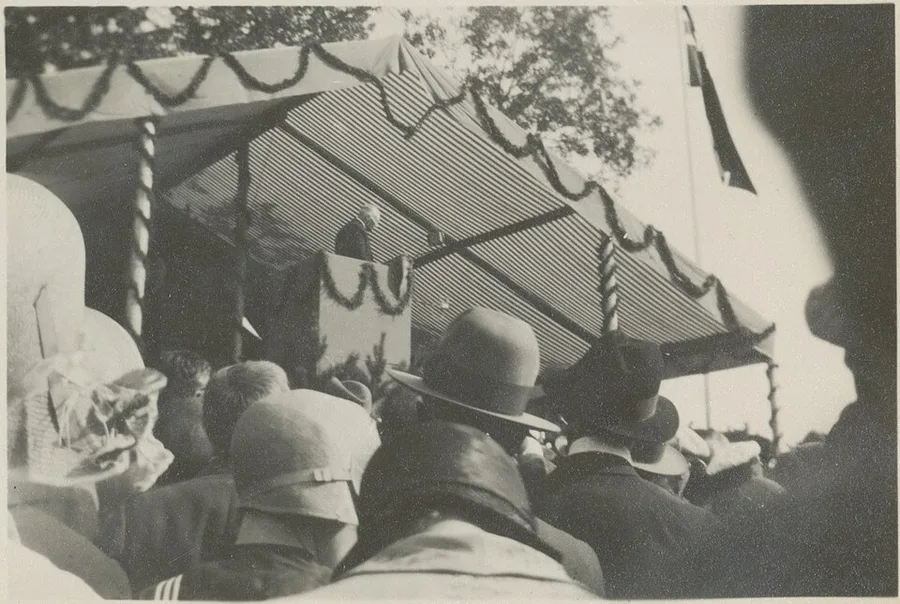 Åsen Museum og Historielag (1930), CC BY 2.0 The downgraded feast as pure folk observance — a crowd, a speaker, a flag, and no liturgy anywhere in frame — photographed at Stiklestad four centuries after 1537 stripped the religious content from the day. The feast day of Saint Olav — Olav's wake, observed on 29 July,
the anniversary of the king's death at Stiklestad in 1030. Across
the medieval period Olsok was the great summer holiday of the
Norse Atlantic, kept across Norway, Iceland, the Faroes, Greenland,
and the Norse colonies of the British Isles. The Reformation
stripped the religious content from the Norwegian observance after
1537, but the day persisted as a folk holiday and was made the
national flag-day of Norway in 1948. Today Olsok centres on the
Stiklestad commemoration, with the open-air Spelet om Heilag
Olav drawing audiences in the tens of thousands.
On the trip Day 4 of the trip is olsok itself — 29 July. The Gråhårsklubben (the Oldsters) spend it in the Stjørdal heritage country and return to Trondheim for the night, with the Olavsfest filling the city around the cathedral. Also discussed in The King Who Became a Saint — how the Nordmen came to ChristA Catholic Norway — the faith that gave the kingdom its first institutions and the stave churchesTradisjoner — celebrations across the Norwegian year feast day on the twenty-ninth of July, the formal commemoration of Saint Olav’s death, was downgraded from a major liturgical day to a local folk holiday with the religious content stripped out.
Åsen Museum og Historielag (1930), CC BY 2.0 The downgraded feast as pure folk observance — a crowd, a speaker, a flag, and no liturgy anywhere in frame — photographed at Stiklestad four centuries after 1537 stripped the religious content from the day. The feast day of Saint Olav — Olav's wake, observed on 29 July,
the anniversary of the king's death at Stiklestad in 1030. Across
the medieval period Olsok was the great summer holiday of the
Norse Atlantic, kept across Norway, Iceland, the Faroes, Greenland,
and the Norse colonies of the British Isles. The Reformation
stripped the religious content from the Norwegian observance after
1537, but the day persisted as a folk holiday and was made the
national flag-day of Norway in 1948. Today Olsok centres on the
Stiklestad commemoration, with the open-air Spelet om Heilag
Olav drawing audiences in the tens of thousands.
On the trip Day 4 of the trip is olsok itself — 29 July. The Gråhårsklubben (the Oldsters) spend it in the Stjørdal heritage country and return to Trondheim for the night, with the Olavsfest filling the city around the cathedral. Also discussed in The King Who Became a Saint — how the Nordmen came to ChristA Catholic Norway — the faith that gave the kingdom its first institutions and the stave churchesTradisjoner — celebrations across the Norwegian year feast day on the twenty-ninth of July, the formal commemoration of Saint Olav’s death, was downgraded from a major liturgical day to a local folk holiday with the religious content stripped out.
What survived
What survived was the church buildings themselves. Almost every Catholic church standing in Norway in 1537 continued in use under the new Lutheran establishment — partly because the country had too little stone and too little capital to rebuild from scratch, and partly because Lutheran practice, unlike the Reformed traditions that emerged elsewhere in Europe, did not demand the stripping of the visual and ceremonial inheritance from its newly Lutheran churches. Nidaros Cathedral itself, despite the destruction of the shrine and the breaking of the surrounding Catholic infrastructure, remained the principal church of central Norway and was used continuously under the Lutheran name. The stave churches in the rural districts were kept in service by the same congregations who had used them before the Reformation.
Much of the Catholic-era art survived in place rather than only in hiding. Crucifixes, altarpieces, statues of saints, and painted ceilings remained in their original churches under Lutheran reuse — some removed or whitewashed over and rediscovered in later centuries, but a great deal kept on view through the four hundred years that followed. The painted ceiling at Torpo Stave Church 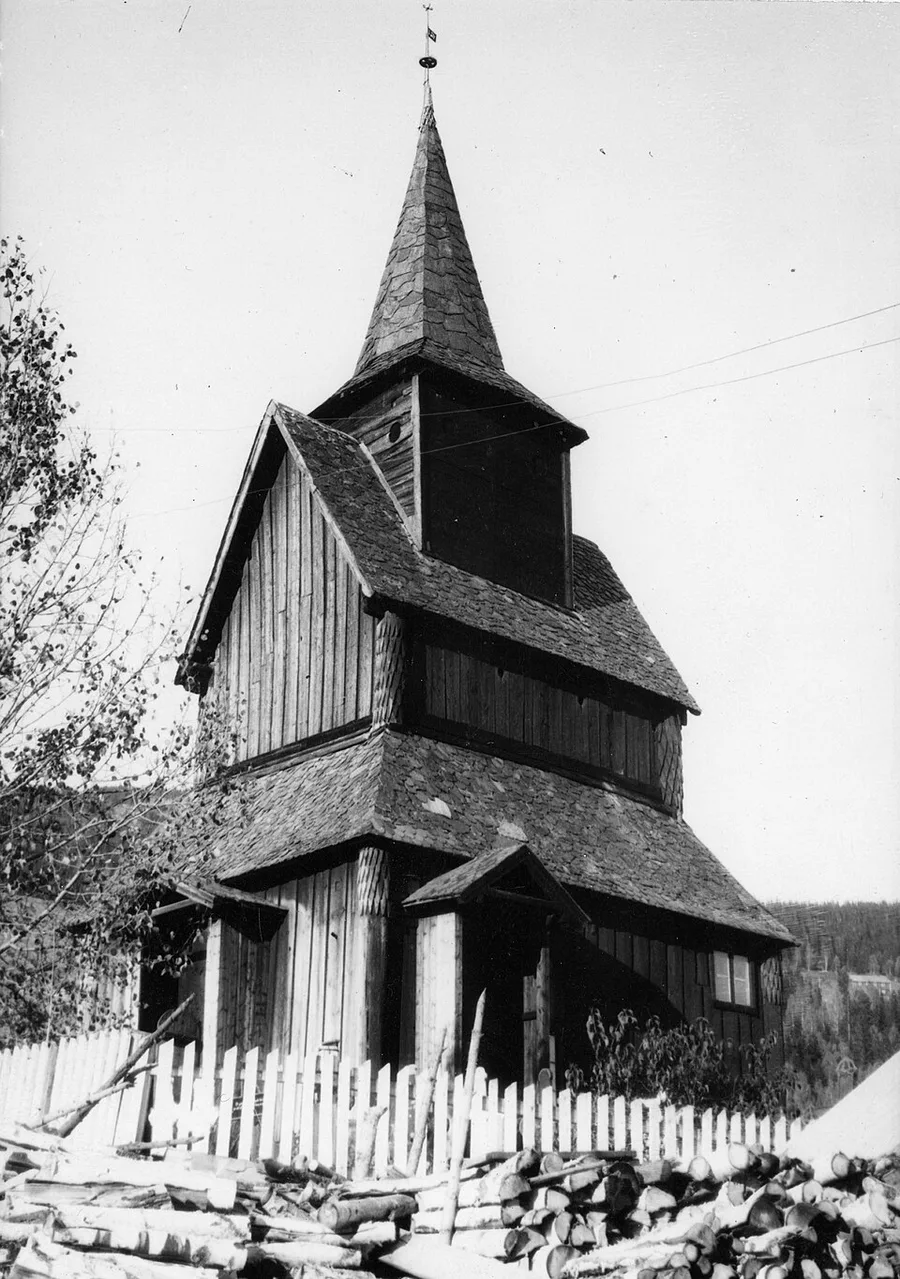 Domenico Erdmann, Torpo stave church from the southwest (early 1900s), Riksantikvaren Torpo stave church itself, photographed from the southwest by Riksantikvaren conservator Domenico Erdmann in the early 1900s — the c. 1192 building whose chancel canopy still holds the painted medieval ceiling that survived the Reformation hidden under whitewash. Stave church at Torpo in Hallingdal, central southern Norway,
built about 1192 — among the oldest surviving stave churches.
The principal claim to attention is the painted ceiling
inside the chancel canopy, dating from around 1250: a series
of medieval Catholic scenes including the legend of Saint
Margaret and the dragon, executed in the standard medieval
Norwegian church-painting palette of red lead, white lead,
and green earth. The ceiling survived the Reformation in
place, was hidden behind whitewash for centuries, and was
rediscovered and restored in the late nineteenth century.
One of the most important surviving examples of Catholic-era
Norwegian church art preserved within its original setting.
in Hallingdal and the mid-thirteenth-century Madonna of Hedalen stave church in Valdres are well-known examples of Catholic-era objects that survived in or near their original churches through the long Lutheran period. The larger destructive forces on Norwegian medieval church art were the centuries that followed, not 1537 itself: Baroque-era refurbishment in the seventeenth and eighteenth centuries, the great fires that destroyed many of the original buildings, and the simple neglect of small parish churches in poor districts.
Domenico Erdmann, Torpo stave church from the southwest (early 1900s), Riksantikvaren Torpo stave church itself, photographed from the southwest by Riksantikvaren conservator Domenico Erdmann in the early 1900s — the c. 1192 building whose chancel canopy still holds the painted medieval ceiling that survived the Reformation hidden under whitewash. Stave church at Torpo in Hallingdal, central southern Norway,
built about 1192 — among the oldest surviving stave churches.
The principal claim to attention is the painted ceiling
inside the chancel canopy, dating from around 1250: a series
of medieval Catholic scenes including the legend of Saint
Margaret and the dragon, executed in the standard medieval
Norwegian church-painting palette of red lead, white lead,
and green earth. The ceiling survived the Reformation in
place, was hidden behind whitewash for centuries, and was
rediscovered and restored in the late nineteenth century.
One of the most important surviving examples of Catholic-era
Norwegian church art preserved within its original setting.
in Hallingdal and the mid-thirteenth-century Madonna of Hedalen stave church in Valdres are well-known examples of Catholic-era objects that survived in or near their original churches through the long Lutheran period. The larger destructive forces on Norwegian medieval church art were the centuries that followed, not 1537 itself: Baroque-era refurbishment in the seventeenth and eighteenth centuries, the great fires that destroyed many of the original buildings, and the simple neglect of small parish churches in poor districts.
A Danish state church
What emerged from 1537 was not a new institution but a captured one. The Norwegian church continued physically — the same buildings, much of the same clergy, congregations gathering as they always had — while its administrative life was transferred wholesale to the Danish crown. From 1537 on, the church was a branch of the state, administered by Danish-appointed superintendents, financed through royal taxation, staffed by clergy who were royal civil servants under the Church Ordinance issued in Copenhagen. The pastor in every Norwegian parish was a state official whose appointment was approved by the king. The parish records were state records. The bishops, when they were eventually appointed in Norway, were typically Danish-born or Danish-trained Norwegians. The institution of Den norske kirke  Church of Norway official coat of arms (kirken.no) The modern emblem of the institution the Kirkeordinansen of 1537 created: a gold cross over the two silver axes of Saint Olav on a red shield — the royal-Lutheran continuity the ordinance built when it made the church a state institution under the crown. The Church of Norway — the Lutheran state church
established by the Kirkeordinansen of 1537 as the religious
arm of the Danish-Norwegian crown. From 1537 every
Norwegian parish was administered by a state-appointed
Lutheran pastor financed through royal taxation; the
bishops (initially called superintendents) were appointed
by the king and their offices were branches of the royal
government. The arrangement operated essentially unchanged
for four hundred and eighty years through Danish rule, the
1814 constitutional transition, and the personal union with
Sweden, into the modern Norwegian state. A 2012
constitutional amendment ended the state religion, and on
1 January 2017 the church became a separate legal entity —
no longer the state church, still the national folk
church.
Also discussed in Lutheran Norway and Pietism — a farmer named Hans Nielsen Hauge and a lay revival that could not be silencedWorld War II — the King’s “No” and the Nazis in NorwayStatskirken — the state church and what's left of it — the Church of Norway — emerged from 1537 as an arm of the Danish royal government and operated in that form for the next four hundred and eighty years. The 2017 disestablishment, in which the Church of Norway was formally separated from the Norwegian state, was the end of an arrangement that 1537 began.
Church of Norway official coat of arms (kirken.no) The modern emblem of the institution the Kirkeordinansen of 1537 created: a gold cross over the two silver axes of Saint Olav on a red shield — the royal-Lutheran continuity the ordinance built when it made the church a state institution under the crown. The Church of Norway — the Lutheran state church
established by the Kirkeordinansen of 1537 as the religious
arm of the Danish-Norwegian crown. From 1537 every
Norwegian parish was administered by a state-appointed
Lutheran pastor financed through royal taxation; the
bishops (initially called superintendents) were appointed
by the king and their offices were branches of the royal
government. The arrangement operated essentially unchanged
for four hundred and eighty years through Danish rule, the
1814 constitutional transition, and the personal union with
Sweden, into the modern Norwegian state. A 2012
constitutional amendment ended the state religion, and on
1 January 2017 the church became a separate legal entity —
no longer the state church, still the national folk
church.
Also discussed in Lutheran Norway and Pietism — a farmer named Hans Nielsen Hauge and a lay revival that could not be silencedWorld War II — the King’s “No” and the Nazis in NorwayStatskirken — the state church and what's left of it — the Church of Norway — emerged from 1537 as an arm of the Danish royal government and operated in that form for the next four hundred and eighty years. The 2017 disestablishment, in which the Church of Norway was formally separated from the Norwegian state, was the end of an arrangement that 1537 began.
The single most durable consequence of 1537 was the linguistic one. The new Lutheran establishment conducted everything in Danish — the liturgy, the catechism, the Bible (Christian III commissioned the standard Danish translation in 1550), the sermon from every pulpit, the schoolroom catechism class. Spoken Norwegian survived in the rural districts, in the kitchen and the boat-shed and the harvest field, but the written register collapsed. Across the next three centuries, Danish became the only available written form for any literate Norwegian, and the long shadow it cast over the Norwegian language was not lifted until Ivar Aasen 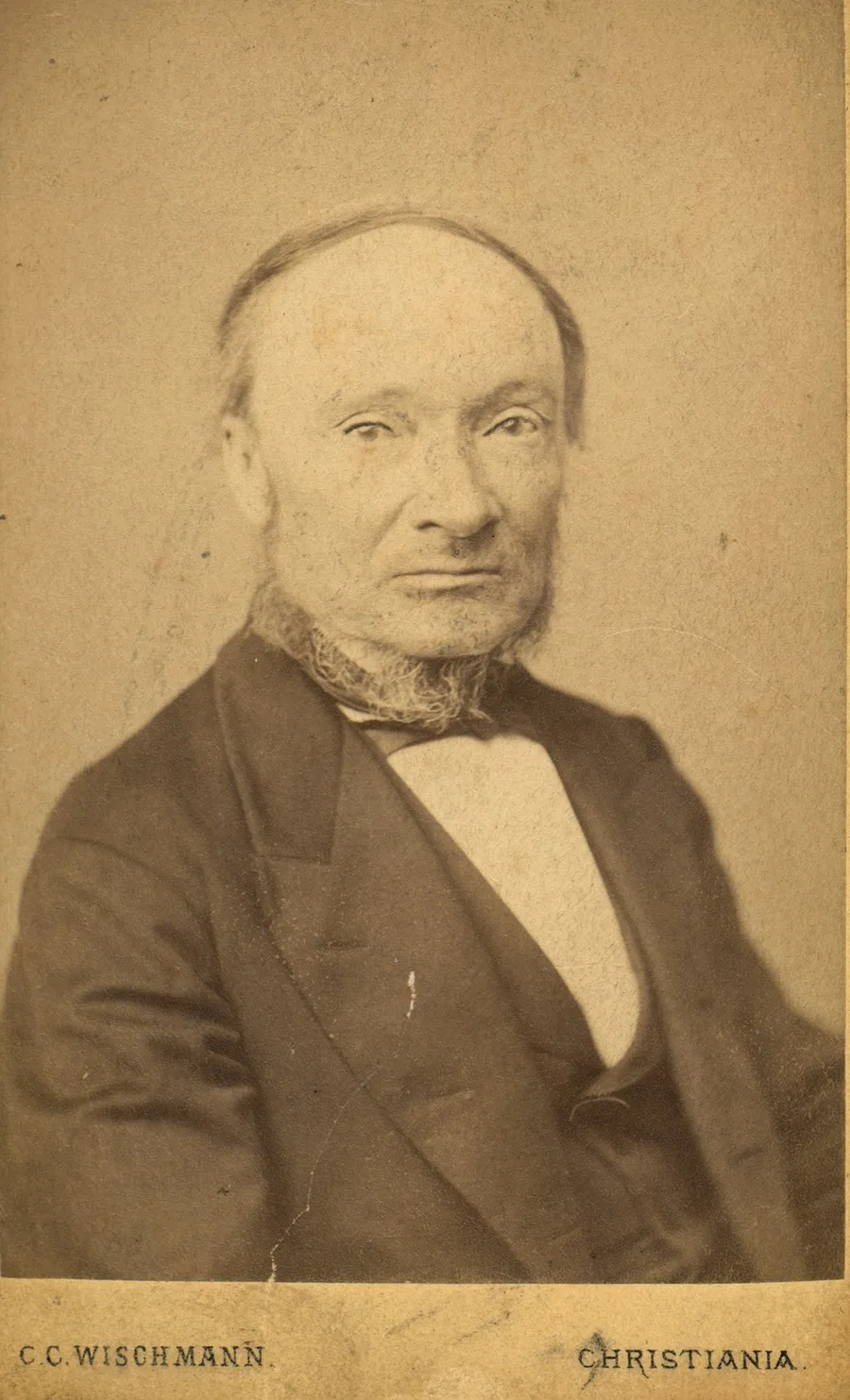 Carl Christian Wischmann, photograph of Ivar Aasen (1871), Ivar Aasen-tunet / Digitalt Museum, CC BY-SA 3.0 This 1871 studio photograph by C. C. Wischmann is the standard portrait of Ivar Aasen, the philologist who reconstructed a written Norwegian language, Landsmål (later Nynorsk), from dialects that survived three centuries of Danish written hegemony. Norwegian philologist, lexicographer, and poet (1813–1896),
born to a smallholding farm family at Ørsta in Sunnmøre on
the western coast. Self-taught — never attended university —
he spent the 1840s and 1850s walking through the rural
districts of southern and western Norway collecting the
dialects that had survived three centuries of Danish written
hegemony. From the surviving spoken Norwegian forms he
reconstructed a written language he called Landsmål —
country-language — later renamed Nynorsk. His major
works are the Det norske Folkesprogs Grammatik (1848) and
Ordbog over det norske Folkesprog (1850), with revised
editions in the 1860s. The two written Norwegian standards
Bokmål and Nynorsk that share the country today are the
direct outcome of his recovery.
Also discussed in The 400-Year Night — when the Northern Lion lay dormantLutheran Norway and Pietism — a farmer named Hans Nielsen Hauge and a lay revival that could not be silencedWorld War II — the King’s “No” and the Nazis in Norway reconstructed a written Norwegian from the rural dialects in the 1840s and 1850s. The church was the mechanism: the pulpit was the unifying literate institution in every Norwegian community, and what the pulpit spoke was Danish.
Carl Christian Wischmann, photograph of Ivar Aasen (1871), Ivar Aasen-tunet / Digitalt Museum, CC BY-SA 3.0 This 1871 studio photograph by C. C. Wischmann is the standard portrait of Ivar Aasen, the philologist who reconstructed a written Norwegian language, Landsmål (later Nynorsk), from dialects that survived three centuries of Danish written hegemony. Norwegian philologist, lexicographer, and poet (1813–1896),
born to a smallholding farm family at Ørsta in Sunnmøre on
the western coast. Self-taught — never attended university —
he spent the 1840s and 1850s walking through the rural
districts of southern and western Norway collecting the
dialects that had survived three centuries of Danish written
hegemony. From the surviving spoken Norwegian forms he
reconstructed a written language he called Landsmål —
country-language — later renamed Nynorsk. His major
works are the Det norske Folkesprogs Grammatik (1848) and
Ordbog over det norske Folkesprog (1850), with revised
editions in the 1860s. The two written Norwegian standards
Bokmål and Nynorsk that share the country today are the
direct outcome of his recovery.
Also discussed in The 400-Year Night — when the Northern Lion lay dormantLutheran Norway and Pietism — a farmer named Hans Nielsen Hauge and a lay revival that could not be silencedWorld War II — the King’s “No” and the Nazis in Norway reconstructed a written Norwegian from the rural dialects in the 1840s and 1850s. The church was the mechanism: the pulpit was the unifying literate institution in every Norwegian community, and what the pulpit spoke was Danish.
Why Norway, alone among the major Reformation territories, produced no popular religious movement to drive the change from below has a structural answer. The country had been demographically broken by the Black Death and had not recovered its pre-plague population. It had lost its independent statehood a century and a half earlier. It had no university (the Royal Frederik University would not be founded until 1811), no printing press of its own (the first Norwegian press would not appear until 1643), and no Norwegian-language urban merchant class to carry new ideas. The Hanseatic community at Bergen had Lutheran preaching from the 1520s, but it operated in German and stayed inside its own German-speaking institutions. The other Reformation territories — Saxony 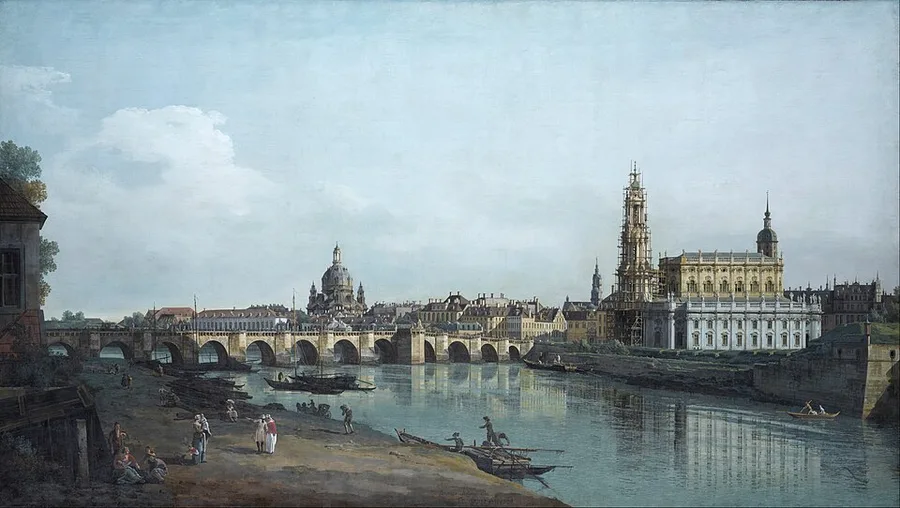 Bernardo Bellotto, Dresden seen from the Right Bank of the Elbe (1748), Gemäldegalerie Alte Meister, Dresden Bellotto's view of Dresden on the Elbe, electoral Saxony's residence city, painted in 1748. This is the territory whose electors — Frederick the Wise foremost — sheltered Luther and made Saxony the launching ground of the Reformation that later reached Norway. Imperial duchy and later electorate in central Germany,
centred on the Elbe valley. The electoral Saxony of the
early sixteenth century — Wittenberg, Leipzig, the silver-
mining Erzgebirge — was the heartland of the German
Reformation. Elector Frederick the Wise (r. 1486–1525)
founded the University of Wittenberg in 1502, protected
Luther from imperial arrest after the Diet of Worms by
sheltering him at the Wartburg, and refused to enforce the
papal bull of excommunication. His brother and successor
John the Steadfast formally introduced Lutheran reform in
the Saxon electorate in 1527 — the first imperial territory
to make the official confessional change. The Schmalkaldic
League and the eventual cuius regio, eius religio
settlement of 1555 carried the principle into European law.
, Brandenburg, Württemberg, the Hanseatic Baltic cities, eventually Sweden — all had at least some of the infrastructure for indigenous reform. Norway had none. What was politically possible elsewhere was, in Norway, not possible at all.
Bernardo Bellotto, Dresden seen from the Right Bank of the Elbe (1748), Gemäldegalerie Alte Meister, Dresden Bellotto's view of Dresden on the Elbe, electoral Saxony's residence city, painted in 1748. This is the territory whose electors — Frederick the Wise foremost — sheltered Luther and made Saxony the launching ground of the Reformation that later reached Norway. Imperial duchy and later electorate in central Germany,
centred on the Elbe valley. The electoral Saxony of the
early sixteenth century — Wittenberg, Leipzig, the silver-
mining Erzgebirge — was the heartland of the German
Reformation. Elector Frederick the Wise (r. 1486–1525)
founded the University of Wittenberg in 1502, protected
Luther from imperial arrest after the Diet of Worms by
sheltering him at the Wartburg, and refused to enforce the
papal bull of excommunication. His brother and successor
John the Steadfast formally introduced Lutheran reform in
the Saxon electorate in 1527 — the first imperial territory
to make the official confessional change. The Schmalkaldic
League and the eventual cuius regio, eius religio
settlement of 1555 carried the principle into European law.
, Brandenburg, Württemberg, the Hanseatic Baltic cities, eventually Sweden — all had at least some of the infrastructure for indigenous reform. Norway had none. What was politically possible elsewhere was, in Norway, not possible at all.
The country accepted the new religion without popular resistance and without confessional martyrdoms. The archbishop’s faction had resisted with arms — Engelbrektsson’s brief campaign, the killing of the realm councillor Vincens Lunge  Anders Thiset, arms of the Dyre family, Danmarks Adels Aarbog, 1891 No contemporary portrait of Vincens Lunge survives. These are the arms of the Dyre family, the Danish noble house he was born into — his branch carried the Lunge name from a maternal line while bearing the Dyre arms. Danish-Norwegian magnate and realm-councillor (c. 1483–
1536), the most powerful Danish noble in Norway in the
decade before the Reformation. As royal stadtholder
(governor) of Bergenhus from 1523 he ran the western half
of Norway on behalf of the Danish crown, becoming the chief
political rival of Archbishop Olav Engelbrektsson. Allied
with Christian III's faction in the Count's Feud. Killed on
3 January 1536 at the archbishop's banquet table in
Nidaros, in what was widely understood as Engelbrektsson's
coordinated strike against Christian III's local agents
before the king's forces could reach Trøndelag. His death
was one of the precipitating events of the Norwegian
Reformation crisis; Engelbrektsson's brief campaign and
flight followed within the year.
in Nidaros on the third of January 1536, the death of the last Catholic Bishop of Hamar
Anders Thiset, arms of the Dyre family, Danmarks Adels Aarbog, 1891 No contemporary portrait of Vincens Lunge survives. These are the arms of the Dyre family, the Danish noble house he was born into — his branch carried the Lunge name from a maternal line while bearing the Dyre arms. Danish-Norwegian magnate and realm-councillor (c. 1483–
1536), the most powerful Danish noble in Norway in the
decade before the Reformation. As royal stadtholder
(governor) of Bergenhus from 1523 he ran the western half
of Norway on behalf of the Danish crown, becoming the chief
political rival of Archbishop Olav Engelbrektsson. Allied
with Christian III's faction in the Count's Feud. Killed on
3 January 1536 at the archbishop's banquet table in
Nidaros, in what was widely understood as Engelbrektsson's
coordinated strike against Christian III's local agents
before the king's forces could reach Trøndelag. His death
was one of the precipitating events of the Norwegian
Reformation crisis; Engelbrektsson's brief campaign and
flight followed within the year.
in Nidaros on the third of January 1536, the death of the last Catholic Bishop of Hamar 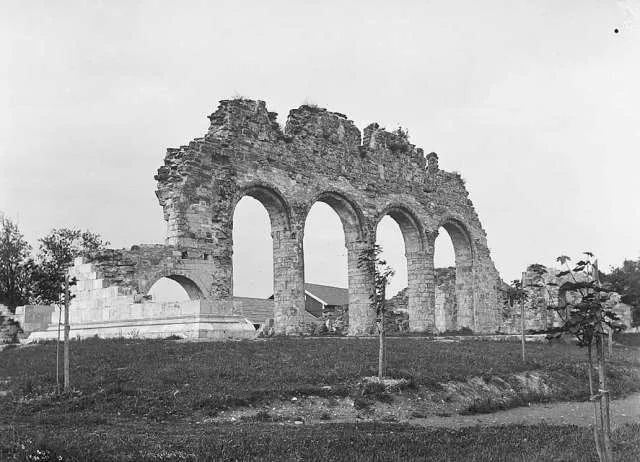 Axel Lindahl, the cathedral ruins in Hamar (c. 1880-1890), Norwegian Museum of Cultural History Hamar's medieval cathedral, seat of the diocese Nicholas Breakspear established in 1152, stood until Swedish forces burned it in 1567; this 1880s photograph shows the roofless nave arches before the ruins were enclosed under their present protective canopy. City on the western shore of Lake Mjøsa in the inland east of
Norway. Founded as a market town and episcopal seat by the papal
legate Nicholas Breakspear in 1152, when it was also made one of
the four Norwegian suffragan dioceses of the new Nidaros
archdiocese. The medieval cathedral was destroyed by Swedish
forces in 1567; the surviving ruins on the Hamar peninsula are
preserved under a protective glass-and-steel canopy. The modern
city has around thirty thousand people and is the seat of the
Eidsivating Court of Appeal — the inheritance of the medieval
inland law-tradition.
Hamar Also discussed in A Catholic Norway — the faith that gave the kingdom its first institutions and the stave churchesThe 400-Year Night — when the Northern Lion lay dormant in Danish prison some years afterward — but no organised lay movement either welcomed the Reformation or opposed it doctrinally. There were no Norwegian theological treatises of either party, no popular religious tracts, no martyrs of the faith on either side. The Norwegian peasant changed denomination because the king had ordered it. The personal dimension of faith — the conscious adoption of a religion as a matter of individual conviction — was largely absent from the Norwegian experience of the Reformation. That dimension would begin to return in the 1730s through state Pietism: King Christian VI of Denmark-Norway
Axel Lindahl, the cathedral ruins in Hamar (c. 1880-1890), Norwegian Museum of Cultural History Hamar's medieval cathedral, seat of the diocese Nicholas Breakspear established in 1152, stood until Swedish forces burned it in 1567; this 1880s photograph shows the roofless nave arches before the ruins were enclosed under their present protective canopy. City on the western shore of Lake Mjøsa in the inland east of
Norway. Founded as a market town and episcopal seat by the papal
legate Nicholas Breakspear in 1152, when it was also made one of
the four Norwegian suffragan dioceses of the new Nidaros
archdiocese. The medieval cathedral was destroyed by Swedish
forces in 1567; the surviving ruins on the Hamar peninsula are
preserved under a protective glass-and-steel canopy. The modern
city has around thirty thousand people and is the seat of the
Eidsivating Court of Appeal — the inheritance of the medieval
inland law-tradition.
Hamar Also discussed in A Catholic Norway — the faith that gave the kingdom its first institutions and the stave churchesThe 400-Year Night — when the Northern Lion lay dormant in Danish prison some years afterward — but no organised lay movement either welcomed the Reformation or opposed it doctrinally. There were no Norwegian theological treatises of either party, no popular religious tracts, no martyrs of the faith on either side. The Norwegian peasant changed denomination because the king had ordered it. The personal dimension of faith — the conscious adoption of a religion as a matter of individual conviction — was largely absent from the Norwegian experience of the Reformation. That dimension would begin to return in the 1730s through state Pietism: King Christian VI of Denmark-Norway 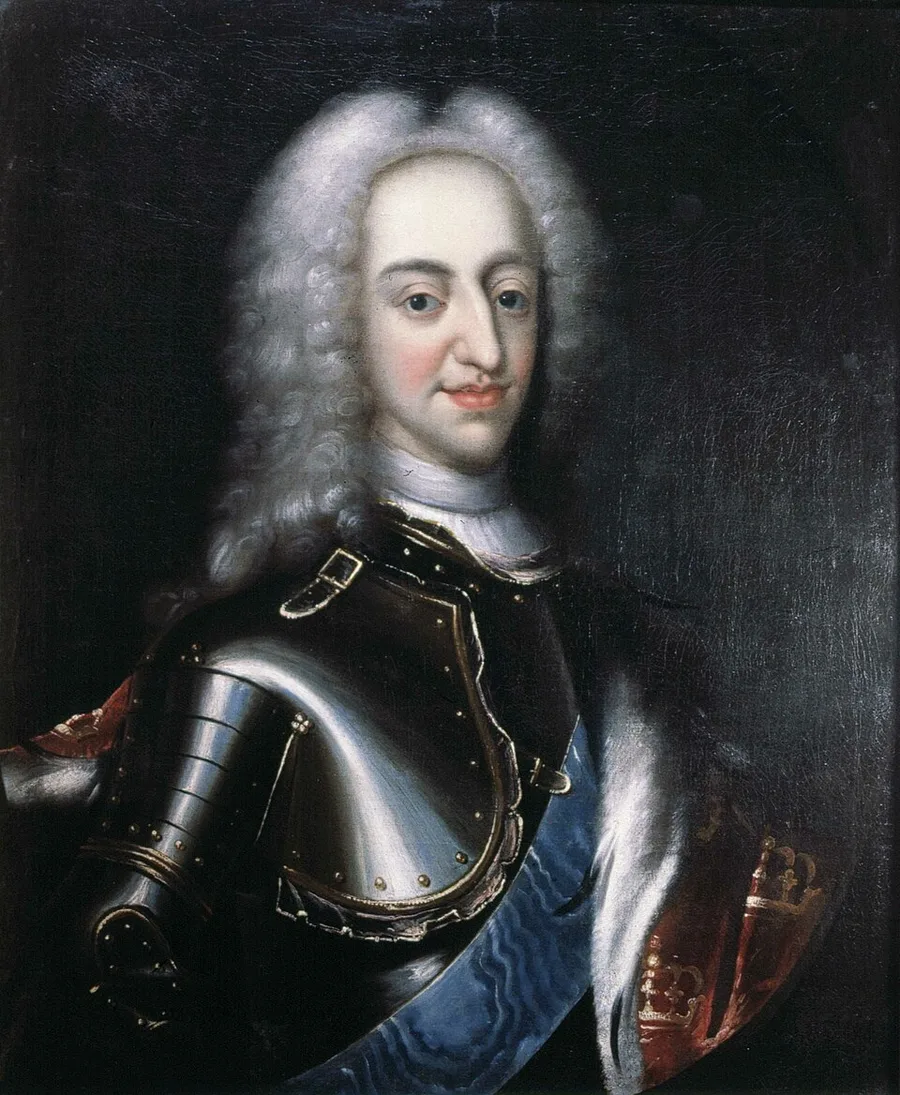 Anonymous, Portrait of Christian VI of Denmark (c. 1730-1740), Oslo Museum Christian VI, the Pietist king who made Lutheran confirmation compulsory nationwide in his 1736 decree, reshaping how ordinary Norwegians experienced faith two centuries after the Reformation was first imposed from above. King of Denmark and Norway (1699–1746), reigned 1730–1746.
A deeply Pietist king whose reign reshaped the religious
life of his realms in the direction of personal interior
faith — the second great transformation of Scandinavian
Lutheranism after Christian III's 1537 imposition. He made
Sunday church attendance compulsory in 1735, introduced
compulsory Lutheran confirmation in January 1736 (the
Konfirmasjonsforordningen), and supported the publication
of Erik Pontoppidan's Sandhed til Gudfrygtighed in 1737
as the standard Lutheran catechism for both halves of the
kingdom. Revived royal backing for the Greenland mission,
established the Latin school system in Norway, and ordered the deepest set
of religious-instruction reforms in eighteenth-century
Scandinavia.
Also discussed in Lutheran Norway and Pietism — a farmer named Hans Nielsen Hauge and a lay revival that could not be silenced introduced Konfirmasjonsforordningen 1736
Anonymous, Portrait of Christian VI of Denmark (c. 1730-1740), Oslo Museum Christian VI, the Pietist king who made Lutheran confirmation compulsory nationwide in his 1736 decree, reshaping how ordinary Norwegians experienced faith two centuries after the Reformation was first imposed from above. King of Denmark and Norway (1699–1746), reigned 1730–1746.
A deeply Pietist king whose reign reshaped the religious
life of his realms in the direction of personal interior
faith — the second great transformation of Scandinavian
Lutheranism after Christian III's 1537 imposition. He made
Sunday church attendance compulsory in 1735, introduced
compulsory Lutheran confirmation in January 1736 (the
Konfirmasjonsforordningen), and supported the publication
of Erik Pontoppidan's Sandhed til Gudfrygtighed in 1737
as the standard Lutheran catechism for both halves of the
kingdom. Revived royal backing for the Greenland mission,
established the Latin school system in Norway, and ordered the deepest set
of religious-instruction reforms in eighteenth-century
Scandinavia.
Also discussed in Lutheran Norway and Pietism — a farmer named Hans Nielsen Hauge and a lay revival that could not be silenced introduced Konfirmasjonsforordningen 1736  Adolph Tidemand, Anmeldelse til konfirmasjon (1846), Nasjonalmuseet Tidemand's 1846 painting shows a mother registering her son with the parish pastor ahead of the oral confirmation examination the 1736 ordinance required of every fourteen- or fifteen-year-old in Denmark-Norway. The Confirmation Decree of 1736 — the royal ordinance of
Christian VI of Denmark-Norway, dated 13 January 1736,
making Lutheran confirmation compulsory for every subject
of his kingdoms at fourteen or fifteen years old. The
ordinance specified the doctrinal instruction (Pontoppidan's
catechism, which followed in 1737), the public oral
examination by the parish pastor, and the civil
consequences of refusal — no marriage, no military service,
no apprenticeship, no inheritance, no work outside the
parish — for any adult who had not been confirmed. The
decree marked the institutional return of personal interior
faith to Danish-Norwegian Lutheran practice, two centuries
after the imposed Reformation, and shaped Scandinavian
religious culture for the next two centuries.
Also discussed in Lutheran Norway and Pietism — a farmer named Hans Nielsen Hauge and a lay revival that could not be silenced , and Erik Pontoppidan
Adolph Tidemand, Anmeldelse til konfirmasjon (1846), Nasjonalmuseet Tidemand's 1846 painting shows a mother registering her son with the parish pastor ahead of the oral confirmation examination the 1736 ordinance required of every fourteen- or fifteen-year-old in Denmark-Norway. The Confirmation Decree of 1736 — the royal ordinance of
Christian VI of Denmark-Norway, dated 13 January 1736,
making Lutheran confirmation compulsory for every subject
of his kingdoms at fourteen or fifteen years old. The
ordinance specified the doctrinal instruction (Pontoppidan's
catechism, which followed in 1737), the public oral
examination by the parish pastor, and the civil
consequences of refusal — no marriage, no military service,
no apprenticeship, no inheritance, no work outside the
parish — for any adult who had not been confirmed. The
decree marked the institutional return of personal interior
faith to Danish-Norwegian Lutheran practice, two centuries
after the imposed Reformation, and shaped Scandinavian
religious culture for the next two centuries.
Also discussed in Lutheran Norway and Pietism — a farmer named Hans Nielsen Hauge and a lay revival that could not be silenced , and Erik Pontoppidan 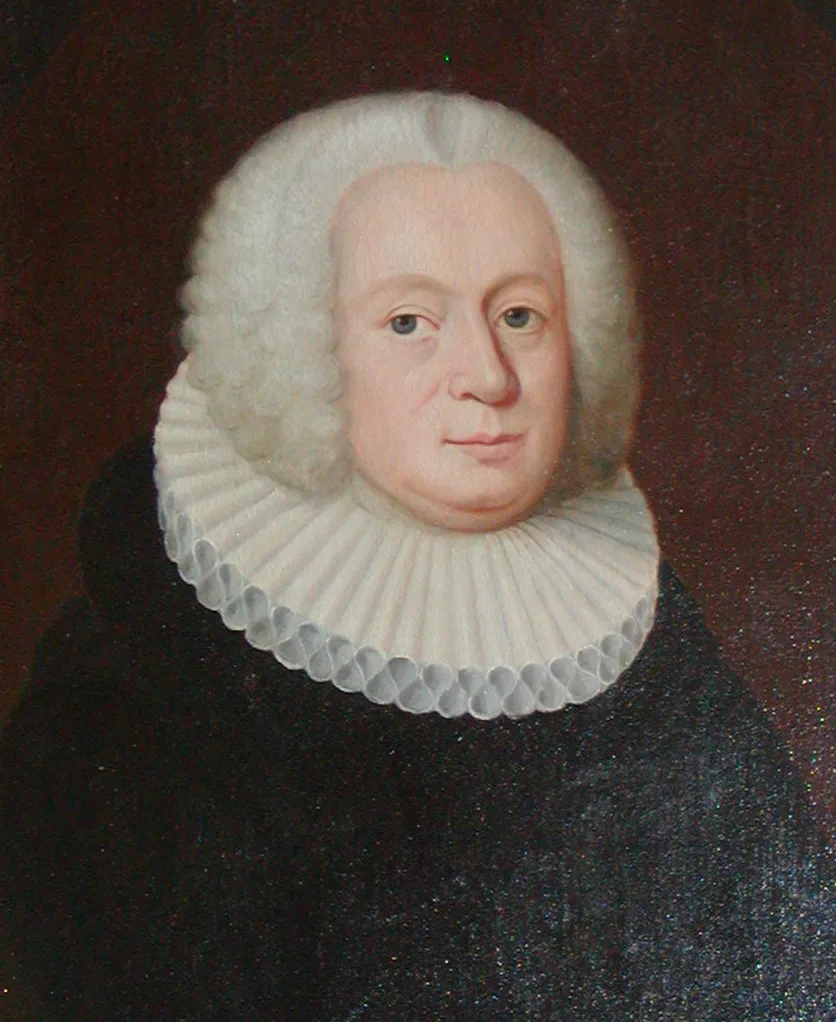 Unknown artist, portrait of Erik Pontoppidan (first half of the 1700s) Pontoppidan in the ruff of the Danish-Norwegian clergy — Christian VI's court chaplain, whose 1737 catechism *Sandhed til Gudfrygtighed* put its 759 questions into the memory of every Norwegian confirmand for well over a century, and who as Bishop of Bergen wrote the natural history that made the kraken famous. Danish-Norwegian Lutheran theologian, bishop, and natural
historian (1698–1764). Court preacher and personal chaplain
to King Christian VI from 1735, who commissioned him to
write the standard catechism that would accompany the new
compulsory confirmation: Sandhed til Gudfrygtighed —
Truth unto Godliness — published 1737 and the principal
instrument of Norwegian Lutheran religious education for
well over a century, into the late 1800s. Appointed Bishop
of Bergen 1747; in that
capacity wrote his two-volume Det første Forsøg paa
Norges naturlige Historie (1752–53), the standard
eighteenth-century natural history of Norway and the work
that first describes the kraken under that name. Later
vice-chancellor of the University of Copenhagen.
Also discussed in Lutheran Norway and Pietism — a farmer named Hans Nielsen Hauge and a lay revival that could not be silencedKraken — the island-sized beast, logged as factSjøormer — the serpents in the deep lakes and fjords ’s catechism of 1737 made the cultivation of personal conviction a stated duty of every Lutheran subject. It would erupt as a popular lay movement at the end of the eighteenth century under the preacher Hans Nielsen Hauge
Unknown artist, portrait of Erik Pontoppidan (first half of the 1700s) Pontoppidan in the ruff of the Danish-Norwegian clergy — Christian VI's court chaplain, whose 1737 catechism *Sandhed til Gudfrygtighed* put its 759 questions into the memory of every Norwegian confirmand for well over a century, and who as Bishop of Bergen wrote the natural history that made the kraken famous. Danish-Norwegian Lutheran theologian, bishop, and natural
historian (1698–1764). Court preacher and personal chaplain
to King Christian VI from 1735, who commissioned him to
write the standard catechism that would accompany the new
compulsory confirmation: Sandhed til Gudfrygtighed —
Truth unto Godliness — published 1737 and the principal
instrument of Norwegian Lutheran religious education for
well over a century, into the late 1800s. Appointed Bishop
of Bergen 1747; in that
capacity wrote his two-volume Det første Forsøg paa
Norges naturlige Historie (1752–53), the standard
eighteenth-century natural history of Norway and the work
that first describes the kraken under that name. Later
vice-chancellor of the University of Copenhagen.
Also discussed in Lutheran Norway and Pietism — a farmer named Hans Nielsen Hauge and a lay revival that could not be silencedKraken — the island-sized beast, logged as factSjøormer — the serpents in the deep lakes and fjords ’s catechism of 1737 made the cultivation of personal conviction a stated duty of every Lutheran subject. It would erupt as a popular lay movement at the end of the eighteenth century under the preacher Hans Nielsen Hauge 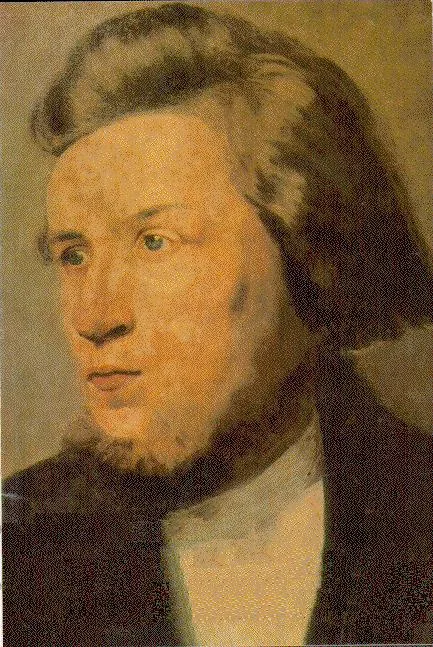 Unknown artist, Portrait of Hans Nielsen Hauge (Copenhagen, c. 1800) The only known original life portrait of Hauge, painted in Copenhagen around 1800 — the farmer's son in his late twenties, midway through the eight walking years in which he preached across Norway and was arrested again and again under the Konventikkelplakaten. Norwegian lay preacher, entrepreneur, and farmer (1771–
1824). The single most influential Norwegian religious
figure of the modern period. Underwent a conversion
experience on his family farm at Rolvsøy in Østfold on 5
April 1796 and spent the next eight years walking across
Norway, preaching and organising lay Christian gatherings
outside the official state church — illegal under the
Konventikkelplakaten of 1741. Arrested fourteen times
across his career; held in prison for roughly nine years
cumulatively — the long final detention, in the Christiania
town prison from 1804 to 1811, was settled at last in 1814
by a judgment reduced to a fine. His followers,
the Haugianere, founded businesses, mills, schools, and
printing presses across nineteenth-century Norway.
Also discussed in Lutheran Norway and Pietism — a farmer named Hans Nielsen Hauge and a lay revival that could not be silenced800,000 Norwegians Leave — the century that built a Second NorwayStatskirken — the state church and what's left of it — but the institutional return of interior faith, like the Reformation itself, would arrive first by royal decree from Copenhagen.
Unknown artist, Portrait of Hans Nielsen Hauge (Copenhagen, c. 1800) The only known original life portrait of Hauge, painted in Copenhagen around 1800 — the farmer's son in his late twenties, midway through the eight walking years in which he preached across Norway and was arrested again and again under the Konventikkelplakaten. Norwegian lay preacher, entrepreneur, and farmer (1771–
1824). The single most influential Norwegian religious
figure of the modern period. Underwent a conversion
experience on his family farm at Rolvsøy in Østfold on 5
April 1796 and spent the next eight years walking across
Norway, preaching and organising lay Christian gatherings
outside the official state church — illegal under the
Konventikkelplakaten of 1741. Arrested fourteen times
across his career; held in prison for roughly nine years
cumulatively — the long final detention, in the Christiania
town prison from 1804 to 1811, was settled at last in 1814
by a judgment reduced to a fine. His followers,
the Haugianere, founded businesses, mills, schools, and
printing presses across nineteenth-century Norway.
Also discussed in Lutheran Norway and Pietism — a farmer named Hans Nielsen Hauge and a lay revival that could not be silenced800,000 Norwegians Leave — the century that built a Second NorwayStatskirken — the state church and what's left of it — but the institutional return of interior faith, like the Reformation itself, would arrive first by royal decree from Copenhagen.
The Sámi mission
What happened to the The Sámi 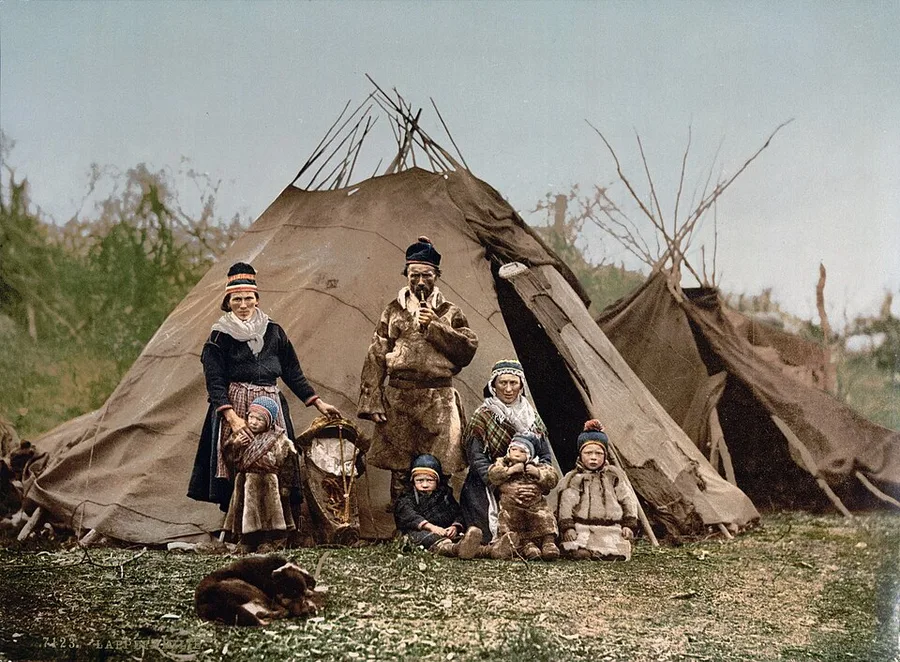 Unknown photographer, Saami Family (c. 1896, Kanstadfjord near Lødingen), Library of Congress A hand-tinted photochrom of a Sámi family in gákti dress outside their lávvu tents, around 1896. A late photograph of a very old fact: alongside and north of Norse Norway, the Sámi have always been a parallel people, with their own languages, livelihoods, and religious world. The Indigenous people of Sápmi, the cultural region across the
northern interior of present-day Norway, Sweden, Finland, and the
Russian Kola Peninsula. Sámi languages belong to the Uralic family,
unrelated to Norse. A distinctly Sámi material culture is visible
in the archaeological record from about 500 BCE. The traditional
Sámi economy ran on hunting, fishing, and trapping, with
semi-domesticated reindeer used for transport long before the
large-scale reindeer pastoralism of later centuries. Sámi religious
life centred on the noaidi (ritual specialist), the goavddis
(painted ritual drum), and the sieidi (sacred natural places).
Modern Sámi political representation runs through the Sámi
parliaments in Norway, Sweden, and Finland.
Also discussed in Samene — the other people of NorwayBefore There Was Norway — petty kingdoms at the edge of the worldWorshiping Odin and Thor — the lived religion of pre-Christian NorwayWorld War II — the King’s “No” and the Nazis in NorwayPolitikk — the left, the right, and the Norwegian way in the seventeenth and eighteenth centuries was a separate and harsher event. The Sámi had not been Catholics in 1537; they held an indigenous shamanic religion with its own cosmology, its own sacred sites, and its own ritual specialists, the Noaidi
Unknown photographer, Saami Family (c. 1896, Kanstadfjord near Lødingen), Library of Congress A hand-tinted photochrom of a Sámi family in gákti dress outside their lávvu tents, around 1896. A late photograph of a very old fact: alongside and north of Norse Norway, the Sámi have always been a parallel people, with their own languages, livelihoods, and religious world. The Indigenous people of Sápmi, the cultural region across the
northern interior of present-day Norway, Sweden, Finland, and the
Russian Kola Peninsula. Sámi languages belong to the Uralic family,
unrelated to Norse. A distinctly Sámi material culture is visible
in the archaeological record from about 500 BCE. The traditional
Sámi economy ran on hunting, fishing, and trapping, with
semi-domesticated reindeer used for transport long before the
large-scale reindeer pastoralism of later centuries. Sámi religious
life centred on the noaidi (ritual specialist), the goavddis
(painted ritual drum), and the sieidi (sacred natural places).
Modern Sámi political representation runs through the Sámi
parliaments in Norway, Sweden, and Finland.
Also discussed in Samene — the other people of NorwayBefore There Was Norway — petty kingdoms at the edge of the worldWorshiping Odin and Thor — the lived religion of pre-Christian NorwayWorld War II — the King’s “No” and the Nazis in NorwayPolitikk — the left, the right, and the Norwegian way in the seventeenth and eighteenth centuries was a separate and harsher event. The Sámi had not been Catholics in 1537; they held an indigenous shamanic religion with its own cosmology, its own sacred sites, and its own ritual specialists, the Noaidi 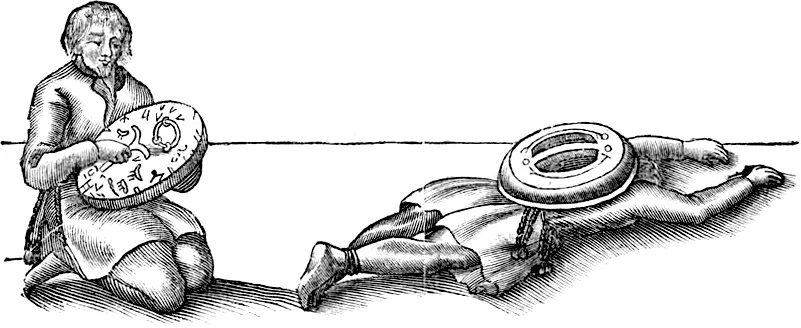 Johannes Schefferus, Lapponia (1673), engraving of a noaidi with drum A 1673 engraving from Schefferus's Lapponia — a Sámi noaidi lying in trance with his painted drum, a companion kneeling nearby — one of the few old depictions of the shaman-officiant whose drums Lutheran missionaries later burned. The Sámi ritual specialist — shaman, in the comparative-religion
vocabulary that Western anthropology applied to similar figures
across Eurasia. The noaidi was the religious officiant of the
pre-Christian Sámi community, responsible for divination, healing,
and communication with the spirits of the land and the dead. The
noaidi's principal instrument was the goavddis, the painted drum
whose surface diagrammed an entire spiritual cosmology. The
practice was systematically persecuted by Norwegian and Swedish
Lutheran missionaries through the seventeenth and eighteenth
centuries; many drums were burned, the recorded knowledge lost.
The tradition survives in fragments in modern Sámi cultural and
religious revival.
Also discussed in Samene — the other people of NorwayBefore There Was Norway — petty kingdoms at the edge of the world . What Lutheran missionaries imposed across the next two centuries — Thomas von Westen
Johannes Schefferus, Lapponia (1673), engraving of a noaidi with drum A 1673 engraving from Schefferus's Lapponia — a Sámi noaidi lying in trance with his painted drum, a companion kneeling nearby — one of the few old depictions of the shaman-officiant whose drums Lutheran missionaries later burned. The Sámi ritual specialist — shaman, in the comparative-religion
vocabulary that Western anthropology applied to similar figures
across Eurasia. The noaidi was the religious officiant of the
pre-Christian Sámi community, responsible for divination, healing,
and communication with the spirits of the land and the dead. The
noaidi's principal instrument was the goavddis, the painted drum
whose surface diagrammed an entire spiritual cosmology. The
practice was systematically persecuted by Norwegian and Swedish
Lutheran missionaries through the seventeenth and eighteenth
centuries; many drums were burned, the recorded knowledge lost.
The tradition survives in fragments in modern Sámi cultural and
religious revival.
Also discussed in Samene — the other people of NorwayBefore There Was Norway — petty kingdoms at the edge of the world . What Lutheran missionaries imposed across the next two centuries — Thomas von Westen 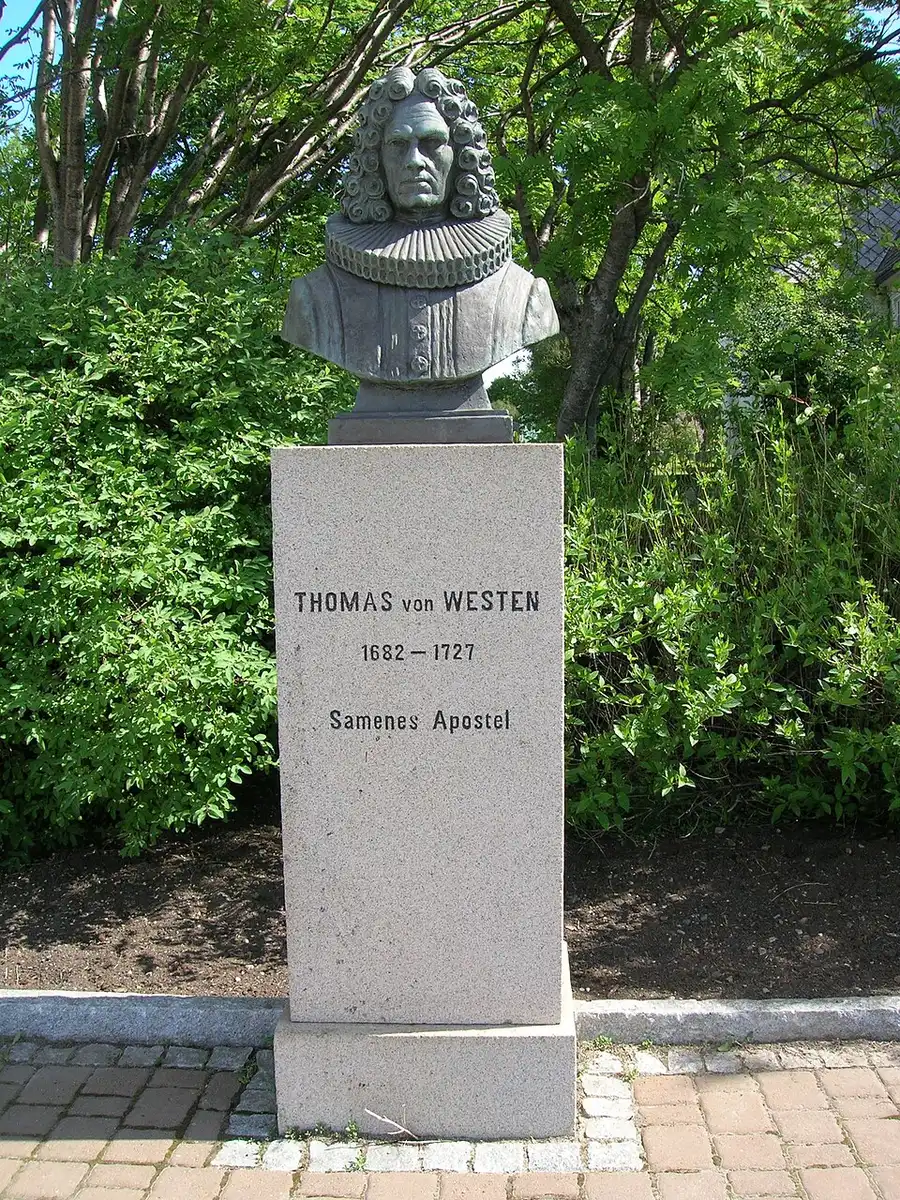 Photograph by Sandivas, Bust of Thomas von Westen, outside Mo church, Mo i Rana, CC BY-SA 3.0 The commemorative bust outside Mo church honors the priest Norwegian tradition calls the Apostle of the Sami; no contemporary portrait of Thomas von Westen survives at usable resolution, so the monument stands in for the man. Norwegian Lutheran priest and missionary (1682–1727).
Appointed in 1716 by King Frederik IV as head of the
Finne-missionen — the official mission to the Sami of
northern Norway. Across the next decade he conducted three
large missionary journeys through Finnmark, Troms,
Nordland, and the inland Sami districts of southern Norway,
learning Sami and ordering the confiscation and burning of
the noaidi drums and other sacred objects he encountered.
Much of the Sami material his mission collected burned in
the Copenhagen fire of 1728.
Buried in the choir of Nidaros Cathedral, under an epitaph
the Sami Mission raised in 1927. Often called the Apostle
of the Sami; in modern Sami historiography he is treated
as the principal agent of the violent Christianisation of
Sami religion.
On the trip Thomas von Westen lies buried in the choir of Nidaros Cathedral, beneath an epitaph the Norwegian Sami Mission raised in 1927, two centuries after his death — inside the cathedral the Gråhårsklubben (the Oldsters) visit on the evening of Day 3. Also discussed in Samene — the other people of Norway and his successors most prominently — was not a Reformation, in the sense of one form of Christianity replacing another, but a Christianisation. The drums of the noaidi were burned. Sacred sites were destroyed. Christian observance was imposed at the point of state authority. The cultural destruction was much heavier than what happened in central and southern Norway in 1537, the violence was more direct, and the consequences are still being worked through today.
Photograph by Sandivas, Bust of Thomas von Westen, outside Mo church, Mo i Rana, CC BY-SA 3.0 The commemorative bust outside Mo church honors the priest Norwegian tradition calls the Apostle of the Sami; no contemporary portrait of Thomas von Westen survives at usable resolution, so the monument stands in for the man. Norwegian Lutheran priest and missionary (1682–1727).
Appointed in 1716 by King Frederik IV as head of the
Finne-missionen — the official mission to the Sami of
northern Norway. Across the next decade he conducted three
large missionary journeys through Finnmark, Troms,
Nordland, and the inland Sami districts of southern Norway,
learning Sami and ordering the confiscation and burning of
the noaidi drums and other sacred objects he encountered.
Much of the Sami material his mission collected burned in
the Copenhagen fire of 1728.
Buried in the choir of Nidaros Cathedral, under an epitaph
the Sami Mission raised in 1927. Often called the Apostle
of the Sami; in modern Sami historiography he is treated
as the principal agent of the violent Christianisation of
Sami religion.
On the trip Thomas von Westen lies buried in the choir of Nidaros Cathedral, beneath an epitaph the Norwegian Sami Mission raised in 1927, two centuries after his death — inside the cathedral the Gråhårsklubben (the Oldsters) visit on the evening of Day 3. Also discussed in Samene — the other people of Norway and his successors most prominently — was not a Reformation, in the sense of one form of Christianity replacing another, but a Christianisation. The drums of the noaidi were burned. Sacred sites were destroyed. Christian observance was imposed at the point of state authority. The cultural destruction was much heavier than what happened in central and southern Norway in 1537, the violence was more direct, and the consequences are still being worked through today.
What 1537 left behind
What 1537 left behind was Norwegian Christianity as Danish state machinery, and not as the country’s own religious culture. It would take nearly five centuries to undo. The pilgrim routes to Nidaros were reopened in 1997 as the Pilegrimsleden  Øyvind Holmstad, Pilegrimsleden between Hoff church and Kapp, Toten (2021), Wikimedia Commons, CC BY-SA 4.0 The reopened route in walking use: a stretch of the Gudbrandsdalsleden's western branch between Hoff medieval church and Kapp on Toten, with Lake Mjøsa beyond the trees. Farm lanes like this one carry the modern pilgrim's-passport walkers north toward Nidaros every summer. The modern network of marked pilgrim walking paths to Trondheim —
the inheritance of the medieval pilgrim economy around the Olav
cult. The two principal routes are the Gudbrandsdalsleden (Oslo
to Trondheim, 643 km) and the St. Olavsleden (Selånger in Sweden
to Trondheim, 580 km); a network of shorter feeders and side-
routes connects to both. Re-opened in stages between 1997 and
2013 with a modern hostel-and-stamping system; the Pilegrims-
kontoret in Oslo and the Pilegrimssenter in Trondheim issue the
pilgrim's passport. Walked again every summer by thousands.
Also discussed in The King Who Became a Saint — how the Nordmen came to Christ800,000 Norwegians Leave — the century that built a Second Norway — silent for four hundred and sixty years before that — and were designated a European Cultural Route by the Council of Europe in 2010. The 2017 disestablishment formally separated church from state. By 2026, the Lutheran institutional church remains the largest religious organisation in the country but no longer claims the country itself.
Øyvind Holmstad, Pilegrimsleden between Hoff church and Kapp, Toten (2021), Wikimedia Commons, CC BY-SA 4.0 The reopened route in walking use: a stretch of the Gudbrandsdalsleden's western branch between Hoff medieval church and Kapp on Toten, with Lake Mjøsa beyond the trees. Farm lanes like this one carry the modern pilgrim's-passport walkers north toward Nidaros every summer. The modern network of marked pilgrim walking paths to Trondheim —
the inheritance of the medieval pilgrim economy around the Olav
cult. The two principal routes are the Gudbrandsdalsleden (Oslo
to Trondheim, 643 km) and the St. Olavsleden (Selånger in Sweden
to Trondheim, 580 km); a network of shorter feeders and side-
routes connects to both. Re-opened in stages between 1997 and
2013 with a modern hostel-and-stamping system; the Pilegrims-
kontoret in Oslo and the Pilegrimssenter in Trondheim issue the
pilgrim's passport. Walked again every summer by thousands.
Also discussed in The King Who Became a Saint — how the Nordmen came to Christ800,000 Norwegians Leave — the century that built a Second Norway — silent for four hundred and sixty years before that — and were designated a European Cultural Route by the Council of Europe in 2010. The 2017 disestablishment formally separated church from state. By 2026, the Lutheran institutional church remains the largest religious organisation in the country but no longer claims the country itself.
Norway suggests something about the wider Protestant Reformation. The popular image of the Reformation — Luther’s theses, the German cities, the lay engagement with new doctrine — is the part that survives in modern memory. Less remembered, especially outside scholarly accounts, is what the Reformation also did, wherever it succeeded, for the political rulers who adopted it. The English Reformation passed something like a quarter to a third of all English land through the Tudor crown, much of it then sold off to fund war and to reward a loyal gentry. The Swedish Reformation enriched the Vasa monarchy on a similar scale. The German princes who chose Lutheran reform took possession of the Catholic Church’s territories within their realms. The Peace of Augsburg 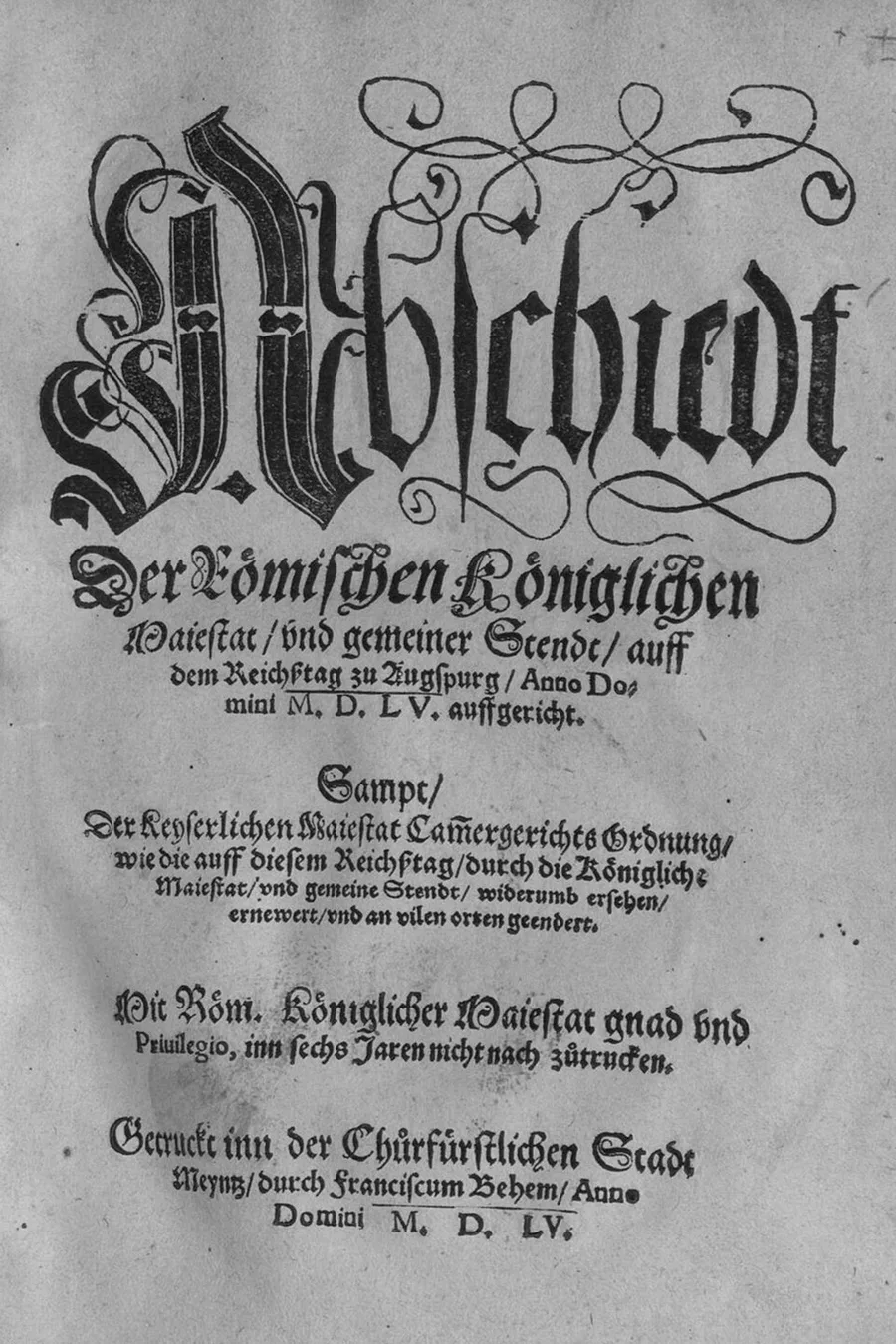 Title page, printed Augsburg Imperial and Religious Peace (Mainz, 1555) The title page of the 1555 Mainz printing of the settlement itself, the document that let each prince of the Empire fix his territory's confession and made the Reformation, in much of Europe, a change ordered from the top down. Treaty signed at Augsburg on 25 September 1555 between
Emperor Charles V's brother Ferdinand of Austria and the
Lutheran and Catholic imperial estates, ending the
religious wars that had followed the German princes'
adoption of the Reformation. The Peace codified into imperial law the
principle cuius regio, eius religio — whose realm, his
religion — by which each prince of the Empire determined
the official confession of his territory, choosing between
Catholicism and the Augsburg Confession (Lutheranism).
Subjects who did not wish to follow their prince's
confession were given the right to emigrate. The settlement
held for sixty-three years before its breakdown in the
Thirty Years' War; the Peace of Westphalia in 1648 extended
it to include the Reformed (Calvinist) confession.
of 1555 eventually codified the political dimension into law: Cuius regio, eius religio
Title page, printed Augsburg Imperial and Religious Peace (Mainz, 1555) The title page of the 1555 Mainz printing of the settlement itself, the document that let each prince of the Empire fix his territory's confession and made the Reformation, in much of Europe, a change ordered from the top down. Treaty signed at Augsburg on 25 September 1555 between
Emperor Charles V's brother Ferdinand of Austria and the
Lutheran and Catholic imperial estates, ending the
religious wars that had followed the German princes'
adoption of the Reformation. The Peace codified into imperial law the
principle cuius regio, eius religio — whose realm, his
religion — by which each prince of the Empire determined
the official confession of his territory, choosing between
Catholicism and the Augsburg Confession (Lutheranism).
Subjects who did not wish to follow their prince's
confession were given the right to emigrate. The settlement
held for sixty-three years before its breakdown in the
Thirty Years' War; the Peace of Westphalia in 1648 extended
it to include the Reformed (Calvinist) confession.
of 1555 eventually codified the political dimension into law: Cuius regio, eius religio 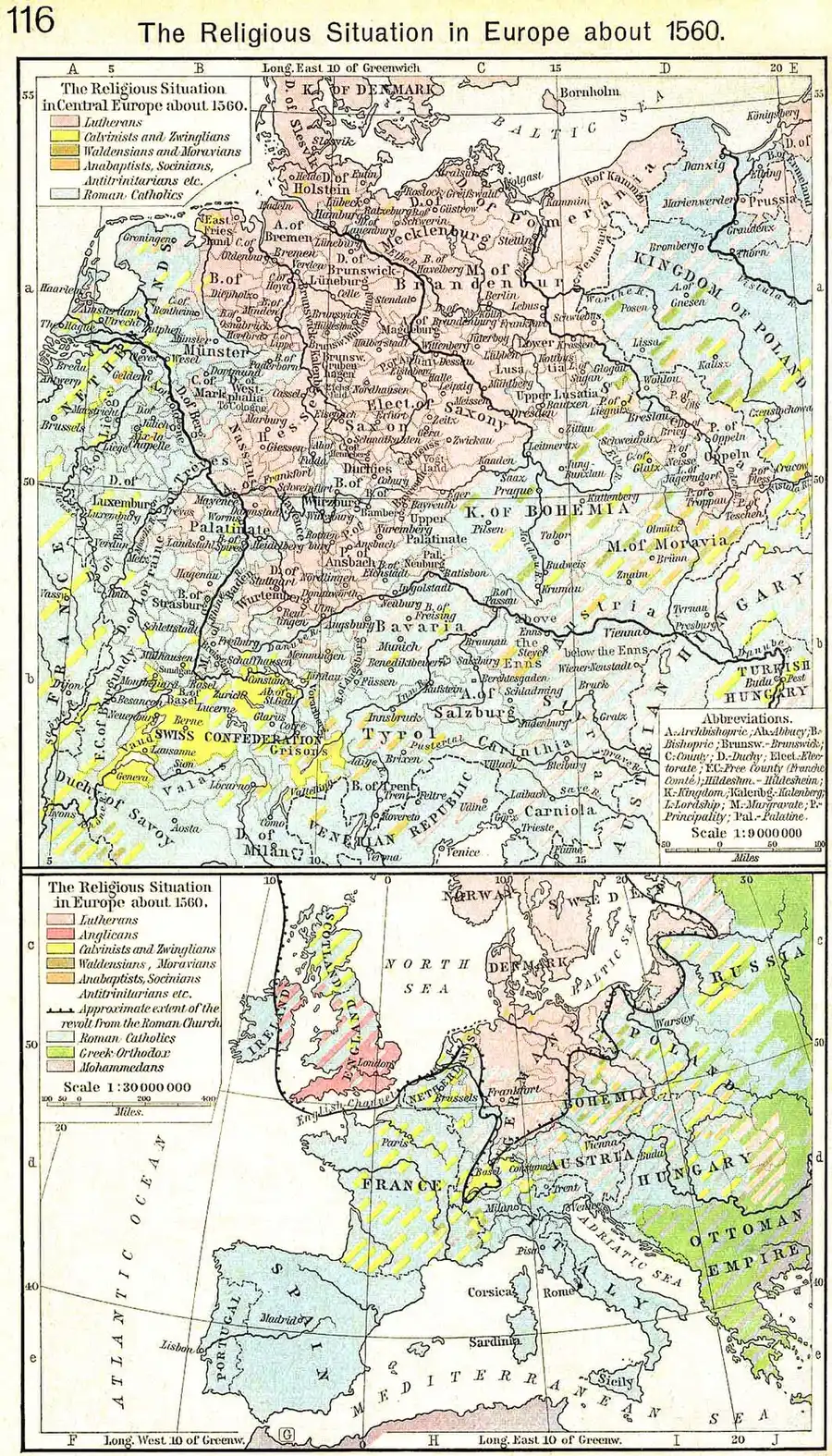 William R. Shepherd, Historical Atlas (1923), "Europe: Religions, 1560" This 1923 historical-atlas map colors each territory by its confession around 1560, the patchwork cuius regio, eius religio produced, in which a prince's own choice of Catholic or Lutheran worship became binding law for everyone under him. Whose realm, his religion — the Latin phrase summarising
the central constitutional principle of the post-Reformation
European religious settlement. Codified in the Peace of
Augsburg of 1555: each prince of the Holy Roman Empire
determined the official confession of his territory,
choosing between Catholicism and Lutheranism. Extended to
include Calvinism by the Peace of Westphalia in 1648.
Outside the Empire the same principle operated in fact
wherever the Reformation succeeded — Henry VIII's English
settlement, Gustav Vasa's Swedish, Christian III's Danish.
The principle gave rulers formal authority over the
confessional life of subjects and made the Reformation, in
much of Europe, a transformation imposed from above.
— whose realm, his religion. None of this is hidden from scholarly history, which has long known the magisterial Reformation worked partly by adoption from above. But the popular memory of the Reformation tends to crowd the political and material dimensions out — and Norway, where the religious motivation was thinnest of all the major Reformation territories, is the case in which the political and material machinery shows most clearly. The country does not prove anything about Germany or England, where genuine popular movement complicates the picture. It exposes a mechanism that was present everywhere, even where popular movement was real.
William R. Shepherd, Historical Atlas (1923), "Europe: Religions, 1560" This 1923 historical-atlas map colors each territory by its confession around 1560, the patchwork cuius regio, eius religio produced, in which a prince's own choice of Catholic or Lutheran worship became binding law for everyone under him. Whose realm, his religion — the Latin phrase summarising
the central constitutional principle of the post-Reformation
European religious settlement. Codified in the Peace of
Augsburg of 1555: each prince of the Holy Roman Empire
determined the official confession of his territory,
choosing between Catholicism and Lutheranism. Extended to
include Calvinism by the Peace of Westphalia in 1648.
Outside the Empire the same principle operated in fact
wherever the Reformation succeeded — Henry VIII's English
settlement, Gustav Vasa's Swedish, Christian III's Danish.
The principle gave rulers formal authority over the
confessional life of subjects and made the Reformation, in
much of Europe, a transformation imposed from above.
— whose realm, his religion. None of this is hidden from scholarly history, which has long known the magisterial Reformation worked partly by adoption from above. But the popular memory of the Reformation tends to crowd the political and material dimensions out — and Norway, where the religious motivation was thinnest of all the major Reformation territories, is the case in which the political and material machinery shows most clearly. The country does not prove anything about Germany or England, where genuine popular movement complicates the picture. It exposes a mechanism that was present everywhere, even where popular movement was real.
Much of what is now commonly thought to distinguish Protestant from Catholic doctrine has more to do with the centuries that followed Luther than with Luther himself. Luther was an Augustinian friar, formed in the monastery’s disciplines of prayer, confession, and scripture, and what he set out to do was reform the church he belonged to, not found a rival to it. The differences were real — justification by faith alone, scripture over papal authority, the rejection of indulgences — and Rome answered them point by point at the Council of Trent  Pasquale Cati, The Council of Trent (1588 fresco), Cappella Altemps, Santa Maria Maggiore, Rome Pasquale Cati's 1588 fresco imagines the council in session, bishops and cardinals ranked beneath the dais where doctrine was debated and confirmed across the eighteen years Rome spent answering Luther's challenge point by point. General council of the Catholic Church held at Trent in the
Italian Alps across twenty-five sessions between 1545 and
1563. The principal doctrinal and disciplinary response of
Rome to the Protestant Reformation. Trent reaffirmed
Catholic teaching on justification, the seven sacraments,
the canon of scripture and the authority of tradition, the
Real Presence and the Mass as sacrifice, indulgences,
purgatory, and the invocation of saints — at each precise
point on which Luther had broken from Rome. Trent also
instituted the disciplinary reforms that shaped the
Counter-Reformation church for the next four centuries:
episcopal residence requirements, the seminary system, the
Roman Catechism, and the Tridentine liturgy that remained
the Catholic Mass form until the Second Vatican Council.
(1545–1563) a generation later. But the ground the two churches shared was wide, and Luther spent much of his later career defending it. He kept infant baptism. He affirmed the Real Presence of Christ in the bread and wine of communion, and broke with the more radical reformers of his own movement over precisely that point, standing nearer to Rome than to them. He retained the Apostles’ and Nicene creeds, private confession and absolution, the commemoration of the saints in the church’s annual calendar of feast days, and the traditional liturgy with its vestments and festivals, against those who wanted all of it stripped away. In Norway the continuity was visible in the churches themselves: the parish buildings stayed in use, the medieval crucifixes and altarpieces stayed on the walls, and much of the shape of the old worship carried on in Lutheran form. The two confessions that would later face each other across a hardened divide began as near neighbours — and nowhere nearer than in Norway, where the same congregations kept the same buildings, the same art, and much of the same worship, under a new name.
Pasquale Cati, The Council of Trent (1588 fresco), Cappella Altemps, Santa Maria Maggiore, Rome Pasquale Cati's 1588 fresco imagines the council in session, bishops and cardinals ranked beneath the dais where doctrine was debated and confirmed across the eighteen years Rome spent answering Luther's challenge point by point. General council of the Catholic Church held at Trent in the
Italian Alps across twenty-five sessions between 1545 and
1563. The principal doctrinal and disciplinary response of
Rome to the Protestant Reformation. Trent reaffirmed
Catholic teaching on justification, the seven sacraments,
the canon of scripture and the authority of tradition, the
Real Presence and the Mass as sacrifice, indulgences,
purgatory, and the invocation of saints — at each precise
point on which Luther had broken from Rome. Trent also
instituted the disciplinary reforms that shaped the
Counter-Reformation church for the next four centuries:
episcopal residence requirements, the seminary system, the
Roman Catechism, and the Tridentine liturgy that remained
the Catholic Mass form until the Second Vatican Council.
(1545–1563) a generation later. But the ground the two churches shared was wide, and Luther spent much of his later career defending it. He kept infant baptism. He affirmed the Real Presence of Christ in the bread and wine of communion, and broke with the more radical reformers of his own movement over precisely that point, standing nearer to Rome than to them. He retained the Apostles’ and Nicene creeds, private confession and absolution, the commemoration of the saints in the church’s annual calendar of feast days, and the traditional liturgy with its vestments and festivals, against those who wanted all of it stripped away. In Norway the continuity was visible in the churches themselves: the parish buildings stayed in use, the medieval crucifixes and altarpieces stayed on the walls, and much of the shape of the old worship carried on in Lutheran form. The two confessions that would later face each other across a hardened divide began as near neighbours — and nowhere nearer than in Norway, where the same congregations kept the same buildings, the same art, and much of the same worship, under a new name.
The shrine of Saint Olav was melted down in 1540. The body lies somewhere in or beneath Nidaros Cathedral, in a grave lost since 1568. The cathedral is still standing.
Sources & further reading
Primary sources
- Ordinatio ecclesiastica regnorum Daniae et Norwegiae (Copenhagen, 2 September 1537). The Church Ordinance signed by Christian III that imposed Lutheranism across the Danish kingdoms. Critical edition: Martin Schwarz Lausten, ed., Kirkeordinansen 1537/39 (Akademisk Forlag, 1989).
- Olav Engelbrektssons Jordebog (the rent rolls of the last Catholic archbishop), drafted in the 1530s and partially extant. The administrative record of the archbishopric of Nidaros at the moment of its dissolution; the records Engelbrektsson took with him into exile.
- Norwegian National Archives (Riksarkivet), records of the post-Reformation crown estate, including the rolls of confiscated monastic and episcopal lands across the 1537–1560 period.
- Peace of Augsburg, 25 September 1555. The treaty that codified cuius regio, eius religio — the principle that the ruling prince determined the religion of his territory — into European public law.
- Konfirmasjonsforordningen av 1736 and Erik Pontoppidan, Sandhed til Gudfrygtighed (1737). The two state-Pietist instruments by which interior personal faith was reintroduced into Norwegian Lutheran practice by royal decree, two centuries after the Reformation.
Modern scholarship
- Sverre Bagge, Cross and Scepter: The Rise of the Scandinavian Kingdoms from the Vikings to the Reformation (Princeton University Press, 2014). The Scandinavian political context for the formation of the union.
- Diarmaid MacCulloch, Reformation: Europe’s House Divided 1490–1700 (Penguin, 2003). The standard modern treatment of the European Reformation, with substantial attention to the political and material mechanism across territories.
- Heiko A. Oberman, Luther: Man Between God and the Devil (Yale University Press, 1989). The standard modern biography, with extensive treatment of both Luther’s central ruptures with Rome and his substantial continuity with Catholic doctrine on Mary, the Eucharist, and ceremonial worship.
- Øystein Rian, Den aristokratiske fyrstestaten 1536–1648 (Universitetsforlaget, 1997). The standard Norwegian-language treatment of the political consolidation after 1536.
- Lars Hamre, Norsk politisk historie 1513–1537 (Det Norske Samlaget, 1998). On the politics of the Reformation crisis itself.
- Martin Schwarz Lausten, A Church History of Denmark (Ashgate, 2002). The Lutheran institutional context.
- Tarald Rasmussen and Ole Peter Grell, eds., The Scandinavian Reformation: From Evangelical Movement to Institutionalisation of Reform (Cambridge University Press, 1995). The comparative Scandinavian treatment.
- Per Gunnar Holm, Olav Engelbrektsson: Erkebiskop og rikspolitiker (Trondheim, 1992). The biography of the last archbishop.
- Einar Haugen, Language Conflict and Language Planning: The Case of Modern Norwegian (Harvard University Press, 1966). The long linguistic shadow of the Danish-language church.
Reference
- Store norske leksikon (snl.no). See in particular reformasjonen i Norge, Olav Engelbrektsson, Steinvikholm slott, Kirkeordinansen av 1537, Pilegrimsleden, and Konfirmasjonsforordningen av 1736.
- Nidaros Cathedral, https://www.nidarosdomen.no/en/historie-og-arkitektur/olav-den-hellige.
- Pilegrimsleden (St. Olav Ways) official site, https://www.pilegrimsleden.no/en.
Visit
- Nidaros Cathedral, Trondheim. The medieval archbishopric, the site of the Olavskrinet’s empty pedestal, and the building in or beneath which the body of Saint Olav was reburied in a grave that has been lost since 1568. The cathedral is open daily.
- Steinvikholm Castle, the fortified island in the Trondheim Fjord where Engelbrektsson moved the Olavskrinet in 1536 to keep it from seizure, and where the body of the saint may have remained for a further generation after the shrine itself was destroyed. The fortress fell in May 1537. The ruins are accessible to visitors by causeway at low tide.
- Sint-Gummaruskerk, Lier in Belgium. The church where Engelbrektsson was buried in February 1538. A memorial plaque was placed at the grave by Queen Sonja of Norway in the early 2000s.
- Selja, the island monastery on the western coast. The founding episcopal seat of medieval western Norway, founded around 1100, whose bishopric moved to Bergen by 1170 and whose monastery declined slowly across the late Middle Ages. The ruins of the monastery and the eleventh-century Sunniva caves above survive on the island, accessible by boat from Selje.
- Munkeliv (Munkeliv monastery site), Bergen. The medieval Benedictine and later Bridgettine house, taken over by the bishop after the Reformation and largely demolished. The site is on the Klosteret slope near the modern Bergenhus.
- Pilegrimsleden, the modern St. Olav Ways. Reopened in 1997 after four hundred and sixty years of silence, the routes from Oslo, eastern Sweden, and the inland valleys to Nidaros are now waymarked and provisioned for modern walkers. Pilgrim passports and overnight hostels are available at the route’s offices.