Language basics — just enough Norwegian to be polite
Norwegian phrases worth carrying — the greetings, the polite asks, and the small set of words and pronunciation pointers that make a difference. Plus a short note on the dialect texture the trip meets.
Start with the reassuring part. Almost every Norwegian under fifty speaks excellent English, and a great many speak it better than they will admit. Nobody on this trip needs Norwegian to be understood, to order a meal, to buy a train ticket, or to ask for help. Speaking Norwegian is a courtesy, not a necessity — a small gesture that says we know we are guests here. Carry a handful of phrases, use them where they fit, and switch to English without apology for everything else.
Greetings and farewells
- Hei — the universal hello. Works at any hour, with anyone, in any setting.
- Hallo — also hello, the standard way to answer the phone, and a call to get someone’s attention.
- God dag (good day) — formal, used less by younger people but always correct.
- God kveld (good evening) — for the evening.
- Ha det — goodbye, casual. Ha det bra (have it well) is the warmer version.
- God natt (good night) — at bedtime, or leaving late.
The polite asks
A handful of phrases do most of the work:
- Tusen takk (a thousand thanks) — the warmest everyday thank-you, and worth learning to say well.
- Takk skal du ha — another thank-you, roughly thanks shall you have.
- Vær så snill (please) — literally be so kind.
- Unnskyld — excuse me / sorry / pardon. Use it to get attention or to apologize.
- Ja takk / nei takk — yes please / no thank you. Politer than a bare yes or no.
Pronunciation pointers
Norwegian has three vowel letters English doesn’t have, and they matter:
- æ — like the a in cat.
- ø — like the u in fur, lips rounded. Close to the German ö.
- å — like the o in more. (It used to be written aa — you will still see aa in old place names and surnames.)
A few consonant combinations surprise English speakers:
- kj and tj — a soft sh-ish sound, close to the h in huge. Kjøttkaker (meatballs) begins roughly hyut-.
- skj, sj, and often sk before a soft vowel — a sh sound. Skjønn is shøn.
- hv — the h is silent. Hva (what) is va.
- A final -d is often silent. God sounds like goo; med like meh.
Nobody will grade you on this. Approximate it cheerfully and move on.
Survival vocabulary
- Hvor er…? — where is…?
- Hvor mye koster det? — how much does it cost?
- Toalett — toilet. Hvor er toalettet? — where is the toilet?
- Hjelp — help.
- Snakker du engelsk? — do you speak English? (The answer is almost always yes.)
Numbers one to twenty: en, to, tre, fire, fem, seks, sju, åtte, ni, ti, elleve, tolv, tretten, fjorten, femten, seksten, sytten, atten, nitten, tjue.
The dialect texture
Norway has two official written standards — Bokmål 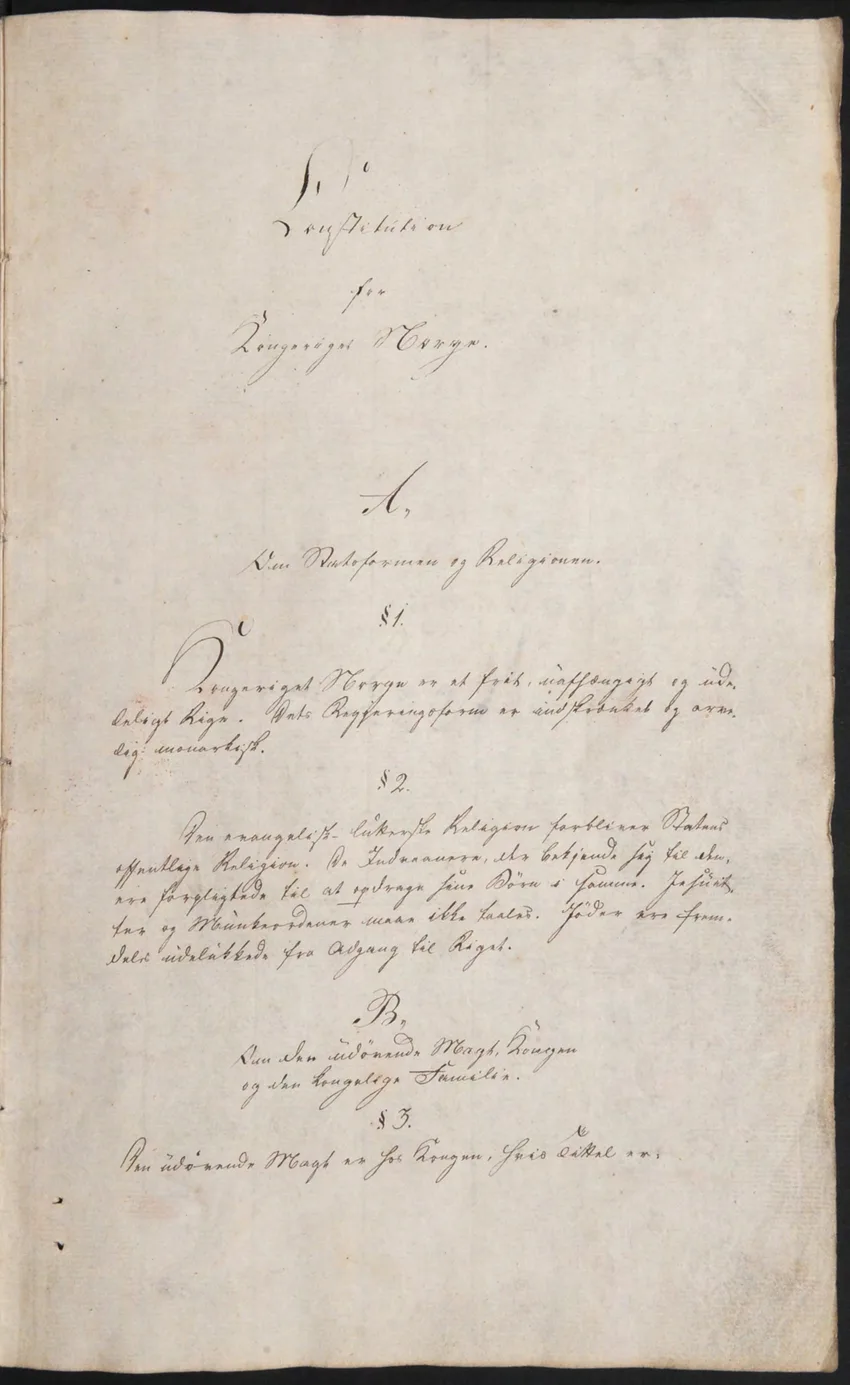 Kongeriget Norges Grundlov, opening page (17 May 1814), Stortingsarkivet The opening page of Norway's 1814 Constitution, penned in the elegant Dano-Norwegian of educated Norwegians — the written language that a century of reforms gradually reshaped into today's Bokmål. Book language — one of the two official written standards
of modern Norwegian. Descended from the written Dano-
Norwegian (Dansk-norsk) that served as the literary and
administrative language of educated Norwegians through the
late Danish period and through most of the nineteenth
century. Across a series of language reforms between 1907
and 1959, the standard was progressively shifted toward
spoken eastern Norwegian usage and away from Danish
orthography, and the name Riksmål (the older form) was
replaced by Bokmål in 1929. Today roughly 85–90% of
Norwegians use Bokmål as their primary written language.
Bokmål and Nynorsk have equal official status;
municipalities and schools choose between them, and any
Norwegian student is required to learn to write both.
Also discussed in The 400-Year Night — when the Northern Lion lay dormantNorske eventyr — the folk tales almost lost forever , the majority form, descended from the Dano-Norwegian of the union centuries, and Nynorsk
Kongeriget Norges Grundlov, opening page (17 May 1814), Stortingsarkivet The opening page of Norway's 1814 Constitution, penned in the elegant Dano-Norwegian of educated Norwegians — the written language that a century of reforms gradually reshaped into today's Bokmål. Book language — one of the two official written standards
of modern Norwegian. Descended from the written Dano-
Norwegian (Dansk-norsk) that served as the literary and
administrative language of educated Norwegians through the
late Danish period and through most of the nineteenth
century. Across a series of language reforms between 1907
and 1959, the standard was progressively shifted toward
spoken eastern Norwegian usage and away from Danish
orthography, and the name Riksmål (the older form) was
replaced by Bokmål in 1929. Today roughly 85–90% of
Norwegians use Bokmål as their primary written language.
Bokmål and Nynorsk have equal official status;
municipalities and schools choose between them, and any
Norwegian student is required to learn to write both.
Also discussed in The 400-Year Night — when the Northern Lion lay dormantNorske eventyr — the folk tales almost lost forever , the majority form, descended from the Dano-Norwegian of the union centuries, and Nynorsk 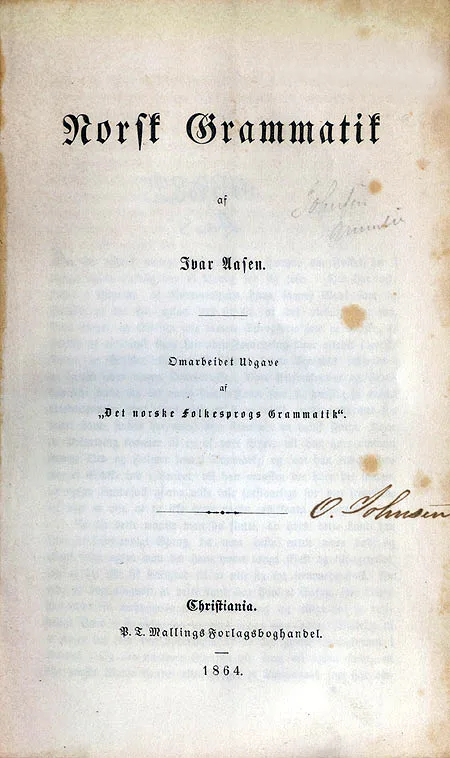 Ivar Aasen, Norsk Grammatik, title page (1864), Språkrådet facsimile library The title page of Aasen's 1864 revised grammar, the scholarly foundation of the written standard renamed Nynorsk in 1929 — where Aasen set out the rural-dialect grammar built to recover a Norwegian written language independent of the Danish overlay. New Norwegian — one of the two official written
standards of modern Norwegian. Originally called Landsmål
(country-language), constructed by the philologist Ivar
Aasen across the 1840s and 1850s from his fieldwork in the
rural dialects of southern and western Norway. Aasen aimed
to recover a written Norwegian that descended from Old
Norwegian without the three centuries of Danish overlay.
Renamed Nynorsk in the 1929 language-reform settlement.
Today roughly 10–15% of Norwegians use Nynorsk as their
primary written language, concentrated in the western
fjord districts; the remainder use Bokmål (descended from
the urban Dano-Norwegian written tradition). Both
standards are taught in school and have equal official
status; municipalities and schools choose between them.
Also discussed in The 400-Year Night — when the Northern Lion lay dormant , assembled in the nineteenth century from rural dialects. You will see both on signs and in print. They are written languages; nobody speaks either one exactly.
Ivar Aasen, Norsk Grammatik, title page (1864), Språkrådet facsimile library The title page of Aasen's 1864 revised grammar, the scholarly foundation of the written standard renamed Nynorsk in 1929 — where Aasen set out the rural-dialect grammar built to recover a Norwegian written language independent of the Danish overlay. New Norwegian — one of the two official written
standards of modern Norwegian. Originally called Landsmål
(country-language), constructed by the philologist Ivar
Aasen across the 1840s and 1850s from his fieldwork in the
rural dialects of southern and western Norway. Aasen aimed
to recover a written Norwegian that descended from Old
Norwegian without the three centuries of Danish overlay.
Renamed Nynorsk in the 1929 language-reform settlement.
Today roughly 10–15% of Norwegians use Nynorsk as their
primary written language, concentrated in the western
fjord districts; the remainder use Bokmål (descended from
the urban Dano-Norwegian written tradition). Both
standards are taught in school and have equal official
status; municipalities and schools choose between them.
Also discussed in The 400-Year Night — when the Northern Lion lay dormant , assembled in the nineteenth century from rural dialects. You will see both on signs and in print. They are written languages; nobody speaks either one exactly.
What people speak is dialect, and Norway wears its dialects openly — there is no single “correct” spoken Norwegian, and Norwegians are proud of the variety. The trip passes through several. Oslo’s speech is the closest to textbook Bokmål. Bergen 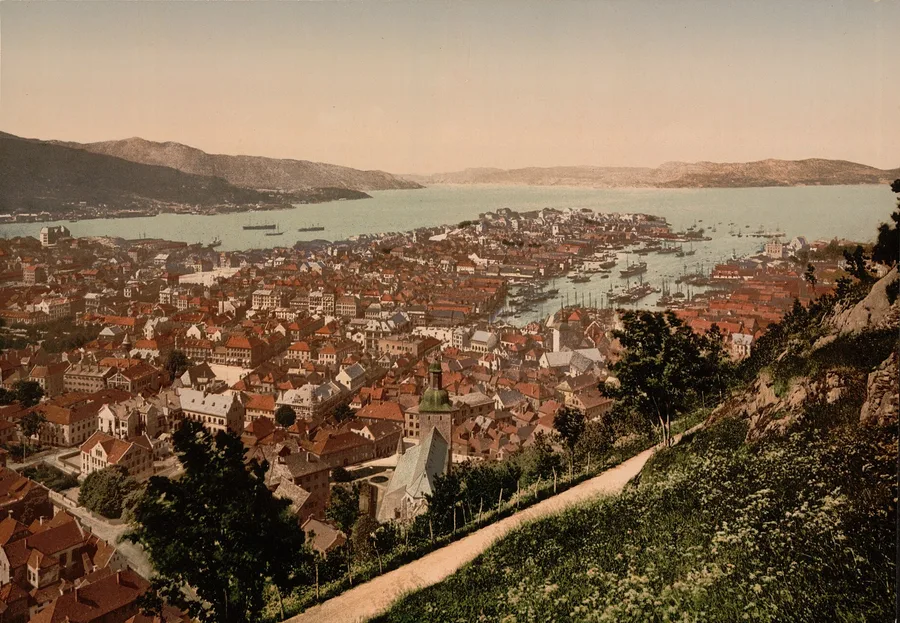 Photochrom print, General view from Fjeldveien, Bergen (c. 1890–1900), Library of Congress Four Hanseatic centuries left their mark on Bergen's own speech — a heavy layer of Low German trade-words and a grammar simplified to two genders. This is the harbour that carried those words in, the Vågen wharf where the German merchants and Norwegian dialect met. Norway's western trading capital, founded around 1070 on the
inner Byfjorden. For four centuries the largest city in the
country and the wharf through which the entire western export
economy ran — dried cod from the Lofoten fisheries, stockpiled
and traded by the Hanseatic merchants at Bryggen from 1360 to
1754. Norway's commercial and intellectual heart through the
Hanseatic period; overtaken in size by Christiania (Oslo) in the
1830s. The painted wooden Bryggen wharf is on the UNESCO World
Heritage list and substantially what it was in the late
seventeenth century.
On the trip The Ungdommene (the Youngsters) reach Bergen late on Day 3
via the Norway-in-a-Nutshell train-and-ferry route from
Oslo. On the Day 4 morning they walk Bryggen and ride the
funicular up Mount Fløyen before flying back to Oslo and driving
on to Lillehammer that evening — a day ahead of the Gråhårsklubben
(the Oldsters), who spend the split days north in Trondheim and
the heritage country of Stjørdal, Hegra, and Kylloplass and come
south on Day 5.
Bergen Also discussed in The Germans Who "Ruled" Bergen — the Hanseatic merchants on Bryggen WharfBefore There Was Norway — petty kingdoms at the edge of the worldThe King Who Became a Saint — how the Nordmen came to ChristA Catholic Norway — the faith that gave the kingdom its first institutions and the stave churchesThe Long Fall — the sudden loss of Norwegian nobility, the end of the kings, and half of Norway gone foreverThe Golden Age — a North Atlantic empire … reaching farther than you thinkThe 400-Year Night — when the Northern Lion lay dormantThe Crusades?!!!! — sixty ships from Bergen, bound for the Holy LandThe Reformation, 1537 — one church eradicated and another imposedWorld War II — the King’s “No” and the Nazis in NorwayKraken — the island-sized beast, logged as factSjøormer — the serpents in the deep lakes and fjordsPesta — an old woman walking from farm to farmFossegrimen — the waterfall fiddler who teaches you to playAlcohol and Vinmonopolet — when and where to buy a drinkEveryday etiquette — quiet voices, wide space, no smilingFood and dining customs — having patience, free water, brunost on everything🚨 Emergencies - important numbers, hospitals, and what you can doWhat to wear — the layering system, on the ground has a distinctive, Bergensk The Norwegian dialect of the Bergen district, distinctive in
Norwegian regional speech for two features attributable to
the four centuries of Hanseatic presence: a heavy substrate
of Middle Low German loanwords (especially in vocabulary for
trade, tools, household objects, building parts, and ship
workings) and a striking grammatical simplification —
bergensk uses two grammatical genders (common and neuter)
rather than the three (masculine, feminine, neuter) of most
other Norwegian dialects, the simplification commonly
attributed to the influence of German speakers across
generations. The dialect is also marked by a uvular
/R/-sound rather than the alveolar trill of most
other Norwegian dialects, though the German connection
for that feature is less certain.
On the trip The Ungdommene (the Youngsters) spend the Day 4 morning in Bergen
— the Fish Market and the Bryggen wharf — where bergensk is the
ordinary speech of the street: the clipped uvular R and the Low
German trade-words that four Hanseatic centuries pressed into the
local tongue.
Also discussed in The Germans Who "Ruled" Bergen — the Hanseatic merchants on Bryggen Wharf with a famously different r. Trøndelag, around Trondheim
Photochrom print, General view from Fjeldveien, Bergen (c. 1890–1900), Library of Congress Four Hanseatic centuries left their mark on Bergen's own speech — a heavy layer of Low German trade-words and a grammar simplified to two genders. This is the harbour that carried those words in, the Vågen wharf where the German merchants and Norwegian dialect met. Norway's western trading capital, founded around 1070 on the
inner Byfjorden. For four centuries the largest city in the
country and the wharf through which the entire western export
economy ran — dried cod from the Lofoten fisheries, stockpiled
and traded by the Hanseatic merchants at Bryggen from 1360 to
1754. Norway's commercial and intellectual heart through the
Hanseatic period; overtaken in size by Christiania (Oslo) in the
1830s. The painted wooden Bryggen wharf is on the UNESCO World
Heritage list and substantially what it was in the late
seventeenth century.
On the trip The Ungdommene (the Youngsters) reach Bergen late on Day 3
via the Norway-in-a-Nutshell train-and-ferry route from
Oslo. On the Day 4 morning they walk Bryggen and ride the
funicular up Mount Fløyen before flying back to Oslo and driving
on to Lillehammer that evening — a day ahead of the Gråhårsklubben
(the Oldsters), who spend the split days north in Trondheim and
the heritage country of Stjørdal, Hegra, and Kylloplass and come
south on Day 5.
Bergen Also discussed in The Germans Who "Ruled" Bergen — the Hanseatic merchants on Bryggen WharfBefore There Was Norway — petty kingdoms at the edge of the worldThe King Who Became a Saint — how the Nordmen came to ChristA Catholic Norway — the faith that gave the kingdom its first institutions and the stave churchesThe Long Fall — the sudden loss of Norwegian nobility, the end of the kings, and half of Norway gone foreverThe Golden Age — a North Atlantic empire … reaching farther than you thinkThe 400-Year Night — when the Northern Lion lay dormantThe Crusades?!!!! — sixty ships from Bergen, bound for the Holy LandThe Reformation, 1537 — one church eradicated and another imposedWorld War II — the King’s “No” and the Nazis in NorwayKraken — the island-sized beast, logged as factSjøormer — the serpents in the deep lakes and fjordsPesta — an old woman walking from farm to farmFossegrimen — the waterfall fiddler who teaches you to playAlcohol and Vinmonopolet — when and where to buy a drinkEveryday etiquette — quiet voices, wide space, no smilingFood and dining customs — having patience, free water, brunost on everything🚨 Emergencies - important numbers, hospitals, and what you can doWhat to wear — the layering system, on the ground has a distinctive, Bergensk The Norwegian dialect of the Bergen district, distinctive in
Norwegian regional speech for two features attributable to
the four centuries of Hanseatic presence: a heavy substrate
of Middle Low German loanwords (especially in vocabulary for
trade, tools, household objects, building parts, and ship
workings) and a striking grammatical simplification —
bergensk uses two grammatical genders (common and neuter)
rather than the three (masculine, feminine, neuter) of most
other Norwegian dialects, the simplification commonly
attributed to the influence of German speakers across
generations. The dialect is also marked by a uvular
/R/-sound rather than the alveolar trill of most
other Norwegian dialects, though the German connection
for that feature is less certain.
On the trip The Ungdommene (the Youngsters) spend the Day 4 morning in Bergen
— the Fish Market and the Bryggen wharf — where bergensk is the
ordinary speech of the street: the clipped uvular R and the Low
German trade-words that four Hanseatic centuries pressed into the
local tongue.
Also discussed in The Germans Who "Ruled" Bergen — the Hanseatic merchants on Bryggen Wharf with a famously different r. Trøndelag, around Trondheim 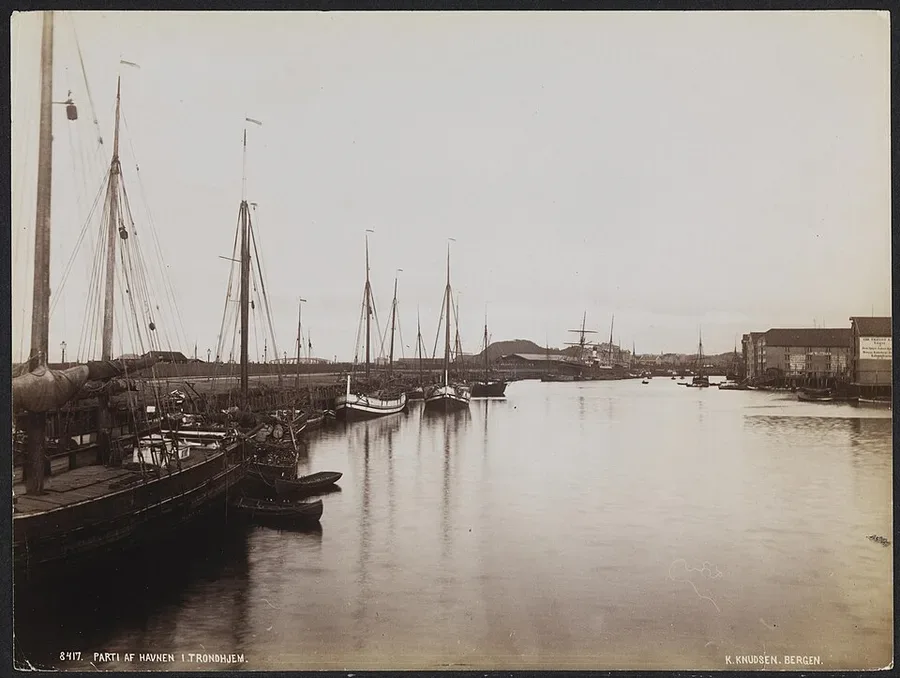 Knud Knudsen, Parti af Havnen i Trondhjem (1888-1894), National Library of Norway Knud Knudsen's 1890s photograph of the Trondheim harbour — the Trøndelag capital whose broad, musical trøndersk is one of the dialects that make spoken Norwegian a moving target from region to region, and nothing like the bokmål on the page. Norway's third-largest city, founded by Olav Tryggvason in 997 as
Nidaros at the mouth of the Nid River on the inner Trondheim
Fjord. Capital of the Norwegian kingdom for much of the medieval
period; seat of the Norwegian archbishopric from 1153 and of the
Olav cult that anchored medieval Norwegian Christianity. Renamed
Trondheim in 1931 — after a controversial one-year spell
officially named Nidaros from 1930 — replacing the Danish-era
spelling Trondhjem and reviving the medieval Old Norse district
name (Þrándheimr). About two hundred thousand people in the municipality
today. Home to Nidaros Cathedral, NTNU (the Norwegian University
of Science and Technology), and the Trondheim Fjord harbour.
On the trip Day 3 of the trip routes the Gråhårsklubben (the Oldsters) through
Trondheim. The visit centres on Nidaros Cathedral — the building
the Olav devotion raised, and the architectural inheritance of
Bishop Grimkell's pronouncement on a summer day in 1031.
Trondheim Also discussed in The King Who Became a Saint — how the Nordmen came to ChristA Catholic Norway — the faith that gave the kingdom its first institutions and the stave churchesThe Crusades?!!!! — sixty ships from Bergen, bound for the Holy LandThe Golden Age — a North Atlantic empire … reaching farther than you thinkThe Long Fall — the sudden loss of Norwegian nobility, the end of the kings, and half of Norway gone foreverThe 400-Year Night — when the Northern Lion lay dormantThe Reformation, 1537 — one church eradicated and another imposedLutheran Norway and Pietism — a farmer named Hans Nielsen Hauge and a lay revival that could not be silencedWorld War II — the King’s “No” and the Nazis in NorwayBefore There Was Norway — petty kingdoms at the edge of the worldDriving in Norway — tolls, ferries, and a near-zero alcohol limitEveryday etiquette — quiet voices, wide space, no smiling🚨 Emergencies - important numbers, hospitals, and what you can do , has its own broad musical lilt — trøndersk. None of this affects an English-speaking visitor much — but if a Norwegian relative’s speech sounds nothing like the app you practiced with, that is the dialect, and it is a feature, not a problem.
Knud Knudsen, Parti af Havnen i Trondhjem (1888-1894), National Library of Norway Knud Knudsen's 1890s photograph of the Trondheim harbour — the Trøndelag capital whose broad, musical trøndersk is one of the dialects that make spoken Norwegian a moving target from region to region, and nothing like the bokmål on the page. Norway's third-largest city, founded by Olav Tryggvason in 997 as
Nidaros at the mouth of the Nid River on the inner Trondheim
Fjord. Capital of the Norwegian kingdom for much of the medieval
period; seat of the Norwegian archbishopric from 1153 and of the
Olav cult that anchored medieval Norwegian Christianity. Renamed
Trondheim in 1931 — after a controversial one-year spell
officially named Nidaros from 1930 — replacing the Danish-era
spelling Trondhjem and reviving the medieval Old Norse district
name (Þrándheimr). About two hundred thousand people in the municipality
today. Home to Nidaros Cathedral, NTNU (the Norwegian University
of Science and Technology), and the Trondheim Fjord harbour.
On the trip Day 3 of the trip routes the Gråhårsklubben (the Oldsters) through
Trondheim. The visit centres on Nidaros Cathedral — the building
the Olav devotion raised, and the architectural inheritance of
Bishop Grimkell's pronouncement on a summer day in 1031.
Trondheim Also discussed in The King Who Became a Saint — how the Nordmen came to ChristA Catholic Norway — the faith that gave the kingdom its first institutions and the stave churchesThe Crusades?!!!! — sixty ships from Bergen, bound for the Holy LandThe Golden Age — a North Atlantic empire … reaching farther than you thinkThe Long Fall — the sudden loss of Norwegian nobility, the end of the kings, and half of Norway gone foreverThe 400-Year Night — when the Northern Lion lay dormantThe Reformation, 1537 — one church eradicated and another imposedLutheran Norway and Pietism — a farmer named Hans Nielsen Hauge and a lay revival that could not be silencedWorld War II — the King’s “No” and the Nazis in NorwayBefore There Was Norway — petty kingdoms at the edge of the worldDriving in Norway — tolls, ferries, and a near-zero alcohol limitEveryday etiquette — quiet voices, wide space, no smiling🚨 Emergencies - important numbers, hospitals, and what you can do , has its own broad musical lilt — trøndersk. None of this affects an English-speaking visitor much — but if a Norwegian relative’s speech sounds nothing like the app you practiced with, that is the dialect, and it is a feature, not a problem.
Phrases worth knowing — and not over-translating
A few Norwegian phrases carry more than their dictionary meaning:
- Takk for sist — thanks for the last time, said when you meet someone again. There is no English equivalent.
- Takk for maten — thanks for the food, said to whoever cooked or hosted, at the end of a meal. Always say it in someone’s home.
- God tur — have a good trip / journey. You will hear it often.
- Gratulerer — congratulations.
- Kos
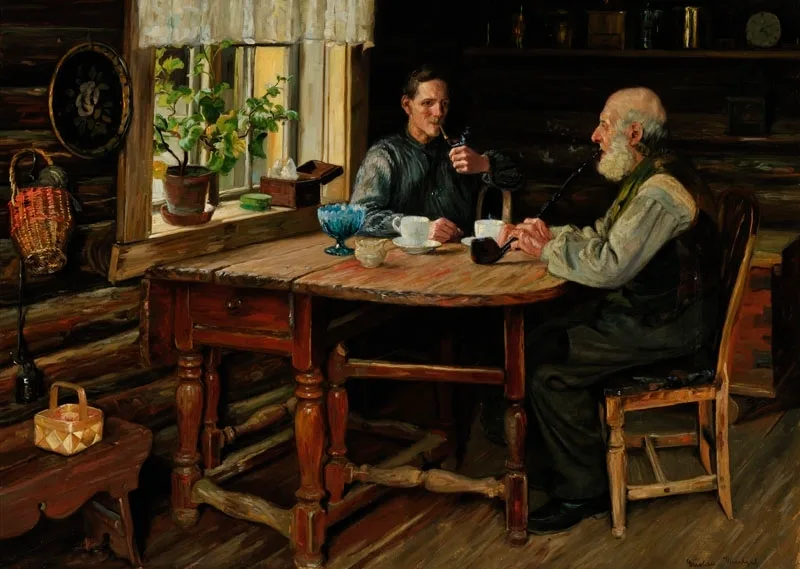 Gustav Wentzel, Øktakaffe (1900), Lillehammer Kunstmuseum Wentzel's Øktakaffe — the work-break coffee: two men, two cups, pipes lit, nobody going anywhere. The warmth sits in the company and the pause rather than any arranged scene — exactly the ground kos claims from hygge. Kos is the Norwegian word for a particular kind of unhurried warmth — company over decor. Its nearest English proxy arrived by way of the Danish cognate hygge, but Norwegians draw a real distinction: hygge leans toward the arranged setting (candles, wool socks, the composed scene), kos leans toward the people and the moment. The adjective is koselig, applied to an evening, a kitchen, a walk, a person — anything carrying the warmth. It is not the same as comfort or luxury; usually all it takes is a small number of people, no hurry, something warm to hold, and an unspoken permission to simply be where you are. On the trip The family meets kos most directly at the table — dinner together on the Oslo harbor near City Hall the first night, the unhurried meals through the Lillehammer reunion, the long light of a late-July evening that makes lingering easy. It is not a special occasion so much as what happens when nobody is trying to get anywhere. Also discussed in (*Draft)Kos — the warmth of being togetherIdentitet — what it means to be NorwegianFriluftsliv — the open-air life and koselig — the warmth-and-cosiness words, worth carrying but resistant to a clean translation, and that is the point. The meaning runs deep, and some of it is best left unglossed; the mystery is part of the welcome.